Cessna · 1981–1986
Cessna 172P Skyhawk
 i
iSpecifications
MOSAIC eligiblePerformance
Cruise
122KTAS
Range
580nm
Climb
770fpm
Ceiling
14,200ft
Fuel Burn
8.0gph
Fuel Cap.
40gal
MPG
17.5mpg
Stall (Vs0)
40KIAS
T/O roll
890ft
Ldg roll
540ft
Size & weight
Seats
4
Useful Load
970lbs
Full-fuel payload
730lbs
Max gross
2,400lbs
Wingspan
36.1ft
Length
27.2ft
Engine
Engine
Lycoming O-320-D2J
Power
160hp
TBO
2,000hrs
Overhaul
$42k
Owning it
Hull insurance
$1k/yr
Parts
excellent
Mechanics
universal
Gear
Fixed
IFR
Yes
Category
certified
Full specification
V-speeds
Airframe
- Empty weight
- 1,430 lbs
- Max fuel weight
- 240 lbs
- Height
- 8.9 ft
- Wing position
- high
Obstacle performance
- Takeoff over 50 ft
- 1,625 ft
- Landing over 50 ft
- 1,280 ft
Paperwork
- Type certificate
- 3A12
- Certification basis
- CAR 3
These figures are typical for the model, not a specification for any individual aircraft. Real-world numbers vary with year, installed equipment, weight, modifications and engine condition — often by more than you would expect. Use them to compare types, and confirm anything you would act on against the Pilot's Operating Handbook for that specific airframe and a prebuy inspection.
Pricing
Typical
$78k
Range
$60k – $105k
Annual all-in
~$22k/yr
All-in at ~100 flying hours a year, using the midpoint of each range — the same figures broken out under “Cost to own” below. Your number will differ, and mostly for two reasons. Experience sets your insurance: a 2,000-hour pilot with recent training pays 30–40% less than a 200-hour owner, and student owners pay 20–40% more — on the same aircraft that is often a doubling. Location sets your hangar: a T-hangar runs $200–400 a month in the Midwest against $400–1,500 in a coastal metro, and an outside tie-down is less again. Engine reserves move too — a local shop reusing your serviceable cylinders can come in 30–50% under the national specialty-shop pricing we quote, though you trade the warranty and turnaround that comes with it. Reserves are money set aside toward a future overhaul, not a bill this year, and the annual inspection figure is the shop’s labor to look — whatever they find is separate.
Cost to own — estimate
Set your yearly hours and local fuel price. Fixed costs (insurance, hangar, annual inspection) don't change with hours; fuel, maintenance and the engine reserve do.
- Fuel (8 gph)
- $5,200
- Engine reserve
- $2,100
- Maintenance, parts & wear items ($12/hr)
- $1,200
- Insurance
- $900–$1,950
- Hangar
- $5,892–$14,729
- Annual inspection (labor only)
- $1,200
- Databases & subscriptions
- $400
- Total per year
- $21,835
- Per flight hour
- $218
- Miles flown / year (at cruise)
- 14,040 mi
- Cost per mile
- $1.56/mi
- Time in the air
- 2 hr 28 min
- Fuel burned
- 20 gal
- Out of pocket
- $209
Fuel, engine reserve and wear only. Insurance, hangar and the annual are already paid whether you make the trip or not, so they are not charged here.
Estimate, not a quote. Where a line shows a range, the total, per-hour and per-mile figures use its midpoint— insurance moves most with your experience and time in type, hangar with where you base the aircraft, so your own number could sit at either end. Annual inspection is the shop's labor to open and inspect — what they find is the maintenance line, which covers oil changes, plugs, tires, brakes, hoses, lights, a battery and vacuum pump amortised over their life, and the unscheduled squawks that are the largest and least predictable part of it. Reserves are sinking funds toward an overhaul, not a bill you pay this year — and note that a propeller is due on hours or calendar time, typically six years, so flying less does not put it off forever.
See how every Cessna 172 / Skyhawkyear stacks up — engines, changes, and which to buy — in our year-by-year buyer's guide.
Strengths
- Reliable O-320-D2J engine with dual independent magnetos—no cam/valve history problems
- 2,400 lbs gross weight and 50-gal fuel capacity enable 580+ nm range with reserves
- Lowest AD burden of mid-era 172s; straightforward pre-buy inspection
- Gold-standard trainer and first-airplane platform—easy to insure, maintain, and resell
Weaknesses
- Cruise speed limited to 122 KTAS—cross-country trips require patience
- 40+ year old airframes prone to corrosion; coastal tied-down examples require thorough inspection
- Basic panel examples often need $15K–$45K avionics upgrade for IFR capability
- 30-degree max flap travel (vs. 40 on 172N) causes slight float on landing
Overview
Why the 172P Is the Mid-Era Pick
| Item | 172N (1977-1980) | 172P (1981-1986) |
|---|---|---|
| Engine | O-320-H2AD (single Slick dual mag, history of cam/valve issues) | O-320-D2J (dual independent magnetos, no cam/lifter issues) |
| Max gross weight | 2,300 lbs | 2,400 lbs (+100 lbs useful load advantage) |
| Flap travel | 40 degrees | 30 degrees max (slight float on landing -- worth knowing) |
| Standard fuel | 42 gal (40 usable) | 42 gal (40 usable) -- unchanged; TCDS 3A12 Rev 88 states no other tank for the 172P |
| Windows (1983+) | Standard | Thicker, better soundproofing |
| Door latches (1984+) | Single | Dual safety pin latch |
| Landing lights | Cowl-mounted | Wing-mounted (1982+) -- better illumination, longer bulb life |
| Electrical | 28V | 28V (unchanged) |
The combination of the D2J engine and the 2,400-lb gross weight made the 172P a genuinely capable two-pilot IFR cross-country airplane. Standard fuel is what the 172N carried -- 42 gallons, 40 usable -- and the type certificate lists no long-range option for this model, so the extra 100 lb of gross weight is the real gain over the N, not extra tankage. The range and cruise figures on this page still come from the April 2026 generated data and have NOT been re-sourced; the 580 nm figure was written against a 50-gallon airplane and should be treated as unverified until the 172P POH is read.
The Engine: Lycoming O-320-D2J
The D2J was Lycoming's response to the H2AD reliability disaster. The key changes:
- Dual independent magnetos (Bendix or Slick) -- redundancy restored
- Lower compression ratio (8.5:1 retained for 160 HP, but with revised valve train metallurgy)
- Larger-diameter tappets and improved cam lobe profile (the "T" modification that was retrofitted to late H2AD engines is standard from D2J factory)
- Proven cylinder design -- the wide-deck problems were resolved
In practice, the D2J is one of the most reliable engines in the Lycoming O-320 family. Owners routinely take them to TBO (2,000 hours) and beyond with proper maintenance. The 2,000-hour TBO can be extended to 2,400 hours under Lycoming's recommended on-condition operation if cylinder compression and oil analysis trends remain healthy.
[!tip] An on-condition D2J at 2,200-2,400 hours with strong compression and clean oil analysis is often a better deal than an early-overhaul example. The engine has proven itself, and the next overhaul can be deferred for years.
Bottom Line for 172P Buyers
If your mission fits the 172 envelope -- training, time-building, low-budget IFR cross-country, first-airplane ownership -- the 172P is almost always the right answer in the pre-litigation-gap market. The D2J engine, 2,400-lb gross weight, and refined airframe make it the most usable mid-era 172. The only practical alternative at this price tier is a D2J-converted 172N, which gives you 90% of the 172P at an $8K-$15K discount.
The two factors that make or break a 172P deal are corrosion and avionics. Walk away from coastal tied-down examples without thorough corrosion inspection. Pay up for a modern Garmin panel if you fly IFR -- the upgrade cost on a basic-panel airplane usually exceeds the price delta to a pre-upgraded one.
See also: cessna-172-mid, Cessna 172N Skyhawk, Cessna R172K Hawk XP, Cessna 172Q Cutlass, Cessna 172R Skyhawk, Cessna 172S Skyhawk SP
Mission Suitability
| Mission | Score | Notes |
|---|---|---|
| Flight Training | 9/10 | The gold standard of mid-era trainers. Reliable D2J engine means flight schools can budget overhauls accurately. |
| First Airplane | 9/10 | Easy to insure, easy to maintain, cheap to fly, easy to sell. The textbook first-time-owner aircraft. |
| IFR Platform | 8/10 | Modern Garmin retrofits make this a capable IFR machine. Limited by 122 KTAS cruise. |
| Cross-Country | 7/10 | Four-hour legs are comfortable, though on 40 usable gallons rather than the 50 this page previously assumed. Cruise speed is the real limiter. |
| Backcountry | 2/10 | Nosewheel + low ground clearance + marginal climb at high DA. Not the right airplane. |
| Aerobatics | 1/10 | Normal category only. |
| Local Fun | 8/10 | Forgiving, pleasant, low operating cost. |
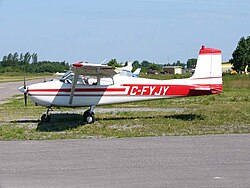
1975 Cessna 172M Skyhawk (1973-1976)
Good plane - Demo
Avionics Ecosystem
Like the 172N, the 172P uses a 28V electrical system. Modern Garmin avionics (GTN 650/750, G5, GFC 500 autopilot, GTX 345 transponder) are all available in 28V variants.
Common modern panel configurations encountered on 2026-market 172Ps:
| Tier | Configuration | Typical Cost (Installed) | Resale Impact |
|---|---|---|---|
| Basic IFR | Garmin GNS 430W + KX-155 + KAP 140 autopilot + Mode S transponder | $15K-$20K original install | Adds $10K-$15K to a basic 172P |
| Modern IFR | Garmin GTN 650Xi + G5 ADI + GTX 345 transponder + analog HSI | $25K-$35K | Adds $20K-$30K |
| Modern IFR + Autopilot | Above + GFC 500 two-axis autopilot | $35K-$50K | Adds $30K-$45K |
| Full Glass | GTN 750 + dual G5 + GFC 500 + GMA 350 + GTX 345 + JPI EDM-830 | $45K-$60K | Adds $40K-$55K (may exceed airframe value) |
The 60-amp alternator is adequate for typical modern panel loads but should be inspected at pre-buy.
2006 Cessna 172S
G1000 Skyhawk · Mid-Time Engine · Clean Logs
Valuation Factors
| Factor | Typical Swing |
|---|---|
| Engine time since major overhaul (SMOH) | $25K-$35K |
| Avionics tier (see table above) | $15K-$45K |
| 62-gal wet wing fuel tanks (late 172P option) | +$5K-$8K |
| Long-range tanks (52-gal) | +$3K-$5K |
| Air conditioning (rare) | +$3K-$5K |
| Corrosion history | $5K-$15K swing |
| Damage history | $10K-$25K discount |
| ADS-B Out compliance | Mandatory; non-compliant is unsellable |
| Logbook completeness | Missing logs = $15K-$25K discount |
| Year (1981 vs 1986) | $5K-$10K -- later years preferred for thicker windows and dual door latch |
| Paint and interior | $5K-$15K swing |
Typical 2026 market range
- Run-out engine, basic panel, 1981-1982: $55K-$70K
- Mid-time engine, basic IFR panel: $70K-$85K
- Mid-to-low time, modern Garmin panel + GFC 500: $90K-$120K
- Pristine 1985-1986 with full glass + recent OH: $130K-$165K
The 172P market has firmed substantially since 2020 -- demand from flight school owners, partnership groups, and first-time buyers consistently exceeds supply.
ADs & Common Problems
Airworthiness Directives (172P-specific)
The 172P benefits from the same family-wide ADs as other mid-era 172s and adds no major variant-specific problems:
- Seat rail/roller AD (recurring) -- all 172s
- Wing spar inspection AD (per schedule, high-time aircraft) -- all high-wing Cessnas
- Doorpost fuel line AD -- 172N and 172P
- Stabilizer abrasion boot AD -- mid-era 172s
- Mixture control AD -- one-time pilot-performed check on idle mixture
- Carb heat duct AD -- one-time inspection
The O-320-D2J has no major engine-specific ADs of the type that plagued the H2AD. The 172P is the lowest-AD-burden mid-era 172.
Pre-Buy Inspection Priorities
The 172P pre-buy is shorter than a 172N pre-buy because there are no engine-specific landmines:
- Engine condition -- compression check (target 70+ on all four), oil analysis trends, cam inspection via borescope or visual through tappet bores
- Corrosion -- 40+ year old airframes; inspect wing spar carry-through, belly skins, battery box, tailcone, fuel tank sealant
- Seat rails and pins -- recurring AD compliance; test locking
- Logbooks -- complete and continuous back to manufacture
- Doorpost fuel line -- AD compliance
- Avionics -- ADS-B Out compliance verified; navigator databases current
- Fuel system -- selector valve operation, tank integrity (especially older bladder tanks if not converted to wet wing), fuel sender accuracy
- Landing gear -- nose gear shimmy dampener, tubular main gear leg condition, brake disc thickness
- Damage history -- review FAA 337 forms; verify any repair work was done correctly
- Hangar vs tied-down history -- coastal tied-down aircraft often have hidden corrosion issues
For sale (1)
For sale elsewhere (1)
Current ads on Barnstormers, checked daily. Photos, full details and the seller are on the listing site.
1981 Cessna 172P Skyhawk
Listed on BarnstormersADF · 406 MHz ELT · Garmin GNC 255 / SL30 · Garmin GTX 330/330ES
View photos and full ad on Barnstormers ↗Also worth looking at
What buyers usually weigh against the Cessna 172P Skyhawk — aircraft flown for the same kind of mission.

