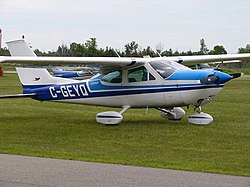
Cessna · 1977–1981
Cessna R172K Hawk XP
 i
iSpecifications
MOSAIC eligiblePerformance
Cruise
131KTAS
Range
525nm
Climb
870fpm
Ceiling
17,000ft
Fuel Burn
10.0gph
Fuel Cap.
49gal
MPG
15.1mpg
Stall (Vs0)
42KIAS
T/O roll
800ft
Ldg roll
580ft
Size & weight
Seats
4
Useful Load
970lbs
Full-fuel payload
676lbs
Max gross
2,550lbs
Wingspan
36.1ft
Length
27.2ft
Engine
Engine
Continental IO-360-K or IO-360-KB
Power
195hp
TBO
1,500hrs
Overhaul
$45k
Owning it
Hull insurance
$1k/yr
Parts
good
Mechanics
common
Gear
Fixed
IFR
Yes
Category
certified
Full specification
V-speeds
Airframe
- Empty weight
- 1,530 lbs
- Max fuel weight
- 294 lbs
- Height
- 8.9 ft
- Wing position
- high
Obstacle performance
- Takeoff over 50 ft
- 1,360 ft
- Landing over 50 ft
- 1,330 ft
Paperwork
- Type certificate
- 3A17
- Certification basis
- CAR 3
These figures are typical for the model, not a specification for any individual aircraft. Real-world numbers vary with year, installed equipment, weight, modifications and engine condition — often by more than you would expect. Use them to compare types, and confirm anything you would act on against the Pilot's Operating Handbook for that specific airframe and a prebuy inspection.
Pricing
Typical
$78k
Range
$60k – $105k
Annual all-in
~$24k/yr
All-in at ~100 flying hours a year, using the midpoint of each range — the same figures broken out under “Cost to own” below. Your number will differ, and mostly for two reasons. Experience sets your insurance: a 2,000-hour pilot with recent training pays 30–40% less than a 200-hour owner, and student owners pay 20–40% more — on the same aircraft that is often a doubling. Location sets your hangar: a T-hangar runs $200–400 a month in the Midwest against $400–1,500 in a coastal metro, and an outside tie-down is less again. Engine reserves move too — a local shop reusing your serviceable cylinders can come in 30–50% under the national specialty-shop pricing we quote, though you trade the warranty and turnaround that comes with it. Reserves are money set aside toward a future overhaul, not a bill this year, and the annual inspection figure is the shop’s labor to look — whatever they find is separate.
Cost to own — estimate
Set your yearly hours and local fuel price. Fixed costs (insurance, hangar, annual inspection) don't change with hours; fuel, maintenance and the engine reserve do.
- Fuel (10 gph)
- $6,500
- Engine reserve
- $3,000
- Maintenance, parts & wear items ($12/hr)
- $1,200
- Insurance
- $900–$1,950
- Hangar
- $5,892–$14,729
- Annual inspection (labor only)
- $1,200
- Databases & subscriptions
- $400
- Total per year
- $24,035
- Per flight hour
- $240
- Miles flown / year (at cruise)
- 15,075 mi
- Cost per mile
- $1.59/mi
- Time in the air
- 2 hr 17 min
- Fuel burned
- 23 gal
- Out of pocket
- $245
Fuel, engine reserve and wear only. Insurance, hangar and the annual are already paid whether you make the trip or not, so they are not charged here.
Estimate, not a quote. Where a line shows a range, the total, per-hour and per-mile figures use its midpoint— insurance moves most with your experience and time in type, hangar with where you base the aircraft, so your own number could sit at either end. Annual inspection is the shop's labor to open and inspect — what they find is the maintenance line, which covers oil changes, plugs, tires, brakes, hoses, lights, a battery and vacuum pump amortised over their life, and the unscheduled squawks that are the largest and least predictable part of it. Reserves are sinking funds toward an overhaul, not a bill you pay this year — and note that a propeller is due on hours or calendar time, typically six years, so flying less does not put it off forever.
See how every Cessna 172 / Skyhawkyear stacks up — engines, changes, and which to buy — in our year-by-year buyer's guide.
Strengths
- 195 HP fuel-injected engine with 17,000 ft service ceiling — superior hot-and-high performance
- Constant-speed propeller enables proper engine management and IFR capability
- 195 HP avoids FAA high-performance endorsement requirement — regulatory and insurance advantage
- Excellent mission fit for Western mountain operations where no fixed-gear peer exists
Weaknesses
- 1,500-hour TBO is 25% shorter than Lycoming O-360 alternatives — permanent operating-cost penalty
- Continental IO-360 less universal than Lycoming; fewer mechanics and higher overhaul cost ($32K–$38K)
- Hot-start procedure requires practice; frustration point for pilots transitioning from carbureted 172s
- Operating cost premium (10.0 GPH vs 8.5 GPH) does not justify ownership outside mountain mission
Overview
What Makes the Hawk XP Different
| Item | Standard 172N | R172K Hawk XP |
|---|---|---|
| Engine | Lycoming O-320-H2AD (carbureted) | Continental IO-360-K (fuel-injected) |
| Horsepower | 160 | 195 |
| Propeller | Fixed-pitch McCauley 1C160 | Constant-speed McCauley |
| TBO | 2,000 hours | 1,500 hours (shorter due to higher BMEP) |
| Cruise speed | 122 KTAS | 131 KTAS |
| Service ceiling | 14,200 ft | 17,000 ft |
| Useful load | 860 lbs | 970 lbs (despite heavier engine, due to 2,550-lb gross) |
| Max gross weight | 2,300 lbs | 2,550 lbs |
| Fuel burn (75% power) | 8.5 GPH | 10.0 GPH |
| Insurance category | Standard fixed | Standard fixed (no complex endorsement -- fixed gear) |
At 195 HP, the Hawk XP falls just under the FAA's 200 HP high-performance threshold, so no high-performance endorsement is required. This is unusual and creates a meaningful regulatory + insurance advantage over comparable 200-300 HP airplanes (which require both the endorsement and typically command higher premiums).
The Engine: Continental IO-360-K
The IO-360-K is the source of both the Hawk XP's character and its operating cost premium:
- 195 HP at 2,600 RPM -- continuous; no time-limited maximums
- 8.5:1 compression ratio
- Continuous-flow fuel injection (Continental's RSA/Bendix system)
- Dual independent magnetos (Slick or Bendix)
- 1,500-hour TBO -- meaningfully shorter than the 2,000-hour Lycoming O-320/O-360 family
The IO-360 is a less common engine than the Lycoming O-360 series, which has practical implications:
- Parts availability is good but not excellent -- some specialty parts require specific Continental distribution
- Mechanic familiarity is "common" not "universal" -- most shops can work on it, but it is not the default piston engine in their toolbox
- Cylinder availability -- Continental cylinders are well-supported by ECi/Superior alternatives
- Overhaul cost is higher -- $32K-$38K field overhaul vs $26K-$32K for an O-360
The 1,500-hour TBO is a permanent operating-cost penalty. Over the life of the airplane, this means roughly 33% more overhauls per total hour flown vs an O-360-powered Cutlass.
Hot-and-High Performance: Where the XP Shines
The Hawk XP is the right answer for one specific mission: Western mountain operations. Its 17,000-ft service ceiling, 870 fpm sea-level rate of climb, and fuel injection (no carb ice concerns) make it materially more capable in high-DA conditions than any other fixed-gear 172.
Climb at altitude (4-place loading, max gross):
| Density Altitude | 172P (160 HP) | Hawk XP (195 HP) |
|---|---|---|
| Sea level | 770 fpm | 870 fpm |
| 5,000 ft | 480 fpm | 600 fpm |
| 8,000 ft | 280 fpm | 420 fpm |
| 10,000 ft | 150 fpm | 310 fpm |
| 12,000 ft | barely climbing | 190 fpm |
For pilots operating from Western airports (Aspen, Telluride, Bryce Canyon, Mammoth, etc.), the Hawk XP delivers 172-family friendliness with usable mountain performance that the standard 172 lacks. This is the buyer profile where the Hawk XP makes the most economic sense.
Propeller and Engine Management
The constant-speed McCauley propeller adds workload over a fixed-pitch 172 but enables proper engine management:
- Takeoff: Full throttle + 2,600 RPM
- Climb: Full throttle (or reduce 1-2" MP after passing 1,000 ft AGL) + 2,500 RPM
- Cruise: Lean to peak EGT or 50F LOP depending on owner preference; typically 23"/2,400 RPM at 8,000 ft for ~75% power
- Descent: Pull MP for descent rate; maintain 2,400+ RPM until pattern
The fuel-injected IO-360 starts hot the same way most Continental injection systems do -- different from the cold-start procedure. Hot-start technique requires practice; this is the #1 source of frustration for pilots transitioning from carbureted 172s.
Bottom Line for Hawk XP Buyers
Buy a Hawk XP if:
- You operate from Western mountain airports and need real hot-high performance
- You want a fixed-gear 4-seater with constant-speed prop and fuel injection experience for IFR/commercial training
- You found a clean example in your budget and price seems fair vs market
Do not buy a Hawk XP if:
- Your mission is sea-level training, $100 hamburger flying, or low-altitude cross-country -- the operating cost premium over a 172P does not pay back
- You are price-sensitive and short TBO matters -- the 1,500-hour Continental TBO is a permanent disadvantage vs the 2,000-hour Lycoming alternatives
- You want maximum parts availability and mechanic familiarity -- the Continental engine is "common" but not "universal" like the O-320/O-360
The Hawk XP is a specialist airplane. In its specialty (mountain operations) it has no fixed-gear peer. Outside its specialty, a 172P or 172RG is usually a better economic choice.
See also: cessna-172-mid, Cessna 172N Skyhawk, Cessna 172P Skyhawk, Cessna 172Q Cutlass, Cessna 172RG Cutlass, cessna-182-early
Mission Suitability
| Mission | Score | Notes |
|---|---|---|
| Mountain Flying / Hot-High | 9/10 | The Hawk XP's defining mission. Service ceiling, climb rate, and fuel injection all matter. |
| Cross-Country | 7/10 | 131 KTAS over 525 nm is competitive with 172RG; insurance and maintenance are friendlier |
| Flight Training | 6/10 | Capable but expensive vs 172P; constant-speed prop adds complexity for primary students |
| First Airplane | 6/10 | Excellent if mission is mountain/hot-high; less efficient elsewhere |
| IFR Platform | 7/10 | Fuel injection is a plus over carbureted alternatives; good climb performance enables high-altitude IFR routing |
| Backcountry | 4/10 | Better climb than 172P but still nosewheel + low ground clearance |
| Local Fun | 8/10 | Fun engine, faster than standard 172, very capable |
| Surveying | 8/10 | High service ceiling, stable platform, fuel injection for high altitude survey work |
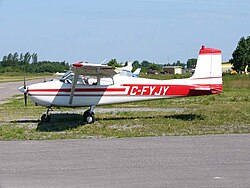
1975 Cessna 172M Skyhawk (1973-1976)
Good plane - Demo
Avionics Ecosystem
Like the 172N, the Hawk XP uses a 28V electrical system. Avionics retrofit options are identical to the 172N/172P (modern Garmin variants in 28V).
The constant-speed propeller and fuel injection make engine instrumentation more important than in a standard 172. A JPI EDM-800 or EDM-830 engine monitor (CHT/EGT per cylinder, fuel flow, etc.) is essentially required for proper engine management on the IO-360. Budget $4K-$6K for a basic engine monitor installation if not already present.
2006 Cessna 172S
G1000 Skyhawk · Mid-Time Engine · Clean Logs
Valuation Factors
The Hawk XP market is thin (~1,455 produced, lower attrition than common 172 variants suggests perhaps 800-1,000 still flying). Valuation:
| Factor | Typical Swing |
|---|---|
| Engine time since major overhaul (SMOH) | $25K-$35K |
| Avionics tier | $15K-$45K |
| Engine monitor (JPI/EI) | $3K-$5K |
| Mountain-state hangar / known mountain operations history | Positive signal; supports the Hawk XP buyer thesis |
| Damage history | $10K-$25K discount |
| Corrosion history | $5K-$15K |
| ADS-B Out compliance | Mandatory |
| Logbook completeness | $15K-$25K swing |
| Long-range tanks (62-gal wet wing option) | +$5K-$8K |
| Constant-speed prop overhaul time | $3K-$6K -- factor into pre-buy |
Typical 2026 market range
- Run-out engine, basic panel: $55K-$68K
- Mid-time engine, basic IFR panel: $70K-$85K
- Mid-to-low time, modern Garmin panel: $85K-$105K
- Pristine with low time + glass panel: $105K-$130K
The Hawk XP commands roughly the same price as a 172P at equivalent condition -- the better performance offsets the higher operating cost and shorter TBO in buyer math.
ADs & Common Problems
Airworthiness Directives
The Hawk XP shares family-wide 172 ADs (seat rails, wing spar, stabilizer abrasion boot) and adds Continental IO-360-specific ADs:
| AD | Applies To | Requirement |
|---|---|---|
| AD 87-21-02 | Continental crankshafts | Inspection of certain SN ranges |
| AD 91-14-22 | IO-360 fuel injection servo | Inspection / replacement |
| AD 96-12-22 | TCM cylinders | Inspection for certain manufacturing lots |
| AD 2009-02-03 | Various Continental engines | Crankshaft inspection |
Pre-buy must verify all Continental engine ADs are documented as complied with.
Pre-Buy Inspection Priorities
- Continental IO-360 condition -- compression check, oil analysis trends, crankshaft AD compliance, cylinder condition
- Constant-speed propeller condition -- propeller logs, time since overhaul (10-year or 2,000-hour interval), governor condition
- Fuel injection system -- servo condition (AD 91-14-22 compliance), injector cleanliness, mixture cable freedom
- Engine monitor -- if installed, review historical data for CHT trends and bad cylinders
- Corrosion -- standard 40+ year old 172 inspection
- Logbooks -- complete and continuous; verify R172K designation (not 172 with 195 HP STC, which is different)
- Avionics and ADS-B compliance
- Seat rails, wing spar -- AD compliance
For sale (1)
Also worth looking at
What buyers usually weigh against the Cessna R172K Hawk XP — aircraft flown for the same kind of mission.