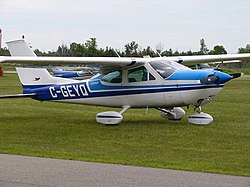
Cessna · 1983–1984
Cessna 172Q Cutlass
 i
iSpecifications
MOSAIC eligiblePerformance
Cruise
130KTAS
Range
530nm
Climb
800fpm
Ceiling
14,400ft
Fuel Burn
9.5gph
Fuel Cap.
50gal
MPG
15.7mpg
Stall (Vs0)
41KIAS
T/O roll
760ft
Ldg roll
540ft
Size & weight
Seats
4
Useful Load
1,080lbs
Full-fuel payload
780lbs
Max gross
2,550lbs
Wingspan
36.1ft
Length
27.2ft
Engine
Engine
Lycoming O-360-A4N
Power
180hp
TBO
2,000hrs
Overhaul
$45k
Owning it
Hull insurance
$1k/yr
Parts
excellent
Mechanics
universal
Gear
Fixed
IFR
Yes
Category
certified
Full specification
V-speeds
Airframe
- Empty weight
- 1,470 lbs
- Max fuel weight
- 300 lbs
- Height
- 8.9 ft
- Wing position
- high
Obstacle performance
- Takeoff over 50 ft
- 1,380 ft
- Landing over 50 ft
- 1,280 ft
Paperwork
- Type certificate
- 3A12
- Certification basis
- CAR 3
These figures are typical for the model, not a specification for any individual aircraft. Real-world numbers vary with year, installed equipment, weight, modifications and engine condition — often by more than you would expect. Use them to compare types, and confirm anything you would act on against the Pilot's Operating Handbook for that specific airframe and a prebuy inspection.
Pricing
Typical
$88k
Range
$68k – $115k
Annual all-in
~$23k/yr
All-in at ~100 flying hours a year, using the midpoint of each range — the same figures broken out under “Cost to own” below. Your number will differ, and mostly for two reasons. Experience sets your insurance: a 2,000-hour pilot with recent training pays 30–40% less than a 200-hour owner, and student owners pay 20–40% more — on the same aircraft that is often a doubling. Location sets your hangar: a T-hangar runs $200–400 a month in the Midwest against $400–1,500 in a coastal metro, and an outside tie-down is less again. Engine reserves move too — a local shop reusing your serviceable cylinders can come in 30–50% under the national specialty-shop pricing we quote, though you trade the warranty and turnaround that comes with it. Reserves are money set aside toward a future overhaul, not a bill this year, and the annual inspection figure is the shop’s labor to look — whatever they find is separate.
Cost to own — estimate
Set your yearly hours and local fuel price. Fixed costs (insurance, hangar, annual inspection) don't change with hours; fuel, maintenance and the engine reserve do.
- Fuel (9.5 gph)
- $6,175
- Engine reserve
- $2,250
- Maintenance, parts & wear items ($12/hr)
- $1,200
- Insurance
- $900–$2,200
- Hangar
- $5,892–$14,729
- Annual inspection (labor only)
- $1,200
- Databases & subscriptions
- $400
- Total per year
- $23,085
- Per flight hour
- $231
- Miles flown / year (at cruise)
- 14,960 mi
- Cost per mile
- $1.54/mi
- Time in the air
- 2 hr 18 min
- Fuel burned
- 22 gal
- Out of pocket
- $222
Fuel, engine reserve and wear only. Insurance, hangar and the annual are already paid whether you make the trip or not, so they are not charged here.
Estimate, not a quote. Where a line shows a range, the total, per-hour and per-mile figures use its midpoint— insurance moves most with your experience and time in type, hangar with where you base the aircraft, so your own number could sit at either end. Annual inspection is the shop's labor to open and inspect — what they find is the maintenance line, which covers oil changes, plugs, tires, brakes, hoses, lights, a battery and vacuum pump amortised over their life, and the unscheduled squawks that are the largest and least predictable part of it. Reserves are sinking funds toward an overhaul, not a bill you pay this year — and note that a propeller is due on hours or calendar time, typically six years, so flying less does not put it off forever.
See how every Cessna 172 / Skyhawkyear stacks up — engines, changes, and which to buy — in our year-by-year buyer's guide.
Strengths
- Fastest fixed-gear 172 ever (130 KTAS vs 122 KTAS for 172P)
- 180 HP performance without retractable gear complexity or insurance premium
- Proven O-360-A4N engine with excellent parts availability
- Excellent climb performance, especially at altitude and hot/high operations
Weaknesses
- Higher fuel burn (9.5 GPH vs 8.0 GPH for 172P) adds ~$9/hr to operating cost
- Carbureted engine requires carb heat management on humid days and long descents
- Rare production (only ~220 built); thin resale market and inconsistent pricing
- Lower useful load (830 lbs) than 172P or 172RG due to more powerful engine
Overview
What the 172Q Is
The 172Q was Cessna's answer to a specific market gap: pilots who wanted the 180 HP performance of the 172RG without the maintenance burden and insurance cost of retractable gear. By installing the O-360 in the standard 172P fixed-gear airframe, Cessna created a faster, harder-climbing variant that retained the trainer-friendly maintenance profile.
The result is the fastest fixed-gear 172 ever produced -- 130 KTAS cruise vs 122 KTAS for the 172P -- and it is the bigger airplane rather than merely the faster one: 150 lb more gross weight and 10 more usable gallons than the 172P, plus meaningfully better climb performance at altitude. The trade-off is fuel burn (9.5 GPH vs 8.0 GPH for the 172P) and a $25K-$35K higher acquisition cost. The extra tankage largely pays for the extra burn, which is why the two have similar range despite the Cutlass drinking 19% more.
Comparison With 172P and 172RG
| Item | 172P (1981-1986) | 172Q Cutlass (1983-1984) | 172RG Cutlass (1980-1985) |
|---|---|---|---|
| Engine | O-320-D2J | O-360-A4N | O-360-F1A6 |
| Horsepower | 160 | 180 | 180 |
| Propeller | Fixed-pitch | Fixed-pitch (some w/ CS prop) | Constant-speed |
| Gear | Fixed | Fixed | Retractable |
| Cruise speed | 122 KTAS | 130 KTAS | 140 KTAS |
| Max gross weight | 2,400 lbs | 2,550 lbs | 2,650 lbs |
| Usable fuel | 40 gal | 50 gal | 62 gal |
| Useful load | 970 lbs | 1,080 lbs | 870 lbs |
| Fuel burn (75% power) | 8.0 GPH | 9.5 GPH | 10.5 GPH |
| Insurance category | Standard fixed | Standard fixed | Complex/retractable |
| 2026 typical price | $78K | $88K | $95K |
| Pre-purchase complexity | Low | Low | High (gear inspection) |
Gross weights and usable fuel are the certificated figures: the 172P and 172Q from TCDS 3A12 Rev 88 Sections IX and X, the 172RG from its own TCDS 3A17 — the RG is a separate type certificate, not a section of this one. Useful loads are gross minus the empty weight each page carries, and those empty weights are still unverified April 2026 data; treat the useful-load row as indicative rather than certificated.
The Cutlass sits in a sweet spot: most of the 172RG's speed advantage without the gear inspection burden, retract insurance premium, or complex endorsement requirement. It is also the roomiest of the three on paper, carrying the most useful load of any fixed-gear pre-gap 172.
The Engine: Lycoming O-360-A4N
The O-360-A4N is one of the most produced 180 HP four-cylinder aircraft engines ever built. It powers the Piper Cherokee 180, Cessna 177 Cardinal, Beech Sundowner, and countless others. Key characteristics:
- 180 HP at 2,700 RPM
- 8.5:1 compression ratio
- Carbureted (no fuel injection -- carb heat required)
- Dual independent magnetos (Slick or Bendix)
- 2,000-hour TBO (extendable on-condition)
Common operational quirks:
- Carb ice susceptibility -- not unusual on humid days at part-power settings. Carb heat application is a standard procedure for IFR pilots and during long descents.
- Hot start technique -- different from fuel-injected engines. Standard "mixture lean, throttle cracked, full prime" procedure works reliably.
- Magneto timing drift -- routine inspection at 100-hour or annual interval
Overhaul cost is approximately $26K-$32K for a field overhaul, $34K-$42K for a Lycoming factory reman. Parts availability is excellent.
Bottom Line for 172Q Buyers
The 172Q is the right airplane for a specific buyer profile: someone who flies regularly enough that the 8-knot cruise speed advantage matters, but who does not want the maintenance burden, insurance premium, or training requirements of a retract. It pairs particularly well with high-DA operations (Western mountain states) where the extra 20 HP makes meaningful climb-rate differences.
The 172Q is not the right airplane for buyers focused on minimum operating cost (172P is cheaper to fly), maximum cruise speed (172RG is faster), or trainer/time-builder roles (172P is the obvious pick). Where the 172Q wins is for the owner-pilot who wants a fast fixed-gear four-seater with no compromises in maintenance simplicity.
Watch for listings that confuse it with the 172RG -- occasional arbitrage opportunities exist when a 172Q is mistakenly priced as a 172RG.
See also: cessna-172-mid, Cessna 172P Skyhawk, Cessna 172RG Cutlass, Cessna R172K Hawk XP, Cessna 177 Cardinal
Performance
The 172Q's performance edge over the 172P comes from the extra 20 HP. Specific differences:
Climb: 800 fpm vs 770 fpm sea level rate of climb -- 4% improvement at sea level, larger advantage at altitude. At a 5,000-ft DA departure, the 172Q's advantage grows to roughly 15% better climb rate.
Cruise: 130 KTAS at 75% power vs 122 KTAS for the 172P -- a 6% speed gain. Over a 400 nm leg, this saves about 15 minutes.
Takeoff: 760 ft ground roll vs 890 ft for the 172P at max gross -- a noticeable shorter-field advantage, particularly at altitude.
Fuel burn at cruise: 9.5 GPH vs 8.0 GPH for the 172P -- 19% higher. At cruise prices ($6/gal in 2026), this adds about $9/hr to operating cost.
Range: Comparable to the 172P with similar tankage. The higher fuel burn offsets the speed advantage on a per-mile basis.
The 172Q's value is in mission flexibility -- shorter strips, hot/high operations, faster cruise -- not in lower per-mile cost. Buyers focused on minimum operating cost should still consider the 172P.
[!warning] The performance figures on this page have not been re-sourced, and two of them are now known to be wrong in a stated direction. Only the type-design fields above (V-speeds, gross weight, seats, baggage, usable fuel, engine, certification basis) come from TCDS 3A12 Rev 88. Everything else -- cruise, range, burn, climb, ceiling, takeoff and landing distances, empty weight -- is April 2026 generated data.
The two to distrust specifically: the stall speeds (41/49 KIAS) were written against a 2,400 lb airplane, and the real airplane is certificated at 2,550 lb. A stall speed rises with weight, so both are understated. The takeoff and landing distances were likewise computed at the wrong gross weight and are optimistic for the same reason. A type certificate publishes no performance data at all, so it cannot fix any of this -- that needs the 172Q POH, Section 2 Figure 2-1 for the stall speeds and Section 5 for the distances.
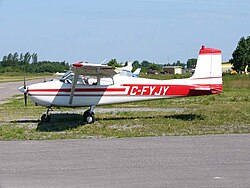
1975 Cessna 172M Skyhawk (1973-1976)
Good plane - Demo
Mission Suitability
| Mission | Score | Notes |
|---|---|---|
| Flight Training | 7/10 | Capable but expensive vs 172P; flight schools rarely choose Cutlass over standard 172 for primary training |
| First Airplane | 7/10 | Excellent if you want 180 HP without retract complexity; insurance is friendly |
| IFR Platform | 7/10 | Carbureted engine adds carb heat workload but is reliable; 130 KTAS cruise is a meaningful gain |
| Cross-Country | 7/10 | The Cutlass's natural mission -- 130 KTAS for 4 hours at a time |
| Backcountry | 3/10 | Slightly better than 172P due to climb, but still nosewheel + low ground clearance |
| Local Fun | 8/10 | Fun engine, responsive at full throttle, all the 172 friendly handling |
2006 Cessna 172S
G1000 Skyhawk · Mid-Time Engine · Clean Logs
Valuation Factors
The 172Q is rare enough (~220 produced) that pricing is less consistent than for the 172P. Specific factors:
| Factor | Typical Swing |
|---|---|
| Engine time since major overhaul (SMOH) | $25K-$35K |
| Avionics tier | $15K-$45K |
| Constant-speed prop conversion (rare aftermarket option) | +$5K-$8K |
| Not a 172Q option. TCDS 3A12 Rev 88 Section X states one fuel configuration — 54 gal total, 50 usable, two 27-gal tanks — and no alternative. 62 gallons is the 172RG's figure, from TCDS 3A17. Treat any listing advertising 62 gallons on a 172Q as a model mix-up until the logbooks show an STC. | |
| Corrosion history | $5K-$15K |
| Damage history | $10K-$25K discount |
| ADS-B Out compliance | Mandatory |
| Logbook completeness | $15K-$25K swing |
| Confirmed 172Q (not RG) -- buyer education matters | Listings sometimes priced as RG, allowing arbitrage |
| Production year (1983 vs 1984) | Minimal -- both years are very similar |
Typical 2026 market range
- Run-out engine, basic panel: $60K-$72K
- Mid-time engine, basic IFR panel: $75K-$90K
- Mid-to-low time, modern Garmin panel: $95K-$115K
- Pristine with low time + glass panel: $115K-$135K
The 172Q market is thin -- often only 5-15 active listings nationwide at any given time. Patience is required to find the right combination of engine time + avionics + condition + price.
ADs & Common Problems
Airworthiness Directives
The 172Q shares the same family-wide ADs as the 172P (seat rails, wing spar, doorpost fuel line, stabilizer abrasion boot) and the O-360-A4N ADs:
| AD | Applies To | Requirement |
|---|---|---|
| AD 96-09-10 | O-360 series | Crankshaft inspection at certain serial numbers |
| AD 2008-09-08 | Various Lycoming engines | Crankshaft inspection for SN-affected ranges |
| AD 2017-16-11 | Slick 4000/6000 series mags | Inspection/replacement of certain magneto components |
None of these are 172Q-specific show-stoppers, but pre-buy must verify compliance.
Pre-Buy Inspection Priorities
- Verify 172Q (fixed gear) vs 172RG (retract) -- this seems obvious but listing confusion is real, and the insurance/operating cost implications are significant. Check the serial number against TCDS 3A12 Section X, which lists every eligible airframe: 1983 models are 17275869 thru 17276054 and 1984 models are 17276101 thru 17276211. Note that these interleave with the 172P's blocks from the same two years, so a serial in that numeric neighbourhood does not by itself make an airplane a 172Q -- the data plate and the airworthiness certificate have to say 172Q. Two independent checks that agree with the data plate: the engine is an O-360-A4N (the 172P's is an O-320-D2J) and the certificated gross weight is 2,550 lb (the 172P's is 2,400).
- Engine condition -- compression check, oil analysis history, propeller logs. The O-360 is a known-quantity engine; standard pre-buy applies.
- Crankshaft AD compliance -- verify any applicable Lycoming crankshaft inspection ADs are documented.
- Corrosion -- 40+ year old airframes; standard 172 corrosion inspection.
- Logbooks -- complete and continuous; verify model designation as 172Q.
- Fuel system -- carbureted engine requires functional carb heat valve; verify operation.
- Avionics and ADS-B compliance
- Seat rails, wing spar, doorpost fuel line -- AD compliance
For sale (1)
Also worth looking at
What buyers usually weigh against the Cessna 172Q Cutlass — aircraft flown for the same kind of mission.