Cessna · 1973–1976
Cessna 172M Skyhawk (1973-1976)
 i
iSpecifications
MOSAIC eligiblePerformance
Cruise
122KTAS
Range
440nm
Climb
645fpm
Ceiling
13,100ft
Fuel Burn
8.0gph
Fuel Cap.
38gal
MPG
17.5mpg
Stall (Vs0)
40KIAS
T/O roll
890ft
Ldg roll
520ft
Size & weight
Seats
4
Useful Load
920lbs
Full-fuel payload
668lbs
Max gross
2,300lbs
Wingspan
36.1ft
Length
27.2ft
Engine
Engine
Lycoming O-320-E2D
Power
150hp
TBO
2,000hrs
Overhaul
$42k
Owning it
Hull insurance
$1k/yr
Parts
excellent
Mechanics
universal
Gear
Fixed
IFR
Yes
Category
certified
Full specification
V-speeds
Airframe
- Empty weight
- 1,410 lbs
- Max fuel weight
- 252 lbs
- Height
- 8.9 ft
- Wing position
- high
Obstacle performance
- Takeoff over 50 ft
- 1,625 ft
- Landing over 50 ft
- 1,280 ft
Paperwork
- Type certificate
- 3A12
- Certification basis
- CAR 3
These figures are typical for the model, not a specification for any individual aircraft. Real-world numbers vary with year, installed equipment, weight, modifications and engine condition — often by more than you would expect. Use them to compare types, and confirm anything you would act on against the Pilot's Operating Handbook for that specific airframe and a prebuy inspection.
Pricing
Typical
$68k
Range
$45k – $95k
Annual all-in
~$22k/yr
All-in at ~100 flying hours a year, using the midpoint of each range — the same figures broken out under “Cost to own” below. Your number will differ, and mostly for two reasons. Experience sets your insurance: a 2,000-hour pilot with recent training pays 30–40% less than a 200-hour owner, and student owners pay 20–40% more — on the same aircraft that is often a doubling. Location sets your hangar: a T-hangar runs $200–400 a month in the Midwest against $400–1,500 in a coastal metro, and an outside tie-down is less again. Engine reserves move too — a local shop reusing your serviceable cylinders can come in 30–50% under the national specialty-shop pricing we quote, though you trade the warranty and turnaround that comes with it. Reserves are money set aside toward a future overhaul, not a bill this year, and the annual inspection figure is the shop’s labor to look — whatever they find is separate.
Cost to own — estimate
Set your yearly hours and local fuel price. Fixed costs (insurance, hangar, annual inspection) don't change with hours; fuel, maintenance and the engine reserve do.
- Fuel (8 gph)
- $5,200
- Engine reserve
- $2,100
- Maintenance, parts & wear items ($12/hr)
- $1,200
- Insurance
- $900–$1,800
- Hangar
- $5,892–$14,729
- Annual inspection (labor only)
- $1,200
- Databases & subscriptions
- $400
- Total per year
- $21,760
- Per flight hour
- $218
- Miles flown / year (at cruise)
- 14,040 mi
- Cost per mile
- $1.55/mi
- Time in the air
- 2 hr 28 min
- Fuel burned
- 20 gal
- Out of pocket
- $209
Fuel, engine reserve and wear only. Insurance, hangar and the annual are already paid whether you make the trip or not, so they are not charged here.
Estimate, not a quote. Where a line shows a range, the total, per-hour and per-mile figures use its midpoint— insurance moves most with your experience and time in type, hangar with where you base the aircraft, so your own number could sit at either end. Annual inspection is the shop's labor to open and inspect — what they find is the maintenance line, which covers oil changes, plugs, tires, brakes, hoses, lights, a battery and vacuum pump amortised over their life, and the unscheduled squawks that are the largest and least predictable part of it. Reserves are sinking funds toward an overhaul, not a bill you pay this year — and note that a propeller is due on hours or calendar time, typically six years, so flying less does not put it off forever.
See how every Cessna 172 / Skyhawkyear stacks up — engines, changes, and which to buy — in our year-by-year buyer's guide.
Strengths
- Camber-Lift wing improves slow-flight handling and reduces stall speed by 1-2 knots
- Most refined 150 HP 172 variant; standard baggage door is major convenience for touring
- Reliable Lycoming O-320-E2D engine (last 172 with this proven powerplant before the problematic H2AD)
- Useful load of ~920 lbs is highest in the 1968-1976 Lycoming era
Weaknesses
- 50-year-old engines warrant borescope inspection and careful filter analysis
- Baggage door seals are original and likely dry; water intrusion risk in baggage compartment
- Camber-Lift leading edge vulnerable to hangar rash and ramp damage; costly to repair
- Priced $3,000–$8,000 above equivalent 172L; fully restored examples approach 172N/172P pricing
Overview
The 1973-1976 Cessna 172M is the most-produced single variant in the 1968-1976 Lycoming 150 HP era -- approximately 6,825 examples built across four model years, accounting for over a third of all 150 HP Lycoming 172 production. Its defining feature is the Camber-Lift wing with a slight drooped leading edge that improved low-speed handling, increased aileron authority near the stall, and reduced takeoff distance. A baggage door also became standard (previously optional). Combined with the tubular gear inherited from the 172L and the standard interior of the 172K, the 172M represents the most refined 150 HP 172 before the 160 HP era began with the 172N.
For buyers seeking a 150 HP 172, the 172M is the clear preferred choice over the 172I/K/L when budget allows. The Camber-Lift wing makes the airplane noticeably more docile in slow flight, and the standard baggage door is a meaningful convenience.
Standard Baggage Door
The 172L (and earlier) required all baggage to be loaded through the right cabin door, then passed back to the baggage compartment. The 172M's standard baggage door (on the right side of the fuselage behind the rear seats) allows direct loading from outside. This is a major convenience for cross-country flying with luggage and is one of the reasons the 172M is preferred over the 172L for serious touring use.
Variants & History
Certificated Limits Split at the 1976 Model Year
The 172M has two sets of airspeed limits, and which one applies depends on the serial number, not on the letter on the tail. FAA TCDS 3A12 Rev. 88 states them in calibrated airspeed:
| 1973-1975 (S/N 17256493, 17260759-17265684) | 1976 (S/N 17265685-17267584) | |
|---|---|---|
| Maneuvering (Va) | 97 kt CAS | 97 kt |
| Maximum structural cruising (Vno) | 126 kt CAS | 128 kt |
| Never exceed (Vne) | 158 kt CAS | 160 kt |
| Flaps extended (Vfe) | 87 kt CAS | 85 kt |
The frontmatter carries the 1976 column, and the reason is a units question rather than a preference. The certificate's NOTE 4 says that on the 1976 serials the airspeed indicator is marked in CAS and that "TIAS is exactly equal to CAS" — so for those airplanes calibrated and indicated are the same number and the figures are honestly KIAS. The 1973-1975 airplanes carry an IAS-marked indicator under plain CAR 3.757, and the certificate never states their limits in indicated airspeed. We record what the document says and do not convert.
If you are looking at a 1973, 1974 or 1975 airframe, fly the left-hand column and read your own airspeed indicator and placards, which are the operative limits for that serial.
Distinguishing Features (vs 172L and 172N)
| Feature | 172L (1971-1972) | 172M (1973-1976) | 172N (1977-1980) |
|---|---|---|---|
| Wing | Original | Camber-Lift drooped leading edge (new) | Same as 172M |
| Baggage door | Optional | Standard (new) | Standard |
| Engine | Lycoming O-320-E2D 150 HP | Lycoming O-320-E2D 150 HP | Lycoming O-320-H2AD 160 HP (new, problematic) |
| Electrical | 14V | 14V | 28V (new) |
| Gross weight | 2,300 lbs | 2,300 lbs | 2,300 lbs |
The Camber-Lift Wing
The Camber-Lift modification introduced in 1973 added a slight downward curvature to the leading edge of the wing inboard of the strut attach point. The change is visually subtle -- you have to know what to look for -- but the aerodynamic effect is meaningful:
- Lower stall speed: Roughly 1-2 knots reduction in stall speed (Vs0 ~40 KIAS)
- Improved aileron authority near the stall: The drooped leading edge keeps inboard wing sections flying at higher AOA, leaving outboard ailerons effective
- Better low-speed handling: More docile behavior in slow flight and approach configurations
- Shorter takeoff distance: Slight improvement (~50-100 ft) at typical operating weights
The Camber-Lift design became standard on all subsequent 172s through 1986 and remained on the post-1996 restart 172R/172S. It is one of the more impactful wing aerodynamic refinements in 172 history.
Comparison: 172M vs 172N vs 172P
| Factor | 172M (1973-1976) | 172N (1977-1980) | 172P (1981-1986) |
|---|---|---|---|
| HP | 150 | 160 | 160 |
| Engine | O-320-E2D (reliable) | O-320-H2AD (problematic) | O-320-D2J (reliable) |
| Gross weight | 2,300 lbs | 2,300 lbs | 2,400 lbs |
| Typical price | $68,000 | $62,000 | $78,000 |
| Engine concern | None | Cam/lifter spalling | None |
| Best for | Budget-conscious buyers | Buyers willing to inspect engine | Owners wanting peace of mind |
Performance
122 KTAS cruise, 645 FPM climb, 8.0 GPH. The Camber-Lift wing adds approximately 1 KTAS cruise vs the 172L due to better leading-edge airflow. Useful load: ~920 lbs (the highest of the 1968-1976 Lycoming era due to slightly lower empty weight relative to the L).
Fuel: 38 gallons usable, not 42. TCDS 3A12 gives the 172M two 21-gallon wing tanks — "42 gal. total, 38 gal. usable" — and the catalogue stores usable. The 172N that followed it has two 21.5-gallon tanks and 40 usable, which is a distinction worth holding onto when comparing the two on paper.
The cruise, climb, range and runway figures on this page are not sourced from the type certificate, because a type certificate contains none of them. They remain from the April 2026 generation pass and are still to be re-sourced from a 172M Pilot's Operating Handbook.
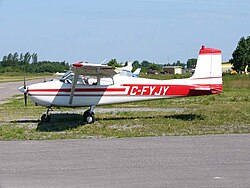
1975 Cessna 172M Skyhawk (1973-1976)
Good plane - Demo
Maintenance & Support
Identical to 172I/K/L. See Cessna 172I Skyhawk (1968) for engine details. The 172M is the last 172 with the O-320-E2D; the 172N (1977) introduced the troublesome O-320-H2AD that prompted the famous "Operation Blue Streak" remediation program.
Valuation Factors
| Condition | Price Range |
|---|---|
| Project / needs engine | $32,000-$48,000 |
| Flying but tired | $48,000-$68,000 |
| Well-maintained | $62,000-$82,000 |
| Restored / upgraded | $80,000-$105,000 |
The 172M typically commands $3,000-$8,000 over a 172L in equivalent condition. Restored 172Ms with modern panels often exceed $90,000 -- approaching the price of a 172N (which has its engine-related questions) or a 172P (which is mechanically preferable but pricier). The 172M-172P spread is the central "what mid-era 172 should I buy" decision.
2006 Cessna 172S
G1000 Skyhawk · Mid-Time Engine · Clean Logs
ADs & Common Problems
Universal Cessna 172 pre-buy concerns apply. 172M-specific:
- Wing leading edge inspection: The Camber-Lift drooped leading edge can be damaged by hangar rash or ramp incidents. Inspect for dents or repairs.
- Baggage door seals: Original 1973-1976 baggage door seals are likely dry. Water intrusion through poor seals causes corrosion in the baggage compartment floor.
- Camber-Lift documentation: Verify the airplane has the factory Camber-Lift wing (some 1973 early-production airframes may have been pre-Camber-Lift; check the type data plate).
- Engine cam/lifter condition: Although the 172M's E2D is generally reliable, a 50-year-old engine deserves an oil filter inspection and (ideally) borescope inspection.
For sale (1)
For sale elsewhere (6)
Current ads on Barnstormers, checked daily. Photos, full details and the seller are on the listing site.
1975 Cessna 172M Skyhawk (1973-1976)
Listed on BarnstormersADF · ADS-B Out · Audio panel · Bendix/King KX 155/165
View photos and full ad on Barnstormers ↗1975 Cessna 172M Skyhawk (1973-1976)
Listed on Barnstormers1974 Cessna 172M Skyhawk (1973-1976)
Listed on BarnstormersEngine monitor · Garmin GNS 430 · STOL kit
View photos and full ad on Barnstormers ↗1973 Cessna 172M Skyhawk (1973-1976)
Listed on BarnstormersADS-B In · ADS-B Out · Garmin G5 · Garmin GNS 430
View photos and full ad on Barnstormers ↗1975 Cessna 172M Skyhawk (1973-1976)
Listed on Barnstormers1974 Cessna 172M Skyhawk (1973-1976)
Listed on BarnstormersGarmin GTN 650
View photos and full ad on Barnstormers ↗Also worth looking at
What buyers usually weigh against the Cessna 172M Skyhawk (1973-1976) — aircraft flown for the same kind of mission.


