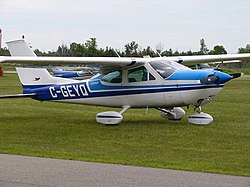
Piper Aircraft · 1958–1964
Comanche 180
Specifications
Performance
Cruise
130KTAS
75% power @ 0 ft
Range
652nm
75% power @ 0 ft
Climb
910fpm
Ceiling
18,500ft
Fuel Burn
10.0gph
75% power @ 0 ft
Fuel Cap.
nullgal
MPG
15.0mpg
Stall (Vs0)
53KIAS
T/O roll
750ft
Ldg roll
600ft
Size & weight
Seats
4
Useful Load
1,040lbs
Full-fuel payload
—lbs
Max gross
2,550lbs
Wingspan
36ft
Length
24.7ft
Engine
Engine
Lycoming O-360-A1A
Power
180hp
TBO
2,000hrs
Overhaul
$45k
Owning it
Hull insurance
$2k/yr
Parts
good
Mechanics
moderate
Gear
Retractable
IFR
Yes
Category
certified
Full specification
V-speeds
Airframe
- Empty weight
- 1,510 lbs
- Height
- 7.3 ft
- Wing position
- low
Paperwork
- Type certificate
- 1A15
- Certification basis
- CAR Part 3
These figures are typical for the model, not a specification for any individual aircraft. Real-world numbers vary with year, installed equipment, weight, modifications and engine condition — often by more than you would expect. Use them to compare types, and confirm anything you would act on against the Pilot's Operating Handbook for that specific airframe and a prebuy inspection.
Pricing
Typical
$68k
Range
$45k – $95k
Annual all-in
~$26k/yr
All-in at ~100 flying hours a year, using the midpoint of each range — the same figures broken out under “Cost to own” below. Your number will differ, and mostly for two reasons. Experience sets your insurance: a 2,000-hour pilot with recent training pays 30–40% less than a 200-hour owner, and student owners pay 20–40% more — on the same aircraft that is often a doubling. Location sets your hangar: a T-hangar runs $200–400 a month in the Midwest against $400–1,500 in a coastal metro, and an outside tie-down is less again. Engine reserves move too — a local shop reusing your serviceable cylinders can come in 30–50% under the national specialty-shop pricing we quote, though you trade the warranty and turnaround that comes with it. Reserves are money set aside toward a future overhaul, not a bill this year, and the annual inspection figure is the shop’s labor to look — whatever they find is separate.
Cost to own — estimate
Set your yearly hours and local fuel price. Fixed costs (insurance, hangar, annual inspection) don't change with hours; fuel, maintenance and the engine reserve do.
- Fuel (10 gph)
- $6,500
- Engine reserve
- $2,250
- Propeller reserve
- $175
- Maintenance, parts & wear items ($22/hr)
- $2,200
- Insurance
- $1,600–$3,000
- Hangar
- $5,335–$13,338
- Annual inspection (labor only)
- $2,500
- Databases & subscriptions
- $700
- Total per year
- $25,962
- Per flight hour
- $260
- Miles flown / year (at cruise)
- 14,960 mi
- Cost per mile
- $1.74/mi
- Time in the air
- 2 hr 18 min
- Fuel burned
- 23 gal
- Out of pocket
- $257
Fuel, engine reserve and wear only. Insurance, hangar and the annual are already paid whether you make the trip or not, so they are not charged here.
Estimate, not a quote. Where a line shows a range, the total, per-hour and per-mile figures use its midpoint— insurance moves most with your experience and time in type, hangar with where you base the aircraft, so your own number could sit at either end. Annual inspection is the shop's labor to open and inspect — what they find is the maintenance line, which covers oil changes, plugs, tires, brakes, hoses, lights, a battery and vacuum pump amortised over their life, and the unscheduled squawks that are the largest and least predictable part of it. Reserves are sinking funds toward an overhaul, not a bill you pay this year — and note that a propeller is due on hours or calendar time, typically six years, so flying less does not put it off forever.
Strengths
- Same proven Comanche airframe and cabin as 250/260 at lower acquisition cost
- Excellent cross-country performer: 130 KTAS on just 10 GPH
- O-360 engine is one of the most common Lycoming engines—parts and service widely available
- 1,040 lb useful load adequate for typical 4-seat flying without the fuel bill of larger siblings
Weaknesses
- Only produced 1958–1964; smaller buyer pool than 250/260 affects resale and parts demand for 180-specific items
- Retractable gear and low-wing design rule out backcountry and unimproved-strip operations
- Fuel capacity documentation gap: certificate vs. AOH figures do not reconcile; usable fuel must be confirmed on specific airframe
- Noticeably lower payload than 250/260 (1,040 vs. 1,270–1,427 lb)—not suitable for regular 4-seat + baggage missions
Overview
The Piper PA-24-180 is the entry-level, four-cylinder member of the Comanche family -- the model FAA TCDS 1A15 lists simply as "PA-24," approved June 20, 1957 and put into production in 1958 alongside the six-cylinder 250. Where the 250/260 use the six-cylinder Lycoming O-540, the 180 uses the smaller four-cylinder O-360-A1A, and the certificate gives it a materially lower gross weight (2,550 lb against the 250/260's 2,900-3,200 lb) and a different useful-load and speed class entirely. This page exists because those differences cross the splitting rule's Step 2 thresholds against the rest of the family -- see the main Comanche 250/260 page for the split reasoning.
The 180 was the original, most affordable way into a Comanche: the same laminar-flow wing, retractable gear and roomy cabin as its bigger siblings, at a lower price and a more modest fuel burn. It gave up 70-80 hp and a meaningful chunk of useful load and cruise speed in exchange. Piper discontinued the 180 hp option in 1964, after which the Comanche line was six-cylinder only through the 260 and eight-cylinder for the rare 400.
Variants & History
| Variant | Years | Engine | HP | Gross Weight | Notes |
|---|---|---|---|---|---|
| PA-24-180 (this page) | 1958-1964 | Lycoming O-360-A1A | 180 | 2,550 lb | Entry-level Comanche |
| PA-24-250/260 | 1958-1972 | Lycoming O-540/IO-540 | 250-260 | 2,900-3,200 lb | The mainstream Comanche |
| PA-24-400 | 1964-1966 | Lycoming IO-720-A1A | 400 | 3,600 lb | 8-cylinder flagship |
Performance
Source: The Piper Comanche Airplane Owner's Handbook, Piper No. 753 570, PA-24 180 column (see data/vault/raw/poh/pohaoh753570-pa24-180-250-2026-09-08.md). At 75% power and sea level, the AOH's own figure is 130 KTAS burning 10 GPH, giving a published range of 652 nm on standard fuel. A second 75%-power row exists at an unstated "optimum altitude" (160 mph = 139 kt) but since the AOH does not print which altitude that is, this page does not use it as the reference (runbook rule 3's "leave the altitude out if the source does not state it" does not apply cleanly here since a NUMBER is given without its condition -- so the safer choice is the fully-specified sea-level row).
Fuel capacity is a genuine gap on this page (see validator_exempt): the certificate states 60 gallons total with no unusable-fuel breakdown for this specific model, and the AOH's own "Standard 50 / With Reserve 60" pair does not reconcile with the certificate's single figure. A buyer should confirm actual usable fuel against the specific airplane's POH supplement or a fuel-totalizer calibration rather than plan against a number this page cannot responsibly publish.
Climb (910 fpm at sea level) and takeoff/landing ground rolls (750 ft / 600 ft) are all sourced, but this AOH's spec table -- unlike the later 260C AOH -- does not print over-50-ft obstacle distances or a best-angle-of-climb (Vx) speed for the 180/250 columns; both are exempted rather than estimated.
Payload & Range
| Scenario | Payload | Notes |
|---|---|---|
| 2 occupants + baggage | Pilot 200 + pax 170 + bags 100 = 470 lb | Well under the 1,040 lb useful load; fuel-limited by the (unconfirmed) usable-fuel gap noted above, not by weight |
| 4 occupants | 4 x 180 lb = 720 lb | Leaves 320 lb for fuel and baggage -- workable, but confirm actual usable fuel on the specific airframe before planning a long leg with four aboard |
Because this page cannot responsibly state a usable-fuel figure (see the confidence note), payload-range planning here is necessarily qualitative rather than a worked fuel/payload table like the 250/260 page's. A buyer should get the specific airplane's actual W&B and fuel system supplement before planning a mission.

2019 Cirrus SR22
One Owner · Platinum · FIKI · Low 690 Hours · Hangared
Mission Suitability
Cross-Country (8/10): A genuine 4-seat, retractable, 130-knot traveling machine at a meaningfully lower fuel burn than the 250/260 -- the practical case for choosing the 180 over its bigger siblings.
Business Travel (7/10): Respectable speed and IFR-capable panel space, at the lowest acquisition and operating cost in the Comanche line.
Cargo Hauling (5/10): 1,040 lb useful load is solid for a 4-seat retractable of this era, though well short of the 250/260's 1,270-1,427 lb.
Local Fun (6/10): Pleasant handling from the same airframe as its faster siblings, without the fuel bill.
Flight Training (3/10): Complex (retractable gear, constant-speed prop) -- usable only for complex/high-performance-adjacent training, not primary instruction.
Backcountry (2/10): Retractable gear and a low-wing laminar airfoil are a poor match for unimproved strips.
Aerobatics (1/10): Normal category only.
Surveying (4/10): Low wing hurts downward visibility; no survey-specific equipment is common on this type.
Avionics Ecosystem
Shares the Comanche family's wide panel and the same avionics STC base as the 250/260 -- Garmin GTN/GNS series, G500 TXi, and GFC 500 (certified for the PA-24-180 as well as the 250/260/260C) are all common upgrades. See the main Comanche page's Avionics Ecosystem section for the full breakdown; nothing about the 180's panel is materially different.
STCs & Modifications
The most consequential modification on this specific variant is the engine upgrade path: a documented STC exists to bring a PA-24-180 up to the Lycoming O-540 (250 hp), effectively converting it into a 250 -- a common move for owners who bought a cheap 180 airframe and wanted 250-class performance. Otherwise the airframe shares the 250/260's modification ecosystem (speed mods, gear door seals, LED lighting) -- see the main Comanche page.

2006 Cessna 172S
G1000 Skyhawk · Mid-Time Engine · Clean Logs
Maintenance & Support
Parts and mechanic familiarity track the rest of the Comanche line -- the ICS type club, shared airframe parts with the 250/260, and widely available Lycoming O-360 parts and service. The O-360 itself is one of the most common Lycoming engines ever built, so engine-specific parts and shop familiarity are, if anything, easier to find than for the 250/260's O-540/IO-540.
Valuation Factors
The 180 consistently sells for less than a comparable 250 or 260 -- less horsepower, less useful load, and a smaller pool of buyers who specifically want the four-cylinder model. It is the value entry point into Comanche ownership: same airframe, same type-club support, same cabin, at a real discount. Buyers planning to fly mostly solo or with one passenger, at lower fuel cost, are the natural market; buyers who need to regularly fill four seats with baggage are better served by a 250/260.
ADs & Common Problems
Shares the Comanche family's AD list -- stabilator inspections, wing spar attach-point inspections, and the electro-mechanical landing gear's routine maintenance items apply equally to the 180. See the main Comanche 250/260 page for the full AD and pre-buy discussion; nothing in the certificate or the AOH suggests the 180 has a different AD exposure than its siblings.
Insurance Profile
Falls into a complex/retractable category but below the FAA's 200 hp "high performance" line the 250/260 sit in -- typically a modest discount against the 260's premiums for a comparably experienced pilot. See GA Insurance Underwriting for category detail.
For sale (0)
No listings for this model right now.
For sale elsewhere (1)
Current ads on Barnstormers, checked daily. Photos, full details and the seller are on the listing site.
1959 Comanche 180
Listed on BarnstormersADS-B Out · Audio panel · Garmin G5 · Garmin GNC 355
View photos and full ad on Barnstormers ↗Also worth looking at
What buyers usually weigh against the Comanche 180 — aircraft flown for the same kind of mission.