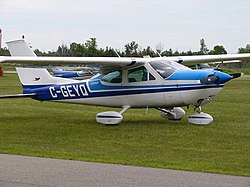
Cessna · 1956–1959
Cessna 182 / 182A / 182B (1956-1959)

Specifications
Performance
Cruise
135KTAS
Range
615nm
Climb
980fpm
Ceiling
18,900ft
Fuel Burn
12.5gph
Fuel Cap.
55gal
MPG
12.4mpg
Stall (Vs0)
49KIAS
T/O roll
705ft
Ldg roll
590ft
Size & weight
Seats
4
Useful Load
1,030lbs
Full-fuel payload
700lbs
Max gross
2,650lbs
Wingspan
36ft
Length
29ft
Engine
Engine
Continental O-470-L
Power
230hp
TBO
1,500hrs
Overhaul
$48k
Owning it
Hull insurance
$1k/yr
Parts
good
Mechanics
universal
Gear
Fixed
IFR
Yes
Category
certified
Full specification
V-speeds
Airframe
- Empty weight
- 1,620 lbs
- Max fuel weight
- 330 lbs
- Height
- 9.3 ft
- Wing position
- high
Obstacle performance
- Takeoff over 50 ft
- 1,350 ft
- Landing over 50 ft
- 1,335 ft
Paperwork
- Type certificate
- 3A13
- Certification basis
- CAR 3
These figures are typical for the model, not a specification for any individual aircraft. Real-world numbers vary with year, installed equipment, weight, modifications and engine condition — often by more than you would expect. Use them to compare types, and confirm anything you would act on against the Pilot's Operating Handbook for that specific airframe and a prebuy inspection.
Pricing
Typical
$65k
Range
$45k – $100k
Annual all-in
~$27k/yr
All-in at ~100 flying hours a year, using the midpoint of each range — the same figures broken out under “Cost to own” below. Your number will differ, and mostly for two reasons. Experience sets your insurance: a 2,000-hour pilot with recent training pays 30–40% less than a 200-hour owner, and student owners pay 20–40% more — on the same aircraft that is often a doubling. Location sets your hangar: a T-hangar runs $200–400 a month in the Midwest against $400–1,500 in a coastal metro, and an outside tie-down is less again. Engine reserves move too — a local shop reusing your serviceable cylinders can come in 30–50% under the national specialty-shop pricing we quote, though you trade the warranty and turnaround that comes with it. Reserves are money set aside toward a future overhaul, not a bill this year, and the annual inspection figure is the shop’s labor to look — whatever they find is separate.
Cost to own — estimate
Set your yearly hours and local fuel price. Fixed costs (insurance, hangar, annual inspection) don't change with hours; fuel, maintenance and the engine reserve do.
- Fuel (12.5 gph)
- $8,125
- Engine reserve
- $3,200
- Propeller reserve
- $175
- Maintenance, parts & wear items ($12/hr)
- $1,200
- Insurance
- $900–$1,800
- Hangar
- $6,264–$15,660
- Annual inspection (labor only)
- $1,200
- Databases & subscriptions
- $400
- Total per year
- $26,612
- Per flight hour
- $266
- Miles flown / year (at cruise)
- 15,536 mi
- Cost per mile
- $1.71/mi
- Time in the air
- 2 hr 13 min
- Fuel burned
- 28 gal
- Out of pocket
- $282
Fuel, engine reserve and wear only. Insurance, hangar and the annual are already paid whether you make the trip or not, so they are not charged here.
Estimate, not a quote. Where a line shows a range, the total, per-hour and per-mile figures use its midpoint— insurance moves most with your experience and time in type, hangar with where you base the aircraft, so your own number could sit at either end. Annual inspection is the shop's labor to open and inspect — what they find is the maintenance line, which covers oil changes, plugs, tires, brakes, hoses, lights, a battery and vacuum pump amortised over their life, and the unscheduled squawks that are the largest and least predictable part of it. Reserves are sinking funds toward an overhaul, not a bill you pay this year — and note that a propeller is due on hours or calendar time, typically six years, so flying less does not put it off forever.
Strengths
- Genuine 4-seat touring capability with 230 hp and constant-speed prop
- O-470-L engine well-supported by larger installed base through 182R production
- Cruise 135 KTAS on 12.5 gph; economical for the performance class
- Straightforward, proven airframe design with 70 years of field history
Weaknesses
- Fastback design with small rear windows and no wraparound glass; limited visibility aft
- Range figures unverified and overstated (55 usable gal vs. 65-gal baseline)
- Universal corrosion risk on outside-stored airframes; tail cone/lower fuselage inspection mandatory
- Performance and weight data unsourced; original Owner's Manual required to verify specs
Overview
The 1956-1959 Cessna 182 covers the first four model years of what became the workhorse of 230 hp general aviation: the original 182 (1956, straight vertical tail), the 182A (1957-1958, which brought the swept tail and the "Skylane" name), and the 182B (1959).
The 182 was Cessna's tricycle-gear development of the Cessna 180, sharing airframe DNA with the Cessna 172 but with substantially more power, a constant-speed propeller where the early 172 had a fixed-pitch one, and a much higher gross weight. The result was a genuine four-seat touring airplane in 1956 and remains a capable one.
All three are fastback airplanes — small rear windows, no wraparound glass. The Omni-Vision rear window arrives with the 182C in 1960.
Variants & History
Certified figures below are FAA TCDS 3A13 Rev. 75, Sections I, II and III. The serial counts are counts of eligible serials on the certificate, not deliveries.
| Variant | Model year | Section | Eligible serials | Engine | Gross | Fuel total / usable | Va / Vno / Vne / Vfe (CAS kt) |
|---|---|---|---|---|---|---|---|
| 182 | 1956 | I | 844 (613; 33000-33842) | O-470-L, 230 hp | 2,550 lb | 60 / 55 gal | 106 / 139 / 160 / 87 |
| 182A (frontmatter) | 1957-1958 | II | 1,712 (33843-34753; 34755-34999; 51001-51556) | O-470-L, 230 hp | 2,650 lb | 65 / 55 gal | 106 / 139 / 160 / 87 |
| 182B | 1959 | III | 802 (34754; 51557-52358 less 51623) | O-470-L, 230 hp | 2,650 lb | 65 / 55 gal | 106 / 139 / 160 / 87 |
What actually changed year to year:
- 182 to 182A (1957) — swept-back vertical tail, the single most visible change in the type's history; the "Skylane" name introduced as a deluxe trim option; gross weight up 100 lb; total fuel up 5 gallons in the same two wing tanks (32.5 gal a side rather than 30), with usable unchanged at 55.
- 182A to 182B (1959) — the certificate records no change at all. Every Section III figure equals Section II's. The differences are cabin trim and cowling detail, which a type certificate does not reach and which this page therefore does not claim.
The "Skylane" name
The 1957 182A introduced "Skylane" as a deluxe trim option, the same year Cessna did the same thing with "Skyhawk" on the 172. Skylane trim meant full exterior paint rather than bare aluminum, an upgraded interior, and a radio package. Today "Skylane" is the universal name for a 182 regardless of trim, and the original distinction has no effect on resale.
Performance
None of the performance figures on this page have been re-sourced. Cruise 135 KTAS, 12.5 gph, 980 fpm, 18,900 ft, ~615 nm range, and both takeoff and landing distances are all April 2026 generated values, carried forward unchanged and unverified. A type certificate contains no performance data of any kind.
Two of them are now visibly suspect and should be treated as such until the Owner's Manual is read:
- The range figure was written against a 65-gallon airplane. The airplane has 55 usable, so ~615 nm is at best 15% optimistic before reserves.
- The empty weight (1,620 lb) and the useful load derived from it (1,030 lb) are unsourced. The certificate gives C.G. envelopes, not weights.
Settling this needs the period Cessna Owner's Manual for each model. These airplanes predate the GAMA-standard POH by two decades, so there is no part number on the certificate to chase.

2006 Cessna 172S
G1000 Skyhawk · Mid-Time Engine · Clean Logs
Maintenance & Support
The O-470-L is a 230 hp six-cylinder, horizontally opposed, air-cooled engine with a 1,500-hour TBO. It is smooth, durable, and the certificate rates it at 2,600 rpm for all operations — there is no separate takeoff rating to track.
The wider O-470 family stayed in Cessna production through the 182R in 1986, so
parts support for the L is carried by a much larger installed base than the
1956-1959 airplanes alone would justify. Field overhaul runs $42,000-$54,000;
engine_overhaul_cost_usd here is the national specialty-shop figure from
reference/engine-overhaul-pricing.md.
Valuation Factors
| Condition | Price Range |
|---|---|
| Project / needs engine | $30,000-$48,000 |
| Flying but tired | $45,000-$65,000 |
| Well-maintained | $58,000-$85,000 |
| Restored / upgraded | $80,000-$115,000 |
These are April 2026 generated bands and have not been re-sourced against a price guide. Original 1956 straight-tail 182s command a modest collector premium when restored; 182A and 182B trade at similar money in equivalent condition. Float-equipped examples can exceed $130,000, but that is float value rather than airframe value.
2005 Cessna 182T Skylane
G1000 Skylane · No Damage · Hangared
ADs & Common Problems
Universal Cessna pre-buy concerns apply. Specific to these airframes:
- Wing strut attach fittings — AD 99-12-15 inspection. Corrosion here can be unrepairable.
- Seat rail wear — AD 2011-10-09 applies across the Cessna single line.
- Tail cone and lower fuselage corrosion — near-universal on outside-stored airframes of this age. Inspect with the tail cone off.
- Nose gear strut — AD 2007-23-04 inspection; repairs are expensive.
- Constant-speed propeller hub — these hubs are 65+ years old. The certificate lists five eligible installations between Hartzell and McCauley, including one that only applies to airframes reworked per Cessna Service Kit SK182-121. Verify which one is fitted and that the logs support it — a mismatch between the airplane and its data plate is a common finding at this age.
- Gross weight paperwork — a 182 is 2,550 lb and a 182A/182B is 2,650 lb. Check the weight and balance against the model, not against what the seller says.
For sale (0)
No listings for this model right now.
For sale elsewhere (3)
Current ads on Barnstormers, checked daily. Photos, full details and the seller are on the listing site.
1957 Cessna 182 / 182A / 182B (1956-1959)
Listed on Barnstormers406 MHz ELT · Garmin GTR 200/225 / SL40 · Garmin GTX 327/320
View photos and full ad on Barnstormers ↗1956 Cessna 182 / 182A / 182B (1956-1959)
Listed on BarnstormersGarmin GNS 430
View photos and full ad on Barnstormers ↗1959 Cessna 182 / 182A / 182B (1956-1959)
Listed on BarnstormersAutopilot (unspecified)
View photos and full ad on Barnstormers ↗Also worth looking at
What buyers usually weigh against the Cessna 182 / 182A / 182B (1956-1959) — aircraft flown for the same kind of mission.