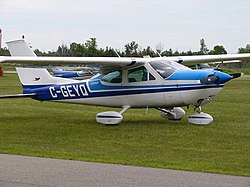
Cessna · 1958–1962
Cessna 175 Skylark

Specifications
Performance
Cruise
122KTAS
Range
630nm
Climb
850fpm
Ceiling
15,900ft
Fuel Burn
11.0gph
Fuel Cap.
52gal
MPG
12.8mpg
Stall (Vs0)
48KIAS
T/O roll
735ft
Ldg roll
590ft
Size & weight
Seats
4
Useful Load
1,011lbs
Full-fuel payload
699lbs
Max gross
2,350lbs
Wingspan
36ft
Length
26ft
Engine
Engine
Continental GO-300-A/C/D/E
Power
175hp
TBO
1,200hrs
Overhaul
$30k
Owning it
Hull insurance
$1k/yr
Parts
poor
Mechanics
specialist
Gear
Fixed
IFR
Yes
Category
certified
Full specification
V-speeds
Airframe
- Empty weight
- 1,339 lbs
- Max fuel weight
- 312 lbs
- Height
- 8.9 ft
- Wing position
- high
Obstacle performance
- Takeoff over 50 ft
- 1,340 ft
- Landing over 50 ft
- 1,155 ft
Paperwork
- Type certificate
- 3A13
- Certification basis
- CAR 3
These figures are typical for the model, not a specification for any individual aircraft. Real-world numbers vary with year, installed equipment, weight, modifications and engine condition — often by more than you would expect. Use them to compare types, and confirm anything you would act on against the Pilot's Operating Handbook for that specific airframe and a prebuy inspection.
Pricing
Typical
$45k
Range
$25k – $110k
Annual all-in
~$24k/yr
All-in at ~100 flying hours a year, using the midpoint of each range — the same figures broken out under “Cost to own” below. Your number will differ, and mostly for two reasons. Experience sets your insurance: a 2,000-hour pilot with recent training pays 30–40% less than a 200-hour owner, and student owners pay 20–40% more — on the same aircraft that is often a doubling. Location sets your hangar: a T-hangar runs $200–400 a month in the Midwest against $400–1,500 in a coastal metro, and an outside tie-down is less again. Engine reserves move too — a local shop reusing your serviceable cylinders can come in 30–50% under the national specialty-shop pricing we quote, though you trade the warranty and turnaround that comes with it. Reserves are money set aside toward a future overhaul, not a bill this year, and the annual inspection figure is the shop’s labor to look — whatever they find is separate.
Cost to own — estimate
Set your yearly hours and local fuel price. Fixed costs (insurance, hangar, annual inspection) don't change with hours; fuel, maintenance and the engine reserve do.
- Fuel (11 gph)
- $7,150
- Engine reserve
- $2,500
- Maintenance, parts & wear items ($12/hr)
- $1,200
- Insurance
- $900–$1,800
- Hangar
- $5,616–$14,040
- Annual inspection (labor only)
- $1,200
- Databases & subscriptions
- $400
- Total per year
- $23,628
- Per flight hour
- $236
- Miles flown / year (at cruise)
- 14,040 mi
- Cost per mile
- $1.68/mi
- Time in the air
- 2 hr 28 min
- Fuel burned
- 27 gal
- Out of pocket
- $267
Fuel, engine reserve and wear only. Insurance, hangar and the annual are already paid whether you make the trip or not, so they are not charged here.
Estimate, not a quote. Where a line shows a range, the total, per-hour and per-mile figures use its midpoint— insurance moves most with your experience and time in type, hangar with where you base the aircraft, so your own number could sit at either end. Annual inspection is the shop's labor to open and inspect — what they find is the maintenance line, which covers oil changes, plugs, tires, brakes, hoses, lights, a battery and vacuum pump amortised over their life, and the unscheduled squawks that are the largest and least predictable part of it. Reserves are sinking funds toward an overhaul, not a bill you pay this year — and note that a propeller is due on hours or calendar time, typically six years, so flying less does not put it off forever.
See how every Cessna 172 / Skyhawkyear stacks up — engines, changes, and which to buy — in our year-by-year buyer's guide.
Strengths
- Excellent value for O-360 converted models — 180 HP Cessna high-wing performance at 172N/P pricing
- Proven, solid airframe — same design basis as the 172, with strong safety record
- Pleasant handling and visibility — classic high-wing design suitable for personal flying and regional travel
Weaknesses
- Stock GO-300 engine is maintenance-intensive and increasingly hard to support — parts scarce, specialist mechanics required
- GO-300 has short 1,200-hour TBO and high overhaul costs ($28k–$35k) that may exceed aircraft value
- GO-300 demands constant RPM discipline — must stay above 2,500 RPM or risk gearbox lubrication failure; careful descent management required
Overview
The Cessna 175 Skylark is a four-seat, single-engine high-wing aircraft produced from 1958 to 1962, with 2,106 built. It occupies a unique and somewhat tragic niche in general aviation history — an airplane that was faster and more powerful than the Cessna 172 it was based on, but doomed by its Continental GO-300 geared engine's reputation for unreliability. Cessna dropped the model after just five years of production, though the 175 airframe itself lived on as the basis for later 172 variants and the T-41 Mescalero military trainer.
The 175 is two fundamentally different airplanes depending on its engine. With the stock GO-300, it is a maintenance-intensive headache available at rock-bottom prices. With the Lycoming O-360 STC conversion, it becomes a genuine hidden gem — a 180 HP Cessna high-wing with better performance than a standard 172, for less money than a comparable Skyhawk. Understanding this duality is essential to evaluating any 175 on the market.
The "Skylark" name was applied to deluxe-trim 175s starting with the 1960 model year (175A). In common usage, "175" and "Skylark" are used interchangeably.
Variants & History
| Variant | Years | Engine | HP | Gross Weight | Usable Fuel | Serials | Share |
|---|---|---|---|---|---|---|---|
| 175 | 1958-1959 | Continental GO-300-A/C | 175 | 2,350 lb | 43 gal | 1,239 | 58% |
| 175A | 1960 | Continental GO-300-C/D | 175 | 2,350 lb (2,450 lb seaplane) | 42 gal | 540 | 25% |
| 175B | 1960-1961 | Continental GO-300-C/D | 175 | 2,350 lb (2,450 lb seaplane) | 42 gal | 225 | 11% |
| 175C | 1961-1962 | Continental GO-300-E | 175 | 2,450 lb | 41.5 gal | 117 | 6% |
Figures above are FAA TCDS 3A17 Rev. 47's own per-section numbers (see
data/vault/raw/tcds/cert-cessna175-3a17-rev47-2026-09-08.md). All variants
share the same basic airframe, dimensionally close to the contemporary Cessna
172. The 175C is the most refined version with its constant-speed prop and
higher gross weight, but it is also the rarest of the four, and the engine
reliability concerns apply equally across all of them.
Performance
Sourced from the 1959 Owner's Manual (P/N P-175A), cross-checked against the type certificate on gross weight (2,350 lb) and usable fuel (43 gal) before transcribing anything.
Cruise: 116 KTAS at 74% power, 2,500 ft, the manual's own nearest row to the house 75% reference (Figure 25, rich mixture, 3000 RPM). Burn at this setting is 12.0 GPH and range is 413 NM -- this is the chart's own NO-RESERVE figure; the pre-GAMA manual has no taxi/climb/45-minute-reserve convention built in, unlike later Cessna POHs, so plan a real reserve on top of it rather than reading 413 NM as a book range with margin already included. No economy (~65%) row is stored: the nearest published row (67%) is only 7 points off the reference row and not a genuine economy setting.
Climb: 850 FPM at sea level, 2,350 lb (Figure 24) -- this figure was already on the page with no citation and is now confirmed. Vy (best rate) 73 KIAS at sea level, declining to 70 KIAS by 10,000 ft. Vx (best angle) 53 KIAS at sea level, RISING to 61 KIAS by 10,000 ft (Section III prose) -- an unusual shape but as the manual states it, not smoothed over.
Runway: 735 ft ground roll / 1,340 ft over a 50-ft obstacle for takeoff; 590 ft / 1,155 ft for landing (sea level, standard day, gross weight, hard-surface runway). Both figures were already correct on the page with no citation; both are now sourced to Figures 24 and 27.
Stall speeds: Vs1 (flaps up) 54 KIAS, Vs0 (flaps 40 deg) 46 KIAS, gross weight, power off, 0-degree bank (Figure 12). The previous 56/48 KIAS figures were unsourced and had the values transposed against the correct 54/46.
No published service ceiling or best-glide speed. The 1959 manual's climb
chart tops out at 15,000 ft still showing a positive rate of climb, and this
predates the dedicated best-glide figure later POHs carry as standard. Both
are validator_exempt rather than guessed.
The engine operating note that matters more than any single number: the GO-300 must be run above 2,500 RPM at all times, in cruise and in descent — the reduction gearbox loses adequate lubrication below that speed, and the original manual's own charts (which step down to 2,400 RPM) understate how firm that floor really is in practice. This is a bigger factor in this airplane's ownership economics than any cruise or range figure.
With the stock GO-300, real-world owners report cruise speeds in the same 110-125 KTAS band the certificate and manual support, with fuel burns of 9-12 GPH depending on power setting and altitude. With the O-360 conversion, the airplane transforms: 180 HP with a direct-drive engine, 1,800-hour TBO, standard operating procedures, and cruise speeds several knots higher than stock.
Payload & Range
| Scenario | Fuel (gal) | Fuel Weight | Payload | Range (nm) | Endurance (hr) |
|---|---|---|---|---|---|
| Full fuel (43 gal usable) + 2 pax (170 lbs each) | 43 | 258 lbs | 340 lbs pax | 413 | 3.6 |
| Full fuel + 2 adults (200 lbs each) | 43 | 258 lbs | 400 lbs used | 413 | 3.6 |
| 4 adults (170 lbs each) + bags | 25 | 150 lbs | 680 lbs pax, 134 lbs bags | 240 | 2.1 |
The 175's useful load of approximately 964 lbs (base model; varies by variant and equipment) is competitive with the 172 of the same era, though lighter than the previous pass's unsourced 1,011 lb figure. Full fuel plus two adults leaves adequate margin for baggage. Four-up trips require reducing fuel noticeably on this airplane's smaller 43-gallon tank.
The 175C variant, at 2,450 lb gross with a larger fuel option, has the best payload-range combination in the family — but it is also the rarest, at only 6% of production.
1975 Cessna 172M Skyhawk (1973-1976)
Good plane - Demo
Mission Suitability
Mission scores below are for the stock GO-300 configuration. An O-360-converted 175 would score similarly to a Cessna 172N/P with 180 HP.
- Flight Training (4): The GO-300's operational restrictions and maintenance demands make it a poor training platform. The engine requires specialized knowledge that student pilots should not need to manage. An O-360 conversion raises this to a 6-7.
- Backcountry (3): Fixed gear and high wing are good, but the GO-300's sensitivity to power management during descents is a liability in mountainous terrain. Airframe performance is adequate.
- Business Travel (3): Marginal speed and range. The GO-300's short TBO and maintenance needs make it unreliable for schedule-dependent travel. An O-360 conversion improves this to a 5.
- Aerobatics (1): Not certified for aerobatic flight.
- Cross-Country (5): Adequate speed and range for regional trips. The GO-300 demands constant attention to engine management. With the O-360, this becomes a solid 7.
- Cargo Hauling (3): Useful load of approximately 964 lbs is adequate, but the 172-sized cabin limits volume.
- Local Fun (5): A pleasant-flying Cessna high-wing for weekend flying, provided you respect the GO-300's quirks. With the O-360, it is a cheerful and inexpensive fun flyer (7).
- Surveying (5): High wing provides good ground visibility. Performance is adequate for the mission.
Avionics Ecosystem
Most surviving 175s have been through multiple avionics upgrades over their 60+ year lives. The panel is standard Cessna 172-era dimensions, and all 172 avionics solutions fit.
- Budget ($25K-$40K aircraft): Expect original or vintage avionics — a single nav/com, possibly no GPS. These are VFR-only machines unless the buyer invests in avionics.
- Mid-range ($40K-$70K): Basic IFR GPS (Garmin GNS 430 or GTN 650), ADS-B compliant, functional panel. These are typically O-360-converted aircraft.
- Premium ($70K-$110K): O-360 conversion plus modern avionics — Garmin G500/GTN 750, autopilot, full IFR capability. These aircraft represent the best value proposition in the 175 market.
Given the low hull values of stock GO-300 aircraft, investing heavily in avionics is not recommended unless the engine conversion is also planned. See Avionics Pricing Reference for current equipment costs.
STCs & Modifications
The O-360 Conversion — The STC That Changes Everything
The most important modification available for the Cessna 175 is the Lycoming O-360 engine conversion. Multiple STCs exist, including the Bob Williams STC and others. This conversion replaces the problematic geared Continental GO-300 with a direct-drive Lycoming O-360-A1A or O-360-A1D producing 180 HP.
| STC / Mod | Description | Cost | Performance Delta |
|---|---|---|---|
| Lycoming O-360 STC (Bob Williams et al.) | Replace GO-300 with O-360 (180 HP) | $20,000-$35,000 complete | TBO from 1,200 to 1,800 hrs, standard operating procedures, vastly improved reliability |
| IO-360 STC (various) | Fuel-injected Lycoming conversion | $25,000-$40,000 | As above plus fuel injection benefits |
| PowerFlow exhaust | Tuned exhaust system (available for O-360 conversion) | $3,200-$4,000 | +4-6 knots cruise |
| Speed fairings | Wheel pants and gap seals | $1,000-$2,000 | +3-5 knots cruise |
The conversion economics: The STC paperwork costs $1,250-$1,750. A used mid-time O-360 engine can be sourced for $6,000-$10,000. A new or overhauled propeller and governor cost $5,000-$8,000. Labor runs $5,000-$10,000 depending on the shop. Total all-in cost is typically $20,000-$35,000, and the conversion immediately adds that much or more to the airplane's value.
Strategic buy: Purchase a low-airframe-time GO-300 175 for $25,000-$35,000, invest $25,000-$30,000 in an O-360 conversion plus basic avionics, and own a 180 HP Cessna high-wing for $50,000-$65,000 — significantly less than a comparable 172 with the same engine.

2006 Cessna 172S
G1000 Skyhawk · Mid-Time Engine · Clean Logs
Maintenance & Support
Stock GO-300
- Parts availability: Poor and declining. Continental GO-300 parts are scarce, with limited core availability for overhaul. Some parts are available only through salvage yards or specialty suppliers.
- Mechanic familiarity: Specialist. Few A&Ps have hands-on experience with geared Continental engines. Finding a shop comfortable with GO-300 overhauls requires research.
- Annual inspection cost: $2,000-$3,500. The airframe inspection is standard Cessna, but GO-300 inspection items add time and expertise requirements.
- Engine overhaul: National specialty-shop pricing for the O-300/O-470 displacement family runs roughly $48,000 (see
reference/engine-overhaul-pricing.md); a local shop reusing serviceable cylinders can run 30-50% under. Increasingly, owners find that overhaul cost approaches or exceeds the airplane's value, making the O-360 conversion the economically rational choice.
O-360 Converted
- Parts availability: Excellent. The Lycoming O-360 is one of the most common GA engines ever built.
- Mechanic familiarity: Universal. Every A&P knows the O-360.
- Annual inspection cost: $1,800-$3,000. Standard Cessna single-engine annual.
- Engine overhaul: National specialty-shop pricing for the O-360 family is $45,000 (see
reference/engine-overhaul-pricing.md); local/field overhauls typically run 30-50% under that.
See Maintenance Ecosystem for general maintenance context.
Valuation Factors
The 175 market splits into two completely separate valuations:
Stock GO-300 Aircraft
| Condition | Price Range | Notes |
|---|---|---|
| Project / Run-out engine | $20,000-$30,000 | Engine at or past TBO, needs work. Buy only if planning O-360 conversion. |
| Flyable / Mid-time engine | $30,000-$45,000 | Flyable but engine will need attention within 500 hours |
| Good condition / Fresh overhaul | $45,000-$60,000 | Overhauled GO-300, decent avionics. Questionable investment since overhaul cost approaches conversion cost. |
O-360 Converted Aircraft
| Condition | Price Range | Notes |
|---|---|---|
| Basic conversion, older avionics | $55,000-$75,000 | O-360 installed, basic IFR panel |
| Good conversion, modern avionics | $75,000-$95,000 | O-360 with modern GPS, ADS-B, autopilot |
| Premium conversion, full refurb | $95,000-$110,000 | Recent O-360 overhaul, glass panel, fresh paint/interior |
These bands are unsourced generated figures, not a Vref/Bluebook pull. A dedicated pricing pass (runbook rule 27) was not performed this session. The page's own synced market listings below show two priced asking figures ($99,500-$105,000), both within this table's "stock" band, which is at least a sanity check even though it is not a substitute for a real guide lookup.
ADs & Common Problems
GO-300 Engine-Specific Issues
The Continental GO-300's reduction gearbox is the primary reliability concern. The gearbox transfers power from the engine crankshaft to the propeller through a set of reduction gears, and these gears are the Achilles heel of the design.
- Reduction gear wear: Operating below 2,500 RPM starves the gearbox of lubrication, accelerating wear. Many GO-300 failures trace back to chronic low-RPM operation by pilots who treated the engine like a standard direct-drive Continental.
- TBO limitation: The GO-300 has a 1,200-hour TBO, compared to 1,800 hours for the direct-drive O-300 in the 172. Overhaul costs for the GO-300 are high because the gearbox adds significant parts and labor.
- Parts scarcity: GO-300 parts are increasingly difficult to source. Continental no longer actively supports the geared engine line, and the diminishing fleet means fewer cores in the overhaul pipeline. This is the strongest argument for the O-360 conversion.
- Prop strike implications: A prop strike on a geared engine requires teardown inspection of the reduction gearbox in addition to the standard crankshaft and case inspection. This makes prop strikes significantly more expensive on a GO-300.
Airframe ADs
The 175 airframe shares most ADs with the contemporary 172, including standard Cessna single-engine items like spar strap inspections and fuel system ADs. The airframe itself is sound and well-proven.
Pre-Buy Red Flags
- Any GO-300 engine with unknown operating history — the engine may have been chronically run at low RPM
- GO-300 nearing TBO with no conversion plan — overhaul costs may approach or exceed the airplane's value
- Previous prop strikes on GO-300 airplanes with no documented gearbox inspection
- Corrosion in the wing spar carry-through (common on all Cessna singles of this era)
Insurance Profile
Insurance for the Cessna 175 is straightforward standard fixed-gear coverage. Hull values are low enough that premiums are modest — expect $800-$1,200 annually for a private pilot with 200+ hours. The GO-300 engine does not trigger any specific underwriting concern beyond normal piston-single criteria, as insurers price based on aircraft category rather than engine type.
The low hull value of stock GO-300 aircraft means that liability coverage typically exceeds hull coverage in the premium calculation. See GA Insurance Underwriting for category details.
For sale (1)
For sale elsewhere (4)
Current ads on Barnstormers, checked daily. Photos, full details and the seller are on the listing site.
1960 Cessna 175 Skylark
Listed on BarnstormersADS-B Out · Garmin GTX 335
View photos and full ad on Barnstormers ↗1959 Cessna 175 Skylark
Listed on BarnstormersADS-B Out · uAvionix skyBeacon/tailBeacon
View photos and full ad on Barnstormers ↗1961 Cessna 175 Skylark
Listed on BarnstormersuAvionix AV-30
View photos and full ad on Barnstormers ↗Also worth looking at
What buyers usually weigh against the Cessna 175 Skylark — aircraft flown for the same kind of mission.