Cessna · 1961–1961
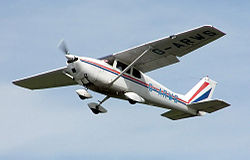
Cessna 172B Skyhawk (1961)
 i
iSpecifications
MOSAIC eligiblePerformance
Cruise
114KTAS
Range
495nm
Climb
645fpm
Ceiling
13,100ft
Fuel Burn
7.0gph
Fuel Cap.
39gal
MPG
18.7mpg
Stall (Vs0)
43KIAS
T/O roll
865ft
Ldg roll
520ft
Size & weight
Seats
4
Useful Load
920lbs
Full-fuel payload
686lbs
Max gross
2,200lbs
Wingspan
36.1ft
Length
27.2ft
Engine
Engine
Continental O-300-C or O-300-D
Power
145hp
TBO
1,800hrs
Overhaul
$45k
Owning it
Hull insurance
$1k/yr
Parts
good
Mechanics
universal
Gear
Fixed
IFR
Yes
Category
certified
Full specification
V-speeds
Airframe
- Empty weight
- 1,280 lbs
- Max fuel weight
- 234 lbs
- Height
- 8.9 ft
- Wing position
- high
Obstacle performance
- Takeoff over 50 ft
- 1,525 ft
- Landing over 50 ft
- 1,250 ft
Paperwork
- Type certificate
- 3A12
- Certification basis
- CAR 3
These figures are typical for the model, not a specification for any individual aircraft. Real-world numbers vary with year, installed equipment, weight, modifications and engine condition — often by more than you would expect. Use them to compare types, and confirm anything you would act on against the Pilot's Operating Handbook for that specific airframe and a prebuy inspection.
Pricing
Typical
$40k
Range
$24k – $62k
Annual all-in
~$22k/yr
All-in at ~100 flying hours a year, using the midpoint of each range — the same figures broken out under “Cost to own” below. Your number will differ, and mostly for two reasons. Experience sets your insurance: a 2,000-hour pilot with recent training pays 30–40% less than a 200-hour owner, and student owners pay 20–40% more — on the same aircraft that is often a doubling. Location sets your hangar: a T-hangar runs $200–400 a month in the Midwest against $400–1,500 in a coastal metro, and an outside tie-down is less again. Engine reserves move too — a local shop reusing your serviceable cylinders can come in 30–50% under the national specialty-shop pricing we quote, though you trade the warranty and turnaround that comes with it. Reserves are money set aside toward a future overhaul, not a bill this year, and the annual inspection figure is the shop’s labor to look — whatever they find is separate.
Cost to own — estimate
Set your yearly hours and local fuel price. Fixed costs (insurance, hangar, annual inspection) don't change with hours; fuel, maintenance and the engine reserve do.
- Fuel (7 gph)
- $4,550
- Engine reserve
- $2,500
- Maintenance, parts & wear items ($12/hr)
- $1,200
- Insurance
- $900–$1,800
- Hangar
- $5,892–$14,729
- Annual inspection (labor only)
- $1,200
- Databases & subscriptions
- $400
- Total per year
- $21,510
- Per flight hour
- $215
- Miles flown / year (at cruise)
- 13,119 mi
- Cost per mile
- $1.64/mi
- Time in the air
- 2 hr 38 min
- Fuel burned
- 18 gal
- Out of pocket
- $217
Fuel, engine reserve and wear only. Insurance, hangar and the annual are already paid whether you make the trip or not, so they are not charged here.
Estimate, not a quote. Where a line shows a range, the total, per-hour and per-mile figures use its midpoint— insurance moves most with your experience and time in type, hangar with where you base the aircraft, so your own number could sit at either end. Annual inspection is the shop's labor to open and inspect — what they find is the maintenance line, which covers oil changes, plugs, tires, brakes, hoses, lights, a battery and vacuum pump amortised over their life, and the unscheduled squawks that are the largest and least predictable part of it. Reserves are sinking funds toward an overhaul, not a bill you pay this year — and note that a propeller is due on hours or calendar time, typically six years, so flying less does not put it off forever.
See how every Cessna 172 / Skyhawkyear stacks up — engines, changes, and which to buy — in our year-by-year buyer's guide.
Strengths
- Well-supported O-300-D engine with good parts availability
- Meaningful useful load (970 lbs) enables true 4-place operations
- Modern 172 profile established design; 988 built in 1961 ensures community support
- Reasonable cruise economy at 6.0 GPH (real-world)
Weaknesses
- Pull starter requires verification; conversion STCs available but add cost
- Unique reshaped cowling limits aftermarket replacement options
- CG envelope shifted forward; weight-and-balance documentation must reflect current config
- Original 1961 paint unlikely; inspect for corrosion under any repaint
Overview
The 1961 Cessna 172B introduced two changes that shaped the 172's identity for the next six decades. First, the "Skyhawk" name debuted as a deluxe option package -- full exterior paint, deluxe interior, full panel with avionics -- effectively the upmarket trim level. Second, usable fuel rose to 39 gallons from the 172A's 37 -- same two 21-gallon tanks, a smaller unusable allowance. (The often-repeated 50 lb gross-weight increase to 2,250 lbs is not this airplane: TCDS 3A12 Rev. 88 gives the 172A and the 172B the same 2,200 lbs, and 2,250 lbs arrives with the 172C in 1962. What the 172B does gain is a wider aft C.G. envelope at weight -- 1,850 lbs against the 172A's 1,733.) The engine also stepped to the Continental O-300-D with longer engine mounts (3 inches forward, balancing CG) and a reshaped cowling with a pointed spinner.
About 988 172B examples were produced in 1961. The 172B is the first 172 most pilots would recognize as a "modern" 172 in profile: swept tail, pointed spinner, longer nose. Only the fastback fuselage (rear windows didn't wrap around until the 172D in 1963) still hints at the airplane's 1950s origins.
Variants & History
Distinguishing Features (vs 172A and 172C)
| Feature | 172A (1960) | 172B (1961) | 172C (1962) |
|---|---|---|---|
| Engine | Continental O-300-C | Continental O-300-D | Continental O-300-D |
| Engine mounts | Standard | +3" longer mounts | +3" longer mounts |
| Cowling | Revised | Reshaped, pointed spinner | Same as 172B |
| Gross weight | 2,200 lbs | 2,200 lbs | 2,250 lbs (+50) |
| Starter | Pull starter | Pull starter | Key starter (new) |
| "Skyhawk" branding | N/A | First year as deluxe option | Standard option |
The "Skyhawk" Distinction
In 1961, "172" and "Skyhawk" were not synonymous -- "Skyhawk" was the deluxe option package adding paint, full interior trim, dual nav radios, and other upgrades on top of the base 172B airframe. Today, when shopping a 1961 model, "172B Skyhawk" and "172B" refer to the same airframe; the Skyhawk-trim cars simply had nicer original equipment. After decades of avionics and interior upgrades, the original Skyhawk vs base distinction is mostly irrelevant for resale.
The name became universally applied to all 172s by the late 1960s and is now the de facto product name regardless of trim level.
Performance
114 KTAS cruise at 75% power, 7.0 GPH. Climb rate of 645 FPM at sea level (max gross 2,200 lbs, per TCDS 3A12 Rev. 88). With a typical 1,280 lb empty weight, useful load is ~920 lbs. Four 180-lb adults = 720 lbs, leaving 200 lbs for fuel and baggage -- about 33 gallons, short of the 39 usable the airplane carries. Full fuel (39 gal usable = 234 lbs) leaves 686 lbs for people and baggage: three adults and a light bag, not four adults.
Real-world cruise: 105-108 KTAS at economy settings, ~6.0 GPH. Range with reserves: 495 NM at economy settings.
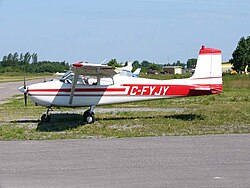
1975 Cessna 172M Skyhawk (1973-1976)
Good plane - Demo
Maintenance & Support
The O-300-D is the most-produced O-300 variant and the easiest to support. Parts availability is "good" compared to the O-300-A/C which are rarer. Field overhaul cost: $39,500–$50,500. Many owners considering an overhaul evaluate the Lycoming O-320 conversion STCs as an alternative.
Valuation Factors
| Condition | Price Range |
|---|---|
| Project / needs engine | $20,000-$45,000 |
| Flying but tired | $45,000-$42,000 |
| Well-maintained | $42,000-$58,000 |
| Restored / upgraded | $55,000-$75,000 |
Pricing tracks 172A closely. 172Bs with original "Skyhawk"-trim paint and interior in restored condition can command a small collector premium ($3,000-$5,000) over base-trim 172Bs in equivalent condition.
2006 Cessna 172S
G1000 Skyhawk · Mid-Time Engine · Clean Logs
ADs & Common Problems
Universal Cessna 172 pre-buy concerns apply. 172B-specific:
- Pull starter: The 172B retained the pull starter from the 172/172A. Verify the starter handle, cable, and engagement linkage are in good condition. Key starter conversion STCs exist.
- Reshaped cowling fit: The 172B's revised cowling is unique to this variant; aftermarket replacement cowlings may not fit perfectly. Original cowling availability is fair.
- CG envelope shift: The longer engine mounts moved CG slightly forward. Verify weight-and-balance documentation reflects current configuration, especially if engine has been changed.
- Original Skyhawk-trim paint: Original 1961 paint is unlikely to remain; check for paint quality, prep, and corrosion underneath any repaint.
For sale (1)
Also worth looking at
What buyers usually weigh against the Cessna 172B Skyhawk (1961) — aircraft flown for the same kind of mission.