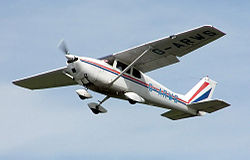
Cessna · 1960–1960
Cessna 172A (1960)
 i
iSpecifications
MOSAIC eligiblePerformance
Cruise
114KTAS
Range
480nm
Climb
645fpm
Ceiling
13,100ft
Fuel Burn
7.0gph
Fuel Cap.
37gal
MPG
18.7mpg
Stall (Vs0)
43KIAS
T/O roll
865ft
Ldg roll
520ft
Size & weight
Seats
4
Useful Load
940lbs
Full-fuel payload
718lbs
Max gross
2,200lbs
Wingspan
36.1ft
Length
27.2ft
Engine
Engine
Continental O-300-C or O-300-D
Power
145hp
TBO
1,800hrs
Overhaul
$45k
Owning it
Hull insurance
$1k/yr
Parts
good
Mechanics
universal
Gear
Fixed
IFR
Yes
Category
certified
Full specification
V-speeds
Airframe
- Empty weight
- 1,260 lbs
- Max fuel weight
- 222 lbs
- Height
- 8.9 ft
- Wing position
- high
Obstacle performance
- Takeoff over 50 ft
- 1,525 ft
- Landing over 50 ft
- 1,250 ft
Paperwork
- Type certificate
- 3A12
- Certification basis
- CAR 3
These figures are typical for the model, not a specification for any individual aircraft. Real-world numbers vary with year, installed equipment, weight, modifications and engine condition — often by more than you would expect. Use them to compare types, and confirm anything you would act on against the Pilot's Operating Handbook for that specific airframe and a prebuy inspection.
Pricing
Typical
$38k
Range
$22k – $60k
Annual all-in
~$22k/yr
All-in at ~100 flying hours a year, using the midpoint of each range — the same figures broken out under “Cost to own” below. Your number will differ, and mostly for two reasons. Experience sets your insurance: a 2,000-hour pilot with recent training pays 30–40% less than a 200-hour owner, and student owners pay 20–40% more — on the same aircraft that is often a doubling. Location sets your hangar: a T-hangar runs $200–400 a month in the Midwest against $400–1,500 in a coastal metro, and an outside tie-down is less again. Engine reserves move too — a local shop reusing your serviceable cylinders can come in 30–50% under the national specialty-shop pricing we quote, though you trade the warranty and turnaround that comes with it. Reserves are money set aside toward a future overhaul, not a bill this year, and the annual inspection figure is the shop’s labor to look — whatever they find is separate.
Cost to own — estimate
Set your yearly hours and local fuel price. Fixed costs (insurance, hangar, annual inspection) don't change with hours; fuel, maintenance and the engine reserve do.
- Fuel (7 gph)
- $4,550
- Engine reserve
- $2,500
- Maintenance, parts & wear items ($12/hr)
- $1,200
- Insurance
- $900–$1,800
- Hangar
- $5,892–$14,729
- Annual inspection (labor only)
- $1,200
- Databases & subscriptions
- $400
- Total per year
- $21,510
- Per flight hour
- $215
- Miles flown / year (at cruise)
- 13,119 mi
- Cost per mile
- $1.64/mi
- Time in the air
- 2 hr 38 min
- Fuel burned
- 18 gal
- Out of pocket
- $217
Fuel, engine reserve and wear only. Insurance, hangar and the annual are already paid whether you make the trip or not, so they are not charged here.
Estimate, not a quote. Where a line shows a range, the total, per-hour and per-mile figures use its midpoint— insurance moves most with your experience and time in type, hangar with where you base the aircraft, so your own number could sit at either end. Annual inspection is the shop's labor to open and inspect — what they find is the maintenance line, which covers oil changes, plugs, tires, brakes, hoses, lights, a battery and vacuum pump amortised over their life, and the unscheduled squawks that are the largest and least predictable part of it. Reserves are sinking funds toward an overhaul, not a bill you pay this year — and note that a propeller is due on hours or calendar time, typically six years, so flying less does not put it off forever.
See how every Cessna 172 / Skyhawkyear stacks up — engines, changes, and which to buy — in our year-by-year buyer's guide.
Strengths
- Historic swept-tail design at below-later-model pricing
- Factory float certification opens seaplane versatility
- Reliable O-300-C engine with decent parts availability
- Affordable entry point to certified four-place aircraft
Weaknesses
- 2,200 lb gross weight limits useful load; careful weight planning required
- Marginal climb performance (645 FPM) degrades further with floats
- Single model year (1960) means fewer airframes in market
- Float equipment adds $8k–$20k+ overhaul cost if needed
Overview
The 1960 Cessna 172A introduced the swept-back vertical tail and rudder that has defined the 172's silhouette ever since -- the single most visible design change in the 172's entire production history. It also became the first 172 certified for float operations, opening the model to seaplane use. About 1,015 172A examples were produced in the single 1960 model year before the 172B arrived in 1961. (The certificate offers the O-300-C and the O-300-D to the 172A and 172B alike, so the engine is not what separates them.)
The 172A is the cheapest swept-tail 172. For buyers who want the "modern" 172 look but cannot stretch to a 172D (Omni-Vision rear window) or later, the 172A delivers the swept-tail aesthetic at straight-tail pricing.
Variants & History
| Feature | 172 (1956-1959) | 172A (1960) | 172B (1961) |
|---|---|---|---|
| Vertical tail | Straight | Swept back (new) | Swept back |
| Engine | Continental O-300-A/B | Continental O-300-C or O-300-D | Continental O-300-C or O-300-D |
| Gross weight | 2,200 lbs | 2,200 lbs | 2,200 lbs |
| Float certification | No | Yes (new) | Yes |
| Cowling | Original | Revised cowling | Pointed spinner |
| "Skyhawk" name | No | No | Yes (deluxe option) |
Performance
Performance
114 KTAS cruise, 645 FPM sea-level climb, 7.0 GPH fuel burn. Identical to the original straight-tail in book numbers except for slight rate-of-climb degradation from the added swept-tail surface area (drag is marginally higher than the straight tail). Real-world cruise: 105-108 KTAS at economy settings (65% power, 6.0-6.5 GPH).
Gross weight is 2,200 lbs, and TCDS 3A12 Rev. 88 gives the 172B the same 2,200 lbs -- the increase to 2,250 lbs arrives with the 172C in 1962, not with the 172B. Plan four-place loading carefully.
Float Operations
The 172A is the first 172 with factory float certification. Common float installations include EDO 2000 and Wipline 2100 series straight floats, and amphibious variants for limited use. Performance penalty with floats:
- Cruise drops 12-15 KTAS (typical 95-100 KTAS)
- Climb degrades 100-150 FPM
- Useful load drops by float weight (~200 lbs for straight floats, ~280 lbs for amphibs)
- Service ceiling drops to ~10,500 ft
A 172A on floats remains one of the most affordable certified seaplanes available, though the Cessna 180 is generally preferred for serious seaplane work.
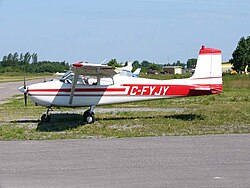
1975 Cessna 172M Skyhawk (1973-1976)
Good plane - Demo
Maintenance & Support
The O-300-C is a minor evolution of the O-300-A with improved magneto installation and accessory mounts. Functionally identical in performance: 145 HP, 1,800 hour TBO, six cylinders. Parts availability is slightly better than the O-300-A because the C and D variants were produced in larger numbers.
Valuation Factors
| Condition | Price Range |
|---|---|
| Project / needs engine | $18,000-$26,000 |
| Flying but tired | $24,000-$40,000 |
| Well-maintained | $40,000-$58,000 |
| Restored / float-equipped | $55,000-$80,000+ |
Float-equipped 172As trade at the high end of the range. A clean amphibious 172A can exceed $90,000 -- driven entirely by float value rather than airframe value.
2006 Cessna 172S
G1000 Skyhawk · Mid-Time Engine · Clean Logs
ADs & Common Problems
See universal Cessna 172 pre-buy concerns. Items specific to 172A:
- Float-history corrosion: Any 172A with float operation history needs aggressive belly skin and lower spar inspection for saltwater/freshwater corrosion.
- Swept-tail attach hardware: The 172A introduced the swept-tail design; verify rudder hinge and vertical fin attach bolt condition.
- Float airworthiness: If equipped with floats, the float assembly itself is often older than the airplane. Float overhaul ($8,000-$20,000+ depending on installation) is its own line item.
- 2,200 lb gross: Earlier owners may have flown over gross routinely. Inspect for fatigue damage particularly in horizontal stabilizer attach area.
For sale (1)
Also worth looking at
What buyers usually weigh against the Cessna 172A (1960) — aircraft flown for the same kind of mission.