Cessna · 1998+
Cessna 172S Skyhawk SP
 i
iSpecifications
MOSAIC eligiblePerformance
Cruise
124KTAS
Range
638nm
Climb
730fpm
Ceiling
14,000ft
Fuel Burn
8.6gph
Fuel Cap.
53gal
MPG
16.6mpg
Stall (Vs0)
40KIAS
T/O roll
960ft
Ldg roll
575ft
Size & weight
Seats
4
Useful Load
887lbs
Full-fuel payload
569lbs
Max gross
2,550lbs
Wingspan
36.1ft
Length
27.2ft
Engine
Engine
Lycoming IO-360-L2A
Power
180hp
TBO
2,000hrs
Overhaul
$45k
Owning it
Hull insurance
$2k/yr
Parts
excellent
Mechanics
universal
Gear
Fixed
IFR
Yes
Category
certified
Full specification
V-speeds
Airframe
- Empty weight
- 1,663 lbs
- Max fuel weight
- 318 lbs
- Height
- 8.9 ft
- Wing position
- high
Obstacle performance
- Takeoff over 50 ft
- 1,630 ft
- Landing over 50 ft
- 1,335 ft
Paperwork
- Type certificate
- 3A12
- Certification basis
- Part 23
These figures are typical for the model, not a specification for any individual aircraft. Real-world numbers vary with year, installed equipment, weight, modifications and engine condition — often by more than you would expect. Use them to compare types, and confirm anything you would act on against the Pilot's Operating Handbook for that specific airframe and a prebuy inspection.
Pricing
Typical
$300k
Range
$160k – $450k
Annual all-in
~$26k/yr
All-in at ~100 flying hours a year, using the midpoint of each range — the same figures broken out under “Cost to own” below. Your number will differ, and mostly for two reasons. Experience sets your insurance: a 2,000-hour pilot with recent training pays 30–40% less than a 200-hour owner, and student owners pay 20–40% more — on the same aircraft that is often a doubling. Location sets your hangar: a T-hangar runs $200–400 a month in the Midwest against $400–1,500 in a coastal metro, and an outside tie-down is less again. Engine reserves move too — a local shop reusing your serviceable cylinders can come in 30–50% under the national specialty-shop pricing we quote, though you trade the warranty and turnaround that comes with it. Reserves are money set aside toward a future overhaul, not a bill this year, and the annual inspection figure is the shop’s labor to look — whatever they find is separate.
Cost to own — estimate
Set your yearly hours and local fuel price. Fixed costs (insurance, hangar, annual inspection) don't change with hours; fuel, maintenance and the engine reserve do.
- Fuel (8.6 gph)
- $5,590
- Engine reserve
- $2,250
- Maintenance, parts & wear items ($12/hr)
- $1,200
- Insurance
- $2,700–$7,500
- Hangar
- $5,892–$14,729
- Annual inspection (labor only)
- $1,200
- Databases & subscriptions
- $400
- Total per year
- $26,050
- Per flight hour
- $261
- Miles flown / year (at cruise)
- 14,270 mi
- Cost per mile
- $1.83/mi
- Time in the air
- 2 hr 25 min
- Fuel burned
- 21 gal
- Out of pocket
- $219
Fuel, engine reserve and wear only. Insurance, hangar and the annual are already paid whether you make the trip or not, so they are not charged here.
Estimate, not a quote. Where a line shows a range, the total, per-hour and per-mile figures use its midpoint— insurance moves most with your experience and time in type, hangar with where you base the aircraft, so your own number could sit at either end. Annual inspection is the shop's labor to open and inspect — what they find is the maintenance line, which covers oil changes, plugs, tires, brakes, hoses, lights, a battery and vacuum pump amortised over their life, and the unscheduled squawks that are the largest and least predictable part of it. Reserves are sinking funds toward an overhaul, not a bill you pay this year — and note that a propeller is due on hours or calendar time, typically six years, so flying less does not put it off forever.
See how every Cessna 172 / Skyhawkyear stacks up — engines, changes, and which to buy — in our year-by-year buyer's guide.
Strengths
- Excellent parts availability and mechanic familiarity worldwide
- G1000 glass cockpit makes capable single-pilot IFR platform
- Predictable, honest performance with 124 KTAS cruise and 550+ nm range
- Benign handling and docile stall characteristics ideal for training and touring
Weaknesses
- Hot-start difficulties on fuel-injected engine common in real-world operation
- Alternator runs near capacity with full G1000 avionics; failures more common than analog variants
- Marginal performance at high density altitude with full fuel and four occupants
- Not suitable for backcountry or unprepared strips; vulnerable nosewheel and minimal ground clearance
Overview
The modern Cessna 172 represents the latest chapter of the most-produced aircraft in aviation history, with over 44,000 total 172s built across all variants since 1956. Cessna restarted 172 production in 1997 after a decade-long hiatus caused by product liability concerns, introducing the 172R as its return-to-market model and following quickly with the 172S Skyhawk SP in 1998. Both models share the same airframe lineage but introduced fuel injection, a significantly modernized interior, and eventually the Garmin G1000 glass cockpit that transformed the type from a basic trainer into a genuinely capable IFR platform.
The 172S is the dominant variant still in production today and the one most commonly encountered on flight school ramps and in private hands. Annual Skyhawk production has fluctuated substantially, from a peak of roughly 490 units in 2000 down to just 85 during the 2009-2010 recession trough, with recent years averaging 100-150 deliveries. Textron Aviation (Cessna's parent since 2014) continues to build the 172S as the only Skyhawk variant in production.
The modern 172 occupies a unique market position: it is simultaneously the gold standard trainer for Part 141 flight schools, a popular first airplane for newly certificated pilots, and a reliable IFR touring machine for modest-budget owners. Its only real weakness is that it does none of these things spectacularly; it does all of them adequately, which is precisely why it remains the default recommendation for buyers who want the safest, most-supported, most-liquid aircraft purchase in general aviation.
See also: cessna-172-early, cessna-172-mid, cessna-172rg
Variants & History
| Variant | Years | Engine | HP | RPM | Max Gross (lbs) | Useful Load (lbs) | Key Differences |
|---|---|---|---|---|---|---|---|
| 172R Skyhawk | 1997-2005 | IO-360-L2A (derated) | 160 | 2,400 | 2,450 | 857 | First fuel-injected 172; restarted production; derated engine for noise/durability; 56-gal fuel; analog six-pack standard |
| 172R (G1000) | 2005-2012 | IO-360-L2A (derated) | 160 | 2,400 | 2,450 | 857 | Added Garmin G1000 glass cockpit option; "Nav III" designation; KAP 140 autopilot available |
| 172S Skyhawk SP | 1998-2004 | IO-360-L2A | 180 | 2,700 | 2,550 | 887 | Full-rated engine; 20 HP more than R; 100-lb higher gross weight; analog panels; leather interior standard |
| 172S (G1000) | 2005-2010 | IO-360-L2A | 180 | 2,700 | 2,550 | 887 | Garmin G1000 glass cockpit; "Nav III" designation; KAP 140 autopilot option |
| 172S (G1000 + GFC 700) | 2007-2017 | IO-360-L2A | 180 | 2,700 | 2,550 | 887 | GFC 700 three-axis digital autopilot replaced KAP 140; coupled approaches; altitude preselect |
| 172S (G1000 NXi) | 2017-present | IO-360-L2A | 180 | 2,700 | 2,558 (ramp) | ~890 | G1000 NXi with faster processors, LED displays, wireless Flight Stream 510, visual approach guidance; GFC 700 standard |
172R vs 172S: The Core Difference
Both models use the same Lycoming IO-360-L2A engine block. The difference is the rated RPM and corresponding power output. The 172R derates the engine to 2,400 RPM for 160 HP, trading performance for reduced noise and extended component life. The 172S runs at the full 2,700 RPM for 180 HP. This 20-HP gap produces meaningful differences:
- Climb: 172S climbs at ~730 fpm vs ~720 fpm for the 172R, but the 172S does it at a 100-lb-higher gross weight, making it noticeably better when loaded
- Cruise: 172S cruises at 124 KTAS vs 122 KTAS for the 172R at 75% power
- Useful load: 172S carries 887 lbs vs 857 lbs for the 172R (the extra gross weight matters for full-fuel-plus-passengers scenarios)
- Takeoff: 172S ground roll is ~960 ft vs ~890 ft for the 172R at max gross, but the 172R is lighter at its max gross
The 172S is the better airplane in almost every practical scenario and commands a $20,000-$50,000 premium over equivalent-year 172R models on the used market.
Pre-G1000 vs G1000: The Avionics Divide
The 2005 model year is the critical dividing line. Pre-2005 aircraft have conventional analog six-pack instruments with Bendix/King or Garmin 430/530 GPS navigators. Post-2005 "Nav III" aircraft have the Garmin G1000 integrated flight deck with dual 10.4-inch screens, built-in GPS/NAV/COM, engine monitoring, and traffic/weather datalink capability.
The G1000 introduction had an outsized impact on values. A 2004 172S with steam gauges and a Garmin 430W might trade for $180,000-$220,000, while a 2005 172S with G1000 commands $250,000-$320,000. The avionics gap is worth more than the one year of airframe age.
Performance
The 172S delivers predictable, honest performance that is well-documented and closely matches POH numbers when the engine is properly leaned and the aircraft is well-maintained.
Real-world cruise: Book numbers claim 124 KTAS at 75% power and 8,500 ft. Most owners report 115-120 KTAS in real-world conditions with typical leaning. At 65% power (the sweet spot for range and engine longevity), expect 110-115 KTAS burning 7.5-8.0 GPH.
Density altitude sensitivity: The 180-HP IO-360 handles density altitude better than the older 160-HP O-320 variants but is still a normally aspirated four-cylinder. At a 5,000-ft DA departure, expect climb rates to drop to 400-500 fpm at gross weight. At 7,500-ft DA, the airplane is marginal for four-occupant operations and demands careful weight management.
Fuel injection considerations: The IO-360-L2A's fuel injection eliminates carb ice concerns but introduces hot-start challenges. Vapor lock on hot days is the most common operational complaint. The standard technique involves a flooded-start procedure (full rich, full throttle, no boost pump, crank). Pilots transitioning from carbureted 172s should practice this.
Climb performance at weight: At maximum gross weight (2,550 lbs), the initial rate of climb is 730 fpm. Reduce this by roughly 150 fpm per 2,000 ft of density altitude. At typical training weights (2,200 lbs), initial climb improves to approximately 900 fpm.
Endurance: With 53 gallons usable and a cruise burn of 8.6 GPH at 75% power, the 172S offers roughly 5.5 hours of endurance with a 45-minute VFR reserve (about 4.5 hours with IFR reserves). This translates to 550-640 nm of practical range depending on power setting and winds.
Payload & Range
The 172S useful load of 887 lbs sounds generous until you account for fuel and realistic passenger weights.
Scenario 1: Full Fuel + 2 Occupants
| Item | Weight (lbs) |
|---|---|
| Full fuel (56 gal) | 336 |
| Pilot (200 lbs) | 200 |
| Front passenger (180 lbs) | 180 |
| Baggage | 171 |
| Total payload | 887 |
This is the 172S at its best: two adults with generous baggage allowance and full fuel for 550+ nm range. A genuine 4-hour cross-country with reserves.
Scenario 2: Four Occupants + Reduced Fuel
| Item | Weight (lbs) |
|---|---|
| Fuel (36 gal / 64% tanks) | 216 |
| Pilot (200 lbs) | 200 |
| Front passenger (180 lbs) | 180 |
| Rear passenger 1 (170 lbs) | 170 |
| Rear passenger 2 (140 lbs) | 140 |
| Total payload | 906 -- OVER GROSS by 19 lbs |
Four average-sized adults with full fuel is not possible in the 172S. Even reducing to 36 gallons (about 3.5 hours endurance at cruise) barely works and leaves zero baggage allowance. With four 200-lb adults, you would need to reduce fuel to roughly 24 gallons (under 2.5 hours endurance). This is the fundamental limitation of the 172 as a "four-seat" airplane: it is realistically a two-adult-plus-kids or three-adult airplane for any meaningful range.
Scenario 3: Solo IFR Training/Practice
| Item | Weight (lbs) |
|---|---|
| Full fuel (56 gal) | 336 |
| Pilot (200 lbs) | 200 |
| Flight bag/equipment | 30 |
| Remaining capacity | 321 lbs unused |
The 172S excels as a solo or two-person IFR machine. Light weight means excellent climb performance (900+ fpm), full fuel gives maximum endurance for approach practice, and you are well within CG limits for any configuration.
CG Considerations
The 172S has a relatively forgiving CG envelope, but four-occupant loadings with minimal fuel push the CG aft. Always run a weight-and-balance calculation with four occupants, paying special attention to heavy rear-seat passengers combined with baggage. The aft CG limit is more commonly encountered than the forward limit in the modern 172.
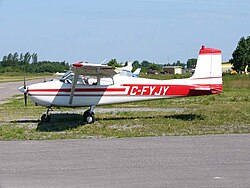
1975 Cessna 172M Skyhawk (1973-1976)
Good plane - Demo
Mission Suitability
| Mission | Score | Rationale |
|---|---|---|
| Flight Training | 9/10 | The definitive training airplane. Fuel injection teaches proper mixture management. G1000 versions prepare students for modern cockpits. Benign handling, docile stall characteristics, widespread availability at flight schools. Only loses a point because the fuel-injected engine can frustrate students with hot-start issues and the higher acquisition cost relative to older carbureted models. |
| Backcountry/Bush | 3/10 | Not a backcountry airplane. Nosewheel is vulnerable on rough strips, ground clearance is minimal, and takeoff performance at high DA with camping gear aboard is marginal. Owners occasionally add vortex generators and STOL kits, but the fundamental design is wrong for this mission. See maule-m7 or cubcrafters-xcub instead. |
| Business Travel | 5/10 | Adequate for 200-400 nm trips with 1-2 passengers and light bags. The G1000 + GFC 700 makes single-pilot IFR comfortable. But the 120-knot cruise speed and modest cabin make it uncompetitive against faster alternatives like the mooney-m20j or cirrus-sr22 for regular business use. |
| Aerobatics | 1/10 | Normal category only. Not approved for aerobatic flight. |
| Cross-Country | 7/10 | A solid cross-country machine within its speed class. 550+ nm range, comfortable for two occupants, excellent IFR capability with G1000. The high wing provides shade and turbulence stability. Penalized for cruise speed; trips over 400 nm become tedious compared to faster types. |
| Cargo Hauling | 3/10 | Useful load of ~887 lbs sounds decent until you subtract fuel. Full fuel (336 lbs) leaves 551 lbs for people and cargo. The cargo area behind the rear seats is small (120 lbs max in the baggage area). Not a hauler. |
| Local Fun Flying | 7/10 | Pleasant for sightseeing, $100 hamburger runs, and Sunday flying. The high wing gives great ground visibility. Comfortable for 1-2 hour flights. Not exciting, but reliably enjoyable. |
| Surveying | 7/10 | High wing provides unobstructed downward visibility. Stable platform. Adequate endurance for survey work. The G1000 can integrate with external equipment. Used by Civil Air Patrol extensively. |
Avionics Ecosystem
The modern 172 spans three distinct avionics eras, and the panel configuration is the single largest driver of both capability and market value.
Tier 1: Pre-G1000 Analog (1997-2004) -- $160K-$220K aircraft value
Standard equipment typically includes:
- Dual Bendix/King KX-155 or KX-165 NAV/COM radios
- Bendix/King KI-208/209 VOR/LOC/GS indicators
- Garmin GMA 340 audio panel
- Optional Garmin GNS 430 or 430W GPS/NAV/COM
- KAP 140 two-axis autopilot (option)
- ADS-B Out compliance via uAvionix or Garmin GTX 345 transponder (retrofit)
Many pre-G1000 aircraft have been upgraded with aftermarket avionics. Common retrofits include Garmin GTN 650/750 replacing the GNS 430/530, Garmin G5 or GI 275 electronic flight instruments replacing vacuum gyros, and Garmin GFC 500 digital autopilot replacing the KAP 140.
Tier 2: G1000 Original (2005-2016) -- $250K-$350K aircraft value
The Garmin G1000 integrated flight deck includes:
- Dual 10.4-inch displays (PFD and MFD)
- Dual integrated GPS/NAV/COM receivers with WAAS
- GEA 71 engine/airframe computer with full engine monitoring
- GRS 77 AHRS and GMU 44 magnetometer
- GDL 69A XM Weather datalink
- GTX 33 Mode S transponder (later upgraded to ADS-B Out compliant)
- KAP 140 autopilot (early) or GFC 700 three-axis autopilot (2007+)
- Terrain awareness (TAWS-B), traffic (TIS), and Stormscope integration
Tier 3: G1000 NXi (2017-present) -- $350K-$450K+ aircraft value
The NXi upgrade brought:
- Faster processors with near-instant boot times
- LED-backlit displays (better sunlight readability, longer life)
- Flight Stream 510 wireless gateway for Garmin Pilot app integration
- Database Concierge for wireless database updates
- Visual approach guidance (synthetic glidepath on non-precision approaches)
- Surface Watch runway awareness
- Baro-corrected VNAV
- GFC 700 three-axis autopilot with coupled visual approaches as standard
- ADS-B In/Out (built-in via GTX 345 transponder)
G1000 to NXi Retrofit
Owners of 2008-2017 G1000-equipped 172R and 172S aircraft can retrofit the NXi upgrade. The upgrade replaces the display processors and transponder while retaining the existing sensors and wiring. Cost is approximately $45,000-$40,000 installed. This is one of the highest-value avionics upgrades available for any piston single, as it brings a 10-year-old panel to current-production capability.
STCs & Modifications
The modern 172R/S has a more limited STC ecosystem compared to older 172 variants because fewer owners feel the need to modify a relatively modern airframe. Key available modifications include:
| Modification | Provider | Effect | Approx. Cost |
|---|---|---|---|
| Vortex generators | Micro AeroDynamics | Reduces stall speed ~5 kts, improves low-speed handling | $2,500-$3,500 installed |
| Flap gap seals | Knots 2U | +2-4 knots cruise, improved roll response | $800-$1,200 installed |
| PowerFlow exhaust | PowerFlow Systems | +3-5 knots cruise, better climb, reduced CHTs | $4,000-$5,500 installed |
| Wheel pants | Various | +3-5 knots cruise (if not already equipped) | $1,500-$2,500 |
| G1000 NXi upgrade | Garmin (dealer installed) | Modern displays, wireless, visual approaches | $45,000-$40,000 |
| GFC 500 autopilot | Garmin | Digital autopilot for pre-G1000 aircraft | $8,000-$12,000 installed |
| LED lighting | Whelen, AeroLEDs | Brighter, lower draw, longer life landing/nav lights | $2,000-$4,000 |
| Rosen sun visors | Rosen Aviation | Vastly improved sun protection vs stock visors | $600-$900 |
Note that the popular engine upgrade STCs (Air Plains 180-HP conversion, Penn Yan Aero conversions) apply to older 150/160-HP carbureted 172 models, not the modern 172R/S which already have the IO-360 engine.
2006 Cessna 172S
G1000 Skyhawk · Mid-Time Engine · Clean Logs
Maintenance & Support
Parts availability: Excellent. Textron Aviation continues to manufacture and support the 172S. Parts are readily available through Cessna's network, Wentworth Aircraft (salvage), and numerous aftermarket suppliers. The IO-360-L2A engine has an enormous installed base across multiple aircraft types, making engine parts universally available.
Mechanic familiarity: Universal. Every A&P mechanic in North America has worked on Cessna 172s. The modern 172R/S differs from older models primarily in the fuel injection system and G1000 avionics; the airframe is fundamentally the same design that mechanics have maintained for decades.
Annual inspection costs: $1,500-$3,000 for a straightforward annual with no discrepancies. G1000 aircraft may add $200-$500 for avionics checks. Budget $3,000-$5,000 for annuals that include addressing typical discrepancies.
Expensive maintenance items to anticipate:
- Engine overhaul: $40,000–$50,000 for a field overhaul; $38,000-$45,000 for a Lycoming factory reman. The IO-360-L2A is more expensive to overhaul than the O-320 in older 172s due to fuel injection components, counterweights, and higher parts costs.
- Propeller overhaul: $2,500-$3,500 every 2,000 hours or 6 years (whichever comes first) for the McCauley fixed-pitch prop.
- G1000 display repair: $3,000-$8,000 per display unit if a GDU fails out of warranty. Original CCFL-backlit displays are more failure-prone than NXi LED displays.
- Magneto replacement: $800-$1,200 per magneto at 500-hour inspection intervals; consider upgrading to SureFly or E-MAG electronic ignition.
- Brake discs and linings: $300-$600 per side; more frequent replacement on flight school aircraft.
- Fuel servo overhaul: $1,500-$2,500; typically required every 1,000-1,500 hours or when hot-start issues become persistent.
Garmin database subscriptions: G1000 aircraft require active navigation database subscriptions. Garmin OnePak or Pilot Pak bundles run $700-$1,200 per year for combined US IFR/VFR databases, terrain, obstacles, and SafeTaxi.
Valuation Factors
The modern 172 market is stratified primarily by avionics configuration, with engine time and total airframe hours as secondary factors.
Price Tiers (2026 Market)
| Configuration | Year Range | Typical Price | Notes |
|---|---|---|---|
| 172R, analog panel | 1997-2004 | $130,000-$180,000 | Lowest tier; value depends heavily on avionics upgrades |
| 172R, G1000 | 2005-2012 | $180,000-$250,000 | Limited production; less common than 172S |
| 172S, analog panel | 1998-2004 | $160,000-$220,000 | The 180-HP advantage commands a premium over equivalent 172R |
| 172S, G1000 (no GFC 700) | 2005-2006 | $240,000-$300,000 | KAP 140 autopilot; G1000 displays may show age |
| 172S, G1000 + GFC 700 | 2007-2016 | $280,000-$360,000 | Sweet spot for value; capable IFR platform |
| 172S, G1000 NXi | 2017-present | $350,000-$450,000+ | Current production equivalent; lowest depreciation |
Key Value Drivers
- G1000 vs analog: The single biggest value discriminator. A G1000 aircraft is worth $60,000-$100,000 more than an equivalent analog aircraft.
- GFC 700 autopilot: Adds $20,000-$45,000 over a KAP 140 equipped aircraft. The GFC 700 is a dramatically better autopilot with coupled approaches, altitude preselect, and flight director integration.
- NXi upgrade (retrofit): Adds $20,000-$45,000 to an original G1000 aircraft's value, roughly matching the upgrade cost. One of the few avionics upgrades that pays for itself at resale.
- Engine time: Standard linear depreciation applies. A mid-time engine (1,000 hrs since overhaul) reduces value by roughly $15,000 vs fresh overhaul. A run-out engine reduces value by $32,000–$58,000.
- Total time: Less impactful than engine time but still relevant. Aircraft under 3,000 TT command a premium; above 8,000 TT (common for ex-flight-school aircraft) expect a discount.
- ADS-B compliance: All aircraft should be ADS-B Out compliant by now (2020 mandate). Aircraft that also have ADS-B In (traffic and weather on the displays) add modest value.
Modern 172S vs Upgrading an Older 172
A common buyer question: is it better to buy a $70,000 1970s 172 and spend $50,000 on avionics upgrades, or buy a $250,000 G1000 172S?
The upgraded older 172 gives you modern avionics in a proven airframe for roughly half the cost. But you retain the limitations of the older airframe: higher empty weight relative to gross, 160 HP (or less), older wiring, older landing gear, and lower resale liquidity. The modern 172S offers a cohesive, factory-integrated package with better performance, fuel injection, and dramatically better resale value. For buyers who can afford it, the modern 172S is almost always the better long-term investment. For budget-constrained buyers, upgrading an older 172 with a Garmin GTN 750Xi, G5 PFD, and GFC 500 autopilot is a compelling alternative. See Avionics Pricing Reference for detailed cost breakdowns.
ADs & Common Problems
The modern 172R/S has a relatively clean AD history compared to the decades of ADs accumulated by older 172 variants. Key ADs and known issues include:
Active/Recurring Airworthiness Directives
- Fuel servo/flow settings (AD 2001-07-14): Requires inspection and adjustment of engine fuel flow settings. Improper factory settings caused rough running, inability to idle, and potential in-flight restart failures. Applies to early 172R and 172S models.
- Fuel return line chafing (AD 2000-04-02): Requires installation of support clamps and brackets on the fuel return line to prevent chafing against the rudder steering tube. Unaddressed chafing can cause fuel leaks in the engine compartment.
- Oil pressure switch diaphragm (AD 2001-08-18): Requires replacement of the oil pressure switch to prevent diaphragm failure that could cause engine oil loss through the switch vent hole.
- Flight control rigging (AD 2004-05-15): Requires inspection of flight control system rigging on certain serial numbers. Incorrect factory rigging could cause control issues.
- KAP 140 autopilot (AD 2005-05-09): Applies to aircraft equipped with Honeywell KAP 140 autopilot. Requires software update or replacement to address potential uncommanded roll inputs.
Common Pre-Buy Red Flags
- Hot start difficulties: Not an AD item, but the most common owner complaint. Persistent hot-start problems often indicate a need for fuel servo adjustment or injector cleaning. A well-maintained IO-360-L2A should hot-start reliably with proper technique.
- Alternator failures: The 172S alternator runs near capacity with all G1000 avionics powered. Failures are more common than in analog-panel aircraft. Check alternator output and belt condition during pre-buy.
- Vacuum pump (pre-G1000 only): Dry vacuum pumps have a typical life of 500-800 hours. Pre-G1000 aircraft still rely on vacuum for attitude and heading indicators. Budget for a backup vacuum or transition to electronic gyros.
- Nose gear shimmy: Chronic on high-time airframes. Usually caused by worn shimmy dampener or nose gear bushings. Inexpensive to fix but indicates overall landing gear wear.
- Paint and corrosion: Post-2005 aircraft use better primers and paint systems than older 172s, but inspect for filiform corrosion under wing skins and around fuel tank sealant, especially on coastal or high-humidity aircraft.
Flight School Wear Patterns
Many modern 172S aircraft spent their early lives in flight school service accumulating 800-1,200 hours per year. These aircraft may have low calendar age but very high airframe hours. Pre-buy considerations for ex-flight-school aircraft:
- Multiple engine overhauls already completed
- Landing gear and brake wear accelerated by student operations
- Interior wear disproportionate to airframe age
- G1000 display hours (displays have a finite backlight life; NXi LED displays last much longer than original CCFL)
Insurance Profile
The modern 172S is one of the most favorably rated aircraft in GA insurance. Fixed gear, well-documented accident history, and massive fleet size make it a low-risk category for underwriters.
Typical annual premiums (2026 estimates):
| Pilot Profile | Hull Value | Annual Premium |
|---|---|---|
| Student/low-time (< 200 hrs) | $250,000 | $3,500-$6,000 |
| Private pilot (200-500 hrs) | $250,000 | $1,800-$3,000 |
| Instrument rated (500+ hrs) | $300,000 | $1,200-$2,000 |
| Experienced (1,000+ hrs) | $300,000 | $1,000-$1,500 |
Underwriting notes:
- No high-performance endorsement required (below 200 HP threshold)
- No complex endorsement required (fixed gear, fixed prop)
- Flight school/rental use dramatically increases premiums (2-4x personal-use rates)
- G1000 aircraft may receive modest premium discounts from some underwriters due to improved situational awareness
- IFR training use may require specific instrument instructor endorsements on the policy
- Hull values have increased significantly since 2020, and some owners are underinsured; review hull coverage annually
See GA Insurance Underwriting for general GA insurance guidance.
For sale (4)
For sale elsewhere (1)
Current ads on Barnstormers, checked daily. Photos, full details and the seller are on the listing site.
2002 Cessna 172S Skyhawk SP
Listed on BarnstormersADS-B Out · Garmin GDL 88/82 · Bendix/King KAP 140
View photos and full ad on Barnstormers ↗Also worth looking at
What buyers usually weigh against the Cessna 172S Skyhawk SP — aircraft flown for the same kind of mission.


