Cessna · 1977–1980
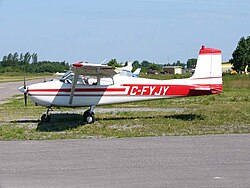
Cessna 172N Skyhawk
 i
iSpecifications
MOSAIC eligiblePerformance
Cruise
122KTAS
75% power @ 8,000 ft
Range
485nm
75% power @ 8,000 ft
Climb
770fpm
Ceiling
14,200ft
Fuel Burn
8.4gph
75% power @ 8,000 ft
Fuel Cap.
40gal
MPG
16.7mpg
Stall (Vs0)
41KIAS
T/O roll
805ft
Ldg roll
520ft
Economy cruise · 64% power @ 8,000 ft
114 KTAS·7.2 gph·527 nm
8 kt slower than the 75% figure above, and 42 nm further on the same fuel.
Size & weight
Seats
4
Useful Load
897lbs
Full-fuel payload
639lbs
Max gross
2,300lbs
Wingspan
36.1ft
Length
27.2ft
Engine
Engine
Lycoming O-320-H2AD
Power
160hp
TBO
2,000hrs
Overhaul
$42k
Owning it
Hull insurance
$1k/yr
Parts
excellent
Mechanics
universal
Gear
Fixed
IFR
Yes
Category
certified
Full specification
V-speeds
Airframe
- Empty weight
- 1,403 lbs
- Max fuel weight
- 258 lbs
- Height
- 8.9 ft
- Wing position
- high
- Auto fuel (mogas)
- Not approved for auto fuel
Obstacle performance
- Takeoff over 50 ft
- 1,440 ft
- Landing over 50 ft
- 1,250 ft
Paperwork
- Type certificate
- 3A12
- Certification basis
- Part 23
These figures are typical for the model, not a specification for any individual aircraft. Real-world numbers vary with year, installed equipment, weight, modifications and engine condition — often by more than you would expect. Use them to compare types, and confirm anything you would act on against the Pilot's Operating Handbook for that specific airframe and a prebuy inspection.
Pricing
Typical
$62k
Range
$50k – $80k
Annual all-in
~$22k/yr
All-in at ~100 flying hours a year, using the midpoint of each range — the same figures broken out under “Cost to own” below. Your number will differ, and mostly for two reasons. Experience sets your insurance: a 2,000-hour pilot with recent training pays 30–40% less than a 200-hour owner, and student owners pay 20–40% more — on the same aircraft that is often a doubling. Location sets your hangar: a T-hangar runs $200–400 a month in the Midwest against $400–1,500 in a coastal metro, and an outside tie-down is less again. Engine reserves move too — a local shop reusing your serviceable cylinders can come in 30–50% under the national specialty-shop pricing we quote, though you trade the warranty and turnaround that comes with it. Reserves are money set aside toward a future overhaul, not a bill this year, and the annual inspection figure is the shop’s labor to look — whatever they find is separate.
Cost to own — estimate
Set your yearly hours and local fuel price. Fixed costs (insurance, hangar, annual inspection) don't change with hours; fuel, maintenance and the engine reserve do.
- Fuel (8.4 gph)
- $5,460
- Engine reserve
- $2,100
- Maintenance, parts & wear items ($12/hr)
- $1,200
- Insurance
- $900–$1,800
- Hangar
- $5,892–$14,729
- Annual inspection (labor only)
- $1,200
- Databases & subscriptions
- $400
- Total per year
- $22,020
- Per flight hour
- $220
- Miles flown / year (at cruise)
- 14,040 mi
- Cost per mile
- $1.57/mi
- Time in the air
- 2 hr 28 min
- Fuel burned
- 21 gal
- Out of pocket
- $215
Pulled back to 64% power the same trip takes 2 hr 38 min and costs $210 — 10 minutes slower, $5 cheaper.
Fuel, engine reserve and wear only. Insurance, hangar and the annual are already paid whether you make the trip or not, so they are not charged here.
Estimate, not a quote. Where a line shows a range, the total, per-hour and per-mile figures use its midpoint— insurance moves most with your experience and time in type, hangar with where you base the aircraft, so your own number could sit at either end. Annual inspection is the shop's labor to open and inspect — what they find is the maintenance line, which covers oil changes, plugs, tires, brakes, hoses, lights, a battery and vacuum pump amortised over their life, and the unscheduled squawks that are the largest and least predictable part of it. Reserves are sinking funds toward an overhaul, not a bill you pay this year — and note that a propeller is due on hours or calendar time, typically six years, so flying less does not put it off forever.
See how every Cessna 172 / Skyhawkyear stacks up — engines, changes, and which to buy — in our year-by-year buyer's guide.
Strengths
- 28V electrical system enables modern glass panel retrofits
- 160 HP O-320-H2AD delivers reliable cruise performance (122 KTAS)
- D2J conversion path (STC SA2714CE) turns 172N into 172P equivalent at significant discount
- Four-seat capability with stable, forgiving handling makes it suitable for training and personal flying
Weaknesses
- Original H2AD engine prone to cam/lifter spalling, stuck exhaust valves, and premature wear—requires meticulous maintenance
- Single Slick dual magneto eliminates ignition redundancy compared to dual independent mags on 172M
- O-320-H2AD overhaul costs $5K–$10K higher than D2J or E2D alternatives
- 122 KTAS cruise speed limits cross-country utility; 440 nm range is modest without long-range tanks
Overview
The 172N is a calculated value play. Two paths to consider:
Path A (lowest cost): Buy an original H2AD with mid-time engine, clean cam/lifter inspection, documented TCP use, and ride it carefully to TBO. Plan on a Lycoming factory reman or Airplains conversion at next overhaul. Total ownership cost is competitive with a 172M of similar avionics. Budget $50K-$65K acquisition.
Path B (best value): Buy an Airplains D2J-converted 172N. You get a 172P-equivalent airframe at a 172N price, with documented SB compliance, dual independent magnetos, and 100 lbs additional gross weight. Budget $70K-$90K acquisition.
What you should not do is buy an unconverted, run-out H2AD 172N without budget for either an overhaul or a conversion. The math does not work -- and the H2AD's metallurgy issues are not entirely solved even with all SB compliance.
See also: cessna-172-mid, Cessna 172P Skyhawk, Cessna 172S Skyhawk SP, Cessna R172K Hawk XP
Variants & History
| Item | 172M (1973-1976) | 172N (1977-1980) |
|---|---|---|
| Engine | Lycoming O-320-E2D (150 HP, 7.0:1) | Lycoming O-320-H2AD (160 HP, 8.5:1) |
| Ignition | Dual independent Slick/Bendix magnetos | Single Slick dual magneto (one accessory drive, two ignition outputs) |
| Electrical | 14V system | 28V system (major change -- affects avionics retrofit options) |
| Useful load | ~960 lbs | ~860 lbs (heavier engine accessories) |
| Fuel | 100/130 octane | 100LL (auto-fuel STC eligible after conversion) |
The 28V electrical system is the often-overlooked variant difference. Some older 14V avionics will not work in a 172N without converters, and some modern panel installs require ordering the 28V variants of LRUs.
Mission Suitability
The 172N is identical in role to other mid-era 172s once you account for the H2AD risk:
- Flight training: 8/10 -- still an excellent platform, but the H2AD makes commercial school operators wary. Many flight schools have shifted to D2J-converted 172Ns or skipped to 172P/172R.
- First airplane: 9/10 if you find a D2J-converted example; 7/10 for an original H2AD with clean inspection history
- IFR platform: 8/10 -- 28V electrical actually advantages modern glass panel retrofits
- Cross-country: 6/10 -- 122 KTAS cruise, 440 nm standard fuel range (570+ nm with long-range tanks)
- Backcountry: 2/10 -- nosewheel, low ground clearance, marginal climb at high DA
1975 Cessna 172M Skyhawk (1973-1976)
Good plane - Demo
Avionics Ecosystem
The 172N's 28V electrical system has practical implications for panel retrofits:
- Older 14V LRUs (some legacy Bendix/King radios, some KAP 100/140 autopilot variants) require 28V→14V step-down converters or 28V LRU variants
- Modern Garmin avionics (GTN 650/750, G5, GFC 500, GTX 345) are typically available in 28V variants out of the box
- The 60-amp alternator is adequate for typical modern panels but runs near capacity with a fully-loaded glass panel + LED lighting + transponder + autopilot. Watch alternator condition at pre-buy.
A typical "modern panel" 172N upgrade (GTN 650Xi + dual G5 + GFC 500 autopilot + GTX 345) runs $30K-$45K installed in 2026 -- and the panel may be worth more than the airframe itself on the resale market.
Valuation Factors
| Factor | Typical Swing |
|---|---|
| H2AD engine status (original vs Airplains D2J conversion) | $10K-$25K |
| Engine time since major overhaul (SMOH) | $20K-$30K |
| Avionics (steam vs Garmin GTN/G5 panel) | $20K-$40K |
| ADS-B Out compliance | Mandatory; non-compliant aircraft are unsellable |
| 76A serial / SB compliance documentation | $3K-$5K |
| Corrosion history (coastal/humid storage) | $5K-$15K |
| Air conditioning (rare option) | +$3K-$5K |
| Long-range fuel tanks (52 gal vs standard 43 gal) | +$3K-$6K |
| Logbook completeness | Missing logs = $10K-$20K discount or walk-away |
Typical 2026 market range
- Run-out engine, original H2AD, basic panel: $40K-$55K
- Mid-time H2AD, well-maintained, basic IFR: $55K-$70K
- D2J converted, mid-to-low time, modern panel: $70K-$95K
- Pristine 172N with 180 HP conversion + glass panel: $95K-$120K
2006 Cessna 172S
G1000 Skyhawk · Mid-Time Engine · Clean Logs
ADs & Common Problems
The O-320-H2AD Engine Problem (CRITICAL)
[!warning] If you remember only one thing about the 172N, remember this: the original O-320-H2AD engine has a long history of cam, lifter, valve, and magneto problems. Any 172N purchase must hinge on knowing exactly which engine is installed today.
What Lycoming changed
The H2AD was a "76 series" Lycoming with three meaningful departures from the proven O-320-E2D:
- Higher compression (8.5:1 vs 7.0:1) -- required for the 160 HP rating
- Single Slick dual magneto instead of two independent magnetos -- a meaningful loss of redundancy
- Wide-deck cylinders and revised valve train geometry
What went wrong
Within months of introduction, owners and shops began reporting:
- Cam and lifter spalling -- the H2AD's hydraulic lifters and camshaft lobes shed metal flakes (some engines as early as 250 hours TBO), contaminating the oil system, requiring teardown
- Stuck exhaust valves -- related to lubrication and metallurgy
- Premature cylinder wear on the wide-deck cylinders
- Single magneto vulnerability -- a failed Slick dual mag = total ignition loss in flight, unlike the redundant two-mag setup on the E2D
What Lycoming did about it
Through the early 1980s, Lycoming issued progressive service bulletins under the "Operation Blue Streak" program:
- Larger-diameter tappets with wider cam lobes
- The "T" modification (1980+) with further enlarged tappets and improved top-end lubrication
- Engines that have received the final fix carry serial numbers ending in 76A (vs the original L-XXXX-76 designation)
AD 80-04-03 required replacement of upper exhaust valve spring seats and exhaust hydraulic lifters on affected serial numbers within 50 hours.
The FAA also mandated use of TCP (tricresyl phosphate) oil additive in all 76-series engines. Owners who religiously used TCP-additized oil report dramatically fewer valve sticking events.
What this means for a buyer in 2026
| Engine Status on the Airplane | Value Impact | Risk |
|---|---|---|
| Original H2AD, never converted, recent overhaul w/ all SBs | Baseline | Moderate -- engine can still be ridden to TBO if maintained, but next overhaul will be H2AD parts (expensive) |
| Original H2AD, run-out engine | -$15K to -$25K | High -- overhaul cost is $5K-$10K above a D2J, and you may want to convert anyway |
| Original H2AD, mid-time, recent cam/lifter inspection clean | -$5K to -$10K | Low-to-moderate if oil analysis is clean |
| Airplains/Penn Yan D2J conversion under STC SA2714CE | +$10K to +$15K | Low -- you now effectively own a 172P with a 172N price |
| Airplains 180 HP O-360 conversion | +$15K to +$25K | Low -- 180 HP capability with new engine |
[!tip] A 172N with documented Airplains STC SA2714CE conversion to the O-320-D2J is functionally a 172P at a $10K-$20K discount. This is one of the best value plays in fixed-gear GA -- you get the reliable D2J engine, dual independent magnetos, and 100 lbs additional gross weight.
Airworthiness Directives (172N-specific)
Beyond the recurring 172-family ADs (seat rails, wing spar inspection, etc.), the 172N carries:
| AD | Applies To | Requirement |
|---|---|---|
| AD 80-04-03 | O-320-H2AD serial numbers | One-time replacement of upper exhaust valve spring seats and hydraulic lifters within 50 hours |
| AD 79-04-05 | Slick dual magneto on H2AD | Recurring inspection of magneto rotor / impulse coupling |
| AD 78-12-08 | Cessna 172/177/180/182/185 (high wings) | Stabilizer abrasion boot inspection |
| AD 87-23-08 | Various 172s | Carburetor heat box and duct security inspection |
| Doorpost / fuel line AD | 172N, 172P | Inspect doorpost switch cover, fuel line for chafing |
Pre-buy must verify all H2AD-era ADs are documented as complied with, and that any "T" modification or 76A re-serial work is reflected in the engine logs.
Pre-Buy Inspection Priorities
A 172N pre-buy is a 172 pre-buy plus a long list of engine-specific checks:
- Engine identification and SB compliance
- Check engine dataplate serial number -- does it end in 76A?
- Pull engine logs and verify all Lycoming SB compliance (especially Operation Blue Streak service bulletins)
- Verify AD 80-04-03 was complied with on the upper exhaust valve seats and lifters
- Cam and lifter condition
- Borescope inspection or cylinder pull on cylinder #1 (cam lobe most accessible)
- Oil filter cut + screen inspection for any metal particles
- Recent oil analysis trend -- iron and aluminum levels are leading indicators
- Magneto condition
- Slick single dual magneto: inspect impulse coupling, check timing
- Verify all recurring inspection AD compliance
- Consider whether SureFly or E-MAG conversion is a near-term need
- TCP additive use
- Ask owner directly: have you been using TCP-additized oil (Aeroshell W100 Plus or equivalent)? Inconsistent TCP use is a yellow flag for valve sticking history.
- Corrosion (any 172, but especially 45+ year old airframes)
- Wing spar carry-through structure
- Belly skins, battery box, tailcone
- Fuel tank sealant and surrounding skin
- Logbooks
- Complete and continuous back to manufacture
- Engine conversion documentation (if D2J or O-360 STC applied) -- must include FAA 337 form
- Seat rails (recurring AD compliance)
- Fuel system -- tank integrity, selector valve condition
For sale (1)
For sale elsewhere (5)
Current ads on Barnstormers, checked daily. Photos, full details and the seller are on the listing site.
1980 Cessna 172N Skyhawk
Listed on BarnstormersAudio panel · Garmin GNS 430 · Garmin GTX 327/320
View photos and full ad on Barnstormers ↗1977 Cessna 172N Skyhawk
Listed on BarnstormersADS-B Out · Audio panel · Garmin GNS 430 · Garmin GTX 335
View photos and full ad on Barnstormers ↗1977 Cessna 172N Skyhawk
Listed on BarnstormersADS-B In · ADS-B Out · 406 MHz ELT · Garmin GPS 175
View photos and full ad on Barnstormers ↗1980 Cessna 172N Skyhawk
Listed on BarnstormersGarmin GNS 430
View photos and full ad on Barnstormers ↗1979 Cessna 172N Skyhawk
Listed on BarnstormersADS-B Out
View photos and full ad on Barnstormers ↗Also worth looking at
What buyers usually weigh against the Cessna 172N Skyhawk — aircraft flown for the same kind of mission.


