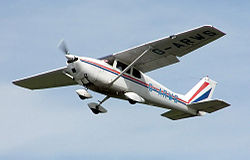
Cessna · 1966–1967
Cessna 172G Skyhawk (1966-1967)
 i
iSpecifications
MOSAIC eligiblePerformance
Cruise
114KTAS
Range
515nm
Climb
645fpm
Ceiling
13,100ft
Fuel Burn
7.0gph
Fuel Cap.
36gal
MPG
18.7mpg
Stall (Vs0)
43KIAS
T/O roll
865ft
Ldg roll
520ft
Size & weight
Seats
4
Useful Load
1,025lbs
Full-fuel payload
809lbs
Max gross
2,300lbs
Wingspan
36.1ft
Length
27.2ft
Engine
Engine
Continental O-300-C or O-300-D
Power
145hp
TBO
1,800hrs
Overhaul
$45k
Owning it
Hull insurance
$1k/yr
Parts
good
Mechanics
universal
Gear
Fixed
IFR
Yes
Category
certified
Full specification
V-speeds
Airframe
- Empty weight
- 1,275 lbs
- Max fuel weight
- 216 lbs
- Height
- 8.9 ft
- Wing position
- high
Obstacle performance
- Takeoff over 50 ft
- 1,525 ft
- Landing over 50 ft
- 1,250 ft
Paperwork
- Type certificate
- 3A12
- Certification basis
- CAR 3
These figures are typical for the model, not a specification for any individual aircraft. Real-world numbers vary with year, installed equipment, weight, modifications and engine condition — often by more than you would expect. Use them to compare types, and confirm anything you would act on against the Pilot's Operating Handbook for that specific airframe and a prebuy inspection.
Pricing
Typical
$50k
Range
$30k – $72k
Annual all-in
~$22k/yr
All-in at ~100 flying hours a year, using the midpoint of each range — the same figures broken out under “Cost to own” below. Your number will differ, and mostly for two reasons. Experience sets your insurance: a 2,000-hour pilot with recent training pays 30–40% less than a 200-hour owner, and student owners pay 20–40% more — on the same aircraft that is often a doubling. Location sets your hangar: a T-hangar runs $200–400 a month in the Midwest against $400–1,500 in a coastal metro, and an outside tie-down is less again. Engine reserves move too — a local shop reusing your serviceable cylinders can come in 30–50% under the national specialty-shop pricing we quote, though you trade the warranty and turnaround that comes with it. Reserves are money set aside toward a future overhaul, not a bill this year, and the annual inspection figure is the shop’s labor to look — whatever they find is separate.
Cost to own — estimate
Set your yearly hours and local fuel price. Fixed costs (insurance, hangar, annual inspection) don't change with hours; fuel, maintenance and the engine reserve do.
- Fuel (7 gph)
- $4,550
- Engine reserve
- $2,500
- Maintenance, parts & wear items ($12/hr)
- $1,200
- Insurance
- $900–$1,800
- Hangar
- $5,892–$14,729
- Annual inspection (labor only)
- $1,200
- Databases & subscriptions
- $400
- Total per year
- $21,510
- Per flight hour
- $215
- Miles flown / year (at cruise)
- 13,119 mi
- Cost per mile
- $1.64/mi
- Time in the air
- 2 hr 38 min
- Fuel burned
- 18 gal
- Out of pocket
- $217
Fuel, engine reserve and wear only. Insurance, hangar and the annual are already paid whether you make the trip or not, so they are not charged here.
Estimate, not a quote. Where a line shows a range, the total, per-hour and per-mile figures use its midpoint— insurance moves most with your experience and time in type, hangar with where you base the aircraft, so your own number could sit at either end. Annual inspection is the shop's labor to open and inspect — what they find is the maintenance line, which covers oil changes, plugs, tires, brakes, hoses, lights, a battery and vacuum pump amortised over their life, and the unscheduled squawks that are the largest and least predictable part of it. Reserves are sinking funds toward an overhaul, not a bill you pay this year — and note that a propeller is due on hours or calendar time, typically six years, so flying less does not put it off forever.
See how every Cessna 172 / Skyhawkyear stacks up — engines, changes, and which to buy — in our year-by-year buyer's guide.
Strengths
- Last 172 with smooth-running Continental six-cylinder engine
- Proven 114 KTAS cruise performance with 7.0 GPH efficiency
- Strong parts support thanks to large installed base across 1956–1967 172s and related models
- Eligible for mogas STC (Petersen Aviation) with 1–2 year payback
Weaknesses
- Generator system less common in modern GA; alternator upgrade may be advisable
- Continental O-300 accessory parts (carburetors, magnetos) increasingly scarce
- Engine overhaul cost significant ($25,000–$32,000) with long-term support ecosystem aging
- 1967 serial-number ambiguity: airframe may be designated 172G or 172H depending on configuration
Overview
The 1966-1967 Cessna 172G is the last 172 powered by the Continental O-300 six-cylinder engine. Aside from a longer pointed spinner and minor cowling refinements, it is functionally identical to the 172F: electric flaps, circuit breakers, 2,300 lb gross, Omni-Vision cockpit. Roughly 1,500 examples were produced across the 1966 and 1967 model years (some 1966 production was 172F, with 172G phasing in mid-year and continuing through 1967).
The 172G's significance is historical: it represents the end of the smooth-running Continental six-cylinder era. Starting with the 172H in 1967 (a single model year transition variant -- often grouped with 172G for resale purposes), Cessna prepared for the engine change. The 172I in 1968 introduced the Lycoming O-320-E2D four-cylinder engine that powered every 172 through 1986 except for the R172K Hawk XP.
For buyers who specifically want the six-cylinder Continental experience -- smoother idle, distinctive sound, slightly easier hot starts than the Lycoming -- the 172G is the newest 172 that offers it.
Variants & History
Distinguishing Features (vs 172F and 172H/I)
| Feature | 172F (1965-1966) | 172G (1966-1967) | 172H (1967) | 172I (1968) |
|---|---|---|---|---|
| Spinner | Standard | Longer pointed spinner | Same as 172G | Round, Lycoming-style |
| Cowling | Standard | Minor refinements | Same as 172G | New (Lycoming) |
| Generator | Generator | Generator | 60A alternator (new) | Alternator |
| Stall warning | Electric horn | Electric horn | Pneumatic reed (new) | Pneumatic reed |
| Engine | Continental O-300-D | Continental O-300-D | Continental O-300-D | Lycoming O-320-E2D (new) |
The 172H Transition Year (1967)
Some sources distinguish the 1967 model year as the 172H rather than 172G. The 172H is a single-year transition variant that retained the Continental O-300-D engine but introduced:
- 60-amp alternator (replacing the prior generator) -- significant electrical capacity improvement for radios and avionics
- Pneumatic reed stall warning (replacing the electric horn) -- the system used on every subsequent 172
- Shorter-stroke nose gear oleo strut -- minor handling refinement
For resale purposes, the 172H is often listed and priced alongside the 172G. Some 1967 aircraft were produced as 172G and some as 172H depending on serial number; the airframes are visually indistinguishable. Both share the same Continental O-300-D engine and the same desirability tier.
Performance
Identical to 172E/F: 114 KTAS cruise, 645 FPM climb at 2,300 lb gross, 7.0 GPH. The 172G/H added approximately 5-15 lbs of empty weight compared to the 172F due to the alternator (on H) and accessory mount changes, reducing useful load slightly to ~1,025 lbs.
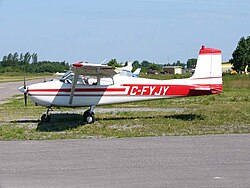
1975 Cessna 172M Skyhawk (1973-1976)
Good plane - Demo
Maintenance & Support
The very last 172 production with the O-300. Field overhaul cost: $39,500–$50,500. By the late 1960s, the Continental O-300 was on its way out of mainstream production. Today, parts availability is "good" thanks to the large installed base across 172 (1956-1967), Cessna 170B (1953-1956), and Cessna 175 (1958-1962), but new-production parts for some accessory components are scarce.
The Lycoming O-320 conversion STCs (AVCON, Penn Yan, others) are particularly relevant for late-Continental 172s at overhaul time. Owners often weigh:
- Field overhaul ($39,500–$50,500): Keeps the Continental experience, retains type-correct configuration
- Lycoming O-320 conversion ($45,000-$38,000 including new engine): Better parts support long-term, modern engine controls, slightly better fuel economy
The conversion is a one-way change (returning to Continental requires another major investment) but is increasingly popular as the Continental support ecosystem ages.
Valuation Factors
| Condition | Price Range |
|---|---|
| Project / needs engine | $25,000-$33,000 |
| Flying but tired | $34,000-$50,000 |
| Well-maintained | $48,000-$66,000 |
| Restored / upgraded | $64,000-$82,000 |
Pricing is essentially identical to 172F. The "last Continental" status doesn't currently command a meaningful collector premium, though buyers specifically seeking six-cylinder smoothness may pay marginally more than for a comparable 172E.
The 1967 172H (with alternator) is sometimes valued slightly higher than 1966 172G/F due to the electrical system upgrade, but the difference is typically within negotiation noise ($1,000-$3,000).
2006 Cessna 172S
G1000 Skyhawk · Mid-Time Engine · Clean Logs
ADs & Common Problems
Universal Cessna 172 pre-buy concerns apply. 172G/H-specific:
- Generator vs alternator: 172G retains a generator; 1967 172H has an alternator. Generators are less common in active GA service today; verify the system is functional and budgeting for upgrades may be advisable.
- Continental O-300 long-term support: Some accessory parts (specific carburetors, magneto installations) are increasingly scarce. Inspect engine accessories with future supply in mind.
- Bridge-era serial numbers: 1967 aircraft can be 172G or 172H depending on serial number; verify the airworthiness certificate matches the airframe configuration.
- Auto fuel STC interest: The Continental O-300 is well-suited to mogas via Petersen Aviation STC. If the airplane qualifies, the STC ($1,500-$2,000) pays for itself in 1-2 years of regular flying.
For sale (1)
For sale elsewhere (2)
Current ads on Barnstormers, checked daily. Photos, full details and the seller are on the listing site.
1967 Cessna 172G Skyhawk (1966-1967)
Listed on BarnstormersADS-B Out · Garmin GNS 430 · Garmin GTX 327/320 · JPI EDM engine monitor
View photos and full ad on Barnstormers ↗1966 Cessna 172G Skyhawk (1966-1967)
Listed on BarnstormersADS-B Out · Engine monitor
View photos and full ad on Barnstormers ↗Also worth looking at
What buyers usually weigh against the Cessna 172G Skyhawk (1966-1967) — aircraft flown for the same kind of mission.