Cessna · 1948–1956
Cessna 170
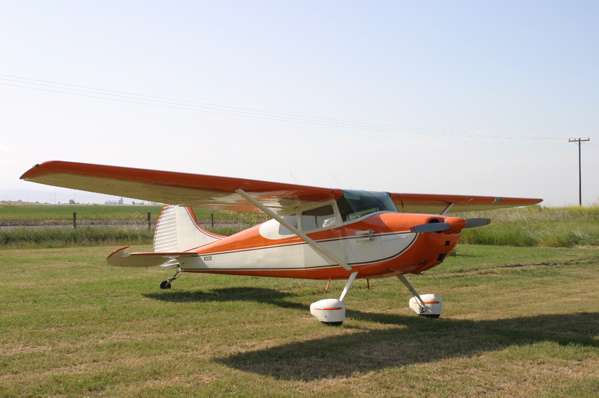
Specifications
MOSAIC eligiblePerformance
Cruise
104KTAS
Range
Not verified
Climb
690fpm
Ceiling
15,500ft
Fuel Burn
8.0gph
Fuel Cap.
37gal
MPG
15.0mpg
Stall (Vs0)
45KIAS
T/O roll
—ft
Ldg roll
—ft
Size & weight
Seats
4
Useful Load
940lbs
Full-fuel payload
718lbs
Max gross
2,200lbs
Wingspan
36ft
Length
25ft
Engine
Engine
Continental O-300-A
Power
145hp
TBO
1,800hrs
Overhaul
$48k
Owning it
Hull insurance
$2k/yr
Parts
good
Mechanics
common
Gear
Fixed
IFR
Yes
Category
certified
Full specification
V-speeds
Airframe
- Empty weight
- 1,260 lbs
- Max fuel weight
- 222 lbs
- Height
- 6.6 ft
- Wing position
- high
Paperwork
- Type certificate
- A-799
- Certification basis
- CAR 3
These figures are typical for the model, not a specification for any individual aircraft. Real-world numbers vary with year, installed equipment, weight, modifications and engine condition — often by more than you would expect. Use them to compare types, and confirm anything you would act on against the Pilot's Operating Handbook for that specific airframe and a prebuy inspection.
Pricing
Typical
$107k
Range
$48k – $339k
Annual all-in
~$22k/yr
All-in at ~100 flying hours a year, using the midpoint of each range — the same figures broken out under “Cost to own” below. Your number will differ, and mostly for two reasons. Experience sets your insurance: a 2,000-hour pilot with recent training pays 30–40% less than a 200-hour owner, and student owners pay 20–40% more — on the same aircraft that is often a doubling. Location sets your hangar: a T-hangar runs $200–400 a month in the Midwest against $400–1,500 in a coastal metro, and an outside tie-down is less again. Engine reserves move too — a local shop reusing your serviceable cylinders can come in 30–50% under the national specialty-shop pricing we quote, though you trade the warranty and turnaround that comes with it. Reserves are money set aside toward a future overhaul, not a bill this year, and the annual inspection figure is the shop’s labor to look — whatever they find is separate.
Cost to own — estimate
Set your yearly hours and local fuel price. Fixed costs (insurance, hangar, annual inspection) don't change with hours; fuel, maintenance and the engine reserve do.
- Fuel (8 gph)
- $5,200
- Engine reserve
- $2,667
- Maintenance, parts & wear items ($12/hr)
- $1,200
- Insurance
- $950–$2,650
- Hangar
- $5,400–$13,500
- Annual inspection (labor only)
- $1,200
- Databases & subscriptions
- $400
- Total per year
- $21,917
- Per flight hour
- $219
- Miles flown / year (at cruise)
- 11,968 mi
- Cost per mile
- $1.83/mi
- Time in the air
- 2 hr 53 min
- Fuel burned
- 23 gal
- Out of pocket
- $262
Fuel, engine reserve and wear only. Insurance, hangar and the annual are already paid whether you make the trip or not, so they are not charged here.
Estimate, not a quote. Where a line shows a range, the total, per-hour and per-mile figures use its midpoint— insurance moves most with your experience and time in type, hangar with where you base the aircraft, so your own number could sit at either end. Annual inspection is the shop's labor to open and inspect — what they find is the maintenance line, which covers oil changes, plugs, tires, brakes, hoses, lights, a battery and vacuum pump amortised over their life, and the unscheduled squawks that are the largest and least predictable part of it. Reserves are sinking funds toward an overhaul, not a bill you pay this year — and note that a propeller is due on hours or calendar time, typically six years, so flying less does not put it off forever.
Strengths
- Excellent backcountry performer with tailwheel gear and Fowler flaps
- Strong parts availability through Cessna, Univair, and Wag-Aero
- Simple airframe and Continental O-300 engine familiar to most A&Ps
- Pure joy for local fun flying and grass-strip operations
Weaknesses
- Fabric-wing models (1948-1949) require expensive re-covering ($15K-$45K per wing)
- 145 HP engine marginal at high density altitude and gross weight
- 70+ year old airframes demand thorough corrosion inspection
- Modest cruise speed (104 KTAS) and range limit cross-country utility
Variants & History
| Variant | Years | Engine | HP | Gross Weight | Units Built | Key Differences |
|---|---|---|---|---|---|---|
| 170 | 1948-1949 | Continental C145-2 | 145 | 2,200 lbs | 714 (AOPA); 730 eligible serials on A-799 | Constant-chord wing with V-struts, three 12.5-gal tanks (37.5 gal total, 33.5 usable), flap limit 78 kt, round tailfin. Essentially a four-seat Cessna 140 with more power. Certification basis CAR Part 03 amended 03-1 thru 03-3. |
| 170A | 1949-1951 | Continental C145-2 or -2H | 145 | 2,200 lbs | 1,522 (AOPA); 1,537 eligible serials | All-metal tapered wing with essentially zero dihedral, single strut replacing the V-strut, plain flaps to 50 deg, two 21-gal tanks (42 gal total, 37 usable), flap limit 87 kt, Model 195 dorsal fin. Certification basis CAR Part 03 amended 03-1 thru 03-4. |
| 170B | 1952-1956 | Continental C145-2 or -2H; O-300-A eligible as Item 112 | 145 | 2,200 lbs | 2,905 eligible serials | Semi-Fowler slotted flaps to 40 deg, revised horizontal tail with an enlarged trim tab and mass-balanced elevator tips, three degrees of dihedral and washout in the wing. 42 gal total / 37 usable. Certification basis CAR Part 3 dated 1 Nov 1949 -- a different basis from the 170 and 170A. Most numerous and most sought-after. |
Note on engine designations: The Continental C-145-2 and O-300-A are closely related engines. The O-300 designation reflects Continental's adoption of the standardized military naming convention; the core engine is the same 6-cylinder, 145 HP horizontally-opposed design. TBO for all variants is 1,800 hours.
Performance
There is a cruise speed on this page and there is no range, and both of those are deliberate. The 170 predates the GAMA Pilot's Operating Handbook by twenty years: Cessna issued an unapproved Owner's Manual plus a short CAA-approved Airplane Flight Manual, and the 170B's is sold commercially rather than posted, so it has not been read.
The cruise speed, 104 KTAS, is a triangulated secondary figure. Aviation Consumer's March 2001 used-aircraft guide states that "a properly rigged 170 will cruise at 104 knots true at around 2,400 RPM (65 to 70 percent power) while burning between seven and eight gallons of fuel an hour at altitudes below 8,000 feet". Jane's All The World's Aircraft 1955-56, FLY8MA and Aerofiles all publish 120 mph, which is 104.3 knots. The International Cessna 170 Association -- the type club, and the only one of the six that does not say 120 -- gives "about 118 mph at 65% power at 4,000-7,000 ft and burn about 8 gph with engine properly leaned", which is 102.5 knots. Five publishers, 1.8% apart.
The 170A factory manual is what makes that believable. It is a primary Cessna document that none of those five is copying, and its 6,000 ft cruise table brackets them from both sides: 122 mph TAS (106.0 kt) at 62% power, and 115 mph (99.9 kt) at 2,400 rpm. A secondary cluster that sits inside a factory table's own rows is corroborated; one that sits outside them is guessing.
There is still no range, and that is not an oversight. No secondary source publishes one for the 170B at all except a spec-aggregator page which, on the same screen, republishes Jane's 120 mph as 120 knots. A range figure also needs the taxi allowance, the climb fuel and distance, and the reserve convention -- none of which any secondary source publishes for any airplane. It waits for the handbook.
What the 170A's factory manual says, which is the best figure anyone reached
These are the Model 170A's numbers, from the Cessna Aircraft Company Operation Manual for the Cessna 170 Series, 1951-1952. The 170B is the same airframe with different flaps and a revised tail, so they are indicative -- but they are not stored in this page's specifications, because they are not this page's airplane.
Cruise, at 6,000 ft pressure altitude, full gross, on 37 usable gallons, zero wind. The manual's speeds are mph TAS and its ranges are STATUTE miles; the knots and nautical conversions are ours and are marked as such:
| RPM | % BHP | TAS mph | (kt) | Lean gal/hr | Lean endurance | Lean range (sm) | (nm) |
|---|---|---|---|---|---|---|---|
| 2500 | 62 | 122 | 106 | 7.9 | 4.7 hr | 571 | 496 |
| 2400 | 55 | 115 | 100 | 7.2 | 5.2 hr | 592 | 515 |
| 2300 | 49 | 108 | 94 | 6.5 | 5.7 hr | 624 | 542 |
| 2200 | 44 | 101 | 88 | 5.9 | 6.3 hr | 633 | 550 |
Full-rich burn at the same settings runs 9.3, 8.4, 7.7 and 7.2 gph. The highest power the table publishes at 6,000 feet is 62%, and the manual's own text puts maximum cruising at 2,450 rpm -- so a 170's real cruising speed is around 100 to 106 knots, not the 110-115 this page used to claim, and it is doing that on 6.5 to 9 gallons an hour. None of those range figures deducts a reserve.
Climb, 2,200 lb, metal McCauley propeller, standard conditions: 690 fpm at sea level, 485 at 5,000 ft, 277 at 10,000 ft, with a best-climb speed of 89 mph TIAS (77 kt) falling to 75 mph (65 kt) at 10,000 ft.
The 170B's standout performance feature is its semi-Fowler flap system. These slotted, rearward-travelling flaps, related to the military L-19 Bird Dog's, provide meaningfully better short-field numbers than the 170A's plain flaps, and the 170B can put a competent pilot into strips that would give a stock 172 serious pause.
This page publishes no takeoff or landing distances, and the reason is the single clearest result of the whole sourcing exercise. The sources disagree by 264% on takeoff ground roll and 186% on landing roll, and they disagree about what the numbers mean rather than about how big they are.
Aviation Consumer reports the book as requiring "1,820 feet for takeoff, 2,190 feet to clear a 50-foot obstacle", and "1,145 feet for a normal landing, 1,210 feet to get in over an obstacle". FLY8MA's table gives 500-600 ft for takeoff and 400-500 ft for landing at sea level. The 170A factory manual's own table gives 1,820 ft at sea level and 60F to clear a 50 ft obstacle, with a ground run of about 40% of that -- roughly 730 ft.
Read those together and the problem shows itself. 1,820 and 2,190 are the sea-level and 2,000-foot entries of the manual's over-50-foot column, one above the other. An altitude step has been read as an obstacle clearance, and neither figure is a ground roll at all. The landing pair has the same shape of problem from the other direction: 1,145 ft of roll against 1,210 ft over a 50 ft obstacle is a 65-foot difference, where every other airplane in this catalogue shows a factor of 1.4 to 2.2.
The page previously carried 1,820 / 728 and 1,145 / 460 -- which are Aviation Consumer's two numbers with the manual's 40% ground-run rule applied to each, including to the landing figure, where the manual's own rule is 45%. All four are gone. For reference, the 170A table gives 1,700 ft over 50 ft at sea level and 40F and 2,050 ft at 100F; landing over 50 ft with flaps down runs 1,580 to 1,860 ft across the same temperature span, with a roll of about 45% of that.
The 170A, by contrast, has plain flaps with 50 degrees of deflection that produce more drag than lift at high settings, making the airplane sink rapidly on approach without meaningful lift benefit. This is a critical distinction for backcountry work.
Real-world climb performance with the 145 HP Continental is adequate but not sprightly. At gross weight on a warm day at elevation, expect 400-500 fpm. Density altitude management matters in this airplane. The relatively low horsepower-to-weight ratio (approximately 15 lbs/hp) means departing high-altitude strips on hot days requires careful planning.
No source of any tier publishes a best glide speed for any 170 -- not A-799, not AOPA, not Jane's, not Aviation Consumer, not the type club, not the 170A manual. The page previously asserted 65 KIAS with no attribution; it has been removed rather than carried forward.
Vy is the closest call on the page and is also blank. Aviation Consumer states that best rate-of-climb speed is 77 knots, and the 170A factory manual's 89 mph TIAS at sea level converts to 77.3 -- 0.4% apart, which looks conclusive. It is not, because those are almost certainly the same document read twice: Aviation Consumer's climb figures match the 170A manual's 60F column cell for cell, 690 fpm at sea level and 370 fpm at 7,000 ft. One secondary source and a primary control it appears to have copied is not the three independent publishers the agreement test requires, so 77 kt is recorded here in prose and not stored as a field.
Payload & Range
The 170B's 940-lb useful load is generous for a 145 HP four-seater, but real-world loading requires thought. Two figures below are ours rather than Cessna's and are labeled: the ranges are computed from the 170A book's lean cruise at 6,000 feet (about 6.5 gph at 94 kt, 7.9 gph at 106 kt) with a 45-minute reserve removed, because no 170B range figure exists in any source reached. Treat them as indicative.
Scenario 1: Full Fuel + 2 Occupants (Touring / Backcountry)
| Item | Weight |
|---|---|
| Full fuel (37 gal usable) | 222 lbs |
| Pilot (standard) | 200 lbs |
| Front passenger | 170 lbs |
| Baggage | 40 lbs |
| Total payload | 632 lbs |
| Remaining for rear seat | 308 lbs |
| Range at economy cruise | ~400 nm (computed, see above) |
This is the sweet spot: two people, full fuel, and enough margin for camping gear or a third lighter passenger. The 170 is a genuine two-plus-two in this configuration.
Scenario 2: Four Occupants (Full Seats)
| Item | Weight |
|---|---|
| Pilot | 200 lbs |
| Front passenger | 180 lbs |
| Rear passenger 1 | 170 lbs |
| Rear passenger 2 | 150 lbs |
| Baggage | 30 lbs |
| Total payload | 730 lbs |
| Remaining for fuel | 210 lbs (35 gal), so not quite full tanks |
| Range at economy cruise | ~375 nm (computed, see above) |
With four standard adults, you can carry nearly full fuel. However, with four large adults (200 lbs each), fuel must be reduced. This is not a four-large-adult airplane at full fuel, but it handles a typical family (two adults, two children) with full tanks comfortably.
Scenario 3: Backcountry Mission (Modified 170B with 180 HP)
| Item | Weight |
|---|---|
| Fuel (30 gal, reduced for short hops) | 180 lbs |
| Pilot | 200 lbs |
| Passenger | 180 lbs |
| Camping gear / supplies | 150 lbs |
| Total payload | 710 lbs |
| Under gross by | 270 lbs |
| Range | ~280 nm |
This configuration leaves comfortable margin below gross weight, which is exactly what you want when operating from unimproved strips at elevation. The 180 HP conversion does not change the gross weight (still 2,200 lbs per most STCs), but it transforms the airplane's ability to use that weight at high density altitudes.
The 170 vs. the 172: Understanding the Succession
When Cessna replaced the 170 with the 172 in 1956, the primary change was swapping conventional gear for tricycle gear. The early 172s shared the same Continental O-300 engine, the same basic airframe, and nearly identical performance. Cessna made the switch because nosewheel aircraft were dramatically easier for new pilots to land, and the post-war flying boom demanded accessible aircraft.
What the 172 gained in accessibility, it lost in backcountry capability. The nosewheel is vulnerable on rough surfaces, the prop is closer to the ground, and the aircraft sits with less angle of attack. The 170's tailwheel configuration gives it inherent advantages on grass, gravel, and unimproved strips. The 172 also adopted a straight tailfin (the 170 has a distinctive rounded fin), and later 172s moved to Lycoming engines, diverging the lineage further.
Today, a stock 170B and a stock early 172 are remarkably similar airplanes in the air. The difference is on the ground, and for many pilots, that difference defines the experience.
Mission Suitability
Flight Training (4/10): Not a primary trainer, but a reasonable tailwheel transition platform for pilots moving beyond the 150/152. Four seats allow an instructor plus student with room for a safety pilot or observer. Insurance for training use is expensive. Better tailwheel trainers exist for primary instruction (Citabria, Decathlon, Super Cub).
Backcountry (7/10): This is where the 170B truly shines relative to expectations. The combination of tailwheel gear, effective Fowler flaps, high wing for ground clearance and visibility, and 940 lbs useful load makes it a legitimate backcountry four-seater. With big tires (26-31 inch Bushwheels), a STOL kit, and an engine upgrade to 180 HP, a modified 170B approaches 180 Skywagon capability at a fraction of the cost. Stock, it scores lower than a purpose-built bush plane, but modified examples are serious backcountry machines. Docked points for the 145 HP engine being marginal at high density altitudes and gross weight.
Business Travel (3/10): Limited by modest cruise speed (the 170A book gives 106 kt at 62% power and 6,000 ft), lack of modern avionics in most examples, and the tailwheel configuration that most FBOs and rental car agencies find unfamiliar. Not the mission this airplane was built for.
Aerobatics (1/10): Not approved for aerobatic flight in Normal Category. Utility Category limits (2 seats, reduced gross weight) allow steep turns and stalls but not aerobatics.
Cross-Country (5/10): Capable but not ideal. With 37 usable gallons and 6.5-8 gph at the lower cruise settings, the 170A book works out near 500 statute miles (about 430 nm) before any reserve, so plan on roughly 350-400 nm with an honest one. The rear seat is comfortable enough for two adults on shorter legs. Drawbacks: modest cruise speed, wind noise, and the fatigue factor of a 1950s airframe on longer flights. A well-equipped 170B with a modern GPS makes a pleasant 200-300 nm touring airplane.
Cargo Hauling (4/10): The 940-lb useful load is good on paper, but full fuel (37 usable gallons, 222 lbs) and two front-seat occupants leave limited cargo capacity. The rear seat folds for bulky items. Not a hauler, but adequate for camping gear and supplies for a backcountry trip.
Local Fun Flying (8/10): This is the 170's sweet spot alongside backcountry. A beautiful Saturday morning, a grass strip, the satisfying rumble of a Continental six-cylinder, and honest tailwheel handling make this airplane a pure joy for recreational flying. The high wing provides excellent sightseeing visibility. Landing a 170 well on a grass strip is one of GA's simple pleasures.
Surveying (5/10): High wing provides decent downward visibility, and the relatively slow speed is actually an advantage. However, no modern examples come with survey-specific modifications, and the tailwheel gear complicates operations at unfamiliar paved airports.

2006 Cessna 172S
G1000 Skyhawk · Mid-Time Engine · Clean Logs
Avionics Ecosystem
Most 170s still flying have panel configurations spanning seven decades of avionics evolution.
Budget / Minimalist ($0-$5,000 upgrade): Many 170s retain original or near-original panels with analog six-pack, a single NAV/COM, and perhaps a handheld GPS mounted on the yoke. For VFR backcountry and local flying, this is adequate. A panel-mounted Garmin GPS (used GNS 430W or GTN 625) is the single most impactful upgrade.
Mid-Range ($10,000-$25,000): A Garmin GNS 430W or GTN 650Xi paired with a modern transponder (GTX 345 for ADS-B In/Out) transforms the airplane's cross-country and IFR capability. Many owners add an electronic attitude indicator (GI 275 or uAvionix AV-30) as a backup or primary.
High-End ($25,000-$50,000+): Full glass conversions are rare but not unheard of, typically featuring dual GI 275s, a GTN 650Xi or 750Xi, and an audio panel upgrade. At this investment level, owners are typically building a "forever airplane" with a concurrent engine upgrade and airframe restoration.
The 170's panel space is adequate but not generous. The steam gauge panel accommodates standard 3-1/8" instruments, and most modern retrofit displays fit without major panel rework.
STCs & Modifications
The 170 has a rich STC ecosystem, reflecting its popularity as a platform for customization.
Engine Upgrades
| STC | Engine | HP | Notes | Approx. Cost |
|---|---|---|---|---|
| SA00461SE (Del Air) | Lycoming O-360-A1A/A1D/A4M | 180 | Most popular upgrade. Fixed-pitch prop. Transforms takeoff and climb performance. | $35,000-$50,000 installed |
| SA02282AK (Stoots Aviation) | Lycoming IO-360-M1A/B | 180 | Fuel-injected version. More precise fuel metering. | $40,000-$55,000 installed |
| IO-370 conversion | Continental IO-370 | 190-200 | Newer STC option. Retains Continental compatibility. | $45,000-$60,000 installed |
| TCM IO-360 | Continental IO-360 | 200 | Requires extensive custom fabrication. Less common. | $50,000+ installed |
The 180 HP Lycoming O-360 conversion is the gold standard upgrade. It improves takeoff roll by 20-25%, climb rate by 200+ fpm, and provides meaningful margin at high density altitudes. It also moves the airplane to a Lycoming parts and overhaul ecosystem that many owners and mechanics prefer.
STOL Modifications
| Modification | Effect | Approx. Cost |
|---|---|---|
| Horton STOL kit | Cuff leading edges, stall fences, vortex generators. Reduces stall speed 5-7 kts. | $3,000-$5,000 installed |
| Sportsman STOL kit | Similar VG and cuff package. | $2,500-$4,500 installed |
Bush / Backcountry Modifications
| Modification | Notes | Approx. Cost |
|---|---|---|
| 26" Alaskan Bushwheels | No STC required for 8.50x6 tires (per TCDS). Good all-around bush tire. | $3,400/pair |
| 29" Alaskan Bushwheels | STC required. Excellent soft-field capability. | $3,800/pair |
| 31" Alaskan Bushwheels | STC required. Maximum floatation. Restricts forward visibility noticeably. | $4,200/pair |
| Double-puck Cleveland brakes | Required for 29"+ tires. Standard single-piston Clevelands inadequate. | $1,500-$2,500 |
| Extended gear legs | Provides ground clearance for larger tires and prop clearance. | $2,000-$4,000 |
| Scott 3200 tailwheel | Heavy-duty tailwheel upgrade for bush ops. | $800-$1,200 |
| Belly pod / cargo pod | External baggage for camping gear. | $2,000-$4,000 |
A fully built-out backcountry 170B with 180 HP conversion, STOL kit, 29" Bushwheels, and heavy-duty gear can easily represent $25,000-$40,000 in modifications on top of the airframe purchase price.
Maintenance & Support
Parts Availability — Good
The Cessna 170 shares substantial parts commonality with the early 172, 180, and other Cessna singles from the same era. This is a significant advantage:
- Airframe parts: Wing skins, ribs, control surfaces, fuselage skins, and hardware are available from Cessna (Textron), Univair, and Wag-Aero. Supply is adequate for routine maintenance; exotic or model-specific parts occasionally require patience.
- Engine parts: Continental O-300 parts remain available through Continental (now Continental Aerospace Technologies), Univair, and the used/surplus market. The engine's long production run and use across multiple Cessna models helps.
- Landing gear: Spring gear legs, tailwheel assemblies, brake components, and tires are readily available.
- Fabric (170 only): Ceconite, Poly-Fiber, and other STC'd covering systems are readily available. Fabric-wing 170 maintenance is not a parts problem; it is a labor and skill problem.
Mechanic Familiarity — Common
Any A&P familiar with Cessna singles can work on a 170. The airframe is simple and well-documented. The Continental O-300/C-145 engine is straightforward. However, tailwheel-specific rigging (tailwheel springs, cables, steerable vs. free-swiveling configurations) benefits from a mechanic experienced with conventional-gear Cessnas.
Annual Cost Range
| Item | Typical Range |
|---|---|
| Annual inspection (labor + routine items) | $1,500-$3,000 |
| Engine reserve (1,800 hr TBO, $30K overhaul) | $17/hour (~$1,700/year at 100 hrs) |
| Insurance (full coverage, $100K hull) | $1,800-$3,000 |
| Hangar | $200-$600/month ($2,400-$7,200/year) |
| Fuel (100 hrs at 8 GPH, $6.50/gal) | $5,200/year |
| Miscellaneous (oil, tires, unexpected) | $1,000-$2,000 |
| Total (100 hrs/year) | $13,600-$18,600/year |
Expensive Maintenance Items
- Engine overhaul: $37,500–$52,500 for O-300. $45,000-$40,000 for Lycoming O-360 conversion engines.
- Fabric re-cover (170 only): $15,000-$45,000 for both wings.
- Prop overhaul: $1,500-$2,500 for fixed-pitch metal prop.
- Exhaust system replacement: $2,000-$4,000 for a complete exhaust.
- Magneto overhaul/replacement: $500-$1,200 each.

2005 Cessna 182T Skylane
G1000 Skylane · No Damage · Hangared
Valuation Factors
The Cessna 170 market has been appreciating steadily, driven by the convergence of two buyer pools: classic aircraft collectors and backcountry enthusiasts. The 170B commands the strongest prices, with the 170A following and the fabric-wing 170 trailing.
Price Tiers (2025-2026)
Dated, and where it comes from. The band in this page's specifications is market ASKING observed on 7 September 2026 across Controller, Hangar67 and AeroGurus, not a Vref or Aircraft Bluebook value -- both guides sell their numbers by subscription and neither was readable. Asking carries an upward bias, so the typical figure is the median asking price less 10 percent. The condition tiers below are ownership guidance rather than observations, and they predate that survey.
| Condition / Configuration | Price Range |
|---|---|
| Fabric-wing 170 (1948-1949), flyable, original | $45,000-$75,000 |
| 170A, average condition, mid-time engine | $55,000-$85,000 |
| 170B, stock, average condition, mid-time engine | $75,000-$120,000 |
| 170B, well-maintained, low-time engine, modern avionics | $110,000-$150,000 |
| 170B, 180 HP conversion, STOL mods, restored | $140,000-$200,000+ |
| Show-quality restoration (any variant) | $150,000-$200,000+ |
Key Value Drivers
- Engine time: A freshly overhauled O-300 or Lycoming O-360 conversion adds $15,000-$25,000 to value versus a run-out engine.
- 180 HP conversion: The single largest value-add STC. Adds $20,000-$35,000 to resale value.
- Avionics: A GNS 430W or GTN 650 with ADS-B adds $10,000-$20,000.
- Total time: Less impactful than engine time, but very high total-time airframes (5,000+ hours) warrant more thorough structural inspection.
- Corrosion history: Any history of significant corrosion repair substantially discounts value.
- Fabric-wing (170 only): Commands lower prices due to higher maintenance burden and re-cover cost, though mint examples have their own collector appeal.
Values are trending upward approximately 5-8% per year as supply naturally contracts (attrition) while demand from the backcountry community grows. The 170 is increasingly seen as a "poor man's 180" with genuine capability when properly modified.
ADs & Common Problems
Airworthiness Directives
The Cessna 170 has accumulated a significant AD list over its 70+ year service life. Key categories include:
Structural ADs:
- Wing spar inspection ADs — Recurring inspections of the wing spar attach fittings. Critical on all models. Ensure compliance is current and documented.
- Seat rail AD (AD 2011-10-09) — Applies broadly to Cessna single-engine aircraft including the 170 series. Inspection/replacement of seat rail and roller assemblies to prevent seat slippage on takeoff. One of the most important ADs across the Cessna fleet.
- Flap actuator inspection — 170B Fowler flap actuating mechanisms require periodic inspection.
Fabric-Wing 170 Specific:
- Early Model 170 (1948-1949) fabric wings require careful attention. Fabric condition, rib stitching, and internal corrosion are primary concerns. A fabric-wing 170 is not necessarily a problem airplane, but the annual inspection must include thorough fabric testing (punch test / Maule tester) and internal inspection of wing structure. Re-covering runs $8,000-$15,000 per wing.
Engine ADs:
- Various Continental C-145/O-300 ADs covering crankshaft inspection, oil pump drive, and accessory case. Most are one-time compliance or addressed at overhaul.
Common Pre-Buy Red Flags
- Corrosion — 70+ year old airframes demand thorough corrosion inspection, especially in the belly, wing roots, and around fuel tank bays.
- Landing gear attach points — Tailwheel aircraft see higher gear loads. Inspect spring gear legs, tailwheel mount, and associated fuselage structure.
- Exhaust system — Continental six-cylinder exhaust systems are prone to cracking. Inspect thoroughly with a mirror and bright light; cracks can be hidden.
- Windshield crazing — Original or aged plexiglass develops fine crazing that worsens visibility in sun glare.
- Control cable wear — Original pulleys and cables may show excessive wear after decades. Complete re-rigging is not uncommon in restorations.
- Fuel tank integrity — Bladder tanks deteriorate; wet-wing tanks can develop leaks at seams.
Insurance Profile
Insurance for the Cessna 170 falls into the tailwheel fixed-gear category, which carries higher premiums than equivalent nosewheel aircraft due to the higher ground-loop incident rate inherent to conventional gear.
Typical Premiums (2025-2026)
| Coverage | Qualified Pilot | Low-Time / New TW Pilot |
|---|---|---|
| Liability only ($1M smooth) | $384-$505/year | $470-$630/year |
| Full coverage ($1M liability + $50K hull) | $1,050-$1,980/year | $1,500-$2,350/year |
| Full coverage ($1M liability + $100K hull) | $1,800-$2,800/year | $2,500-$4,000/year |
| Full coverage ($1M liability + $150K hull) | $2,400-$3,500/year | $3,500-$5,500/year |
Qualified pilot minimums (typical underwriting): Private certificate, 300+ total hours, 25+ tailwheel hours, 10+ hours in make/model. Some underwriters require a formal tailwheel checkout with an instructor endorsed on the policy.
Underwriting notes:
- Tailwheel time is the dominant factor. A 1,000-hour pilot with 10 tailwheel hours will pay more than a 500-hour pilot with 100 tailwheel hours.
- Hull values have risen faster than underwriters have adjusted, so ensure your agreed hull value reflects current market replacement cost, not what you paid years ago.
- Backcountry use endorsements (off-airport operations) may carry additional premium or exclusions depending on the carrier.
- Some carriers restrict coverage for student pilots or renters operating the aircraft.
See GA Insurance Underwriting for broader context on GA insurance markets.
For sale (0)
No listings for this model right now.
For sale elsewhere (1)
Current ads on Barnstormers, checked daily. Photos, full details and the seller are on the listing site.
1951 Cessna 170
Listed on BarnstormersADS-B Out
View photos and full ad on Barnstormers ↗Also worth looking at
What buyers usually weigh against the Cessna 170 — aircraft flown for the same kind of mission.


