PZL-Mielec · 1978+
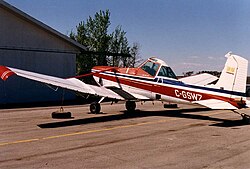
PZL-Mielec M-18 Dromader
 i
iSpecifications
Performance
Cruise
108KTAS
Range
520nm
Climb
890fpm
Ceiling
21,235ft
Fuel Burn
48gph
Fuel Cap.
188gal
MPG
2.6mpg
Stall (Vs0)
55KIAS
T/O roll
1378ft
Ldg roll
820ft
Size & weight
Seats
1
Useful Load
5074lbs
Full-fuel payload
3,946lbs
Max gross
11,684lbs
Wingspan
57.4ft
Length
31ft
Engine
Engine
PZL Kalisz ASz-62IR
Power
1000hp
TBO
1,200hrs
Overhaul
$95k
Owning it
Hull insurance
$18k/yr
Parts
fair
Mechanics
specialist
Gear
Fixed
IFR
No
Category
certified
Full specification
V-speeds
Airframe
- Empty weight
- 6,610 lbs
- Max fuel weight
- 1,128 lbs
- Height
- 12.1 ft
- Wing position
- low
Obstacle performance
- Takeoff over 50 ft
- 2,295 ft
- Landing over 50 ft
- 1,640 ft
Paperwork
- Type certificate
- EASA.A.056
- Certification basis
- FAR 23 (Restricted) / CS-23 Restricted Ag
These figures are typical for the model, not a specification for any individual aircraft. Real-world numbers vary with year, installed equipment, weight, modifications and engine condition — often by more than you would expect. Use them to compare types, and confirm anything you would act on against the Pilot's Operating Handbook for that specific airframe and a prebuy inspection.
Pricing
Typical
$225k
Range
$120k – $450k
Annual all-in
~$71k/yr
All-in at ~100 flying hours a year, using the midpoint of each range — the same figures broken out under “Cost to own” below. Your number will differ, and mostly for two reasons. Experience sets your insurance: a 2,000-hour pilot with recent training pays 30–40% less than a 200-hour owner, and student owners pay 20–40% more — on the same aircraft that is often a doubling. Location sets your hangar: a T-hangar runs $200–400 a month in the Midwest against $400–1,500 in a coastal metro, and an outside tie-down is less again. Engine reserves move too — a local shop reusing your serviceable cylinders can come in 30–50% under the national specialty-shop pricing we quote, though you trade the warranty and turnaround that comes with it. Reserves are money set aside toward a future overhaul, not a bill this year, and the annual inspection figure is the shop’s labor to look — whatever they find is separate.
Cost to own — estimate
Set your yearly hours and local fuel price. Fixed costs (insurance, hangar, annual inspection) don't change with hours; fuel, maintenance and the engine reserve do.
- Fuel (48 gph)
- $31,200
- Engine reserve
- $7,917
- Propeller reserve
- $175
- Maintenance, parts & wear items ($12/hr)
- $1,200
- Insurance
- $2,000–$18,000
- Hangar
- $10,676–$26,691
- Annual inspection (labor only)
- $1,200
- Databases & subscriptions
- $400
- Total per year
- $70,775
- Per flight hour
- $708
- Miles flown / year (at cruise)
- 12,428 mi
- Cost per mile
- $5.69/mi
- Time in the air
- 2 hr 47 min
- Fuel burned
- 133 gal
- Out of pocket
- $1,125
Fuel, engine reserve and wear only. Insurance, hangar and the annual are already paid whether you make the trip or not, so they are not charged here.
Estimate, not a quote. Where a line shows a range, the total, per-hour and per-mile figures use its midpoint— insurance moves most with your experience and time in type, hangar with where you base the aircraft, so your own number could sit at either end. Annual inspection is the shop's labor to open and inspect — what they find is the maintenance line, which covers oil changes, plugs, tires, brakes, hoses, lights, a battery and vacuum pump amortised over their life, and the unscheduled squawks that are the largest and least predictable part of it. Reserves are sinking funds toward an overhaul, not a bill you pay this year — and note that a propeller is due on hours or calendar time, typically six years, so flying less does not put it off forever.
Strengths
- Unmatched 5,000+ lb payload in single-engine piston class; purpose-built for heavy ag/fire tanker work
- Robust airframe and gear suitable for rough-strip operations; proven 760+ aircraft in active service worldwide
- Stable, predictable handling with honest performance; well-documented on fire-contract operations
Weaknesses
- Extreme specialist maintenance: only handful of US shops certified; most overhauls require Poland shipping (4–12 week lead times, $85k–$110k for engine)
- Critical wing-attach corrosion risk requiring expensive magnetic-particle inspection compliance; non-compliance is a deal-killer and safety issue
- Single-seat restricted-category limits utility to dedicated ag/fire missions; no cross-country or recreational value
- Radial engine parts supply fragile outside Europe; magneto and ignition network minimal in US
Overview
The PZL-Mielec M-18 Dromader ("Dromedary") is a Polish single-seat, low-wing, heavy agricultural and aerial firefighting airplane designed in the mid-1970s as a joint Polish-American project with Rockwell (Thrush Commander lineage influenced the airframe concept). First flight was in 1976 and series production began in 1978 at WSK PZL-Mielec. Over 760 airframes have been built, making it one of the most numerous heavy ag aircraft outside North America.
Powered by the enormous Shvetsov-derived 9-cylinder ASz-62IR radial of 1,000 hp (the same engine family that flies the Antonov An-2), the Dromader carries a 2,500 liter (660 US gallon) hopper and routinely operates as a Single Engine Air Tanker (SEAT) in Europe, Africa, Australia, Turkey, Greece, Spain, and the western United States. Operators fly them alongside Air Tractor (AT-301 through AT-802F Fire Boss) AT-802s and Ayres/Thrush S2R Thrush 510/710s on fire contracts; the Dromader's radial sound signature and distinctive stubby silhouette are unmistakable on the fire line. Production slowed dramatically after PZL-Mielec was acquired by Sikorsky/Lockheed Martin, but airframes are still built to order and the type remains in active firefighting service worldwide.
Variants & History
| Variant | Years | Engine | HP | MGW (lbs) | Key Differences |
|---|---|---|---|---|---|
| M-18 | 1978-1984 | ASz-62IR | 1,000 | 9,259 | Original single-seat ag; lighter gross weight |
| M-18A | 1984-1993 | ASz-62IR | 1,000 | 9,921 | Uprated gross weight, improved hopper, better aerodynamics |
| M-18B | 1993-present | ASz-62IR | 1,000 | 11,684 | Strengthened airframe, 11,684 lb MGW, longer tailwheel leg, larger oil cooler, reduced stick forces, reduced flaps-down stall; standard modern production variant |
| M-18BS | 1996-present | ASz-62IR | 1,000 | 11,684 | Two-seat trainer; bolt-on instructor cabin replaces forward hopper section; reduced hopper volume |
| M-18 "Turbine" (STC) | 2000s | PT6A-65AG / H80 | 1,100-1,600 | 11,684 | Third-party turbine conversions (Turbine Conversions Ltd. and others); lighter nose, reduced maintenance, higher acquisition cost |
| M-24 Dromader Super | prototype | PZL-3S / PT6A | varies | - | Enlarged follow-on; never series produced |
Performance
Published book cruise is around 108-115 KTAS at 60% power with the ASz-62IR, but loaded ferry cruise in the field is typically 100-105 KTAS while burning 45-55 gph of 100LL. Working-load performance with a full 2,500 L hopper is dominated by density altitude and field length, not cruise speed. Takeoff ground roll at max gross from a hot/high strip can exceed 2,500 ft; operators routinely plan partial loads above 3,000 ft MSL.
Climb on a loaded dispatch is honest — 700-900 fpm sea level, dropping sharply above 5,000 ft. The big radial loves cool dense air and is surprisingly efficient for its displacement when leaned properly, but oil consumption of 1-2 quarts per hour is normal and expected. Pilots report the airplane is stable, heavy on the controls, and a genuine two-handed airplane when maneuvering with a full load. Vne is 280 km/h (151 KIAS) and the wing is placarded against abrupt pull-ups when loaded.
Payload & Range
The Dromader is a payload-first airframe; range is secondary and intentionally sacrificed.
- Full fuel (188 gal / 1,128 lb), empty hopper: useful load remaining ~3,950 lb, range ~520 nm at 100 KTAS — used for repositioning between contract bases.
- Full hopper (2,500 L retardant at 8.9 lb/gal ≈ 5,880 lb), reduced fuel: operational SEAT profile with ~60-90 gal fuel for a 30-45 minute turnaround cycle; gross weight at or just below 11,684 lb M-18B limit. On hot days and high altitude, hopper load is reduced by 10-25% for climb performance.
- Ferry configuration with hopper fuel tank: up to 1,100 nm / 2,000 km with an auxiliary tank installed in the hopper — this is how Dromaders self-ferry across oceans and continents between contracts.
- Typical fire drop cycle: 15-25 minute cycle time, 5-8 drops per tank of fuel, recharging at a SEAT base between sorties.
Compared to Air Tractor (AT-301 through AT-802F Fire Boss) AT-802F (~820 gal hopper, PT6A-67F turbine), the Dromader carries about 80% of the payload on a piston engine at roughly half the acquisition price — which is why the type remains commercially viable despite its age and parts-support challenges.
Sources:
Mission Suitability
- Cargo hauling (9/10): This is the Dromader's purpose. A 5,000+ lb useful load in a single-engine piston airframe is matched only by the Air Tractor (AT-301 through AT-802F Fire Boss) AT-802 and Ayres/Thrush S2R Thrush 710. For fire retardant, water, fertilizer, or chemical dispersal it is world-class.
- Surveying (4/10): Low, slow, stable platform in principle, but the single-seat restricted-category certification and firefighting-focused cockpit make it a poor fit vs. dedicated survey platforms.
- Backcountry (3/10): Landing rolls and robust gear suit rough strips, but the airplane is a specialized restricted-category ag machine — not a recreational bush plane.
- Cross-country (2/10): 100-kt cruise, 48 gph, no IFR, single seat. Ferry flights between contracts are slow and expensive.
- Business travel / training / aerobatics / local fun (1/10): Not applicable — restricted category, single seat, no passenger carriage, no aerobatic certification.
See Cargo Hauling mission page for scoring rubric.
Avionics Ecosystem
Dromaders are restricted-category VFR ag airplanes; panels are minimalist and purpose-built:
- Base SEAT panel: basic engine instruments (CHT, oil pressure/temp, fuel, MP, RPM), airspeed, altimeter, compass, slip ball, manual-drop controls, hopper level sight gauge.
- Fire contract panel (~$25-50k add): Garmin GTN 650Xi or GTR 225 comm, Trig TT22 mode-S transponder with ADS-B Out, Latitude Technologies IONode or Spidertracks satellite tracker (mandated by USFS SEAT contracts), simple GPS moving map (aera 760 or Garmin G3X Touch VFR).
- Fire attack avionics: Satloc/AgJunction GPS flow controller driving the hopper gate, Trotter/Simplex or Isolair gate hardware, FLIR integration on some aircraft.
- Two-way VHF AM/FM dual: required for Forest Service fire frequencies.
See Avionics Pricing Reference for rates.
STCs & Modifications
- Turbine Conversions Ltd. PT6A-65AG conversion: replaces ASz-62IR with a 1,100-shp PT6A, saves ~500 lb nose weight, eliminates radial overhaul expense. Installed cost roughly $900k-$1.2M; doubles useful airframe life and transforms operating economics.
- General Airborne / European PT6A-67AG conversion: higher-power option seen on Greek and Turkish fire contracts.
- Hopper upgrades: Isolair fire gate, Simplex constant-flow systems, foam injection kits — $35k-$90k.
- Cockpit A/C: aftermarket cockpit air conditioning kits (Air Comm / PZL factory) — $25k-$40k; essentially mandatory for summer fire work.
- Wing fitting reinforcement kits: per PZL Service Bulletin (see ADs below); mandatory on fleet aircraft.
- Night firefighting lighting packages: required by some California and Greek operators.
Maintenance & Support
- Parts availability: Fair overall. New parts are available direct from PZL-Mielec (now Sikorsky/Lockheed Martin) and WSK PZL-Kalisz for the engine, but lead times of 4-12 weeks are common and currency/export paperwork can be painful. US operators typically stock engine consumables and high-wear airframe parts themselves.
- Mechanic familiarity: Specialist. Only a handful of US shops (Forest Service contract maintenance bases, a few ag-specialty shops in the Central Valley, Texas, and the Pacific Northwest) have Dromader IAs. Overseas, maintenance is straightforward where PZL support networks exist (Spain, Turkey, Greece, Australia, Poland).
- Annual inspection cost: $12k-$25k for a clean airframe, $40k-$80k for an airframe needing wing fitting MPI and discrepancy resolution.
- ASz-62IR overhaul: Performed almost exclusively at WSK PZL-Kalisz in Poland; ~$85k-$110k plus shipping and core charges. TBO is 1,200 hours with calendar limits. Field repairs (cylinder replacement, magneto overhaul) available from a small US network.
- Expensive items to watch: wing attach fittings ($$$ if found corroded), main gear legs, hopper corrosion repair, radial cylinders (approximately $4,500 per cylinder exchange), propeller (AV-2 or Hartzell four-blade on STC'd aircraft).
- Annual operating cost (active SEAT operator, 300 hours/year): $60k-$90k direct, excluding crew and insurance.
See Maintenance Ecosystem for broader ag/fire operator economics.
Valuation Factors
Market is thin and driven almost entirely by fire-contract operators and foreign ag operators; there is no recreational Dromader market.
- Radial time remaining: ASz-62IR engines at mid-time (600+ hours SMOH) carry a significant premium; a run-out radial means $95k-$130k for overhaul at WSK Kalisz including shipping.
- Wing fitting inspection status: airframes with recent MPI compliance and no corrosion findings sell for 25-40% more than those due or overdue.
- Fire gate system: Isolair or Trotter constant-flow gates add $50k+; basic dump gates are much less valuable for SEAT contracts.
- Ag vs. fire configuration: Firefighting-ready aircraft (tracker, radios, foam, gate) command a premium of $75k-$150k.
- Turbine conversion: a PT6-converted Dromader trades in the $700k-$1.1M range depending on engine SMOH, vs. $150k-$300k for radial versions.
- Price tiers:
- Radial, run-out / high-time wing: $120k-$170k
- Radial, mid-time, fire-ready M-18B: $200k-$275k
- Radial, fresh overhaul, recent fittings MPI: $300k-$450k
- Turbine conversion: $700k-$1.2M
See Aircraft Valuation Methodology for formulas.
ADs & Common Problems
- AD 2000-18-12 / PZL SB M18/00/006 (Wing Attach Fitting): Corrosion in the lower wing attach fitting lug bore has caused fatigue crack initiation and at least two fatal in-flight wing separations — VH-TZJ (Ulladulla, Australia, 2013) and N2283M (Winnabow, NC, 2016). Requires repetitive magnetic particle and visual inspection of the lower wing fittings. This is THE pre-buy item; records must document MPI compliance at specified hour intervals.
- Recurring fatigue AD on center-section splice: heavy-gross M-18B requires tracking of ag-load cycles, not just hours.
- ASz-62IR cylinder cracking: finned-head radial cylinders occasionally crack between fins; track via SB compliance and differential compression.
- Magneto and ignition harness issues: Slick and PZL-supplied magnetos have limited service network outside Poland.
- Hopper corrosion: aggressive fertilizer and retardant chemistry corrodes the lower fuselage and hopper skin; inspect sump, gate hinges, and belly.
- Landing gear leg cracking: main gear leg attach fittings see heavy cycles on rough strips.
- Control pushrod wear: in the aileron and elevator circuits.
- Polish-language maintenance manuals: many older airframes still have Polish-only documentation, complicating US A&P IAs.
Insurance Profile
Restricted category ag/fire insurance is a specialist market — underwriters include Global Aerospace, Old Republic, Berkley Aviation, and AIG Aviation in the US; HDI and Allianz in Europe.
- Hull premiums: typically 3-5% of hull value per year for active SEAT/ag operators (e.g. $9k-$22k/yr on a $250k hull).
- Liability: $1M smooth is standard; some USFS SEAT contracts require $5M combined single limit with specific endorsements for retardant/chemical release and ground-crew operations.
- Underwriting: requires minimum 500 hours tailwheel, 200 hours ag/fire experience, recurrent ag school (Valley Ag Aviation or similar), and often PZL-specific transition training.
- Fleet operators: SEAT contractors with multiple Dromaders and Air Tractors get blanket fleet policies at better rates.
- Exclusions: night firefighting often excluded unless specifically endorsed; retardant release liability is commonly sub-limited.
See GA Insurance Underwriting for restricted-category insurance details.
For sale (0)
No listings for this model right now.
Also worth looking at
What buyers usually weigh against the PZL-Mielec M-18 Dromader — aircraft flown for the same kind of mission.