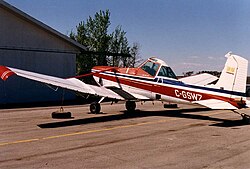
Air Tractor · 1973+
Air Tractor (AT-301 through AT-802F Fire Boss)
 i
iSpecifications
Performance
Cruise
166KTAS
Range
530nm
Climb
780fpm
Ceiling
13,000ft
Fuel Burn
Not verified
Fuel Cap.
250gal
MPG
—mpg
Stall (Vs0)
79KIAS
T/O roll
2000ft
Ldg roll
—ft
Size & weight
Seats
1
Useful Load
9,249lbs
Full-fuel payload
7,574lbs
Max gross
16,000lbs
Wingspan
59.2ft
Length
—ft
Engine
Engine
Pratt & Whitney Canada PT6A-65AG
Power
1295hp
TBO
3,600hrs
Overhaul
$425k
Hot section
$65keach
Owning it
Hull insurance
$26k/yr
Parts
excellent
Mechanics
specialist
Gear
Fixed
IFR
No
Category
certified
Full specification
V-speeds
Airframe
- Empty weight
- 6,751 lbs
- Max fuel weight
- 1,675 lbs
- Wing position
- low
Paperwork
- Type certificate
- A19SW
- Certification basis
- FAR Part 23 Restricted / CAR 8
These figures are typical for the model, not a specification for any individual aircraft. Real-world numbers vary with year, installed equipment, weight, modifications and engine condition — often by more than you would expect. Use them to compare types, and confirm anything you would act on against the Pilot's Operating Handbook for that specific airframe and a prebuy inspection.
Pricing
Typical
$2.1M
Range
$2.1M – $2.1M
Annual all-in
~$133k/yr
All-in at ~100 flying hours a year, using the midpoint of each range — the same figures broken out under “Cost to own” below. Your number will differ, and mostly for two reasons. Experience sets your insurance: a 2,000-hour pilot with recent training pays 30–40% less than a 200-hour owner, and student owners pay 20–40% more — on the same aircraft that is often a doubling. Location sets your hangar: a T-hangar runs $200–400 a month in the Midwest against $400–1,500 in a coastal metro, and an outside tie-down is less again. Engine reserves move too — a local shop reusing your serviceable cylinders can come in 30–50% under the national specialty-shop pricing we quote, though you trade the warranty and turnaround that comes with it. Reserves are money set aside toward a future overhaul, not a bill this year, and the annual inspection figure is the shop’s labor to look — whatever they find is separate.
Cost to own — fixed costs only
No handbook figures for this airplane give a fuel burn, so the fuel, per-hour and per-mile estimates cannot be computed. What follows is what ownership costs before you fly it — these do not change with hours.
Fuel, maintenance and the engine reserve are on top of this and rise with every hour flown — on a comparable airplane they typically exceed the fixed costs at around 100 hours a year. The page above says which document would supply the missing figures.
Strengths
- Industry-leading single-engine payload (800 gal hopper)
- Excellent OEM parts support and global dealer network
- Proven PT6A-65AG reliability in ag/fire environment
- Purpose-built for cargo hauling; no compromises
Weaknesses
- Expensive PT6A hot-section inspections driven by dust/salt exposure
- Repetitive wing spar AD compliance; fatigue cracking risk on high-time airframes
- Single-seat only; restricted category (no passenger ops)
- Specialist A&P skill required; generalist GA mechanics cannot service
Overview
This page's frontmatter describes the Model AT-802 / AT-802A — specifically S/N 802-0064 and subsequent, at 16,000 lb gross with the PT6A-65AG engine, Restricted Category, per FAA TCDS A19SW Section II. Every other model in the Variants table below is a row with its own figures, never blended into the numbers above.
A SPLIT FINDING, recorded prominently and NOT executed this session.
Air Tractor's product line is certificated across three separate FAA type
certificates, not one: A9SW covers the AT-250/300/301/302/400/400A, A17SW
covers the AT-401 through AT-504 (including the AT-502 this page's own
engine_model field used to cite), and A19SW — the certificate named in this
page's frontmatter — covers only the AT-602, AT-802 and AT-802A. Per
docs/CATALOG-SPLITTING-RULE.md Step 1, "different type certificate" is an
absolute hard split with no judgment call: the FAA has already decided these
are different aircraft, the same way 3A20 and A24CE settle the King Air 90 vs
200 split. This page currently holds ALL of them under one frontmatter and one
Variants table — a Step 1 conflation across three certificates. It is not
executed here because a split means new pages, new slugs, and repointed
inbound links, and five other agents are writing into this vault concurrently.
See data/vault/raw/tcds/tcds-a19sw-at802-limits-rev12-2026-09-11.md for the
full finding. This pass instead corrects and sources the AT-802/AT-802A
figures the frontmatter already represented (per its own prior comment,
"AT-802 representative of modern fleet") rather than widening the
conflation further.
Air Tractor is the dominant purpose-built agricultural aircraft manufacturer in North America, building single-seat low-wing turboprop (and originally radial-piston) ag-planes in Olney, Texas. The company was founded in 1974 by Leland Snow, who had previously designed the Snow S-1 (1953) and S-2 series (built in Olney from 1958) before selling Snow Aeronautical to Rockwell-Standard in 1965. After leaving Rockwell, Snow designed a new, larger ag plane beginning in 1972; construction of the prototype AT-300 (redesignated AT-301) started in 1972 and first flew in 1973. Air Tractor delivered its 1,100th airplane in 1993, the 2,000th in 1998, and has since become the world's highest-volume ag-plane manufacturer, with the AT-502 and AT-802 as flagship models.
Unlike most of the GA fleet covered in this wiki, Air Tractors are not personal airplanes — they are FAR Part 137 working machines flown by commercial aerial applicators and Part 137/firefighting contractors. They are certified in the Restricted Category and are not eligible for normal passenger-carrying operations. The AT-802F Fire Boss variant, equipped with Wipaire amphibious floats, is the world's most prolific Single Engine Air Tanker (SEAT) and functions as a Type III air tanker capable of scooping water from lakes and delivering up to 14,000 gallons per hour on extended attack. See Cargo Hauling for mission context; direct competitors are Ayres/Thrush S2R Thrush (the former Snow/Rockwell/Ayres lineage), and the much smaller/older piper-pawnee and Cessna 188 AGwagon / AGtruck / AGhusky.
Variants & History
| Variant | Years | Engine | HP/SHP | Gross Wt (lb) | Hopper (gal) | Notes |
|---|---|---|---|---|---|---|
| AT-301 | 1973–early 1980s | P&W R-1340 radial | 600 | 6,000 | 275 | Original piston model; most now retired or re-engined |
| AT-302 | 1977– | Lycoming LTP-101 turboprop | 600 | 6,000 | 300 | First turbine AT; limited production |
| AT-400/401 | 1979– | P&W PT6A-15AG / -34AG | 550–680 | 6,600–7,000 | 400 | First widely successful AT turbine |
| AT-402A/B | 1988–2001 | PT6A-15AG / -34AG | 680–750 | 7,000 (opt 8,600) | 400 | Mid-size workhorse |
| AT-502A/B | 1987– | PT6A-34AG / -45R / -65AG | 750–1,295 | 9,400 | 500 | Highest-volume modern AT |
| AT-504 | 1995– | PT6A-34AG | 750 | 9,400 | 500 | 2-seat trainer version of 502 |
| AT-602 | 1995– | PT6A-60AG | 1,050 | 12,500 | 630 | Mid-large spray platform |
| AT-802 / 802A | 1990– | PT6A-67AG | 1,350 | 16,000 | 800 | Two-seat/single-seat; largest single-engine ag plane |
| AT-802F Fire Boss | 2003– | PT6A-67AG / -67F | 1,350–1,600 | 16,000 | 820 (FRDS gate tank) | Wipaire 10000 amphib floats; SEAT |
| AT-802U | 2009– | PT6A-67F | 1,600 | 16,000 | n/a | Armed ISR/COIN variant (military) |
| AT-1002 | prototype | PT6A-67F | 1,600 | ~17,500 | 1,000+ | Announced larger variant |
Performance
Air Tractor performance is reported at the working weight the airplane flies at, not the clean ferry condition. The manufacturer's own current spec table (with spray equipment installed, at gross weight, 8,000 ft) books the AT-802A/PT6A-65AG at 166 KTAS; the PT6A-67AG (1,350 SHP) is available as an optional engine upgrade but Air Tractor does not publish a separate performance table for it, so no faster book figure is stored here — treat 166 KTAS as a slight underestimate on a -67AG-equipped airframe. Loaded with a full hopper and spray boom, working speed drops to 130–160 mph (113–139 KIAS) per the same source. No published landing-distance figure was found for the AT-802/AT-802A this session — the manufacturer's table gives takeoff distance (2,000 ft at 16,000 lb) but no landing roll; see validator_exempt in the frontmatter. With Fire Boss floats installed, the AT-802F is reported elsewhere to lose roughly 25 knots of cruise speed and require ~3,300 ft of water run to scoop a full 800-gallon load — this is carried over from the prior generated pass and not independently re-sourced this session, since the AT-802F/Fire Boss sits on the same A19SW certificate as the AT-802 (an STC float conversion per runbook rule 32) but was not the focus of this pass. Service ceiling (13,000 ft for the AT-802, carried over — not independently re-sourced this session) is academic — ag work happens at 5–50 ft AGL, and fire drops are run at 60–150 ft. High-altitude fire bases (Western US, Chile, Turkey) are the real density-altitude headache; hot-and-high scooping margins can be thin enough that operators reduce load fractions. The PT6A is exceptionally reliable, but the ag environment (dust, chemical corrosion, hot-section salt exposure in fire work) drives hot-section inspections well short of book intervals. See Maintenance Ecosystem.
Payload & Range
The AT-802A's 16,000 lb gross weight breaks down as: 6,751 lb empty (with spray equipment, per the manufacturer's own spec table), 1,675 lb usable fuel (250 gal usable, TCDS standard tank), leaving ~7,574 lb of hopper load against the certificate's 8,800 lb max hopper load limit for the PT6A-65/67 series — equivalent to roughly 800 gallons of water (at 8.34 lb/gal) or somewhat more spray mix depending on specific gravity. This is a working-load calculation: ferry range with full fuel and empty hopper is approximately 530 nm at the manufacturer's stated "economy cruise" setting (a different, slower setting than the 166 KTAS book cruise above — see Performance Notes); loaded with a full hopper, operational radius is measured in miles not hundreds-of-nm because the aircraft returns to base between loads.
On a Fire Boss configuration, float installation costs ~1,100 lb of useful load, so scooped water load drops to ~6,500 lb (780 gal) at sea-level standard day. Hot/high scooping (e.g., 6,000 ft MSL lake, ISA+20) further reduces scoop load to ~600 gal due to takeoff-performance limitations coming off the water. Fuel is typically reduced to 150 gal (1,005 lb) in heavy-attack operations to preserve scoop payload, trading on-station endurance for drop quantity. This payload-fuel tradeoff is the central tactical equation of SEAT operations and is why the Fire Boss thrives on short tanker-base-to-fire cycles rather than long ferry missions.
Sources:
- Air Tractor - Wikipedia
- Air Tractor AT-802 - Wikipedia
- Air Tractor AT-500 family - Wikipedia
- Air Tractor AT-602 - Wikipedia
- Air Tractor AT-400 - Wikipedia
- AT-802F Official Specifications
- AT-802U Official Specifications
- Air Tractor Heritage
- Covington Aircraft - Air Tractor PT6A History
- Fire Boss LLC
- planephd - Air Tractor AT-502B
- planephd - Air Tractor AT-802
- Alexander Aviation - Agricultural Aviation Insurance
- AgAir Update - How Much Does It Cost?
Mission Suitability
- Flight training (1) — Not a trainer; only the AT-504 two-seat variant is used for type-specific ag pilot transition, and seat-time on 502s is earned, not scheduled.
- Backcountry (2) — Long flat strips yes, unimproved mountain strips no. The tail-dragger gear is rugged but the wingspan and turning radius rule out most bush strips.
- Business travel (1) — Single-seat, restricted category, no passenger ops.
- Aerobatics (1) — Not approved.
- Cross-country (2) — Ferry flights are routine (Olney to delivery worldwide) but the airplane is not a travel machine.
- Cargo hauling (9) — This is literally what it exists for. 800 gallons of dispersant or 820 gal of water is industry-leading single-engine payload. See Cargo Hauling.
- Local fun (1) — No.
- Surveying (3) — Overkill; slower, cheaper platforms dominate. Some AT-802s carry sensor pods in military ISR roles (AT-802L Longsword, AT-802U Sky Warden).
Avionics Ecosystem
Ag Air Tractors historically ran minimal panels — airspeed, altimeter, engine gauges, a handheld GPS, and a Satloc or Ag-Nav GNSS swath guidance system dominating the glareshield. Modern factory panels integrate Garmin G600 TXi or G3X Touch PFDs with GPSS coupling to the Satloc/Ag-Nav system. Fire Boss aircraft add Trotter Controls or Simplex FRDS gate controllers, fire-suppression radios (VHF-AM, VHF-FM for ground coordination), and TCAS/ADS-B In displays. IFR equipage is rare but not unheard of on Fire Boss aircraft that ferry between bases. No autopilot is installed in ag ops; Fire Boss aircraft use single-axis wing levelers on ferry legs.
STCs & Modifications
- CP Products/Transland spray systems — Swath-width and droplet-spectrum upgrades; near-universal.
- Wipaire 10000 amphibious floats (Fire Boss conversion) — The defining AT-802F modification; ~$1.1M float set plus installation. Adds SEAT scooping capability.
- PT6A-65AG / -67AG re-engine STCs — Popular on older AT-502 airframes to add payload and climb margin.
- Trotter Controls FRDS Mk III gate — Computerized coverage-level dispersal on firefighting conversions.
- Covington and Dallas Airmotive hot-section/overhaul programs — Not STCs per se but the backbone of fleet support.
- Ag-Nav Guia / Satloc Bantam — GNSS flow-control swath systems integrated via STC.
Maintenance & Support
Air Tractor Inc. (Olney, TX) runs one of the best-supported OEM parts operations in general aviation — parts availability is excellent, and the factory directly supports the global fleet with AOG response. Authorized service centers include Lane Aviation (Rosenberg TX), Valley Air Crafts, Farm Air, Frost Flying, and international dealers in Australia, Brazil, South Africa, and Europe. PT6A overhauls are handled by Covington Aircraft, Dallas Airmotive, Standard Aero, and P&W Canada. A&P familiarity is a specialist skill — a generalist GA mechanic cannot reasonably work on an AT-802 without type-specific training. Typical operating cost (excluding engine reserve) runs $350–$550 per hour; with PT6A reserve and insurance, direct operating cost is $750–$1,100/hr for an AT-802. See Maintenance Ecosystem.
Expensive items: PT6A hot-section inspections ($45k–$85k), PT6A overhauls ($400k–$500k), spar-cap inspection/replacement ($50k–$250k), Wipaire float annual inspection and corrosion repair, spray system pumps and gearbox.
Valuation Factors
Air Tractor values are driven almost entirely by: (1) engine status (PT6A hot-section and overhaul position), (2) airframe fatigue life remaining against the spar AD, (3) spray system / fire gate configuration, and (4) avionics/GNSS system generation. See Aircraft Valuation Methodology.
One sourced, dated data point this session: a near-new 2026 AT-802A (150 hours, fully equipped) listed at $2,075,000 (AgAir Update Classifieds, retrieved 2026-09-11) — ABOVE the "$900k–$1.6M" used-market band below, which is consistent (new airplanes cost more than used ones) rather than a disagreement. That band itself is carried over from the prior generated pass and not independently re-sourced this session; every AT-802/802A/802AF listing checked on controller.com showed "Call for price."
Representative used-market pricing (2025–2026), unsourced, carried over from the prior generated pass:
- AT-301 (piston R-1340): $100k–$175k, mostly parts/re-engine projects
- AT-402B (mid-time): $300k–$475k
- AT-502A/B (mid-time PT6A): $500k–$950k
- AT-602 (mid-time): $700k–$1.1M
- AT-802A ag config: $900k–$1.6M
- AT-802F Fire Boss (with Wipaire 10000 floats): $1.8M–$3.0M+
A fresh PT6A-67AG overhaul is approximately $425,000 and can add nearly the full overhaul cost to resale value on an otherwise-sound airframe. Conversely, an airframe nearing spar-cap replacement can discount $150,000–$300,000 off comparables.
ADs & Common Problems
- Wing spar ADs — Air Tractor has a long history of wing lower-spar-cap fatigue ADs, particularly AD 2014-25-03 and follow-on actions requiring repetitive eddy-current inspection of the lower wing spar cap on AT-300/400/500/600/800 series. Compliance drives significant shop downtime and mid-life spar-cap replacement on high-time airframes.
- Hopper attach fittings — Recurring SB and AD actions on hopper-to-fuselage attach hardware due to corrosive chemical exposure.
- Flap system cables and bellcranks — Routine replacement items on high-cycle spray aircraft.
- PT6A hot-section distress — Ag environment (dust/sand ingestion) and fire work (particulate from smoke) both reduce time between hot-section inspections below published schedules.
- Tailwheel lock and steering — High-cycle components; common write-ups at annual.
- Spray boom corrosion and electrolytic pitting — Not airworthiness but huge maintenance cost center.
Pre-buy red flags: undocumented spar AD compliance status, corrosion under hopper and in lower fuselage, non-overhauled PT6A approaching hot-section, mismatched flight hours vs. fatigue cycles (agricultural fatigue spectrum is severe).
Insurance Profile
Agricultural turbine hull & liability is a specialist line. See GA Insurance Underwriting. Typical AT-802 hull value $1.2M–$1.8M; annual premiums run around $22,000–$32,000 for an experienced Part 137 operator with clean loss history, scaling higher for Fire Boss operations (wildland-fire pollution/drift exclusions, wire-strike exposure, water-scoop operations all add load). Operators with <1,000 hours ag time are typically uninsurable without a check-pilot mentoring program. Per-hour insurance cost is roughly $50–$70 at 500 annual hours. Pollution/drift liability is a mandatory add-on under FAR Part 137 that standard GA brokers routinely underwrite incorrectly.
For sale (0)
No listings for this model right now.
Also worth looking at
What buyers usually weigh against the Air Tractor (AT-301 through AT-802F Fire Boss) — aircraft flown for the same kind of mission.