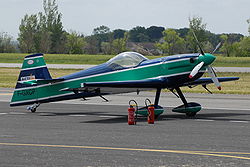
Aviat · 1971+
Pitts Special S-2
Specifications
Performance
Cruise
150KTAS
Range
247nm
Climb
2900fpm
Ceiling
—ft
Fuel Burn
14.0gph
Fuel Cap.
28gal
MPG
12.3mpg
Stall (Vs0)
56KIAS
T/O roll
554ft
Ldg roll
750ft
Size & weight
Seats
2
Useful Load
545lbs
Full-fuel payload
377lbs
Max gross
1,700lbs
Wingspan
20ft
Length
17.75ft
Engine
Engine
Lycoming AEIO-540-D4A5
Power
260hp
TBO
1,600hrs
Overhaul
$52k
Owning it
Hull insurance
$5k/yr
Parts
good
Mechanics
specialist
Gear
Fixed
IFR
No
Category
certified
Full specification
V-speeds
Airframe
- Empty weight
- 1,155 lbs
- Max fuel weight
- 168 lbs
- Height
- 6.4 ft
- Wing position
- mid
Obstacle performance
- Takeoff over 50 ft
- 860 ft
- Landing over 50 ft
- 1,200 ft
Paperwork
- Type certificate
- A8SO
- Certification basis
- Part 23 (FAR 23 through Amendment 23-6), Normal and Acrobatic categories
These figures are typical for the model, not a specification for any individual aircraft. Real-world numbers vary with year, installed equipment, weight, modifications and engine condition — often by more than you would expect. Use them to compare types, and confirm anything you would act on against the Pilot's Operating Handbook for that specific airframe and a prebuy inspection.
Pricing
Typical
$150k
Range
$90k – $270k
Annual all-in
~$22k/yr
All-in at ~100 flying hours a year, using the midpoint of each range — the same figures broken out under “Cost to own” below. Your number will differ, and mostly for two reasons. Experience sets your insurance: a 2,000-hour pilot with recent training pays 30–40% less than a 200-hour owner, and student owners pay 20–40% more — on the same aircraft that is often a doubling. Location sets your hangar: a T-hangar runs $200–400 a month in the Midwest against $400–1,500 in a coastal metro, and an outside tie-down is less again. Engine reserves move too — a local shop reusing your serviceable cylinders can come in 30–50% under the national specialty-shop pricing we quote, though you trade the warranty and turnaround that comes with it. Reserves are money set aside toward a future overhaul, not a bill this year, and the annual inspection figure is the shop’s labor to look — whatever they find is separate.
Cost to own — estimate
Set your yearly hours and local fuel price. Fixed costs (insurance, hangar, annual inspection) don't change with hours; fuel, maintenance and the engine reserve do.
- Fuel (14 gph)
- $9,100
- Engine reserve
- $3,250
- Propeller reserve
- $175
- Maintenance, parts & wear items ($12/hr)
- $1,200
- Insurance
- $1,350–$4,500
- Hangar
- $2,130–$5,325
- Annual inspection (labor only)
- $1,200
- Databases & subscriptions
- $400
- Total per year
- $21,978
- Per flight hour
- $220
- Miles flown / year (at cruise)
- 17,262 mi
- Cost per mile
- $1.27/mi
- Time in the air
- 2 hr 00 min
- Fuel burned
- 28 gal
- Out of pocket
- $275
Fuel, engine reserve and wear only. Insurance, hangar and the annual are already paid whether you make the trip or not, so they are not charged here.
Estimate, not a quote. Where a line shows a range, the total, per-hour and per-mile figures use its midpoint— insurance moves most with your experience and time in type, hangar with where you base the aircraft, so your own number could sit at either end. Annual inspection is the shop's labor to open and inspect — what they find is the maintenance line, which covers oil changes, plugs, tires, brakes, hoses, lights, a battery and vacuum pump amortised over their life, and the unscheduled squawks that are the largest and least predictable part of it. Reserves are sinking funds toward an overhaul, not a bill you pay this year — and note that a propeller is due on hours or calendar time, typically six years, so flying less does not put it off forever.
Strengths
- Reference two-seat aerobatic biplane; taught unlimited-style instruction
- 260 hp S-2B/S-2C climb 2,900 fpm; genuine vertical performance
- S-2C acrobatic gross weight equals normal gross (no weight penalty)
- Aviat still builds S-2C; parts support excellent across all models
Weaknesses
- Landing workload and directional control during rollout; no flaps, forward visibility poor on final
- Wood wing spars and glue joints; no AD forcing inspection
- Engine overhaul $52,000 at 1,600 hr TBO; recurring AD inspections (50–100 hr intervals) add $22k/year all-in
- Requires specialist mechanic; tight cowling makes routine access difficult
Overview
The two-seat Pitts is where almost everybody meets the type. It is the airplane aerobatic instruction happens in, the airplane a single-seat Pitts buyer gets signed off in, and — in S-2B and S-2C form — a competitive Intermediate and Advanced mount in its own right. Aviat Aircraft in Afton, Wyoming still builds the S-2C, which makes this one of the very few aerobatic biplanes you can order new.
Four certified models sit on FAA Type Certificate A8SO: the original 180 hp S-2 (approved March 1971), the 200 hp S-2A (June 1971, 259 built), the 260 hp S-2B (April 1983, 196 built) and the current 260 hp S-2C (June 1998). They divide cleanly into a 200 hp era and a 260 hp era, and that is the decision a buyer actually makes.
The single-seat S-2S is not on this page. Despite the designation it is a one-seat airplane — TCDS A8SO records "Number of Seats: One" — and it lives with the other single-seaters on Pitts Special S-1S. The vault's previous combined page described it as a "solo-capable two-seat," which is exactly how it ended up on the wrong side of a seat-count split.
Construction is welded steel tube, wood wing spars, fabric covering. Baggage allowance is 20 pounds across the whole series.
Variants & History
| Variant | Approved | Engine | HP | Gross, normal (lb) | Gross, acrobatic (lb) | Fuel (gal) | Vne (CAS) | Key differences |
|---|---|---|---|---|---|---|---|---|
| S-2 | 8 Mar 1971 | Lycoming IO-360-B4A | 180 | 1,500 | 1,500 | 24 (23 usable) | 203 mph / 176 kt | The original. Fixed-pitch propeller, acrobatic category only. Very few built, each requiring an individual FAA conformity inspection |
| S-2A | 11 Jun 1971 | Lycoming IO-360-A1A, later AEIO-360 | 200 | 1,575 | 1,500 | 24 (23 usable) | 203 mph / 176 kt | Constant-speed propeller and a normal category added. S/N 2206+ get a 3-inch-longer gear and a 2-inch-wider front cockpit. 259 built |
| S-2B | 6 Apr 1983 | Lycoming AEIO-540-D4A5 | 260 | 1,700 | 1,625 | 29 (28 usable) | 212 mph / 184 kt | The 260 hp six, wings and gear moved 6 inches forward, and a 5-gallon upper-wing auxiliary tank. 196 built |
| S-2C | 4 Jun 1998 | Lycoming AEIO-540-D4A5 | 260 | 1,700 | 1,700 | 29 (28 usable) | 212 mph / 184 kt | Reshaped wings, tail and ailerons, flat-bottomed fuselage, three-blade composite prop. +6/-5 g, and the only model whose acrobatic gross equals its normal gross. Current production |
Va and Vno are 154 mph CAS (134 kt) throughout. Baggage is 20 lb throughout.
The 200 hp / 260 hp line is the real decision. The S-2A climbs about 1,900 fpm and cruises around 124 kt; the S-2B and S-2C climb about 2,900 fpm at light weights and cruise 145-152 kt. That is a different airplane in the vertical, which is where aerobatic performance lives. The market, oddly, does not separate them as sharply as the numbers do — see Valuation Factors.
The S-2C's acrobatic gross weight is a genuine, underrated advantage. An S-2B loses 75 lb of allowable weight the moment you enter the acrobatic category; the S-2C does not. With two adults aboard, that is the difference between legal aerobatics and a fuel-burn-off plan.
Performance
The cruise, burn and range on this page are one triple at one setting, and Aviat states the burn directly rather than leaving it to be derived. AOPA's own S-2B/S-2C factory comparison table gives 14 gallons per hour at 75% power for the S-2C, independently corroborated by Skytamer's Aviat-sourced spec sheet (same 14 gph, alongside the 150 KTAS / 1.6 hr / 284 statute-mile (247 nm) cruise figure "w/30 minute reserve at 75% power"). This corrects an earlier version of this page, which back-derived roughly 12 gph from the range and endurance figures instead of using the manufacturer's own stated number — a plausible-looking arithmetic answer that was about 15% off the real one, and exactly the kind of error this catalogue is being re-sourced to catch.
Two useful cross-checks. Owner reports put the S-2C at 145 knots on 11 gph at 10,000-12,000 ft, the same airplane at a slightly lower setting. And the published S-2B pair — 152 kt cruise, 277 nm range, 14.5 gph per the same AOPA table — is the same 75% reference condition on the 200 hp-lighter-feeling but otherwise similar S-2B. Fly it hard at 75% and it is roughly a 280 nm airplane with reserve; fly it at 65% and both the still-air range and the fuel economy improve, though no published 65% figure exists for this specific airframe (unlike the S-1S, where Jane's gives an explicit lower-power figure). None of that is a contradiction, it is just power settings, but you have to say which one you mean.
The published 2,900 fpm climb is at minimum weight, which is the manufacturer's own phrasing and matters: solo with half fuel is not two adults with full fuel, and the difference in a 1,700 lb airplane is large.
There are no flaps. The 56 KIAS stall is the same clean and dirty, approach speeds are 70-80 KIAS, and steep approaches are flown by slipping. Forward visibility on final and during rollout is poor — the standard technique is a forward slip so you can see where you are going. Landing accidents dominate this type's record: "failure to maintain directional control during the landing rollout" recurs across NTSB findings. It is harder to land than a Citabria or an Extra and every honest owner says so.
The inverted fuel and oil systems on the AEIO engines are what make sustained inverted flight and outside figures possible. Confirm they are present and functional on any airframe you look at, particularly on the earliest S-2A serials whose certified engine was the plain IO-360-A1A.
Payload & Range
S-2C — 545 lb useful load, 29 gal (28 usable), 20 lb maximum baggage, 1,700 lb gross in BOTH categories.
| Scenario | Fuel (gal) | Fuel (lb) | Occupants (lb) | Baggage (lb) | Remaining (lb) | Range with reserve (nm) |
|---|---|---|---|---|---|---|
| Full fuel, two 170 lb adults | 29 | 174 | 340 | 20 | 11 | 247 |
| Full fuel, two 185 lb adults | 29 | 174 | 370 | 1 | 0 | 247 |
| Two 200 lb adults, reduced fuel | 22 | 132 | 400 | 13 | 0 | ~160 |
| Solo aerobatic sortie | 20 | 120 | 200 | 0 | 225 | ~1.4 hr of flying |
S-2B — same 1,700 lb normal gross but only 1,625 lb in the acrobatic category. Two 185 lb adults and full fuel is legal at 1,700 lb for the transit, and 75 lb over the acrobatic limit for the aerobatics. You either fly off 12 gallons first or you fly with less fuel. On the S-2C this problem does not exist, and that is worth money.
The honest summary: a two-seat Pitts carries two average adults, full fuel and a toothbrush. It does not carry two large adults, full fuel and anything else.
See also Pitts Special S-1S for the single-seat airplanes.

1989 Aviat Husky
Husky A-1 · Tundra Tires · Backcountry Ready
Mission Suitability
- Aerobatics (10): The reference two-seat aerobatic biplane. The S-2C is approved to +6/-5 g and is competitive through IAC Advanced; the S-2A is a fine Sportsman and Intermediate airplane. Crucially it is the type in which you can be taught unlimited-style aerobatics.
- Local fun flying (8): Enormous fun, and a second seat means you can share it. Marked down for landing workload and currency demands.
- Flight training (3): Aerobatic and tailwheel transition training only, for pilots who already fly. Emphatically not a primary trainer. But it is the standard machine for signing somebody off to fly a single-seat Pitts.
- Cross-country (2): About 250 nm between stops with a reserve, 20 lb of baggage, no flaps, VFR only. People do fly them long distances. It takes a while and a lot of fuel stops.
- Business travel (1): Two tandem seats, 20 lb of luggage, VFR.
- Backcountry (1): Wrong airplane entirely.
- Cargo hauling (1): 20 pounds.
- Surveying (1): No endurance, no downward visibility, no work platform.
Avionics Ecosystem
- Typical used airframe: airspeed, altimeter, tachometer, engine gauges, slip-skid ball and an accelerometer. Deliberately minimal.
- Mandatory modern addition: ADS-B Out. Panel space is the constraint.
- Factory S-2C: a fuller panel is available and the S-2C has more room behind it than earlier models. Electronic fuel quantity indication is approved on S/N 6001 and up per TCDS A8SO Note 5.
- Sensible upgrades: Garmin G5 or GI-275, a compact GPS, an intercom, a second accelerometer for the rear seat.
- IFR: no. Not equipped, not the mission.
STCs & Modifications
- Smoke system. Effectively standard on airshow and competition airframes.
- Propeller options. The S-2B is approved for the Hartzell two-blade, an MT MTV-9 composite (TCDS Note 3) and a three-blade Hartzell composite (Aviat kit S-2B-526). The S-2C ships with the three-blade composite. Prop choice measurably changes vertical performance and vibration.
- Control stick replacement to the 0.058-inch wall section — terminates a 50-hour repetitive AD inspection.
- Wing attach fitting modification per Aviat SB 25 — terminates another.
- Longeron modification per Aviat kit S-2-513 — repairs cracking found under AD 97-26-20 but does not terminate the 100-hour repetitive inspection. Read that twice; sellers get it wrong.

1980 Cessna 152
Honest Trainer · Mid-Time Engine · Fresh Annual
Maintenance & Support
- Annual inspection: $2,000-$4,000, plus the AD-driven 50-hour and 100-hour items, which on a 100-hour-a-year airplane is a meaningful recurring cost in its own right.
- Engine overhaul: $52,000 for the AEIO-540 at a 1,600-hour TBO. Aerobatic duty — inverted running, rapid throttle movement, sustained high power — is exactly the service Lycoming set that reduced TBO for.
- Parts: good. Aviat supports every certified model on the type certificate.
- Mechanic familiarity: specialist. Biplane rigging, wood spars, fabric and aerobatic structural inspection. Mechanics report that even routine access is difficult under the tight cowling.
- All-in: roughly $22,000/year at 100 hours, driven by the engine reserve, insurance and the recurring AD inspections rather than by fuel.
Valuation Factors
- S-2A: eight listings at $89,500-$169,500 (September 2026).
- S-2B: three listings at $92,000-$169,500; two others at $135,000-$151,800.
- S-2C: $154,000-$270,000, median $212,000; one at $250,000. New from Aviat has been reported around $400,000.
- The S-2A and S-2B trade in the same money, which the performance gap does not justify. A 200 hp S-2A and a 260 hp S-2B at $135,000 are not the same airplane. This is the single most exploitable inefficiency on this page, and it is probably explained by the S-2A's AD 97-26-20 longeron burden depressing its price while a mid-time S-2B carries the same inspection.
- The engine reserve is the biggest recurring number. AEIO-540 overhaul $52,000 at a 1,600-hour TBO is $32.50/hr, before accessories (+$3,000-$8,000) and removal and installation (+$2,000-$5,000).
- Terminated ADs add real value: the 0.058-inch stick, the SB 25 fitting modification, and a longeron history that is clean rather than repaired.
- The Aircraft Bluebook does not track the Pitts Special. There is no authoritative valuation for this type — only comparables. Sample widely.
ADs & Common Problems
Airworthiness Directives. Indexed from the CAA of New Zealand AD schedule for Pitts S-1 and S-2 series aircraft (26 September 2019). Confirm applicability against the FAA record by serial number.
- AD 97-26-20 — fuselage upper longerons. The big one for this page. Applies to the S-2A (all serials) and the S-2B (S/N 5000-5350). Inspect the longerons aft of the rear cabane strut and forward of the instrument panel for cracks with a 10x glass, per Aviat SB 24, from 300 hours total time and then every 100 hours. Cracks must be modified per Aviat kit S-2-513 before further flight, and the modification does not remove the repetitive inspection. The AD also requires either an accelerometer permanently marked at +6 g and -3 g plus a g-limit placard, or a placard reading AEROBATIC MANEUVERS PROHIBITED. An S-2A or early S-2B carrying the second placard is not an aerobatic airplane until somebody does the work. Ask which option the airframe is flying under, in writing, before you view it.
- AD 96-10-12 — flight control stick. S-2, S-2A and S-2B with a 0.035-inch wall stick. Dye-penetrant inspection per Aviat SB 23 at 1,000 hours then every 50 hours, terminated by fitting the 0.058-inch stick. The S-2C is not on the applicability list.
- AD 96-12-03 R2 — aft lower fuselage wing attach fittings. S-2, S-2A (all serials) and S-2B (S/N 5000-5336). Every 50 hours until modified per Aviat SB 25. The unsafe condition is in-flight wing separation.
- Others in the same schedule: 72-19-02, 72-19-05, 73-07-06, 73-16-06, 76-16-08, 85-01-04, 90-20-05, 91-23-02, 96-09-06, 2006-12-07.
Common problems and pre-buy focus.
- Landing damage. Ground loops and prop strikes are the type's signature event. Inspect lower wings, gear box and gear legs. A low-airframe-time airplane with a recent major overhaul is a question, not a selling point.
- Wood spars and glue joints, reached through the wing inspection panels. There is no wood-spar AD on this type, which means nobody is forced to look.
- Fabric condition and age.
- Control system slop at every rod end. This is what a Pitts' precision is made of.
- Engine mount bushing wear — visible as a spinner or nose bowl sitting off-center.
- Anti-drag wires in the upper wing.
- Tailwheel shimmy from a relaxed leaf spring.
- Canopy latch and emergency release.
- Rigging. Known to affect spin characteristics. Ask who rigged it and when.
- Aerobatic hours versus cruise hours. The logbook will not distinguish them. A competition airframe carries fatigue a touring one does not.
Insurance Profile
- Hull: roughly $3,500-$6,000/year on a $150,000 hull, which is 2.3%-4% and above the published 0.8%-2.5% band. Aerobatic operation, a taildragger, and a claims history that runs to total losses all push it up.
- Liability: $800-$1,500/year.
- Pilot minimums: tailwheel endorsement plus documented aerobatic instruction, and commonly 25+ hours in type or a formal type checkout. Low-time applicants are declined rather than surcharged more often than in any other piston class.
- Aerobatics must be named as covered. Standard policies exclude it, and aerobatic hull cover typically runs 25-50% over a standard hull rate. Airshow work needs a separate rider.
- These bands are extrapolated. The vault's insurance reference holds no binder for an aerobatic type. Replace with a real quote when one is obtained.
For sale (0)
No listings for this model right now.
For sale elsewhere (1)
Current ads on Barnstormers, checked daily. Photos, full details and the seller are on the listing site.
1977 Pitts Special S-2
Listed on BarnstormersAlso worth looking at
What buyers usually weigh against the Pitts Special S-2 — aircraft flown for the same kind of mission.