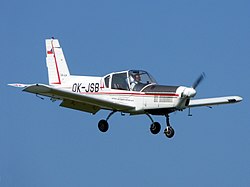
Grob · 1985+
Grob G115 Tutor
 i
iSpecifications
Performance
Cruise
124KTAS
Range
621nm
Climb
—fpm
Ceiling
20,000ft
Fuel Burn
Not verified
Fuel Cap.
38gal
MPG
—mpg
Stall (Vs0)
—KIAS
T/O roll
—ft
Ldg roll
—ft
Size & weight
Seats
2
Useful Load
706lbs
Full-fuel payload
479lbs
Max gross
2,183lbs
Wingspan
32.8ft
Length
24.75ft
Engine
Engine
Lycoming AEIO-360-B1B
Power
180hp
TBO
2,000hrs
Overhaul
$32k
Owning it
Hull insurance
$2k/yr
Parts
fair
Mechanics
specialist
Gear
Fixed
IFR
Yes
Category
certified
Full specification
V-speeds
Airframe
- Empty weight
- 1,477 lbs
- Max fuel weight
- 227 lbs
- Height
- 7.9 ft
- Wing position
- low
Paperwork
- Type certificate
- A57EU
- Certification basis
- 14 CFR Part 21 / Part 23 (Amdts 23-1 to 23-32), validated from LBA TC No. 1078
These figures are typical for the model, not a specification for any individual aircraft. Real-world numbers vary with year, installed equipment, weight, modifications and engine condition — often by more than you would expect. Use them to compare types, and confirm anything you would act on against the Pilot's Operating Handbook for that specific airframe and a prebuy inspection.
Pricing
Typical
$140k
Range
$85k – $220k
Annual all-in
~$15k/yr
All-in at ~100 flying hours a year, using the midpoint of each range — the same figures broken out under “Cost to own” below. Your number will differ, and mostly for two reasons. Experience sets your insurance: a 2,000-hour pilot with recent training pays 30–40% less than a 200-hour owner, and student owners pay 20–40% more — on the same aircraft that is often a doubling. Location sets your hangar: a T-hangar runs $200–400 a month in the Midwest against $400–1,500 in a coastal metro, and an outside tie-down is less again. Engine reserves move too — a local shop reusing your serviceable cylinders can come in 30–50% under the national specialty-shop pricing we quote, though you trade the warranty and turnaround that comes with it. Reserves are money set aside toward a future overhaul, not a bill this year, and the annual inspection figure is the shop’s labor to look — whatever they find is separate.
Cost to own — fixed costs only
No handbook figures for this airplane give a fuel burn, so the fuel, per-hour and per-mile estimates cannot be computed. What follows is what ownership costs before you fly it — these do not change with hours.
Fuel, maintenance and the engine reserve are on top of this and rise with every hour flown — on a comparable airplane they typically exceed the fixed costs at around 100 hours a year. The page above says which document would supply the missing figures.
Strengths
- Purpose-built trainer with honest handling and forgiving stall characteristics
- All-composite airframe with excellent glide ratio (~11:1) and clean aerodynamics
- 180 hp AEIO-360 (G115E/EG) delivers strong climb and density-altitude performance
- Side-by-side seating with bubble canopy offers superior visibility
Weaknesses
- Specialist maintenance required; few A&Ps outside military bases comfortable with composite repair
- Parts lead times 4-8 weeks from Germany; airframe-specific components euro-priced
- Composite airframe vulnerable to hail damage, UV crazing, and delamination — pre-buy inspection critical
- Two-seat, 37.77 gal capacity limits cross-country range and payload flexibility
Overview
The Grob G115 is an all-composite, two-seat, side-by-side, low-wing, fixed-gear trainer designed and built by Grob Aircraft SE (formerly Burkhart Grob Luft- und Raumfahrt) in Tussenhausen-Mattsies, Germany. First flown in November 1985 and FAA-certified in 1987, the G115 leveraged Grob's glider-heritage composite expertise to create one of the first all-GRP (glass-reinforced plastic) certified powered trainers in the world. Its sleek lines, bubble canopy, and low-wing layout made it feel more like a stepping-stone to fast-touring aircraft than the Cessna 150/172 it competed against.
The airframe's defining moment came when the G115E variant was selected by the UK Ministry of Defense as the Tutor T.1, replacing the Scottish Aviation Bulldog for Elementary Flight Training across the RAF's University Air Squadrons, Air Experience Flights, and as an initial pilot-screening type. 99 airframes were delivered to the RAF beginning in 1999 under a contract operated by VT Aerospace (later Babcock). The Egyptian Air Force took 74, the Indonesian Air Force, Jordan, Bangladesh, and others followed. Civilian G115s remain popular with European flight schools and a small but loyal US owner base — a few dozen N-registered aircraft, mostly G115C variants that arrived in the early-to-mid 1990s. The retirement of the RAF Tutor fleet (beginning mid-2020s) is gradually releasing low-time, well-maintained G115Es back onto the civilian market, which is slowly reshaping the used-price landscape.
Variants & History
| Variant | Years | Engine | HP | Prop | MGW (lbs) | Notes |
|---|---|---|---|---|---|---|
| G115 | 1985-1989 | Lycoming O-235 | 115 | Fixed-pitch | ~1,874 | Initial production; original short fin. Civil club sales. |
| G115A | 1989-1990 | Lycoming O-235 | 115 | Fixed-pitch | 1,874 | Taller fin/rudder, relocated tailplane. Mainly European aero clubs. |
| G115B | 1990-1992 | Lycoming O-320-D1A | 160 | Constant-speed | 2,050 | Added CS prop; stronger climb. |
| G115C | 1992-1995 | Lycoming O-320-D1A | 160 | Constant-speed | 2,050 | Uprated airframe, IFR panel option. Bulk of US N-registered fleet. FAA cert. |
| G115C2 | 1994-1997 | Lycoming AEIO-320 | 160 | Constant-speed | 2,050 | Inverted oil/fuel systems; aerobatic capable (+6/-3g). |
| G115D | 1995-1998 | Lycoming AEIO-360-B1F | 180 | Constant-speed | 2,050 | 180 hp aerobatic variant; MT composite prop. |
| G115D2 Heron | 1997-1999 | AEIO-360-B1F | 180 | 3-blade CS | 2,050 | Six purchased by Royal Navy for University of Wales/Birmingham UAS. |
| G115E Tutor / EG | 1999-present | Lycoming AEIO-360-B1B | 180 | 3-blade MT CS | 2,183 | RAF Tutor T.1 (99 airframes). Reinforced airframe, larger fuel, IFR, +6/-3g. Current production. |
A naming gap worth flagging. FAA TCDS A57EU (the certificate this page cites) names "G115EG" and nowhere names "G115E" — every N-registered example on this certificate is, by the FAA's own paperwork, a G115EG. "G115E" is the name Grob and the RAF used for the Tutor T.1 as originally delivered; whether it is identical to, or a predecessor of, the FAA's G115EG was not settled by anything read for this pass. This page's frontmatter describes the G115EG specifically, since that is the only "E"-family model the certificate actually lists.
Performance
Book cruise for the G115E at 75% power is 124 KTAS, but operators report realistic 115-118 KTAS at 8.5-9.5 gph is typical when flown warm-day with two pilots and fuel. The composite airframe is very clean — glide ratio is excellent (around 11:1), making engine-out training feel deceptively benign compared to the Bulldog or PA-28 it replaced.
The 180 hp AEIO-360 gives the G115EG noticeably stronger climb than the 115 hp early G115/G115A and makes it happy at density altitudes that would hobble an O-235-powered 150. (No sourced climb-rate figure survived this pass's re-sourcing — see the confidence note — so no specific fpm number is claimed here.) However, the earlier 115 hp G115/G115A variants are noticeably underpowered in warm weather and should not be confused with the Tutor-spec airplane. The bubble canopy gets hot in summer — G115 cockpits run notably warmer than a high-wing Cessna — and the low-wing layout means no natural shade on the ramp.
The airframe is stressed for +6/-3g in the aerobatic variants (C2, D, D2, E). Control harmony is often described as closer to a Zlin or Extra than a Cessna, with light, crisp ailerons and a positive, honest stall.
Payload & Range
Corrected 2026-09-11: the certificate (TCDS A57EU) gives the G115EG's usable fuel as 37.77 US gal, not the 32 gal previously used here — that figure belongs to the lower-powered G115B. With 37.77 gallons usable (227 lbs of fuel) and a 706 lb useful load on the G115EG:
- Full fuel + 2 pilots (180 lbs each): 706 - 227 - 360 = 119 lbs of margin for baggage — unlike the previous (wrong-fuel-figure) version of this page, the G115EG comfortably carries two FAA-standard pilots with full fuel and a bag apiece. This is a meaningful correction, not a rounding change.
- Two pilots + reduced fuel (20 gal = 120 lbs): 706 - 120 - 360 = 226 lbs of baggage margin, but the baggage locker is physically limited to 121 lb (TCDS) / roughly 40 lbs per bag in practice.
- No sourced fuel-burn or range-at-a-stated-setting figure was found for this pass (see the confidence note), so a specific "practical range" number is not given here — the book range of 621 nm (unqualified power setting, per flugzeuginfo.net) should not be read as an endurance-at-cruise figure.
The G115 is a training and fun-flying airplane first; cross-country utility is a real but constrained secondary mission.

1980 Cessna 152
Honest Trainer · Mid-Time Engine · Fresh Annual
Mission Suitability
Flight Training (9/10): This is the G115's reason for existing. The RAF chose it over a field of modern competitors for ab-initio training, and it excels at the role — honest handling, forgiving stall, robust composite airframe, side-by-side seating with excellent visibility, and (in 180 hp trim) enough performance for unusual-attitude recovery and basic aerobatic instruction. See Flight Training.
Local Fun Flying (8/10): Great canopy, aerobatic capability on C2/D/E variants, and cruise performance that beats a 172 make this a genuinely fun airplane for the Sunday-morning sightseeing and airshow-adjacent pilot. See Local Fun Flying.
Aerobatics (7/10): The G115D/D2/E are certified for +6/-3g and used routinely by the RAF and aero clubs for basic aerobatic training (loops, rolls, spins, stall turns, basic competition figures to Sportsman level). It is not an Extra 300 or Pitts — the 180 hp pulling a 2,183 lb airframe means vertical penetration is limited and it won't snap or tumble like dedicated unlimited machines. Think "aerobatic trainer," not "competition mount." See aerobatics.
Cross-Country (4/10): Two seats, 37.77 gallons usable, and a 621 nm unqualified book-range figure (no stated power setting; treat as an upper bound, not a planning number) limit this to short-to-medium XC missions. Comfortable cockpit and IFR-capable avionics help, but payload is tight.
Business Travel (2/10): Two seats and limited baggage rule this out for most business use.
Backcountry (1/10): Fixed gear but with small tires, a low wing, low ground clearance, and a composite airframe with no STCs for tundra tires or brush flying. Avoid.
Cargo Hauling (1/10): 706 lb useful load with two full-size pilots and fuel leaves almost nothing for baggage.
Surveying (3/10): Low-wing view is poor for survey, endurance is modest, and the aircraft was never adapted for camera ports.
Avionics Ecosystem
Entry tier ($85k-$120k, older G115A/B/C civilian): Steam-gauge six-pack, single nav/com (KX155), transponder, basic intercom. VFR-only or marginal IFR. European-spec avionics may need US replacement.
Mid tier ($120k-$170k, G115C/D with upgrades or low-time Tutor retirees): Garmin GNS 430W or GTN 650, second com, ADS-B Out (GTX 335 or similar), digital engine monitor, upgraded intercom. Solid IFR trainer.
High tier ($170k-$220k, late G115E/EG or refurbished): Garmin G500 TXi or dual G5 with GTN 650Xi, GFC 500 autopilot, ADS-B In/Out, engine data to the PFD. RAF Tutor refurbishments sometimes retain the MoD-spec Bendix/King KLN 94 and KMD 850 MFD but are being modernized to Garmin. See Avionics Pricing Reference.
The G115 panel is relatively small — fitting a full G3X Touch dual-screen retrofit is possible but requires care with composite panel bonding, and Grob Aircraft SE approval is effectively required to maintain European EASA certification, adding paperwork overhead compared to a metal-airframe Cessna.
STCs & Modifications
The G115 has a sparse STC ecosystem compared to legacy metal trainers:
- Garmin GTN/G5/G3X retrofits — typically via field approval (FAA) or EASA Minor Change; installations common on civilian G115C and ex-military Tutors.
- ADS-B Out upgrades — required for US N-registered aircraft; Garmin GTX 335/345 and uAvionix tailBeacon approved.
- LED nav/landing/strobe lighting — Whelen and AeroLEDs installations common.
- MoD-to-civilian conversion package (Grob Aircraft SE, for ex-RAF Tutors) — removes military-specific equipment, re-certifies to standard civil configuration, updates manuals.
There is no STC for higher gross weight, VGs, STOL kits, floats, or tundra tires — the composite airframe and its European certification basis make aftermarket mods far less common than for a Cessna or Piper.

1989 Aviat Husky
Husky A-1 · Tundra Tires · Backcountry Ready
Maintenance & Support
Parts availability: fair. Grob Aircraft SE (Tussenhausen-Mattsies, Germany) remains the OEM and actively supports the fleet, providing IPCs, AMMs, AFMs, and service bulletins through productsupport@grob-aircraft.com. Airframe-specific parts (composite panels, canopy parts, control surfaces) must come from Germany, which means 4-8 week lead times and euro-denominated pricing. Engine, prop, brakes (RAPCO PMA parts now available), tires, and standard avionics are straightforward.
Mechanic familiarity: specialist. Outside of former military operator bases and a handful of US shops with ex-RAF experience, finding an A&P who has worked on a composite Grob is difficult. Composite repair requires specific training and approved materials; a typical general-aviation A&P will be reluctant to sign off on anything beyond routine inspection. Owner communities (Grob Owners Group, European clubs) maintain lists of qualified shops.
Typical annual cost: $13,000-$16,000 for an owner-operated G115E flown 100 hours/year, excluding engine reserve. Annuals run $3,000-$5,000 with no squawks, more with any composite skin work. Engine reserve at $32,000 / 2,000 hrs = ~$16/hr.
Expensive items: Canopy replacement ($15-20k), composite repair after hail or hangar rash, propeller overhaul (MT composite prop ~$5,000), landing gear leg replacement. See Maintenance Ecosystem.
Valuation Factors
Grob G115 values are driven by variant, engine time, aerobatic capability, and whether the airframe is civilian-origin or ex-military Tutor:
- Engine time (AEIO-360 at 2,000 TBO): runout costs ~$32,000 overhaul plus accessories. Value swings $25-30k mid-TBO to fresh.
- Variant premium: G115E/EG commands 30-50% over G115C for comparable panels due to stronger airframe, 180 hp, and aerobatic rating.
- Ex-military Tutors entering the civil market are typically well-maintained with comprehensive records but require the Grob SE civilianization package ($15-25k) and sometimes panel modernization.
- IFR avionics package adds $15-40k depending on tier.
- Gelcoat and paint condition matters more on composite airframes than metal — a mid-life repaint on a composite is $15-25k with proper primer.
Typical price tiers:
- $85-120k: Older G115A/B, higher-time engine, steam gauges, VFR
- $120-160k: G115C/C2, mid-time engine, basic IFR
- $160-200k: G115D or low-time G115E (civilian or recently released Tutor), modern GPS panel
- $200-220k+: Late-build G115EG or fully refurbished Tutor with glass panel
See Aircraft Valuation Methodology for engine-time and avionics adjustment formulas.
ADs & Common Problems
- Rudder hinge and control surface inspection ADs — EASA/FAA issued recurring inspections on control surface bonding and hinge integrity on several G115 variants; compliance is documented in the logbook and checked at annual.
- Fuel system ADs (2022, FAA) — addressed fuel selector valve wear on G115EG airplanes.
- Canopy latch and frame corrosion inspections — composite-to-metal interface at the canopy frame is a known wear point; pre-buy must include careful canopy inspection.
- Landing gear leg attachment bolts — periodic torque checks; any hard landing should trigger a detailed inspection of the composite gear leg attachments.
- Seatbelt attach points — composite airframes with +6g ratings have strict inspection intervals on harness hardpoints.
Pre-buy red flags: Hail damage (composite repair is expensive and non-obvious), UV-degraded gelcoat (resin crazing and yellowing on top surfaces), improperly repaired delamination, non-Grob-approved paint jobs (wrong primer can degrade composite skin), and any prior hard-landing history. Because there are few G115-experienced A&Ps outside dedicated operators, a pre-buy by a Grob-familiar shop is essential.
Insurance Profile
The G115 is an unusual case for US insurance underwriters — fixed-gear, trainer category, but composite airframe and a non-mainstream type with limited qualified A&P network. Typical hull premiums run $1,500-$2,200 annually for an owner-flown G115E with 200+ hours, standard PPL + complex (not required) + type-specific transition, on a $150k hull. Underwriters may require:
- 5-10 hours dual with a G115-experienced CFI before solo.
- If aerobatic flying is intended, a separate aerobatic endorsement and (sometimes) an aerobatic hull rider.
- Evidence of recent tailwheel-equivalent control authority training (not required, but underwriters like it).
Because parts lead times can be long, insurers may scrutinize hangar storage more than for a Cessna. See GA Insurance Underwriting.
For sale (0)
No listings for this model right now.
Also worth looking at
What buyers usually weigh against the Grob G115 Tutor — aircraft flown for the same kind of mission.