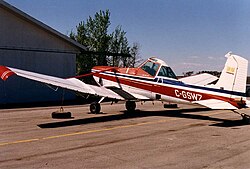
Ayres/Thrush Aircraft · 1977+
Ayres/Thrush S2R Thrush

Specifications
Performance
Cruise
130KTAS
55% power
Range
Not verified
55% power
Climb
—fpm
Ceiling
12,000ft
Fuel Burn
Not verified
55% power
Fuel Cap.
228gal
MPG
—mpg
Stall (Vs0)
—KIAS
T/O roll
1650ft
Ldg roll
—ft
Size & weight
Seats
1
Useful Load
Not verified
Full-fuel payload
—lbs
Max gross
10,500lbs
Wingspan
—ft
Length
—ft
Engine
Engine
Pratt & Whitney Canada PT6A-34AG
Power
750hp
TBO
3,600hrs
Overhaul
$347k
Hot section
$65keach
Owning it
Hull insurance
$28k/yr
Parts
good
Mechanics
specialist
Gear
Fixed
IFR
No
Category
certified
Full specification
V-speeds
Airframe
- Max fuel weight
- 1,528 lbs
- Wing position
- low
Paperwork
- Type certificate
- A4SW
- Certification basis
- CAR 8 / FAR Part 23 (Restricted, Agricultural)
These figures are typical for the model, not a specification for any individual aircraft. Real-world numbers vary with year, installed equipment, weight, modifications and engine condition — often by more than you would expect. Use them to compare types, and confirm anything you would act on against the Pilot's Operating Handbook for that specific airframe and a prebuy inspection.
Pricing
Typical
$335k
Range
$335k – $335k
Annual all-in
~$83k/yr
All-in at ~100 flying hours a year, using the midpoint of each range — the same figures broken out under “Cost to own” below. Your number will differ, and mostly for two reasons. Experience sets your insurance: a 2,000-hour pilot with recent training pays 30–40% less than a 200-hour owner, and student owners pay 20–40% more — on the same aircraft that is often a doubling. Location sets your hangar: a T-hangar runs $200–400 a month in the Midwest against $400–1,500 in a coastal metro, and an outside tie-down is less again. Engine reserves move too — a local shop reusing your serviceable cylinders can come in 30–50% under the national specialty-shop pricing we quote, though you trade the warranty and turnaround that comes with it. Reserves are money set aside toward a future overhaul, not a bill this year, and the annual inspection figure is the shop’s labor to look — whatever they find is separate.
Cost to own — fixed costs only
No handbook figures for this airplane give a fuel burn, so the fuel, per-hour and per-mile estimates cannot be computed. What follows is what ownership costs before you fly it — these do not change with hours.
Fuel, maintenance and the engine reserve are on top of this and rise with every hour flown — on a comparable airplane they typically exceed the fixed costs at around 100 hours a year. The page above says which document would supply the missing figures.
Strengths
- Purpose-built cargo hauler: 4,200+ lb payload from rough strips unmatched in certified GA
- Proven turbine reliability: PT6A-34AG with established overhaul base and support network
- High pilot visibility: elevated single-seat cockpit optimized for aerial work
- Continuous production since 1956: 2,000+ airframes built, strong used-market availability
Weaknesses
- Extreme specialist maintenance: requires ag-turbine A&Ps; general-aviation shops cannot support it
- Restricted-category only: no IFR, no cross-country viability, commercial-use mandate
- High operating cost: $80K–$140K annually at 400 hr/year with major hot-section expenses
- Single-seat liability: no redundancy, limited utility outside ag application
Overview
This page's frontmatter describes the Model S2R-T34 "510P" — specifically the S/N T34-451-and-subsequent block certificated on FAA TCDS A4SW Section III at 10,500 lb gross with 228 gal usable fuel, Restricted Category only. The Thrush family spans piston radials through the 1,300+ SHP 710P; every other variant is a row in the Variants table below with its own figures, never blended into the numbers above. A4SW's Normal-category limitations for this model (fewer, older-weight allowances) are on a different certificate, A3SW, and are not used here.
The Ayres/Thrush S2R is the archetypal American agricultural aircraft — a rugged, single-seat, low-wing turboprop purpose-built for aerial application of fertilizers, herbicides, insecticides, and seed. Originally designed by Leland Snow as the Snow S-2 in 1956, the type has been continuously refined and produced for nearly 70 years under four successive owners: Snow Aeronautical (Olney, TX), Rockwell-Standard/Aero Commander (as the Thrush Commander), Ayres Corporation (Albany, GA, from November 1977), and since 2003 Thrush Aircraft Inc. / Thrush Aircraft LLC (still in Albany).
It competes head-to-head with the Air Tractor (AT-301 through AT-802F Fire Boss) AT-series and is found wherever row crops are grown at scale — the American South, the Mississippi Delta, Argentina, Brazil, Australia, Eastern Europe, and Sub-Saharan Africa. Over 2,000 airframes have been built across all variants. Unlike the smaller piper-pawnee (a 150–235 HP piston trainer-scale ag plane), the Thrush is a serious commercial platform carrying a 500 US gallon hopper and typically flown by full-time ag operators earning revenue by the acre.
Thrush Aircraft Inc. filed Chapter 11 bankruptcy on September 5, 2019 after years of sluggish orders and cash flow trouble. HHM Aircraft Financing purchased the assets on November 4, 2019 and reorganized the business as Thrush Aircraft, LLC under CEO Mark McDonald, resuming deliveries in 2020. The current lineup centers on the 510P2/510P2+ (PT6A-34AG, 750 SHP) and the 710P (PT6A-65AG, 1,300 SHP), with an emerging firefighting/SEAT (single-engine air tanker) market alongside traditional ag work.
Variants & History
| Variant | Years | Engine | HP/SHP | Hopper (US gal) | Gross Wt (lb) | Notes |
|---|---|---|---|---|---|---|
| Snow S-2A/S-2B | 1958–1965 | Continental W670 / P&W R-985 | 220–450 | 150–280 | 4,000 | Original Snow-built piston |
| Rockwell Thrush Commander 600 | 1966–1977 | P&W R-1340 Wasp | 600 | 400 | 6,000 | Rockwell-era piston radial |
| Ayres S2R-600 (S2R-R1340) | 1977–early 1990s | P&W R-1340 Wasp | 600 | 400 | 6,000 | Ayres piston radial; basic model |
| Ayres S2R-800 (S2R-R1820) | 1978–1990s | Wright R-1820 Cyclone | 1,200 | 400–510 | 8,000 | "Bull Thrush"; most powerful piston |
| Ayres S2R-T11 / Turbo-Thrush | 1980s | PT6A-11AG | 500 | 400 | 6,000 | Low-end turbine conversion |
| Ayres S2R-T15 | 1980s | PT6A-15AG | 680 | 400 | 7,500 | Mid-tier turbine |
| Ayres S2R-T34 / 510P | 1983–present | PT6A-34AG | 750 | 510 | 10,500 | The volume seller; "510 Thrush" |
| Ayres S2R-T45 | 1990s | PT6A-45AG | 1,100 | 510 | 10,500 | Higher-power T34 derivative |
| Ayres S2R-T65 / 660 / 710 | 1990s–present | PT6A-65AG / -67AG | 1,295–1,376 | 660–710 | 10,500–16,000 | "Bull Thrush" turbine; firefighting |
| Thrush 510G | 2012–present | GE H80-200 | 800 | 510 | 10,500 | GE H80 variant, eliminates 250 lb ballast |
| Thrush 510P2 / 510P2+ | 2021–present | PT6A-34AG | 750 | 510 | 10,500 | Redesigned forward fuselage, avionics bay |
| Thrush 710P | current | PT6A-65AG/-67AG | 1,300–1,376 | 710 | 16,000 | Flagship, $1.95M new (2024) |
Most variants differ only forward of the firewall. The welded 4130 steel-tube fuselage, aluminum semi-monocoque tailcone, and constant-chord low wing with integral hopper aft of the firewall are common to all models. The single-place cockpit sits high on the fuselage spine for visibility over the hopper and nose; two-place trainer versions exist but are uncommon.
Performance
Book cruise of 130 KTAS (150 mph at 55% power, per Thrush's own 510P spec sheet)
is mostly academic — the Thrush spends its working life at working power in the
spray run, well below this figure, not cross-country. Fuel burn, range, rate
of climb and stall speed are NOT stored in the frontmatter for this variant:
the certificate publishes none of them, the manufacturer's 2014 spec sheet
gives only a 45–60 GPH working range (not tied to any one cruise row) and a
takeoff distance, and no Thrush Airplane Flight Manual — the document the
certificate itself names as required equipment (Rev. 6, 14 Feb 2014) — could
be obtained this session. See validator_exempt in the frontmatter for what
was searched.
Takeoff distance at max gross (10,500 lb) is 1,650 ft, per the
manufacturer's own spec sheet — the only runway figure tied to a stated
weight, and it matches the certificated max gross exactly. It is not labelled
ground roll vs. obstacle-clearance distance; treat it as approximate.
The sheet's separate "landing distance as usually landed" (600 ft) states no
weight or condition and is deliberately not stored as
landing_ground_roll_ft — an operational figure is not the same claim as a
sea-level/standard-day/max-gross one, and the runbook's own traps section
exists to catch exactly this kind of unlabelled substitution. The -34AG and
-65AG are agricultural-rated variants of the PT6 with higher TBOs and lower
ITT margins than commuter PT6s, reflecting the dusty environment.
Payload & Range
The figures below use the pre-2026-09-11 generated useful-load estimate
(~5,600 lb, from an empty weight of ~4,900 lb) as illustrative only — neither
figure is sourced this session (see validator_exempt.empty_weight_lbs in
the frontmatter for why: secondary sources scatter 33% and none independently
confirm a number for this specific serial block). Treat the loadout math below
as directionally right, not as a cited fact, until a real empty weight is
found. The 44 GPH ferry-burn figure below is similarly a carried-over
estimate, not the manufacturer's own 45–60 GPH working range.
Unlike travel GA, the Thrush's "payload-range" dynamic is ferry-vs-working, not seats-vs-fuel:
- Ferry mission (empty hopper, full fuel): 228 gal × 44 GPH ≈ 5 hours, ~600 nm still air, ~4,500 lb useful load remaining after fuel. More than enough to reposition across several states.
- Typical working loadout (full 510 gal hopper ≈ 4,300 lb of water-based chemical, ~40 gal fuel for a 45-minute mission): Takeoff at or slightly over 10,500 lb gross; hopper empties on the first swath pass, and the airplane becomes a 6,500 lb empty-ferry aircraft for the return to the loading strip. This cycle repeats 40–80 times per day in peak season.
- Maximum dry load (seed, fertilizer): Dry product density allows higher weight-for-volume, and many operators will fill to gross weight (~5,600 lb of product) even though the 510 gallon hopper volume isn't fully used.
- Hot / high / heavy: Loading strips at 3,000 ft MSL on a 95°F day reduce useful chemical load by 500–1,000 lb on the 750 SHP -34AG. The 1,300 SHP 710P eats these conditions much more easily, which is why it dominates the high-density-altitude Western and African markets.
Related pages: Air Tractor (AT-301 through AT-802F Fire Boss) (primary competitor), piper-pawnee (entry-level piston ag plane), Cargo Hauling (mission definition), Aircraft Valuation Methodology, GA Insurance Underwriting, Maintenance Ecosystem.
Mission Suitability
- Cargo hauling (9/10): This is what the Thrush does — 4,200+ lb of liquid or dry cargo in a 510 gal hopper (710 gal on the 710P), lifted out of short, rough strips. No other certified GA airplane class is more productive per acre.
- Surveying (3/10): Not purpose-built for it, but SEAT (Single-Engine Air Tanker) operators fly Thrushes on fire patrol and retardant drops; the high pilot station gives excellent downward visibility.
- Backcountry (4/10): Outstanding unimproved-strip performance empty, but single-seat, no cargo volume aft of the hopper, and $1M+ capital cost make it completely impractical as a recreational bush plane.
- Cross-country (2/10): 130 KTAS and 400 nm range at 44 GPH burning Jet-A is fine for repositioning, terrible as a traveling machine.
- Training / Aerobatics / Local fun / Business travel (1/10): Single-seat restricted-category commercial workhorse; none of these missions apply.
See Cargo Hauling for how the Thrush scores against the Air Tractor (AT-301 through AT-802F Fire Boss) AT-502/AT-802 lineup.
Avionics Ecosystem
Ag airplanes live in a completely different avionics world than travel GA. A modern 510P2+ panel typically includes:
- Satloc / AgNav / Hemisphere GPS guidance — Differential/SBAS GPS with lightbar guidance; the primary "nav" on an ag airplane, driving swath guidance and variable-rate application.
- Flow controllers (Satloc Bantam, Hemisphere IntelliFlow) — Close the loop between GPS groundspeed and spray pump output for constant gal/acre.
- Basic round-gauge or Garmin G3X panel — Engine instruments, airspeed, altimeter; most ag operations are day VFR below 500 ft AGL, so IFR capability is largely absent and the platform is not certified IFR.
- Garmin GTR 225 / GNC 255 comm/nav and a basic transponder — the minimum for controlled-airspace transits.
- Appareo Stratus ESG / Garmin GTX 345 ADS-B Out — required in rule airspace.
Night/IFR ag operations exist but are specialist. Firefighting variants add Wulfsberg FM radios for interagency comms and sometimes FLIR.
STCs & Modifications
- Goering Conversion (Goering Aircraft, Inc. — Hobbs, NM): The dominant turbine conversion STC for older R-1340 and R-1820 piston Thrushes, installing a PT6A-34 or -45. A Goering-converted airframe typically commands $150K–$300K over an otherwise equivalent piston machine.
- Hopper upgrades from 400 → 510 → 660 → 710 gallons on appropriate airframes.
- Gross weight increase STCs on T34/T45 airframes, usually 10,500 → 11,000+ lb under restricted category.
- Dispersal systems: CP-11TT nozzles, Micronair AU-5000 rotary atomizers, Transland dry spreaders, SATLOC/AgNav smart systems.
- Firefighting conversion (Fire Boss-style but single-fuselage tank): retardant gates, foam injection, external long-range tanks.
- Night vision goggle (NVG) compatibility for SEAT operators.
Maintenance & Support
- Factory support: Thrush Aircraft LLC in Albany, GA provides parts, structural components, and tech support; parts availability is generally good for current production variants. Older Rockwell-era Thrush Commander 600 and out-of-production R-1820 "Bull Thrush" parts are harder to source and often come from breakers.
- A&P familiarity: Specialist. Ag maintenance shops (Covington Aircraft, Queen Bee Air Specialties, Farm Air Inc., Aero-Mod, Southeastern Aircraft Parts) dominate the support network. A general-aviation A&P without ag or PT6 experience is not a viable maintainer for a working Thrush.
- Engine support: P&WC dealer network (Covington Aircraft in Oklahoma is the leading PT6A-34AG/-65AG overhaul facility in the US), plus GE Aerospace for the H80 in 510G airframes.
- Annual operating cost (owner-operator, 400 hours/year): Roughly $80K–$140K all-in including fuel, insurance, hangar, engine reserves, airframe maintenance, and annual inspection. Hot sections every 1,800 hours are a significant scheduled expense.
- Big-ticket items: Wing spar life extension or replacement ($150K+), PT6 overhaul ($400K–$500K), prop overhaul ($25K–$40K), hopper system refurbishment.
See Maintenance Ecosystem for the ag-turbine support supply chain.
Valuation Factors
Thrush valuation is driven by four things: (1) turbine time since overhaul or hot section, (2) airframe time and spar life, (3) hopper size and dispersal system, (4) guidance/flow control package vintage.
A disagreement worth recording rather than resolving: the only dated, sourced asking price found this session — a 1997 510P at $335,000 (aircraft.com, retrieved 2026-09-11) — sits BELOW the "$400K–$750K" band this section claims for 1990s–2000s S2R-T34/510P airframes. That band is carried over from the pre-2026 generated pass and not independently re-sourced; only one live data point could be found against it this session (see the market passage — Controller's two current listings and AgAir Update's classifieds show no visible price at all). Treat the tiers below as unverified until a broader sample or a Vref/Bluebook entry is checked.
Rough market tiers (2025–2026), unsourced, carried over from the prior generated pass:
- 1970s–early 80s Ayres S2R-600/R-1340 piston, original radial: $90K–$180K. A dying segment — avgas availability and R-1340 parts drive operators to convert.
- Goering-converted S2R-T34 on an older airframe: $250K–$450K depending on TBO status.
- 1990s–2000s Ayres S2R-T34 / 510P: $400K–$750K, heavily dependent on engine reserve and guidance upgrades.
- 2010s Thrush 510P / 510G: $800K–$1.2M.
- Current 510P2+ / 710P new factory: $1.35M (510P2+) to $1.95M+ (710P) as of 2024.
Engine reserve dominates pricing: a mid-time PT6A-34AG with 1,800 hours since overhaul on a 3,600-hour TBO represents ~$200K of deferred cost against a ~$425K overhaul, and buyers bid accordingly. See Aircraft Valuation Methodology for the overhaul-reserve discounting framework applied to turbine ag singles.
ADs & Common Problems
The Thrush is a restricted-category commercial airplane flown hard, and its AD history reflects that:
- Wing spar lower cap inspections — recurring AD on S2R and S2R-T series wings for fatigue cracks at the main spar lower cap, particularly on airframes with high spray-run hours. Life-limited spar cap replacements are a six-figure event.
- Aft fuselage / empennage attachment fittings — AD-driven inspections for corrosion and cracking from chemical exposure.
- Landing gear leg attach fittings — inspections driven by the harsh operating environment (rough strips, hard landings, heavy loads).
- PT6A-34AG / -65AG compressor section — dust erosion is the dominant maintenance driver; compressor washes are daily/weekly procedures, and hot section inspections come up on calendar, not just hours.
- Flight control cable fraying at seal grommets from ag chemical wicking.
- Hopper sump/plumbing corrosion — constant from caustic liquid chemistries.
Pre-buy red flags: hidden corrosion under the hopper, cracked engine mount tubes behind the firewall, spar cap pit corrosion, undocumented gear-up or wire-strike repairs (wire strikes are common in ag work), and PT6 compressor blades with erosion beyond service limits.
Insurance Profile
Agricultural aviation is its own insurance market — see GA Insurance Underwriting for category definitions. Key facts:
- Hull insurance: $18K–$40K/year on a $600K–$1.2M Thrush, a ratio of roughly 2–4% of hull value (vs. ~1–1.5% for travel GA). The high rate reflects the real risk: wire strikes, ditch impacts, engine FOD from dirt strips, and the 50+ low-altitude turnarounds per day.
- Liability: Harder to place than hull. Chemical drift claims, crop damage, and third-party property damage drive aggregate limits up; $1M smooth is typical, higher is available but expensive.
- Underwriting focus: Pilot's ag experience is paramount. A 10,000-hour ag pilot pays dramatically less than a 500-hour pilot transitioning in, regardless of total time. Carriers want season-count, make/model time, PT6 time, and annual recurrent training (typically NAAA PAASS or Ag Flight School).
- Primary markets: AIG, Falcon, Old Republic Aerospace, Berkley Aviation, specialty brokers like Aviation Specialty Insurance (ASI), USAIG.
Low-time ag pilots often cannot obtain insurance on a Thrush at any price and must build hours in a smaller Pawnee or Ag-Cat first.
For sale (0)
No listings for this model right now.
Also worth looking at
What buyers usually weigh against the Ayres/Thrush S2R Thrush — aircraft flown for the same kind of mission.