Cessna · 1971–1983
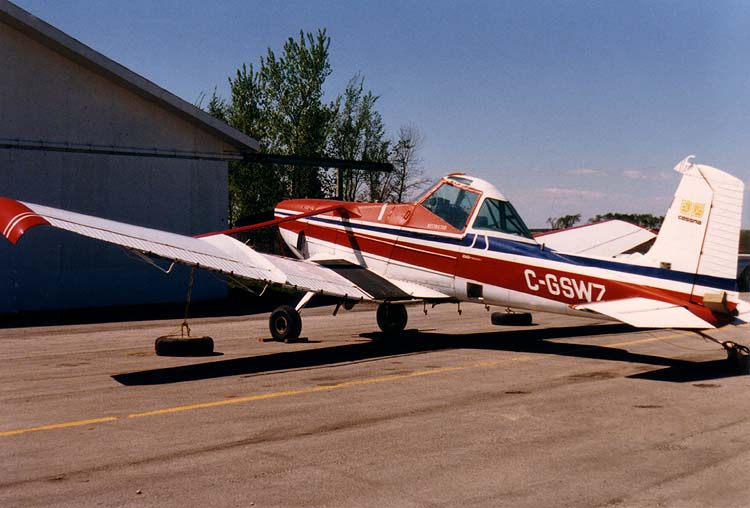
Cessna A188B AGwagon / AGtruck
Specifications
Performance
Cruise
Not verified
Range
Not verified
Climb
—fpm
Ceiling
—ft
Fuel Burn
Not verified
Fuel Cap.
52gal
MPG
—mpg
Stall (Vs0)
—KIAS
T/O roll
—ft
Ldg roll
—ft
Size & weight
Seats
1
Useful Load
1,986lbs
Full-fuel payload
1,674lbs
Max gross
4,200lbs
Wingspan
41.7ft
Length
25.8ft
Engine
Engine
Continental IO-520-D
Power
300hp
TBO
1,700hrs
Overhaul
$48k
Owning it
Hull insurance
$13k/yr
Parts
good
Mechanics
specialist
Gear
Fixed
IFR
No
Category
certified
Full specification
V-speeds
Airframe
- Empty weight
- 2,214 lbs
- Max fuel weight
- 312 lbs
- Height
- 8.4 ft
- Wing position
- low
Paperwork
- Type certificate
- A9CE
- Certification basis
- Part 21 (Restricted Category) / Part 23 (Normal Category)
These figures are typical for the model, not a specification for any individual aircraft. Real-world numbers vary with year, installed equipment, weight, modifications and engine condition — often by more than you would expect. Use them to compare types, and confirm anything you would act on against the Pilot's Operating Handbook for that specific airframe and a prebuy inspection.
Pricing
Typical
$110k
Range
$55k – $175k
Annual all-in
~$24k/yr
All-in at ~100 flying hours a year, using the midpoint of each range — the same figures broken out under “Cost to own” below. Your number will differ, and mostly for two reasons. Experience sets your insurance: a 2,000-hour pilot with recent training pays 30–40% less than a 200-hour owner, and student owners pay 20–40% more — on the same aircraft that is often a doubling. Location sets your hangar: a T-hangar runs $200–400 a month in the Midwest against $400–1,500 in a coastal metro, and an outside tie-down is less again. Engine reserves move too — a local shop reusing your serviceable cylinders can come in 30–50% under the national specialty-shop pricing we quote, though you trade the warranty and turnaround that comes with it. Reserves are money set aside toward a future overhaul, not a bill this year, and the annual inspection figure is the shop’s labor to look — whatever they find is separate.
Cost to own — fixed costs only
No handbook figures for this airplane give a fuel burn or a cruise speed, so the fuel, per-hour and per-mile estimates cannot be computed. What follows is what ownership costs before you fly it — these do not change with hours.
Fuel, maintenance and the engine reserve are on top of this and rise with every hour flown — on a comparable airplane they typically exceed the fixed costs at around 100 hours a year. The page above says which document would supply the missing figures.
Strengths
- Purpose-built ag platform with proven 3,976-aircraft production history
- Textron parts support and established ag-specialist mechanic network
- 300 hp IO-520-D offers solid power-to-weight for ag work
- Hopper design provides built-in crash barrier between engine and pilot
Weaknesses
- Single-seat Restricted-category airframe limits utility outside ag missions
- Chemical corrosion is the defining fleet problem — requires aggressive inspection and wash-down discipline
- Engine overhaul costs ($48k) and hard ag duty cycles mean cylinder work well before TBO
- Wing attach fittings and spar carry-through fatigue from high-G ag pull-ups; eddy-current inspection mandatory at pre-buy
Overview
The Cessna 188 is a purpose-built single-seat agricultural airplane produced by Cessna from 1966 to 1983 (with final deliveries trickling out of Wichita in 1985 as the last light-single lines were shut down). Cessna designed the 188 from a clean sheet to compete with the Piper PA-25 Pawnee / PA-36 Pawnee Brave in the crop-dusting and aerial-application market, leveraging Cessna 180/185 tailwheel DNA but with a low wing, a chemical hopper between the engine and the pilot (acting as a crash barrier), and a high-visibility rear cockpit. A total of 3,976 airframes were built across four variants: 53 AGpickups, 1,589 AGwagons, 1,949 AGtrucks, and 385 AGhuskys. The 188 was the backbone of U.S. and Australian small-field ag work in the 1970s and early 1980s, and a meaningful fleet (several hundred) is still actively flying ag in 2026, though the heavier, more powerful Air Tractor (AT-301 through AT-802F Fire Boss) AT-402/502 has largely displaced the 188 in commercial operations. Today most 188s on the civil register are owned either by small owner-operator ag outfits or by private pilots who have converted them to non-ag utility haulers.
Variants & History
| Variant | Years | Engine | HP | MGW Restricted (lb) | MGW Normal (lb) | Hopper | Notes |
|---|---|---|---|---|---|---|---|
| 188 AGwagon 230 | 1966-1971 | Continental O-470-R | 230 | 3,800 (188 Series tier) | — | 200 gal | Entry-level; TCDS Section I |
| A188 AGwagon 300 | 1966-1971 | Continental IO-520-D | 300 | 4,000 (A188 Series tier) | — | 200 gal | TCDS Section II |
| 188A/188B AGwagon A/B | 1969-1972 | O-470-R | 230 | 4,000 tier | — | 200 gal | TCDS Sections III/IV |
| 188B AGpickup | 1971-1976 | O-470-S | 230 | — | — | 151 gal | TCDS Section V; only 53 built |
| A188B AGwagon C / AGtruck (this page) | 1971-1983 | IO-520-D | 300 | 4,200 (majority tier) | 3,300 | 200-280 gal | TCDS Section VI, majority serial block; bulk of the fleet |
| T188C AGhusky | 1978-1983 | Continental TSIO-520-T | 310 | 4,400 | — | 280 gal | TCDS Section VII; turbocharged; 385 built |
Performance
No performance figures are stored on this page — see "Category & Scope"
above and the frontmatter's validator_exempt entries. Book cruise, stall
speeds and runway distances quoted for "the AGwagon" or "the AGtruck"
elsewhere are not verified against a primary document this session and
should not be assumed accurate for this specific certificated configuration.
What IS certificate-sourced: the airplane's base structural limits (Vne 158
kt / Vno 126 kt / Va 103 kt IAS, majority block) and the additional 105-knot
ceiling the Restricted Category imposes specifically during ag dispensing —
a real, separate number from Vne/Vno that a working pilot flies to, not the
airframe's outer limit.
Payload & Range
Weight and cargo figures on this page describe the RESTRICTED category
configuration (4,200 lb) only. Useful load at that weight is carried at
1,986 lb (empty weight 2,214 lb) — both unverified against a primary
document this session, but arithmetically self-consistent — see
validator_exempt. The certificate's own "Maximum Cargo" figure for a
standard (non-"T"-suffix) hopper is 1,670 lb; "T"-suffixed serials carry
an 1,800 lb hopper instead (per TCDS NOTE 5). No range or endurance figure is
stored this session — the mission is short working loops from a strip
adjacent to the field, with the hopper rather than the fuel tanks governing
most flights, and any "how far can it fly" figure needs a burn rate this
page does not have a sourced value for.
Mission Suitability
- Cargo Hauling (9): A hopper-based airframe built around carrying chemical, not people — see Cargo Hauling. Non-ag haul missions require a Normal-category conversion (3,300 lb, not this page's 4,200 lb figure).
- Surveying (4): Possible as a single-seat low-altitude platform if the hopper bay is converted, but cost-inefficient versus a Cessna 172 or experimental.
- Flight Training (1): Single-seat, Restricted category, heavy tailwheel — disqualified.
- Cross-Country / Business (1): Single seat, no IFR. No range figure is stored this session; historically quoted numbers are not repeated here uncited.
- Aerobatics (1): Not certificated for it, heavy, low-Vne airframe.
- Local Fun (2): A small cult of ex-ag owners fly de-restricted 188s for fun — a niche taste.
- Backcountry (2): Low wing and narrow-track tailwheel make it a poor off-airport choice versus a Super Cub or 185.
Avionics Ecosystem
Ag 188s are famously spartan. Typical working panel: airspeed, altimeter, tachometer, cylinder head and oil temps, fuel pressure, magnetic compass, a single comm radio, and a dedicated ag-guidance GPS for swath tracking (Satloc, Hemisphere AG, or AgNav — not IFR navigators). Most 188s have no vacuum system and no attitude indicator. Conversion panels on de-restricted 188s sometimes add a basic comm/ADS-B stack; glass-panel upgrades are effectively unheard of.
STCs & Modifications
Per runbook rule 32, absence from TCDS A9CE is not evidence any of the following do not exist — a Supplemental Type Certificate is by construction never listed on the base data sheet:
- Spray boom / atomizer conversions (Transland, CP Products, Micronair): standard ag equipment.
- Dry spreader (Transland, Swathmaster): converts liquid ag to granular.
- Gross weight increase STCs: several shops market a 4,400 lb MGW for AGtrucks, matching the AGhusky's certificated tier — this would be a further, STC-based restricted-weight increase beyond this page's stored 4,200 lb TCDS figure, not a correction to it.
- Ferry tank / non-ag conversion: replaces the hopper with an auxiliary fuel tank or cargo pod for bush work.
None of these was independently confirmed via drs.ts search-stc this
session — flagged as trade knowledge, not verified against a primary FAA
record, consistent with the caution this task asked for on unverified
figures.
Maintenance & Support
- Parts availability: good — Textron still supports the 188 through its single-engine parts channel; ag-specific hardware (hoppers, spray booms) is supported by Transland and similar specialty shops.
- Mechanic familiarity: specialist — a general A&P can do an annual, but ag-experienced shops are where most serious 188 structural and corrosion work happens.
- Engine overhaul: $48,000 per
reference/engine-overhaul-pricing.md(IO-520 family). TBO 1,700 hr (unverified this session, seevalidator_exempt).
Valuation Factors
- Engine: a fresh IO-520-D overhaul (this page's sourced $48,000 figure) materially moves hull value in either direction.
- Corrosion history: a hangared, well-washed 188 with a documented wash-down routine commands a real premium over a tied-down hull.
- Restricted vs. Normal-category conversion: aircraft still on Restricted category for ag use have a narrower buyer pool but are the only ones usable for commercial spraying at this page's stored 4,200 lb weight — a Normal-category conversion caps out at 3,300 lb.
- Airframe total time: ag airframes commonly see very high hours; spar and fitting condition matters more than raw total time.
Price figures below are carried from the prior (uncited) page — see
validator_exempt. They were not previously attached to a different model's
data the way the Caravan page's were, but they are not independently
re-verified this session either.
ADs & Common Problems
- AD 2011-10-09 (repetitive): seat rail and seat lock inspection — applies across Cessna 100/200 series including the 188.
- Continental cylinder ADs: cylinder AD cycles affect IO-520/TSIO-520 powered 188s; budget for cylinder work as a routine item in ag use.
- Wing attach fittings and spar carry-through: not a formal AD but a well-known inspection point — ag 188s see repeated high-G pull-ups that fatigue the wing root. An eddy-current inspection at pre-buy is effectively mandatory.
- Corrosion from chemicals: the defining 188 problem. Fertilizer and pesticide residue attacks the lower fuselage, spar caps and control cables. Lift every inspection panel.
- Hopper gate and door seals: leak chemicals into the cockpit area.
- Engine time abuse: ag engines are run hard — full power on takeoff, chopped on pull-ups, quick descents. Expect cylinder work well before TBO.
Pre-buy red flags: unknown wash-down history, un-inspected wing attach fittings, hopper/gate corrosion, incomplete Cessna service-bulletin compliance.
Insurance Profile
The 188 lives in a specialized ag insurance pool — commercial ag use, private non-ag conversions, and Restricted-category endorsements each carry different underwriting. Figures on this page are carried from the prior pass and not independently re-verified this session.
For sale (0)
No listings for this model right now.
Also worth looking at
What buyers usually weigh against the Cessna A188B AGwagon / AGtruck — aircraft flown for the same kind of mission.


