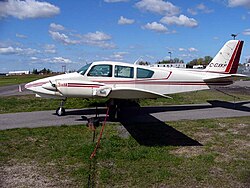
Wing Aircraft · 1966–1982
Wing Derringer D-1
 i
iSpecifications
Performance
Cruise
184KTAS
65% power @ 13,000 ft
Range
1,007nm
65% power @ 13,000 ft
Climb
1700fpm
Ceiling
19,600ft
Fuel Burn
Not verified
65% power @ 13,000 ft
Fuel Cap.
88gal
MPG
—mpg
Stall (Vs0)
55KIAS
T/O roll
—ft
Ldg roll
—ft
Size & weight
Seats
2
Useful Load
980lbs
Full-fuel payload
450lbs
Max gross
3,050lbs
Wingspan
29.2ft
Length
23ft
Engine
Engine
Lycoming IO-320-B1C or IO-320-C1A
Power
320hp
TBO
2,000hrs
Overhaul
$42keach
Engines
2
Owning it
Hull insurance
$7k/yr
Parts
poor
Mechanics
rare
Gear
Retractable
IFR
Yes
Category
certified
Full specification
V-speeds
Airframe
- Empty weight
- 2,070 lbs
- Max fuel weight
- 530 lbs
- Height
- 8 ft
- Wing position
- low
Paperwork
- Type certificate
- A9WE
- Certification basis
- CAR 3
These figures are typical for the model, not a specification for any individual aircraft. Real-world numbers vary with year, installed equipment, weight, modifications and engine condition — often by more than you would expect. Use them to compare types, and confirm anything you would act on against the Pilot's Operating Handbook for that specific airframe and a prebuy inspection.
Pricing
Typical
$175k
Range
$120k – $250k
Annual all-in
~$29k/yr
All-in at ~100 flying hours a year, using the midpoint of each range — the same figures broken out under “Cost to own” below. Your number will differ, and mostly for two reasons. Experience sets your insurance: a 2,000-hour pilot with recent training pays 30–40% less than a 200-hour owner, and student owners pay 20–40% more — on the same aircraft that is often a doubling. Location sets your hangar: a T-hangar runs $200–400 a month in the Midwest against $400–1,500 in a coastal metro, and an outside tie-down is less again. Engine reserves move too — a local shop reusing your serviceable cylinders can come in 30–50% under the national specialty-shop pricing we quote, though you trade the warranty and turnaround that comes with it. Reserves are money set aside toward a future overhaul, not a bill this year, and the annual inspection figure is the shop’s labor to look — whatever they find is separate.
Cost to own — fixed costs only
No handbook figures for this airplane give a fuel burn, so the fuel, per-hour and per-mile estimates cannot be computed. What follows is what ownership costs before you fly it — these do not change with hours.
Fuel, maintenance and the engine reserve are on top of this and rise with every hour flown — on a comparable airplane they typically exceed the fixed costs at around 100 hours a year. The page above says which document would supply the missing figures.
Strengths
- Exceptionally fast for twin-engine class (184 kt cruise)
- Long range (1,000+ nm) with twin redundancy
- Unique, highly collectible design by aerospace legend
- Clean airframe with excellent power-to-weight ratio
Weaknesses
- Orphan airframe—no parts supply, factory, or type club
- Extremely rare (≈7 flying); virtually no A&P familiarity
- Maintenance costs $8–15k annually; structural repairs $42k+
- Two seats only; minimal baggage; high approach speeds
Overview
The Wing Derringer D-1 is a rare two-seat light twin designed by John Thorp in the late 1950s (originally as the Thorp T-17, a twin-engine derivative of his T-11 Sky Scooter) and developed into production form by George Wing of the Hi-Shear Corporation. George Wing — inventor of the Hi-Shear rivet and Hi-Lok fastener and a successful aerospace-fastener industrialist — wanted a "sports car" of the sky: a tiny, fast, retractable-gear twin with the footprint of a trainer and the speed of a Bonanza.
The prototype (N3621G) first flew on May 1, 1962, at Torrance, California. A second prototype flew in November 1964 but was lost weeks later to an in-flight airframe failure. The type certificate (A9WE, corrected this session from a previous, incorrect A21WE — see the frontmatter note) was issued December 20, 1966, but Hi-Shear never put the aircraft into serial production. In 1978, George Wing left Hi-Shear to form the Wing Aircraft Company specifically to build the Derringer. Wing Aircraft completed one pre-production aircraft and six production machines before entering bankruptcy in July 1982. One additional aircraft was later assembled from parts, and seven unfinished airframes were sold off. Total production: approximately 12 airframes, of which roughly 7 remain on the FAA register.
Total production is roughly 12 airframes, not the 30 sometimes quoted. Every source checked this session — Wikipedia's production narrative and this page's own pre-existing text — agrees on the count above (2 prototypes, 1 pre-production plus 6 production Wing Aircraft-built examples, 1 later assembled from parts). No source found supports a production run in the thirties; if a higher figure is circulating, it has not been corroborated here and should not be assumed correct without a named source.
The type certificate is no longer actively administered. FAA's own DRS record for A9WE (checked 2026-09-12) carries no "Current" revision at all — the last technical revision (Rev 2, June 3, 1998, held by Emerald Enterprises Ltd. of San Diego) is also the only one that has ever existed, and a later DRS record (dated 2023) marks the certificate's status Abandoned. Practically, this means there is no active party responsible for the type design: no one to grant a field approval, issue a new STC disposition, or answer an airworthiness question the way a live manufacturer or TC holder would. Emerald Enterprises has no locatable public presence as of this session. A buyer should treat "who holds the certificate" as unresolved in practice, not merely on paper, and budget accordingly for one-off DER/FAA ACO engineering approval on anything beyond routine maintenance — exactly the situation the STCs & Modifications section below already describes for parts fabrication.
The Derringer is an enthusiast's airplane — owned by collectors, engineers, and pilots who value its unique blend of twin-engine safety and tiny footprint. It is not a practical family airplane and never will be. It is a footnote in GA history but a memorable one: arguably the prettiest two-seat twin ever certificated in the United States.
Variants & History
| Variant | Years | Engines | HP (each) | Gross Wt | Notes |
|---|---|---|---|---|---|
| Prototype (Hi-Shear) | 1962 | Continental O-200 | 100 | ~2,400 lb | N3621G, first flight May 1962 |
| Second prototype | 1964 | Lycoming O-320 | 150 | ~2,700 lb | Lost to in-flight structural failure |
| D-1 Derringer (Wing Aircraft) | 1978-1982 | Lycoming IO-320-B1C | 160 | 3,050 lb | Certificated production variant; constant-speed Hartzell props |
Only the D-1 production variant is commonly encountered. All flying Derringers today are D-1s.
Performance
Source. TCDS A9WE publishes no performance at all — no cruise, range, climb, ceiling, runway distance or stall speed. Every performance figure below is Jane's All The World's Aircraft 1980-81 (the only source located this session); the type's own primary documents (Wing Aircraft Report No. RD1-16 and the FAA-Approved Airplane Flight Manual it references) were not obtainable — see the frontmatter note on the certificate's Abandoned status and its holder's absence online.
The Derringer is extraordinarily fast for its power class. With 320 hp total, Jane's states cruise at 184 kt at 13,000 ft, 65% power — speeds competitive with a Bonanza A36 that has nearly twice the horsepower. No fuel burn figure is published at this or any setting, so a GPH figure is not stated on this page (the previous 15.8 gph had no citation). This is a consequence of an exceptionally clean airframe, small wing (shorter span than a C150, less wing area than a Tomahawk), and tight cowlings around the small-displacement IO-320s.
Range (1,007 nm) is a DIFFERENT flight from the cruise figure above — Jane's own table gives it at 10,000 ft under an unspecified lower "econ. cruise" power, not the 65%/13,000 ft cruise condition. The two numbers should not be read as "184 kt for 1,007 nm"; that flight is not what either row describes.
Single-engine performance is not sourced this session. No document located — not the certificate, not Jane's — states a single-engine climb rate, service ceiling, or VMC for this airplane. The previous page's "~7,000 ft single-engine service ceiling" and "clean high-Vmc airframe" characterization had no citation and are removed rather than carried forward; on a twin this is exactly the figure that decides whether an engine failure near the ground is survivable, so treat it as a genuine unknown to raise with a Derringer- familiar mechanic or the type's small owner community, not as "probably fine."
The small wing makes the Derringer stiff in turbulence and sensitive to crosswinds on landing; approach speeds are higher than owners expect for a two-seater. Density altitude performance is respectable thanks to the certificate/Jane's-corroborated rate of climb (1,700 fpm at sea level, both engines, per Jane's — not independently confirmed against a second source).
Payload & Range
With a useful load of 980 lb (3,050 lb max gross minus 2,070 lb empty, both TCDS/Jane's-corroborated) and 88.3 usable gallons (530 lb of fuel at full tanks, TCDS-stated weight), the payload-range trade is:
- Full fuel + 2 pax + bags: 980 - 530 = 450 lb for two people and baggage. Two 175-lb pilots leaves 100 lb for bags — tight but workable for a weekend trip. Jane's 1,007 nm range figure is at a different (lower, unspecified "econ. cruise") power setting than the 184 KTAS/65%/13,000 ft cruise figure — see Performance Notes — so treat the two as separate data points, not one trip profile.
- Two pax at 180 lb + 50 lb bags (410 lb): 570 lb of the 980 lb useful load remains for fuel — more than the 530 lb (88.3 gal) tanks can hold, so fuel capacity is the limit, not structural weight. Full tanks are possible with two average adults.
- Practical reality: The Derringer is almost always fuel-limited rather than weight-limited when carrying two people. It is a genuine 2-person, full-fuel airplane with real range — which is remarkable for a 320-hp twin but is its only useful mission profile. There is no "four people and bags" fallback.
Related references: Aircraft Valuation Methodology · Avionics Pricing Reference · GA Insurance Underwriting · Maintenance Ecosystem Related missions: Cross-Country Flying · Local Fun Flying

1980 Cessna 152
Honest Trainer · Mid-Time Engine · Fresh Annual
Mission Suitability
- Cross-country (7): Genuinely fast, long-legged (1,000+ nm range), twin redundancy over water or mountains. Held back only by 2-seat limit and minimal baggage.
- Local fun flying (6): Unique, eye-catching, and a genuine pilot's airplane — but expense and orphan-parts risk limit casual use.
- Business travel (5): Fast and IFR-capable, but two seats only and no meaningful baggage provision disqualify it for most business missions.
- Surveying (2): Low wing and tight cabin hurt visibility; single-engine-out considerations exist but fuel burn is reasonable.
- Flight training (1): Complex, twin, high insurance, high Vmc — completely unsuited.
- Backcountry (1): Retractable low-wing twin with small wheels; not remotely suited.
- Aerobatics (1): Not certified for aerobatics.
- Cargo hauling (1): 980 lb useful load with 530 lb of fuel leaves ~450 lb for two people and bags — tight.
See Cross-Country Flying and Local Fun Flying mission pages for scoring rubrics.
Avionics Ecosystem
Surviving Derringers were delivered with typical late-1970s/early-1980s King Silver Crown panels (KX-170B/KX-175B, KI-214, KMA-24, KT-76A transponder). Because the aircraft is rare and owned by enthusiasts, most flying examples have been upgraded ad-hoc to modern IFR capability:
- Entry tier (~$120k airframes): Original King panel, perhaps a GNC-255 nav/comm and a used GTX-327 transponder to meet ADS-B. Not practical IFR in 2026.
- Mid tier (~$175k): GNS-430W or GTN-650, GTX-345 ADS-B out/in, digital engine monitors (EDM-760 twin).
- Premium tier (~$250k): Dual GTN navigators, G5 or GI-275 HSI/ADI, STEC-30 or similar autopilot, full engine monitor, ADS-B in/out.
Panel upgrades are limited only by the owner's willingness to spend — there are no type-specific avionics STC hurdles because the aircraft's certification basis is simple and it has no factory supplemental STC library to honor. See Avionics Pricing Reference.
STCs & Modifications
The Derringer has essentially no aftermarket STC ecosystem — the production run was too small to attract STC developers. A handful of owner-specific field approvals exist (vortex generators, engine monitor installs, modern radios). No gross-weight, horsepower, or speed-mod STCs are available. Any major modification requires one-off engineering approval via DER and FAA ACO, which is expensive and time-consuming.

1989 Aviat Husky
Husky A-1 · Tundra Tires · Backcountry Ready
Maintenance & Support
This is the Derringer's Achilles heel. There is no factory, no type club of meaningful size, no PMA parts supplier, and no A&P community that sees these aircraft regularly.
- Parts availability: poor. Engine, prop, wheels, brakes, tires, magnetos, and standard AN hardware are off-the-shelf. Everything specific to the airframe — gear components, cowlings, fairings, flap tracks, windshield, interior plastics — is unobtainium and must be fabricated.
- Mechanic familiarity: rare. Virtually no working A&P has seen more than one Derringer. Owners typically form a direct relationship with a trusted IA willing to research and fabricate as needed.
- Annual cost: $8,000-$15,000 in a normal year (dual engines, retractable gear), with the real risk being a $42,000+ year if a bespoke part fails.
- Expensive items: Dual engine overhauls ($55-70k total), prop ODs ($6-8k each), gear rigging/overhaul, any airframe-specific structural repair.
Cleveland still supports the wheel and brake parts. Lycoming fully supports the IO-320-B1C. Everything else is on the owner. See Maintenance Ecosystem.
Valuation Factors
Because only ~7 airworthy examples exist, there is no meaningful market comparable. Asking prices over the last decade have ranged from roughly $100,000 for project/run-out airframes to $250,000 for well-kept, upgraded examples. A typical flying, IFR-equipped Derringer trades around $150-$200k when one appears — which is rare (zero listed on Trade-A-Plane as of this writing).
Value drivers:
- Engine time. Dual overhaul is ~$60,000+ on these small Lycomings, plus removal/install. A fresh-overhaul airframe is worth $30-50k more than a mid-time example.
- Avionics. A GTN-equipped, ADS-B-compliant panel adds $30-60k.
- Logs and provenance. Because the fleet is so small, complete, traceable logs back to the Wing Aircraft factory are essential to value. Broken log chains crater the price.
- Paint and interior. Collectors pay premiums for well-preserved factory-original finishes.
- Airframe time. Total time matters less than condition and corrosion history; most examples have very low total time.
See Aircraft Valuation Methodology for engine and avionics valuation formulas.
ADs & Common Problems
There are no widely publicized recurring ADs specific to the Derringer airframe — the in-service fleet is too small to generate meaningful AD activity. However, ADs on the Lycoming IO-320-B1C engines, Hartzell constant-speed props (including the blade-fatigue inspection ADs), Bendix magnetos, and Cleveland wheels and brakes all apply normally.
Known problems and pre-buy red flags:
- Orphan parts. No type-club parts pool, no factory, and no surviving supplier network. Airframe-specific components (gear doors, flap tracks, fairings, cowlings, windshield) must be fabricated from drawings or salvaged.
- Structural history. The second prototype was lost to in-flight structural failure. Surviving aircraft should have detailed wing-spar and empennage inspections documented.
- Landing gear. Retraction system is bespoke and rigging is a specialist task; gear problems are the most commonly reported operational issue.
- Fuel system. 88.3 usable gallons spread across wing tanks with cross-feed; fuel selectors and plumbing are unique to type and hard to service.
- Documentation. Pilot operating handbooks are available as reproductions (Essco, Pilot Mall, Flight Manuals Online), but maintenance manuals and IPCs are scarce. Pre-buy should verify complete logs back to new.
Insurance Profile
Insuring a Derringer is difficult. Underwriters treat it as a light retractable twin (multi-engine + retractable gear + high Vmc) but with an orphan-parts hull risk that makes total-loss pricing hazardous. Expect:
- Hull premium: ~3-5% of hull value annually — significantly above the ~1.5% typical for a Baron or Twinkie of comparable value — because any hull damage may be uneconomic to repair given parts scarcity.
- Liability: $1M smooth is generally available to current, multi-engine-rated owners; some underwriters will only write with named-pilot endorsements.
- Requirements: Multi-engine rating, typically 250+ hours total time, 25+ multi, and formal dual instruction in type (which is hard to find — most new owners get transition training from the seller).
- Market: Only a handful of underwriters will quote. Global Aerospace and Starr have written Derringers historically.
Typical all-in hull + liability: $5,500-$8,000/year for a $175k hull. See GA Insurance Underwriting.
For sale (0)
No listings for this model right now.
Also worth looking at
What buyers usually weigh against the Wing Derringer D-1 — aircraft flown for the same kind of mission.