Piper · 1979+
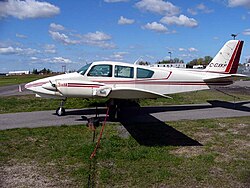
Piper PA-44-180 Seminole
 i
iSpecifications
Performance
Cruise
162KTAS
Range
681nm
Climb
1340fpm
Ceiling
17,100ft
Fuel Burn
22.0gph
Fuel Cap.
110gal
MPG
8.5mpg
Stall (Vs0)
55KIAS
T/O roll
880ft
Ldg roll
590ft
Size & weight
Seats
4
Useful Load
1,394lbs
Full-fuel payload
734lbs
Max gross
3,800lbs
Wingspan
38.6ft
Length
27.6ft
Engine
Engine
Lycoming IO-360-B1G6
Power
360hp
TBO
2,000hrs
Overhaul
$45keach
Engines
2
Owning it
Hull insurance
$3k/yr
Parts
excellent
Mechanics
common
Gear
Retractable
IFR
Yes
Category
certified
Full specification
V-speeds
Airframe
- Empty weight
- 2,406 lbs
- Max fuel weight
- 660 lbs
- Height
- 8.5 ft
- Wing position
- low
Obstacle performance
- Takeoff over 50 ft
- 1,520 ft
- Landing over 50 ft
- 1,238 ft
Paperwork
- Type certificate
- A19SO
- Certification basis
- Part 23
These figures are typical for the model, not a specification for any individual aircraft. Real-world numbers vary with year, installed equipment, weight, modifications and engine condition — often by more than you would expect. Use them to compare types, and confirm anything you would act on against the Pilot's Operating Handbook for that specific airframe and a prebuy inspection.
Pricing
Typical
$175k
Range
$80k – $400k
Annual all-in
~$47k/yr
All-in at ~100 flying hours a year, using the midpoint of each range — the same figures broken out under “Cost to own” below. Your number will differ, and mostly for two reasons. Experience sets your insurance: a 2,000-hour pilot with recent training pays 30–40% less than a 200-hour owner, and student owners pay 20–40% more — on the same aircraft that is often a doubling. Location sets your hangar: a T-hangar runs $200–400 a month in the Midwest against $400–1,500 in a coastal metro, and an outside tie-down is less again. Engine reserves move too — a local shop reusing your serviceable cylinders can come in 30–50% under the national specialty-shop pricing we quote, though you trade the warranty and turnaround that comes with it. Reserves are money set aside toward a future overhaul, not a bill this year, and the annual inspection figure is the shop’s labor to look — whatever they find is separate.
Cost to own — estimate
Set your yearly hours and local fuel price. Fixed costs (insurance, hangar, annual inspection) don't change with hours; fuel, maintenance and the engine reserve do.
- Fuel (22 gph)
- $14,300
- Engine reserve
- $4,500
- Propeller reserve
- $400
- Maintenance, parts & wear items ($45/hr)
- $4,500
- Insurance
- $4,400–$9,650
- Hangar
- $6,392–$15,980
- Annual inspection (labor only)
- $4,500
- Databases & subscriptions
- $900
- Total per year
- $47,311
- Per flight hour
- $473
- Miles flown / year (at cruise)
- 18,643 mi
- Cost per mile
- $2.54/mi
- Time in the air
- 1 hr 51 min
- Fuel burned
- 41 gal
- Out of pocket
- $439
Fuel, engine reserve and wear only. Insurance, hangar and the annual are already paid whether you make the trip or not, so they are not charged here.
Estimate, not a quote. Where a line shows a range, the total, per-hour and per-mile figures use its midpoint— insurance moves most with your experience and time in type, hangar with where you base the aircraft, so your own number could sit at either end. Annual inspection is the shop's labor to open and inspect — what they find is the maintenance line, which covers oil changes, plugs, tires, brakes, hoses, lights, a battery and vacuum pump amortised over their life, and the unscheduled squawks that are the largest and least predictable part of it. Reserves are sinking funds toward an overhaul, not a bill you pay this year — and note that a propeller is due on hours or calendar time, typically six years, so flying less does not put it off forever.
Strengths
- Purpose-built multi-engine trainer with counter-rotating props (no critical engine)
- Excellent parts availability and A&P familiarity across flight schools
- Honest 162 KTAS cruise performance with straightforward Lycoming IO-360 powerplants
- Universal IFR platform — G1000 NXi glass panels on current production
Weaknesses
- High fuel burn (~22 GPH combined) makes per-hour operating cost steep (~$132/hr)
- Training-oriented design limits useful load and cross-country range vs. faster singles
- Landing gear system prone to maintenance costs; trunnion inspection/replacement expensive
- Wing spar life limit of 14,663 factored service hours — high-time training aircraft need FSH verification
Overview
The Piper PA-44-180 Seminole is the dominant multi-engine flight trainer in American general aviation and arguably the world. Introduced as a 1979 model year following FAA type certification on March 10, 1978 (first flight May 1976), it was conceived as an accessible, affordable twin that flight schools could operate in high-cycle training environments. Piper has sold well over 900 units across three production runs — 1979–1982, 1989–1990, and 1995 to the present — and new examples continue rolling off the Vero Beach line with Garmin G1000 NXi glass panels.
The Seminole's lineage traces directly to the Piper Arrow III single. It shares the Arrow's semi-tapered low wing, fuselage cross-section, and landing gear geometry, earning it the informal nickname "Twin Arrow." The most strategically important feature is its counter-rotating propeller system: the left engine turns clockwise (viewed from behind), the right engine counter-clockwise, which eliminates the asymmetric P-factor hazard that makes one engine "critical" on conventional twins. From a training standpoint, engine failure on either side demands the same procedure and imposes the same control challenge — ideal for a syllabus designed to teach the emergency, not reinforce bad habits.
The T-tail was a styling departure for Piper in 1979 and remains the aircraft's most visible design signature. It keeps the horizontal stabilizer out of propwash and away from ramp rash, but requires attention during pitch-up maneuvers near stall (T-tail deep stall risk is low at Seminole weights, but the characteristic is mentioned in training).
Market position: the Seminole directly competes with the Beechcraft Duchess 76 (out of production since 1982, with ~437 built) and, at the lighter end, once competed with the Grumman Cougar (115 built, also discontinued). It outsold and outlasted both competitors, and today it is the unchallenged standard against which multi-engine add-on checkrides are administered. Major operators include ATP Flight School (100+ aircraft fleet), Epic Flight Academy, Skyborne Airline Academy, and dozens of university aviation programs. Military operators include the Royal Jordanian Air Force and Peruvian Air Force.
A diesel-powered variant, the Seminole DX with twin DeltaHawk DHK4A180 engines, entered STC development in 2024 and received its first U.S. customer order (Skyborne) in 2025. The DX is claimed to deliver a 35% reduction in fuel burn, a 32% improvement in single-engine climb rate, and dramatically better single-engine ceiling.
Production total through 2019: approximately 926 aircraft. Current production continues at Piper's Vero Beach facility.
Variants & History
| Variant | Years | Engine | HP Each | Gross Wt | Key Differences |
|---|---|---|---|---|---|
| PA-44-180 (early) | 1979–1982 | Lycoming O-360-E1A6D | 180 | 3,800 lb | Carbureted; 361 built; optional 3-blade props |
| PA-44-180T Turbo Seminole | 1980–1982 | Lycoming TO-360-E1A6D | 180 | 3,925 lb | Turbocharged; prop de-ice; O2 system; ~87 built; 20,000+ ft ceiling |
| PA-44-180 (1989–1990 revival) | 1989–1990 | Lycoming O-360-A1H6 | 180 | 3,800 lb | Updated engine; 29 additional built before Piper's bankruptcy halted production |
| PA-44-180 (current/New Piper) | 1995–present | Lycoming IO-360-B1G6 | 180 | 3,800 lb | Fuel injected; Hartzell Scimitar 2-blade constant-speed feathering; Garmin G1000 NXi avionics; current production model |
| PA-44 Seminole DX | 2025+ | DeltaHawk DHK4A180 | 180 | TBD | Diesel/Jet-A; co-developed STC between Piper and DeltaHawk; 35% fuel savings claimed; first deliveries to Skyborne |
Note on engine designations: Early production used the carbureted O-360-E1A6D (or O-360-A1H6 in 1989 revival). Current production uses the fuel-injected IO-360-B1G6 (left engine) and LIO-360-B1G6 (right engine, counter-rotating). The fuel-injected engines improve cold-start reliability and eliminate carburetor ice risk at the cost of some training value for pilots who will later fly carbureted aircraft.
The Turbo Seminole is a rare airplane — only ~87 built over two years — and parts support for the TO-360 variant is more challenging than for the standard model. Turbo examples command a modest premium in the used market but appeal mainly to operators at high-altitude bases.
Performance
Cruise — corrected this pass. POH VB-2636's own worked flight-planning example (Section 5.5, matched exactly by the Figure 5-27 Speed Power chart) gives 140 KTAS on 17.4 GPH combined at 55% power, 5,500 ft. The page previously stored 162 KTAS and 22 GPH with no citation at all — the real combined fuel flow at 55% is 21% lower than the old 22 GPH figure, which is a meaningful correction to the operating-cost picture below. 55% is used instead of the house-preferred 75% because this handbook labels no true airspeed at 75% — only a fuel-flow number (23.3 GPH combined, from the same chart's printed table) with no paired speed. Economy-mixture fuel flow at the same 55% power is 14.0 GPH per the same table, but pairing it with the 140 KTAS performance-cruise speed would combine two different mixture techniques at one power setting rather than a genuinely lower-power economy row, so no econ_* fields are set — see validator_exempt.
Fuel burn: 17.4 GPH combined at 55% power (8.7 GPH per engine) is the sourced operating reality. At $6/gal avgas, fuel runs roughly $104/hr at this power setting — noticeably better than the $132/hr the old, uncited 22 GPH figure implied. Training operators flying higher power settings for shorter legs will see higher per-hour burn than this cruise-power figure; see the performance grid for the 65%/75% fuel-flow table.
Climb — corrected this pass, and this is the number a twin buyer actually shops on. POH Figure 5-19 (both engines) gives 1,505 fpm and Figure 5-21 (one engine inoperative) gives 285 fpm, both at the SAME labeled example: 1,250 ft pressure altitude, 8°C OAT, 3,430 lb — not sea level, not full gross, because that is the only point either chart labels. The page previously carried 1,340 fpm (both engines) and "approximately 212 fpm" (single engine) with no citation for either number. 285 fpm at a lighter-than-gross weight and near-sea-level altitude is a real, sourced figure rather than a guess, but it is not directly comparable to a sea-level/gross book number — treat it as in the right neighborhood, not as the certified worst case. Density altitude still erodes single-engine climb further at higher weights and hotter days than this example's conditions. The Turbo Seminole's single-engine ceiling is not sourced this pass either — see below.
Blue line (VYSE): 88 KIAS, confirmed by POH Section 2.5's airspeed markings, Section 4.3's speeds table, and Section 3.5a's emergency-procedures text — three independent mentions in the same document, all agreeing. This is the critical single-engine reference speed. The POH does not publish a separate "best glide" speed for the twin-engine-out case (rare for light twins), but 88 KIAS is the universally taught and operationally accepted reference.
Vmca: 56 KIAS — notably close to Vs0 (55 KIAS), both confirmed by POH Section 2.5. This proximity is the core of all multi-engine training: at or near stall speed with full power on one engine, control may be lost before aerodynamic stall protection acts. The counter-rotating design makes Vmca symmetrical for either engine failure, which simplifies training considerably.
Service ceiling — not sourced this pass. Neither POH climb chart (Figure 5-19 or 5-21) labels a zero-rate-of-climb (ceiling) crossing point; the page's prior "17,100 ft" and "single-engine absolute ceiling approximately 3,800-4,100 ft" both carried no citation and have been removed from frontmatter rather than carried forward unverified — see validator_exempt. The Turbo Seminole's higher single-engine ceiling (commonly cited around 12,000+ ft) is likewise not independently sourced this pass.
Range — corrected this pass. POH Figure 5-29 gives 741 nm with a 45-minute reserve at 55% power, 5,500 ft, full 108-gallon usable fuel, 3,800 lb gross — 5.25 hours endurance with reserve. The page previously stored 681 nm with no citation, and the real, sourced figure is actually longer, not shorter, because 55% power burns meaningfully less fuel per mile than the uncited 22 GPH figure implied at whatever power setting produced it.
Payload & Range
Weights:
- Max gross weight: 3,800 lb
- Empty weight (typical current production): 2,406 lb
- Useful load: 1,394 lb
- Full fuel weight (108 gal usable × 6 lb/gal): 648 lb
- Payload with full fuel: 734 lb
Scenario 1: Full fuel, 2 pilots, no bags
- Two 190-lb pilots: 380 lb
- Full fuel: 660 lb
- Total: 1,040 lb ✓ (within 1,394 lb useful load)
- Remaining payload: 354 lb (adequate for bags)
- Range: ~650–680 NM with VFR reserves
Scenario 2: Full fuel, 4 passengers
- Four 190-lb occupants: 760 lb
- Full fuel: 660 lb
- Total: 1,420 lb — exceeds useful load by 26 lb at standard weights
- Resolution: Reduce fuel to ~105 gallons (630 lb), or reduce passenger weight assumption
- Practical max range 4-up with reduced fuel: ~580–620 NM
Scenario 3: 2 pilots + maximum useful payload
- Two 190-lb pilots + 354 lb bags/cargo: 734 lb
- Full fuel: 660 lb
- Total: 1,394 lb ✓ (at limit)
- Range: ~650–680 NM
Scenario 4: Training configuration (2 occupants, typical)
- Instructor + student: 380 lb
- Half fuel (55 gal, 330 lb): 330 lb
- Total: 710 lb — well within limits
- Endurance: ~2.5 hours, range ~400 NM
- This is the typical day-to-day operating profile for flight training
Key takeaways: The Seminole is not a 4-person cross-country airplane with full fuel. Full seats require reducing fuel. The wide CG range (a notable Seminole strength) accommodates diverse loading scenarios without the CG sensitivity of some competitors. The useful load on current-production aircraft (1,394 lb) is somewhat better than early production examples (which varied from 1,190 to 1,350 lb depending on avionics weight). For training use, the light 2-person training configuration provides ample margins.
Cross-references: Piper PA-34-220T Seneca V | Beechcraft 76 Duchess | Aircraft Valuation Methodology | GA Insurance Underwriting | Maintenance Ecosystem | Avionics Pricing Reference

1998 Piper Archer
Archer III · GNS 430W · Honest Trainer · Fresh Annual
Mission Suitability
Flight Training — Score: 10/10 The Seminole is purpose-built for this mission and has no meaningful competition in production. Counter-rotating props eliminate the critical engine variable, making training outcomes transferable and consistent. The manageable Vmca, Hartzell feathering props, straightforward systems, and universal A&P familiarity make it the ideal multi-engine add-on and instrument training platform. Every major flight school in the U.S. operates or has operated Seminoles. The G1000 NXi in current production aircraft bridges seamlessly to airline glass cockpits.
Backcountry / Bush Flying — Score: 1/10 Retractable gear, 3,800 lb gross weight, 860 ft ground roll, and no STOL capability make the Seminole irrelevant for backcountry operations. Low-wing layout adds obstacle/FOD risk on unimproved surfaces.
Business Travel — Score: 4/10 Technically capable: 140 KTAS cruise, IFR avionics, 4 seats, 741 NM range. But the useful load drops significantly with full fuel (see Payload-Range), and the $132/hr fuel cost plus twin-engine maintenance overhead is difficult to justify against faster, more economical singles or turboprops for business. The Seminole is not a prestige aircraft. Suitable for local/regional business hops where twin-engine redundancy is valued over speed or efficiency.
missions/aerobatics — Score: 1/10 Not aerobatic-certified. Normal category only. No relevant capability.
Cross-Country Flying — Score: 5/10 Adequate range, solid IFR platform, and consistent cruise speed make the Seminole workable for cross-country, but the combination of ~17.4 GPH combined burn at cruise power, moderate cruise speed, and relatively modest useful load limits its utility for long-haul personal travel. Works well for the IFR-rated pilot who wants twin redundancy on personal trips up to 500 NM. Over 500 NM, the Turbo's better altitude performance and slightly longer range start to matter.
Cargo Hauling — Score: 3/10 Cabin space is modest — four seats with limited baggage (one aft baggage compartment, ~100 lb limit). Useful load with full fuel leaves approximately 734 lbs for people and bags. Not a cargo hauler; no cargo door.
Local Fun Flying — Score: 4/10 Flying the Seminole for fun is possible — it handles pleasantly and the counter-rotating props are a novelty — but a combined burn in the mid-teens to low-20s GPH depending on power setting makes casual local flying expensive. Better options exist for local pleasure flying unless the pilot also wants to maintain multi-engine currency.
missions/surveying — Score: 5/10 Stable, IFR-capable, and able to loiter at lower altitudes without significant range penalty. However, no dedicated hard points, observer windows, or belly provisions. The low wing limits downward visibility. Can support aerial survey for operators who need twin-engine certification over populated areas, but specialized aircraft (Cessna 206, Cessna 337) are preferred.
Avionics Ecosystem
Current production (post-2010s): Factory Garmin G1000 NXi avionics suite is standard, comprising:
- Dual 10.4" GDU 1050 Primary Flight Display and Multifunction Display
- GMA 1360D digital audio panel with Bluetooth
- GTX 345R ADS-B In/Out transponder
- Garmin G5 standby instrument
- GFC 500 autopilot (optional on some configurations)
- GNS 430W-equivalent navigation integrated into the G1000
1995–2010 era production: Factory-installed Garmin 430/530 stacks, King KX series nav/comms, and Bendix/King autopilots were common. Many have since been retrofitted with G500/G600 EFIS panels and GTN 650/750 navigators.
Pre-1989 vintage aircraft: Original analog steam gauges with KX 155/165 nav/comms, KMA 24 audio panel, and King KAP 100/150 or Piper Altimatic autopilot. Upgrades vary widely. A strong pre-buy avionics inspection is essential — avionics on high-time training aircraft are frequently worn.
Common retrofit upgrades per Avionics Pricing Reference:
- Garmin G500/G600 EFIS retrofit: ~$30,000–$45,000 installed
- GTN 650Xi/750Xi navigator: ~$12,000–$18,000 installed
- GFC 500 autopilot (if not factory): ~$8,000–$14,000 installed
- ADS-B Out (GTX 345): ~$3,000–$5,000 installed
- Garmin G5 standby AI: ~$2,500 installed
For training fleet operators, glass avionics justify a premium both in resale value and student demand. An older Seminole with G500 and GTN 750 is significantly more marketable and valuable than an all-analog panel.
STCs & Modifications
| STC / Mod | Description | Approx. Cost | Performance Impact |
|---|---|---|---|
| DeltaHawk DHK4A180 engine conversion | Diesel/Jet-A engines replacing Lycoming IO-360s; co-developed by Piper and DeltaHawk | TBD (new production STC, 2024–2025) | −35% fuel burn, +32% single-engine climb, +70% single-engine absolute ceiling |
| Garmin G1000 NXi installation | Factory retrofit kit for older G1000-equipped aircraft | ~$15,000–$25,000 | Improves avionics capability; no performance change |
| Hartzell 3-blade composite prop upgrade | Available for select configurations; some operators prefer for vibration reduction | ~$8,000–$14,000 per pair | Modest noise/vibration reduction; minimal performance delta |
| KFC 200 flight control system | King autopilot with optional flight director; common on mid-vintage examples | ~$15,000–$25,000 installed | Operational; no performance change |
| Yaw damper (YK875) | Factory or STC-installed yaw damper for smoother single-engine operations | ~$3,000–$5,000 | Improved handling; cosmetic for normal ops, noticeable on single-engine approaches |
| Propeller synchrophaser | Reduces prop beat/noise in cruise; available on many configurations | ~$1,500–$3,000 | Comfort improvement only |
| Halon-free fire extinguisher | Required for compliance by end of 2025 per EASA/FAA guidance | ~$300–$600 | Safety compliance; no performance impact |
| Oxygen system (PA-44-180T standard, optional elsewhere) | Built-in O2 bottle with overhead outlets | ~$4,000–$8,000 installed | Enables extended high-altitude operations; standard on Turbo variant |
Garmin G1000 installation is the highest-value single upgrade for resale and utility. Aircraft with full glass panels command $30,000–$60,000 premiums over comparable analog-panel examples in the current market.

2019 Cirrus SR22
One Owner · Platinum · FIKI · Low 690 Hours · Hangared
Maintenance & Support
See Maintenance Ecosystem for broader GA twin maintenance context.
A&P familiarity: "Common" — Seminoles are found at almost every flight school, so A&Ps who have worked on them are widespread. The Lycoming IO-360 family is arguably the most familiar aircraft engine series in the U.S. shop environment. That said, familiarity is not "universal" in the sense of the Cessna 172 or Piper Cherokee — a rural shop may not have recent Seminole experience.
Parts availability: Excellent. Piper continues producing the aircraft and supporting it. Lycoming supports the IO-360-B1G6 fully. Landing gear components, control surfaces, and most hardware items are available from Piper, Aircraft Spruce, and secondary markets.
Annual inspection: Expect $2,500–$5,000 for a routine annual with no squawks. High-time training aircraft with deferred maintenance can run $6,000–$10,000+. Gear inspection is labor-intensive and the most commonly expensive line item.
Engine reserves: At 2,000-hour TBO and $18,000–$22,000 per overhaul, plan $9–$11/hr per engine — or ~$18–$22/hr for the pair. At 100 hr/yr that is ~$2,000/year for both engines. reserve discipline is critical for owner-operated aircraft. Fleet operators frequently use factory remanufactured Lycoming exchange units.
Known expensive maintenance items:
- Landing gear trunnion replacement (AD compliance): $3,000–$6,000 per side
- Cabin heater maintenance/repair: $500–$2,000
- Vacuum system (on older aircraft): $800–$2,000 per pump; consider upgrading to electric gyros
- Fuel bladder replacement (nacelle tanks): $2,000–$4,000 per tank
- Autopilot servo overhaul (if equipped with older King/Century autopilot): $1,500–$3,000 per servo
- Prop overhaul (both): $6,000–$10,000
Typical total annual cost for private owner at 100 hours/year:
| Item | Annual Cost |
|---|---|
| Annual inspection | $3,000 |
| Routine maintenance | $2,500 |
| Engine reserve (both engines) | $2,000 |
| Prop reserve | $1,000 |
| Insurance | $3,200 |
| Hangar | $3,600 |
| Avionics/subscription | $800 |
| Fuel (100 hrs × $132/hr) | $13,200 |
| Total | ~$31,300 |
Per-hour cost at 100 hr/yr: approximately $313/hr. At 200 hr/yr: approximately $220/hr (fixed costs amortized over more hours).
Valuation Factors
See Aircraft Valuation Methodology for the underlying framework.
Price Tiers by Year and Condition (2025 Market)
| Year Range | Condition | Avionics | Price Range |
|---|---|---|---|
| 1979–1982 | Average, high time | Analog or partial glass | $80,000–$130,000 |
| 1979–1982 | Good, mid time | G500/GTN 750 glass | $130,000–$175,000 |
| 1989–1990 | Good | Analog or partial glass | $110,000–$160,000 |
| 1995–2005 | Good, mid time | G430/530 or partial glass | $150,000–$250,000 |
| 2006–2015 | Good, factory glass | Garmin G1000 | $220,000–$350,000 |
| 2016–present | Low time | G1000 NXi | $300,000–$450,000+ |
| New (current) | Factory new | G1000 NXi | ~$800,000–$900,000 |
Key value drivers:
- Engine time: Each engine overhaul costs approximately $40,500–$49,500 (2025 market for IO-360 series, per Aircraft Valuation Methodology). Mid-time engines (500–1,000 hours SMOH) are preferred. Both engines fresh adds $35,000–$40,000 in buyer appeal; both at or over TBO reduces value by similar magnitude.
- Prop time: Hartzell constant-speed feathering props overhaul at approximately $3,000–$5,000 each; new props cost $6,000–$8,000 each. Both props fresh adds ~$10,000–$15,000.
- Avionics: Full Garmin G1000 NXi or G500/GTN 750 retrofit commands $30,000–$60,000 premium over analog panels. ADS-B Out compliance is now table stakes.
- Training fleet history: Aircraft from flight school fleets tend to have high utilization, documented maintenance, and known event histories. This can be positive (consistent maintenance) or negative (hard landing events, gear repairs). Verify carefully.
- Damage history: Any gear-up landing, prop strike, or hard landing event should trigger an engine teardown record check and structural inspection sign-off.
ADs & Common Problems
Active / Significant Airworthiness Directives
AD 94-13-11 — Main gear trunnion cracks Recurring inspection of the main landing gear trunnion for fatigue cracks. Training aircraft that have experienced hard landings or gear-up events are especially at risk. Compliance requires repeat inspections at defined intervals; trunnion replacement is expensive. High-time training aircraft warrant scrutiny of compliance records.
AD 94-14-14 — Nose gear collapse modification Mandated modification to prevent nose gear collapse. A known failure mode on early Seminoles subjected to hard landings. Most compliant aircraft have the modification installed; verify via logbooks.
AD 96-10-03 — Flap handle attach bolt failure The flap handle attachment bolt can fail, resulting in loss of flap control. Requires inspection and replacement with a correct bolt and locking hardware.
AD 2003-11-14 / 2005-15-10 — Janitrol cabin heater fuel pump fire risk Applies to Seminoles equipped with the Janitrol heater. The fuel pump microswitch can fail, creating a fire hazard. Requires inspection and modification of the heater system. Critical on cold-weather operations — pilots must allow adequate cooling time before shutdown or the overheat microswitch may pop, leaving the heater inoperative until reset.
AD 2004 — Control wheel attachment (PA-44-180) The screw attaching the control wheel to the column was too short in some installations; the nut-plate lacked adequate locking features. Requires inspection and correction. Safety-critical — loss of control wheel is catastrophic.
Wing spar — life limit per type certificate (14,663 factored service hours) The PA-44 type certificate establishes a wing spar structural life limit of 14,663 factored service hours (FSH) under normal usage conditions. This is not an AD but a TC limitation. High-time training aircraft approaching 10,000+ hours should have their FSH calculated and documented. Separate from (and unrelated to) the PA-28/PA-32 wing spar fatigue crack AD campaign (2019–2024), which does not apply to the PA-44 twin's different spar geometry.
Common Pre-Buy Red Flags
- Gear-up landings and hard landings: High training usage means some aircraft have event history. Review logbooks meticulously. Inspect gear trunnions, firewalls, and engine mounts for damage or unauthorized repairs.
- High factored service hours: Training aircraft can accumulate hours quickly. Calculate FSH against the 14,663-hour spar life limit.
- Corrosion in engine nacelles: Nacelle fuel bladders can seep; nacelle structure is prone to corrosion on aircraft based in humid coastal environments.
- Prop strike history: Any prop strike on training aircraft should be documented with a crankshaft flange inspection; verify all engine logbook entries.
- Avionics wear: Training aircraft cycle avionics switches thousands of times. Expect worn audio panels, failing comm radios, and unreliable autopilot servos on high-time examples.
- Cabin heater AD compliance: Verify AD 2003-11-14 / 2005-15-10 completion if Janitrol heater equipped.
- Vacuum system: Older Seminoles use vacuum-driven gyros; AI and DI failures are common failure modes. Modern glass-panel upgrades eliminate this risk.
Insurance Profile
See GA Insurance Underwriting for GA twin underwriting framework.
The Seminole occupies the "light twin trainer" underwriting category — insurers are familiar with the type and coverage is broadly available, but premiums reflect the higher actuarial risk of twin-engine training operations.
Typical annual premiums (2025):
| Coverage Type | Qualified Pilot | Less-Qualified Pilot |
|---|---|---|
| Liability only ($1M per occurrence) | $650–$800/yr | $875–$1,150/yr |
| Liability ($1M) + Hull (~$150K–$200K) | $2,500–$4,500/yr | $5,000–$10,000+/yr |
| Fleet training operations | Negotiated; typically $2,000–$3,500/hull per year | — |
Underwriter "qualified pilot" definition (typical):
- Private or commercial certificate with instrument rating
- 1,000+ total hours
- 500+ multi-engine hours
- 100+ hours in PA-44 (or make/model checkout)
Pilots with fewer hours or transitioning from single-engine aircraft pay significantly higher premiums. A first-time multi-engine pilot with a new MEI checkout can expect to pay $8,000–$18,000/yr for full coverage on a $200,000 hull — the primary reason most pilots use a flight school's aircraft for the multi-engine add-on rather than purchasing their own.
Underwriting considerations:
- Hull value has risen significantly; current-production G1000 examples insure for $350,000–$500,000+, which changes the premium calculus
- Training use endorsements are typically required for any FBO or school use
- Gear-up landing history may result in premium loading or exclusions
- Counter-rotating design is viewed favorably by underwriters versus conventional critical-engine twins
For sale (0)
No listings for this model right now.
Also worth looking at
What buyers usually weigh against the Piper PA-44-180 Seminole — aircraft flown for the same kind of mission.