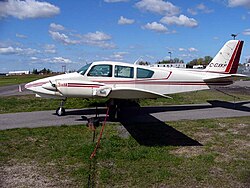
Diamond · 2010+
Diamond DA42 Twin Star

Specifications
Performance
Cruise
175KTAS
Range
1,100nm
Climb
1114fpm
Ceiling
18,000ft
Fuel Burn
10.4gph
Fuel Cap.
76gal
MPG
19.4mpg
Stall (Vs0)
62KIAS
T/O roll
1230ft
Ldg roll
1269ft
Size & weight
Seats
4
Useful Load
1,276lbs
Full-fuel payload
764lbs
Max gross
4,407lbs
Wingspan
44ft
Length
28.1ft
Engine
Engine
Austro Engine AE 300 (E4)
Power
336hp
TBO
—hrs
Overhaul
—each
Engines
2
Owning it
Hull insurance
—/yr
Parts
—
Mechanics
—
Gear
Retractable
IFR
Yes
Category
certified
Full specification
V-speeds
Airframe
- Empty weight
- 3,131 lbs
- Max fuel weight
- 512 lbs
- Height
- 8.2 ft
- Wing position
- low
Obstacle performance
- Takeoff over 50 ft
- 2,129 ft
- Landing over 50 ft
- 2,122 ft
Paperwork
- Type certificate
- A57CE
- Certification basis
- FAR 21.29; JAR 23 Amdt 1 (2001), FAA/EASA interim validation; Special Conditions for Diesel Cycle Engine and Protection of Systems for High Intensity Radiated Fields
These figures are typical for the model, not a specification for any individual aircraft. Real-world numbers vary with year, installed equipment, weight, modifications and engine condition — often by more than you would expect. Use them to compare types, and confirm anything you would act on against the Pilot's Operating Handbook for that specific airframe and a prebuy inspection.
Pricing
Typical
$550k
Range
$250k – $900k
Annual all-in
~$52k/yr
All-in at ~100 flying hours a year, using the midpoint of each range — the same figures broken out under “Cost to own” below. Your number will differ, and mostly for two reasons. Experience sets your insurance: a 2,000-hour pilot with recent training pays 30–40% less than a 200-hour owner, and student owners pay 20–40% more — on the same aircraft that is often a doubling. Location sets your hangar: a T-hangar runs $200–400 a month in the Midwest against $400–1,500 in a coastal metro, and an outside tie-down is less again. Engine reserves move too — a local shop reusing your serviceable cylinders can come in 30–50% under the national specialty-shop pricing we quote, though you trade the warranty and turnaround that comes with it. Reserves are money set aside toward a future overhaul, not a bill this year, and the annual inspection figure is the shop’s labor to look — whatever they find is separate.
Cost to own — estimate
Set your yearly hours and local fuel price. Fixed costs (insurance, hangar, annual inspection) don't change with hours; fuel, maintenance and the engine reserve do.
This is a diesel. It burns Jet-A and cannot run on avgas at all, which matters for fuel availability at small fields as much as for the price per gallon.
- Fuel (10.4 gph)
- $6,240
- Propeller reserve
- $600
- Maintenance, parts & wear items ($45/hr)
- $4,500
- Insurance
- $13,750–$30,250
- Hangar
- $7,418–$18,546
- Annual inspection (labor only)
- $4,500
- Databases & subscriptions
- $900
- Total per year
- $51,722
- Per flight hour
- $517
- Miles flown / year (at cruise)
- 20,139 mi
- Cost per mile
- $2.57/mi
- Time in the air
- 1 hr 43 min
- Fuel burned
- 18 gal
- Out of pocket
- $194
Fuel, engine reserve and wear only. Insurance, hangar and the annual are already paid whether you make the trip or not, so they are not charged here.
Estimate, not a quote. Where a line shows a range, the total, per-hour and per-mile figures use its midpoint— insurance moves most with your experience and time in type, hangar with where you base the aircraft, so your own number could sit at either end. Annual inspection is the shop's labor to open and inspect — what they find is the maintenance line, which covers oil changes, plugs, tires, brakes, hoses, lights, a battery and vacuum pump amortised over their life, and the unscheduled squawks that are the largest and least predictable part of it. Reserves are sinking funds toward an overhaul, not a bill you pay this year — and note that a propeller is due on hours or calendar time, typically six years, so flying less does not put it off forever.
Strengths
- Efficient fuel burn (10.4 gal/h) makes twin-engine economics viable for cross-country and training
- Strong single-engine performance: 16,000 ft service ceiling at gross weight
- Proven multi-engine trainer worldwide; modern avionics (G1000 NXi) standard
Weaknesses
- Austro AE 300 parts source Austria; non-stock items commonly face several-week lead times
- Requires Austro-authorized service centers for engine work; specialist mechanic familiarity needed
- Composite airframe repairs require certified composite shop
- Modest useful load limits payload for a twin; not economical for local-flying missions
Overview
This page describes the Austro-powered DA42 — marketed as the DA42 NG and, in its latest avionics-and-gross-weight form, the DA42-VI. The original Thielert-powered DA42 (2005-2009ish) is covered in the Variants table below but is NOT separately re-sourced this session — see the confidence note for why, and the splitting analysis immediately below for why it stays on this page rather than getting its own.
Splitting-rule analysis, worked explicitly rather than assumed. Step 1 (hard splits) does not fire between the Thielert and Austro engines: both are diesel-cycle piston engines (not a different engine CLASS under the rule's piston/radial/turboprop/jet distinction), same seat count, same retractable gear, same type certificate (A57CE Sections I and II). Step 2 (numeric thresholds): fuel capacity is IDENTICAL between the two engines (both 76.4 gal usable per A57CE) — no fire. Gross weight is 3,935 lb (Thielert, Note 9) vs 4,407 lb (Austro NG, with MÄM 42-678) — a 12.0% spread, under the 15% threshold. Cruise speed, fuel burn and useful load could not be compared because no current manufacturer source describes the Thielert engine at all (Diamond's site sells only the Austro airplane now) and no Thielert-era AFM was located this session — so this page cannot claim Step 2 clears on those fields, only that the two fields it COULD check both fall under threshold. Step 3 (buyer test): the Thielert airplane is effectively a legacy-support question today (most surviving examples have been converted to Austro engines or face mandatory life-limit compliance), not a live cross-shopping decision against the current NG — so this page keeps them together, flagged as a genuinely incomplete rather than a confidently-clean application of the rule.
Variants & History
| Variant | Years | Engine | Gross Weight (lbs) | Notes |
|---|---|---|---|---|
| DA42 (original) | 2005-2009ish | 2x Thielert TAE 125-01/02-99/02-114 | 3,935 (TCDS Note 9) | Thielert bankruptcy left many converted to Austro via Diamond Service Bulletin OSB 42-068. NOT independently re-sourced this session for performance — certificate figures only. |
| DA42 NG | 2010-2012ish | 2x Austro AE 300 | 4,189 (base) / 4,407 (MÄM 42-678) | This page describes the current, MÄM-42-678-equipped configuration. |
| DA42-VI | current | 2x Austro AE 300 | 4,407 | Same TCDS section as DA42 NG; marketing name for the latest G1000 NXi-equipped, MÄM-42-678 standard configuration. |
Performance
Fuel burn and range ARE a matched pair; cruise speed is not paired with
either. Diamond's current spec sheet gives "Range at 60% (12,000 ft, incl.
auxiliary tank)... 1,100 nm" alongside "Consumption at 60% in total... 10.4
US gal/h" — same power, same altitude, genuinely one flight. Separately, the
sheet gives "Cruise speed at 75% (16,000 ft)... 175 kts" with no burn figure
at 75%. cruise_speed_ktas is stored as the 75% figure (the house-preferred
reference power, and the only labelled speed on the page); fuel_burn_gph
and range_nm are the 60% pair. cruise_percent_bhp and cruise_altitude_ft
are left blank because no single setting describes all three fields together.
Rate of climb is stated at a reduced weight, not at gross. Diamond's figure (1,114 ft/min) is explicitly "Rate of climb (ISA SL) 1,760 kg TOW" — 3,880 lb, not this airplane's 4,407 lb certificated gross. Stored anyway as the best available figure, flagged here so a reader does not assume it describes a heavier, more realistic loaded takeoff.
Two different landing ground-roll figures appear on the same manufacturer page and were not reconciled. "Landing ground roll (ISA SL): 1,115 ft" appears separately from "Landing performance (MSL, ground roll / landing distance): 1,269 ft / 2,122 ft." The second, paired figure is stored because it comes with a matching obstacle distance; the first is recorded in the raw passage as an unresolved second number from the same document.
Single-engine performance is a genuine strength. Diamond states a
single-engine service ceiling (50 ft/min climb) of 16,000 ft and a
single-engine absolute ceiling of 17,500 ft — both at MTOM. Stored
single_engine_ceiling_ft: 16000.
Payload & Range
DA42 NG / DA42-VI (2x Austro AE 300, 76.4 gal usable Jet-A, 4,407 lb gross):
| Scenario | Fuel (gal) | Fuel Weight (lbs, Jet-A @ 6.7 lb/gal) | Payload (lbs) | Pax + Bags | Range (nm) |
|---|---|---|---|---|---|
| Full fuel, 2 pax | 76.4 | 512 | 764 | 2 x 200 + 364 bags | 1,100 |
| Full fuel, 4 pax | 76.4 | 512 | 764 | 4 x 175 + 64 bags | 1,100 (tight) |
1,276 lb useful load matches the manufacturer's own stated figure exactly.

2007 Diamond DA40
G1000 · GFC 700 · Composite · No Corrosion Ever
Mission Suitability
- Flight Training (8): The standard modern multi-engine trainer worldwide; efficient fuel burn makes ME training economics workable.
- Backcountry (1): Not applicable.
- Business Travel (6): Adequate cabin and range for moderate business use; limited by a modest useful load for a twin.
- Aerobatics (1): Not certified.
- Cross-Country (7): Strong range-per-gallon for a twin; genuinely efficient long-leg cross-country capability.
- Cargo Hauling (3): Small cabin, modest useful load.
- Local Fun Flying (4): A diesel twin is not an economical local-flying choice even at its own efficient burn.
- Surveying (6): Twin-engine redundancy and long endurance suit this mission.
Avionics Ecosystem
Garmin G1000 NXi standard on current DA42-VI production, FADEC engine management integrated into the glass panel.
STCs & Modifications
None found beyond the factory Thielert-to-Austro conversion path (Diamond Service Bulletin OSB 42-068). Fully integrated system otherwise.

2019 Cirrus SR22
One Owner · Platinum · FIKI · Low 690 Hours · Hangared
Maintenance & Support
- Parts availability: Austro-authorized service centers required for engine work.
- Mechanic familiarity: Specialist.
- Engine overhaul cost: left blank — see
validator_exemptabove.
Valuation Factors
Prices are asking-price data from the site's own listings sync (2026-07-14), not a Vref or Aircraft Bluebook considered value. That snapshot alone shows $568,000-$899,900 across 7 priced listings; broadened to include older Thielert-era used examples the practical floor is closer to $250,000. A Vref/Bluebook subscription would settle a considered value, not obtained this session.
ADs & Common Problems
- Austro AE 300: Documented service history of ADs over its life; no fresh AD-by-AD search was run this session.
- Thielert-era airplanes: Face mandatory life-limit/conversion requirements from the original manufacturer's bankruptcy-era support collapse; a pre-buy on any Thielert-original DA42 should confirm current engine status specifically.
- Composite repair: requires a certified composite shop.
- Parts lead time: Austro parts source from Austria; lead times of several weeks on non-stock items are commonly reported (not independently verified this session).
Insurance Profile
No fresh insurance-broker quote sourced this session;
typical_hull_insurance_annual_usd intentionally left blank.
For sale (0)
No listings for this model right now.
For sale elsewhere (1)
Current ads on Barnstormers, checked daily. Photos, full details and the seller are on the listing site.
2007 Diamond DA42 Twin Star
Listed on BarnstormersGarmin G1000
View photos and full ad on Barnstormers ↗Also worth looking at
What buyers usually weigh against the Diamond DA42 Twin Star — aircraft flown for the same kind of mission.