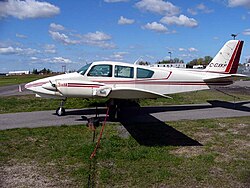
Rutan Aircraft Factory · 1984–1985
Rutan Model 40 Defiant
 i
iSpecifications
Performance
Cruise
167KTAS
Range
980nm
Climb
1600fpm
Ceiling
18,000ft
Fuel Burn
15.0gph
Fuel Cap.
120gal
MPG
12.8mpg
Stall (Vs0)
62KIAS
T/O roll
1100ft
Ldg roll
1200ft
Size & weight
Seats
4
Useful Load
1,296lbs
Full-fuel payload
576lbs
Max gross
2,997lbs
Wingspan
29ft
Length
22ft
Engine
Engine
2x Lycoming O-320 (160 hp each)
Power
320hp
TBO
2,000hrs
Overhaul
$42keach
Engines
2
Owning it
Hull insurance
$5k/yr
Parts
poor
Mechanics
rare
Gear
Fixed
IFR
Yes
Category
experimental
Full specification
V-speeds
Airframe
- Empty weight
- 1,701 lbs
- Max fuel weight
- 720 lbs
- Height
- 8.5 ft
- Wing position
- mid
Obstacle performance
- Takeoff over 50 ft
- 1,850 ft
- Landing over 50 ft
- 2,100 ft
These figures are typical for the model, not a specification for any individual aircraft. Real-world numbers vary with year, installed equipment, weight, modifications and engine condition — often by more than you would expect. Use them to compare types, and confirm anything you would act on against the Pilot's Operating Handbook for that specific airframe and a prebuy inspection.
Pricing
Typical
$95k
Range
$75k – $150k
Annual all-in
~$37k/yr
All-in at ~100 flying hours a year, using the midpoint of each range — the same figures broken out under “Cost to own” below. Your number will differ, and mostly for two reasons. Experience sets your insurance: a 2,000-hour pilot with recent training pays 30–40% less than a 200-hour owner, and student owners pay 20–40% more — on the same aircraft that is often a doubling. Location sets your hangar: a T-hangar runs $200–400 a month in the Midwest against $400–1,500 in a coastal metro, and an outside tie-down is less again. Engine reserves move too — a local shop reusing your serviceable cylinders can come in 30–50% under the national specialty-shop pricing we quote, though you trade the warranty and turnaround that comes with it. Reserves are money set aside toward a future overhaul, not a bill this year, and the annual inspection figure is the shop’s labor to look — whatever they find is separate.
Cost to own — estimate
Set your yearly hours and local fuel price. Fixed costs (insurance, hangar, annual inspection) don't change with hours; fuel, maintenance and the engine reserve do.
- Fuel (15 gph)
- $9,750
- Engine reserve
- $4,200
- Propeller reserve
- $600
- Maintenance, parts & wear items ($45/hr)
- $4,500
- Insurance
- $4,000–$8,000
- Hangar
- $3,828–$9,570
- Annual inspection (labor only)
- $4,500
- Databases & subscriptions
- $900
- Total per year
- $37,149
- Per flight hour
- $371
- Miles flown / year (at cruise)
- 19,218 mi
- Cost per mile
- $1.93/mi
- Time in the air
- 1 hr 48 min
- Fuel burned
- 27 gal
- Out of pocket
- $342
Fuel, engine reserve and wear only. Insurance, hangar and the annual are already paid whether you make the trip or not, so they are not charged here.
Estimate, not a quote. Where a line shows a range, the total, per-hour and per-mile figures use its midpoint— insurance moves most with your experience and time in type, hangar with where you base the aircraft, so your own number could sit at either end. Annual inspection is the shop's labor to open and inspect — what they find is the maintenance line, which covers oil changes, plugs, tires, brakes, hoses, lights, a battery and vacuum pump amortised over their life, and the unscheduled squawks that are the largest and least predictable part of it. Reserves are sinking funds toward an overhaul, not a bill you pay this year — and note that a propeller is due on hours or calendar time, typically six years, so flying less does not put it off forever.
Strengths
- True centerline-thrust twin—no asymmetric yaw risk or Vmc on engine failure
- Exceptional fuel economy (~1.0 NM/gal) for a four-seat 320-hp twin
- Docile handling, canard stall protection, excellent cross-country range (980 NM)
- Low maintenance burden compared to conventional twins (fixed-pitch props, no feathering)
Weaknesses
- Experimental aircraft—no factory support, parts must be fabricated or sourced from builder community
- Finding an A&P willing to work on composite canards is difficult outside specialist shops
- High operating cost (~$14k/year) driven by two engine overhauls and specialized maintenance
- Only ~19–20 flying examples exist; resale market is extremely thin
Overview
The Rutan Defiant is Burt Rutan's four-seat, centerline-thrust light twin, first flown on 30 June 1978 (prototype N78RA). Designed as a proof-of-concept for a genuinely safe light twin, it uses a push-pull engine arrangement — one Lycoming O-320 tractor in the nose, one pusher at the tail — eliminating the asymmetric yaw that kills pilots in conventional twins after engine failure. The airframe is foam-and-fiberglass composite with a canard foreplane, swept main wing, winglets, and a ventral "rhino rudder" offset to port beneath the cabin floor.
The Defiant is notable for its radical simplicity: no flaps, no retractable gear, no constant-speed props, no feathering, no cowl flaps, no rudder pedals connected to a vertical tail. Losing an engine requires no pilot action beyond adding power on the remaining one — there is no Vmc, no critical engine, no asymmetric thrust. It remains controllable all the way to the stall.
Rutan Aircraft Factory (RAF) sold 176 plan sets between 1984 and 1985 before RAF exited the plans business. Roughly 19–20 completed aircraft are thought to fly today (FAA lists ~40 on the registry but many are inactive or mis-registered). No plans or kits have been available from RAF for decades; the builder community centers on the canardzone.groups.io Defiants group. See also Rutan Long-EZ (Model 61) and Rutan Model 33 VariEze for related single-engine Rutan canards, and Cessna 337 Skymaster for the only production centerline-thrust twin it shares a design philosophy with.
Variants & History
| Variant | Year | Engines | HP | Gross Wt | Notes |
|---|---|---|---|---|---|
| Model 40 (prototype N78RA) | 1978 | 2x Lyc O-235 (later O-320) | 2x160 | ~2,900 lb | Burt Rutan's personal aircraft; proof-of-concept |
| Model 40 (plans) | 1984–85 | 2x Lyc O-320 | 2x160 | 2,997 lb | 176 plan sets sold; ~19 flying |
| Model 74 | — | 2x Lyc O-320/O-360 | 2x160–180 | 2,997 lb | Design update; never released as plans |
Builder-installed variations are common: some use Titan/ECi O-320 clones, some O-360s, some with electronic ignition, some with full IFR glass panels. Each aircraft is effectively unique.
Performance
Book cruise is 167 KTAS on ~15 GPH combined at 75% power, giving close to 1.0 NMPG — exceptional economy for a 320-hp four-seat twin because of the low-drag composite airframe and clean canard layout. Single-engine climb is a modest ~390 fpm at low altitude, but unlike a conventional twin this climb is available immediately with no rudder input and no risk of Vmc rollover. Single-engine service ceiling is roughly 8,000 ft with the O-320s.
Because the Defiant has no flaps, approach speeds are higher than book suggests (~85–90 KIAS on final is typical) and landing rolls stretch longer than light singles. The canard stalls before the main wing, so the aircraft cannot be stalled in the traditional sense — it mushes with the nose dropping gently, which is the foundation of the Defiant's "lands itself" reputation. High density altitude hurts takeoff more than cruise because the fixed-pitch props can't be optimized for climb.
Payload & Range
With 1,296 lb useful load and 720 lb max fuel:
- Full fuel (120 gal / 720 lb) + 2 adults (380 lb): 196 lb left for bags — comfortable two-person 900+ NM trip at 167 KTAS, ~5.5 hr.
- Four adults (680 lb) + bags (100 lb): 516 lb fuel = 86 gal, good for ~670 NM with reserves — full-seat range that most four-seat twins can't match.
- Four adults + full fuel: Impossible — ~100 lb over gross. Unlike many four-seat singles, the Defiant is close to a "real" four-place airplane thanks to its generous useful load and tank-efficient cruise.
The big fuel capacity combined with low burn (15 GPH combined) gives the Defiant a payload-range envelope closer to a Baron than to a Skymaster, at half the fuel burn. This is the single strongest argument for the type: no other four-seat twin travels this far on this little fuel.
Mission Suitability
Cross-country (9): This is the Defiant's native mission. 167 KTAS, 980 NM range on 120 gal, four seats, twin redundancy, and canard docility make it an outstanding long-legs traveling machine.
Business travel (7): Fast and efficient enough to compete with a Cessna 337 Skymaster or Baron on fuel burn, and IFR capability is common in well-equipped examples. Held back by experimental insurance, lack of known-ice, and limited maintenance support away from home base.
Local fun flying (6): Head-turning airframe, docile handling, distinctive Rutan heritage. Penalized for operating cost and fuel burn on short hops.
Cargo hauling (3) / Surveying (3): 1,296 lb useful load is respectable but cabin volume is modest and there is no cargo door. Twin reliability is a plus for survey work over hostile terrain.
Flight training (1), Backcountry (1), Aerobatics (1): Disqualified — no dual controls in most builds, no flaps, fixed-pitch props, low prop clearance for the nose engine, and the composite canard airframe is not rated for aerobatics.
Avionics Ecosystem
No factory standard exists — every Defiant reflects its builder's budget and era. Common configurations:
- Vintage (1990s build): King KX155s, KT76A transponder, basic DG/AI, single GPS. $8–15k avionics value.
- Mid-tier: Garmin GNS430W, GI275 or Aspen PFD, GTX345 ADS-B, autopilot (often TruTrak or S-TEC). $25–45k avionics value.
- Modern: Dual Garmin G3X Touch, GTN650Xi, GFC500 autopilot (experimental install), ADS-B In/Out. $45–75k avionics value.
Experimental category allows any non-TSO avionics, so Dynon/Garmin experimental lines are popular on newer builds. See Avionics Pricing Reference for installed costs.

2016 Van's RV-10
Dual G3X Touch · IFR · Beautiful Owner Build
STCs & Modifications
STCs do not apply to experimental amateur-built, but common builder modifications include:
- O-360 upgrade (180 hp each): +~20 fpm single-engine climb, +5 KTAS cruise, ~$15k cost delta per engine at overhaul.
- Electronic ignition (Lightspeed/SureFly): 0.3–0.5 GPH fuel savings, smoother running, $2–4k per engine.
- Constant-speed props: Non-trivial engineering challenge because of the pusher installation; rarely done.
- Tip tanks / auxiliary fuel: A few builders added wing tip tanks for 1,200+ NM range.
- IFR panel upgrades: The most common "mod" — older builds get wholesale avionics refreshes.
Maintenance & Support
Parts availability: poor. Lycoming engines and standard hardware are universally available, but Defiant-specific components (cowlings, canard, rhino rudder hardware, strake fuel fittings) must be fabricated or sourced from the builder community. There is no factory, no kit vendor, and no parts catalog.
Mechanic familiarity: rare. Under experimental rules the owner-builder can do their own maintenance if they hold a Repairman Certificate. Non-builders need an A&P willing to work on composite canards; outside of a few specialist shops (e.g., canard-friendly experimental shops in Mojave, Oshkosh area, and Texas), finding one is hard. Expect to trailer the aircraft home for major work.
Annual condition inspection: $1,500–$3,000 if owner-assisted, higher if fully shop-performed.
Expensive recurring items: Two engine overhauls (~$50k combined at ~2,000 hr TBO), pusher engine cooling plenum rework, gelcoat refinishing every 15–20 years, and propeller replacement on two engines. Budget annual operating cost of ~$14,000 including reserves, insurance, hangar, and typical flying hours.
Valuation Factors
Completed, flying Defiants are extremely rare — often only one or two on the market in a given year, sometimes none. Price history suggests a range of $75k–$150k, with a typical flyable IFR example around $95k. Key drivers:
- Builder reputation: An aircraft built by a known canard community figure can command a 20–30% premium over an anonymous builder.
- Engine time: Two engines means two overhauls; a pair of mid-time O-320s is worth ~$30k more than runout. See Aircraft Valuation Methodology.
- Avionics tier: Modern dual-G3X panels add $40–60k over a steam gauge build.
- Paint and interior: Composite airframes with UV-damaged gelcoat or crazing discount heavily.
- Partially completed projects: Frequently offered for $15–40k but rarely finished by the second builder; treat as a hobby purchase, not an aircraft.
Plans are no longer legally sold by RAF; builder-to-builder plan sale and canardzone archives are the practical route for a new project, though no new builds are known in recent years.
ADs & Common Problems
Experimental aircraft are not subject to FAA ADs in the certified sense, but recurring issues in the fleet include:
- Rear engine cooling: The pusher engine runs hotter than the tractor; CHT management and baffle quality vary by builder and are the #1 reliability concern.
- Nose gear: The castering nosewheel is light-duty; builders have reinforced it after collapses on rough runways.
- Composite delamination: Older glass layups with poor post-cure can show delamination around the canard root and strakes. Pre-buy tap test mandatory.
- Fuel system quirks: Strake tanks and header tank plumbing are builder-dependent; some installations have experienced unporting in uncoordinated flight or at low fuel.
- Rhino rudder wear: The under-cabin rudder actuator and hinges need periodic inspection.
- Engine unsynchronization: Fixed-pitch pusher/tractor combo can produce annoying beat frequencies; electronic sync aids are sometimes added.
Pre-buy should include canard and main wing tap test, full fuel system flow test, and inspection of the rear engine cooling plenum. Builder logbook quality varies wildly and matters more than airframe hours.
Insurance Profile
The Defiant occupies an awkward insurance niche: experimental + twin + rare + composite. Typical hull premiums run $3,500–$6,000/year on a $100k hull, with liability adding another $1,200–$2,000. Underwriters will typically require:
- Multi-engine rating and centerline-thrust endorsement (or a centerline-thrust-only limitation)
- 10+ hours dual in make and model, which is nearly impossible to obtain (no Defiant instructors exist) — underwriters often settle for transition training in a Cessna 337 Skymaster
- 500+ hours total time, often 100+ multi
- Annual IPC and BFR
Some underwriters decline the type outright. See GA Insurance Underwriting.
For sale (0)
No listings for this model right now.
For sale elsewhere (1)
Current ads on Barnstormers, checked daily. Photos, full details and the seller are on the listing site.
Also worth looking at
What buyers usually weigh against the Rutan Model 40 Defiant — aircraft flown for the same kind of mission.