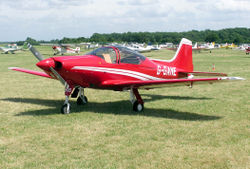
Cozy/Puffer · 1996+
Cozy Mark IV
 i
iSpecifications
Performance
Cruise
180KTAS
Range
870nm
Climb
1800fpm
Ceiling
20,000ft
Fuel Burn
9.5gph
Fuel Cap.
52gal
MPG
21.8mpg
Stall (Vs0)
60KIAS
T/O roll
900ft
Ldg roll
1000ft
Size & weight
Seats
4
Useful Load
1,000lbs
Full-fuel payload
688lbs
Max gross
2,050lbs
Wingspan
28.1ft
Length
17ft
Engine
Engine
Lycoming O-360/IO-360
Power
180hp
TBO
2,000hrs
Overhaul
$45k
Owning it
Hull insurance
$3k/yr
Parts
fair
Mechanics
specialist
Gear
Fixed
IFR
Yes
Category
experimental
Full specification
V-speeds
Airframe
- Empty weight
- 1,050 lbs
- Max fuel weight
- 312 lbs
- Height
- 7.9 ft
- Wing position
- mid
Obstacle performance
- Takeoff over 50 ft
- 1,400 ft
- Landing over 50 ft
- 1,800 ft
These figures are typical for the model, not a specification for any individual aircraft. Real-world numbers vary with year, installed equipment, weight, modifications and engine condition — often by more than you would expect. Use them to compare types, and confirm anything you would act on against the Pilot's Operating Handbook for that specific airframe and a prebuy inspection.
Pricing
Typical
$75k
Range
$45k – $120k
Annual all-in
~$18k/yr
All-in at ~100 flying hours a year, using the midpoint of each range — the same figures broken out under “Cost to own” below. Your number will differ, and mostly for two reasons. Experience sets your insurance: a 2,000-hour pilot with recent training pays 30–40% less than a 200-hour owner, and student owners pay 20–40% more — on the same aircraft that is often a doubling. Location sets your hangar: a T-hangar runs $200–400 a month in the Midwest against $400–1,500 in a coastal metro, and an outside tie-down is less again. Engine reserves move too — a local shop reusing your serviceable cylinders can come in 30–50% under the national specialty-shop pricing we quote, though you trade the warranty and turnaround that comes with it. Reserves are money set aside toward a future overhaul, not a bill this year, and the annual inspection figure is the shop’s labor to look — whatever they find is separate.
Cost to own — estimate
Set your yearly hours and local fuel price. Fixed costs (insurance, hangar, annual inspection) don't change with hours; fuel, maintenance and the engine reserve do.
- Fuel (9.5 gph)
- $6,175
- Engine reserve
- $2,250
- Maintenance, parts & wear items ($12/hr)
- $1,200
- Insurance
- $900–$2,800
- Hangar
- $2,866–$7,166
- Annual inspection (labor only)
- $1,200
- Databases & subscriptions
- $400
- Total per year
- $18,091
- Per flight hour
- $181
- Miles flown / year (at cruise)
- 20,714 mi
- Cost per mile
- $0.87/mi
- Time in the air
- 1 hr 40 min
- Fuel burned
- 16 gal
- Out of pocket
- $160
Fuel, engine reserve and wear only. Insurance, hangar and the annual are already paid whether you make the trip or not, so they are not charged here.
Estimate, not a quote. Where a line shows a range, the total, per-hour and per-mile figures use its midpoint— insurance moves most with your experience and time in type, hangar with where you base the aircraft, so your own number could sit at either end. Annual inspection is the shop's labor to open and inspect — what they find is the maintenance line, which covers oil changes, plugs, tires, brakes, hoses, lights, a battery and vacuum pump amortised over their life, and the unscheduled squawks that are the largest and least predictable part of it. Reserves are sinking funds toward an overhaul, not a bill you pay this year — and note that a propeller is due on hours or calendar time, typically six years, so flying less does not put it off forever.
Strengths
- 180 KTAS cruise on 9.5 gph—outstanding efficiency for four-seat cross-country
- Stall-proof canard design with gentle handling characteristics
- 1,000 lb useful load and genuine 870 nm range
- Composite airframe with indefinite fatigue life; build quality matters more than airframe hours
Weaknesses
- Experimental amateur-built status limits commercial use and student insurance
- Long landing rolls (900–1,100 ft ground roll) rule out short/soft fields
- Builder quality variance is the single largest risk factor; pre-buy by canard specialist essential
- Most A&Ps unfamiliar with canard pushers; maintenance support concentrated in few specialist shops
Overview
The Cozy Mark IV is a four-seat, plans-built composite canard pusher designed by Nat Puffer, derived from Burt Rutan's Long-EZ lineage (see Rutan Long-EZ (Model 61)). Puffer stretched and widened the earlier two-place Cozy (itself a Rutan-authorized Long-EZ derivative) into a genuine four-place side-by-side-plus-rear-bench cross-country machine, releasing the Mark IV plans in 1996. Aircraft Spruce & Specialty Co. has owned the design rights and distributed plans since 2004, after Nat Puffer's retirement.
The Mark IV's reputation is as one of the most efficient four-place homebuilts ever designed: 180 KTAS on 9.5 gph from a 180 hp Lycoming, with genuine 1,000-mile legs and a stall-proof canard configuration. Builders are typically technically capable hobbyists willing to invest 2,500-3,500 hours in foam-and-fiberglass construction. Several hundred Mark IVs have flown worldwide. The aircraft's distinctive winglet-tipped main wing, forward canard, and aft-mounted pusher prop make it instantly recognizable on any ramp.
Variants & History
| Variant | Years | Engine | HP | Gross Weight | Key Differences |
|---|---|---|---|---|---|
| Cozy Mark IV (standard) | 1996-present | Lyc O-360 | 180 | 2050 lb | Baseline plans, carbureted |
| Cozy Mark IV (IO-360) | 1996-present | Lyc IO-360 | 180-200 | 2050 lb | Fuel injection, hot-start immunity, +3-5 KTAS |
| Cozy Mark IV (angle-valve IO-360) | builder option | Lyc IO-360-A1A | 200 | 2050 lb | Higher climb, marginal cruise gain |
| Cozy Mark IV (Mazda 13B rotary) | builder option | Mazda 13B | 180-220 | 2050 lb | Rare, PSRU/cooling challenges, not recommended |
Plans are identical across variants; engine choice is a builder decision. The Mark IV superseded the Cozy III (three-place), which is covered by a separate legacy plans set.
Performance
Book numbers (180 KTAS cruise at 8,500 ft, 9.5 gph) are routinely met or beaten by well-built examples. The canard configuration is aerodynamically efficient — parasite drag is low thanks to the wetted-area-optimized pusher layout and retracted nose gear in flight (the nose gear is manually retractable on the ground and in flight on most builds). Real-world cross-country averages of 175-185 KTAS at 9-10 gph are typical.
Climb is honest at 1,500-1,800 fpm solo, dropping to ~1,000 fpm at gross. Service ceiling comfortably exceeds 18,000 ft with a well-tuned engine. The canard stalls first by design, producing a gentle nose-drop rather than a wing-drop departure — the Mark IV is effectively unstallable in normal flight, which is the Rutan canard configuration's signature safety trait.
Landing is the tricky part: approach speeds are 80-85 KIAS, the airplane floats in ground effect, and landing rolls are longer than comparable four-place Lycomings (900-1,100 ft ground roll, ~1,800 ft over 50 ft). Short/soft fields are not this airplane's friend. Density altitude and contamination (rain on the canard) both sharply increase approach speed requirements.
Payload & Range
With 1,000 lb useful load and 52 gal (312 lb) fuel capacity, the Mark IV is genuinely a four-place airplane — a rarity among experimentals.
- Full fuel, 2 pax + bags: 1,000 lb - 312 lb fuel = 688 lb for occupants and baggage. Two 180-lb pilots + 328 lb of bags. Range: 870 nm with reserves. This is the typical cross-country loading.
- Four adults, reduced fuel: Four 180-lb occupants = 720 lb, leaving 280 lb (45 gal) for fuel. Range: ~750 nm with reserves. Still excellent.
- Four adults + bags, full tanks: 720 lb pax + 312 lb fuel = 1,032 lb — 32 lb over useful load. Mark IV cannot carry four FAA-standard adults, full fuel, and any baggage. Realistic mission is four people, 40 gal, and 50 lb baggage, yielding 650-680 nm range.
The center of gravity envelope is narrow and aft-loaded rear passengers can push limits. Builders and pilots should carefully check W&B before any four-up departure. Compared to a Cessna 182 or Piper Cherokee Six, the Mark IV trades bulk cargo and runway forgiveness for a 35-40 knot cruise advantage on the same fuel burn.
Mission Suitability
- Cross-country (9/10): This is the Mark IV's purpose. 180 KTAS, 870 nm range, four seats, and 9.5 gph fuel burn put it in Mooney/Bonanza cruise territory on O-360 economics. See Cross-Country Flying.
- Business travel (7/10): Fast and efficient, but experimental amateur-built status limits commercial use, and the canard's runway requirements rule out many shorter business airports.
- Local fun (7/10): Head-turning ramp appeal, responsive handling, and the novelty of flying a canard make it a rewarding personal airplane.
- Cargo hauling (3/10): 1,000 lb useful load is good, but the small cabin and awkward baggage access behind the rear seat limit bulk cargo.
- Surveying (2/10): Pusher prop aft of the cabin is good for unobstructed forward view, but the airplane is too fast and fuel-efficient-but-inflexible for low-and-slow work.
- Flight training (1/10): Experimental, unusual configuration, long approach speeds, and limited insurance availability for students.
- Backcountry (1/10): Nose gear clearance, composite belly, and landing roll rule this out entirely.
- Aerobatics (1/10): Not certified or stressed for aerobatics; canard design limits angle-of-attack envelope.
Avionics Ecosystem
Because the Mark IV is experimental, builders can install any avionics they want. Common panel configurations:
- Budget VFR ($5k-$10k): Single Garmin G5 or Dynon D10A, handheld GPS, basic comm. Period-correct for 1996-2005 builds.
- Mid-tier EFIS ($15k-$25k): Dual Dynon SkyView HDX or Garmin G3X Touch, GTN 650Xi, GTR 225 comm, GMC 507 autopilot servos. This is the modern sweet spot.
- High-end IFR ($35k-$60k): Dual G3X Touch, GTN 750Xi, GFC 500 autopilot, ADS-B in/out (GTX 345), angle-of-attack indicator, engine monitor (EI CGR-30P or Garmin EIS).
Panel real estate is limited by the narrow canard cockpit; builders often opt for portrait-oriented displays. Autopilot integration is straightforward because experimental servos (Garmin G3X servos, TruTrak) install without STCs.

2016 Van's RV-10
Dual G3X Touch · IFR · Beautiful Owner Build
STCs & Modifications
Experimental aircraft don't use STCs — modifications are at builder discretion. Common Mark IV mods:
- Extended range tanks (+10-14 gal strake extensions): Pushes range to 1,100+ nm; many builders incorporate during construction.
- Electric nose-gear retraction: Replaces the manual crank; adds ~8 lb but ends builder complaints about forgotten-gear landings.
- IO-360 conversion: Drop-in from carbureted O-360 for hot-start reliability and +3-5 KTAS.
- Constant-speed prop: Most Mark IVs fly fixed-pitch; CS props (Catto, MT) add 150-200 fpm climb and better cruise efficiency for $8k-$15k.
- Winglet modifications: Aftermarket NACA-profile winglet revisions can add 2-3 KTAS; mostly cosmetic.
- Plenum cowling: Better cooling for the pusher installation; addresses the Mark IV's tendency toward high CHTs in climb.
Maintenance & Support
See Maintenance Ecosystem.
- Parts availability: Fair. Lycoming powerplant parts are universal, but canard-specific airframe parts (canopy, wheel pants, nose-gear components) are builder-sourced or come from Aircraft Spruce's legacy stock.
- A&P familiarity: Specialist — most A&Ps have never touched a canard pusher. The condition inspection (experimental equivalent of an annual) is best done by a canard specialist. Marc Zeitlin (Burnside Aerospace) and a handful of shops in Mojave, Oshkosh, and Florida are the recognized authorities.
- Annual/condition inspection cost: $1,200-$2,500 if done by a canard specialist; owner can perform under Repairman Certificate if original builder.
- Recurring costs: Oil changes, plug replacement, and composite inspection are routine. Big-ticket items are prop overhaul ($3,000-$5,000), engine overhaul ($45,000 for IO-360), and occasional canopy replacement ($3,500-$6,000).
- Community: cozybuilders.org and canardzone.groups.io are the technical hubs. The community is small but engaged and unusually technically literate.
Valuation Factors
Used Mark IV values are driven primarily by build quality, avionics, and engine time — airframe hours matter less than on certified aircraft because of the composite structure's indefinite fatigue life. See Aircraft Valuation Methodology.
- Base price tiers:
- Early builds, tired panel, mid-time engine: $45,000-$60,000
- Well-built, modern EFIS, mid-time engine: $70,000-$95,000
- Show-quality, glass panel, low-time engine: $100,000-$130,000
- Engine time premium: A fresh IO-360 adds $20,000-$28,000 over a runout.
- Avionics premium: Modern G3X Touch/GTN 650Xi installation adds $25,000-$40,000.
- Builder reputation: Aircraft built by known, respected builders (documented on canardzone.groups.io) command 15-25% premiums. Unknown-builder airplanes should be discounted 20-30% pending a thorough pre-buy.
New plans cost $500 from Aircraft Spruce. Total build cost for a first-flight airplane (airframe, engine, prop, basic avionics) typically runs $60,000-$100,000 in 2026 dollars, not counting builder labor.
ADs & Common Problems
Experimental aircraft are not subject to ADs, but the canard community tracks recurring problems:
- Nose gear collapse: The manual retraction mechanism wears, and forgotten-gear landings are the single most common Mark IV insurance claim. Electric retrofits mitigate.
- Canard rain sensitivity: Water droplets on the GU25 or Roncz canard airfoil can cause premature canard stall and loss of pitch authority on approach in rain. The Roncz canard (standard on Mark IV) is much improved over the original Long-EZ GU25 but remains a known issue.
- Pusher cooling: CHTs run high in climb due to the aft cowling and limited cooling airflow; plenums and baffling are critical.
- Composite delamination: Older builds (20+ years) occasionally show wing-skin delamination around fuel strake joints; inspection is difficult without destructive methods.
- Builder quality variance: The single largest risk factor is the original builder's workmanship. A pre-buy by a canard specialist (Marc Zeitlin at Burnside Aerospace is the recognized authority) is essential.
Insurance Profile
Insurance is the Mark IV's Achilles heel. See GA Insurance Underwriting.
- Hull premiums: $2,200-$3,500/year on a $75,000 hull, roughly 3-4% of hull value — notably higher than a comparable certified four-place.
- Liability: $1M smooth liability is often unavailable; $100k/$100k per passenger is the common cap for low-time Cozy pilots.
- Underwriting requirements:
- Minimum 250-500 hours total time
- Instrument rating strongly preferred
- 10+ hours dual in type or a canard transition course with a recognized instructor
- Retractable-gear endorsement (for the retractable nose gear)
- Carriers: Avemco and the EAA-sponsored Falcon Insurance program are the primary markets. Global Aerospace occasionally writes high-time owners. New builders with <100 hours total time will struggle to find any hull coverage at all.
For sale (0)
No listings for this model right now.
For sale elsewhere (1)
Current ads on Barnstormers, checked daily. Photos, full details and the seller are on the listing site.
Also worth looking at
What buyers usually weigh against the Cozy Mark IV — aircraft flown for the same kind of mission.