Express Aircraft · 1987+
Wheeler Express / Express S-90
 i
iSpecifications
Performance
Cruise
190KTAS
Range
1,360nm
Climb
1800fpm
Ceiling
24,000ft
Fuel Burn
14.0gph
Fuel Cap.
92gal
MPG
15.6mpg
Stall (Vs0)
47KIAS
T/O roll
1000ft
Ldg roll
900ft
Size & weight
Seats
4
Useful Load
1,370lbs
Full-fuel payload
818lbs
Max gross
3,200lbs
Wingspan
31ft
Length
23ft
Engine
Engine
Lycoming IO-540 (250-300 hp) or Continental IO-360-ES1 (210 hp)
Power
260hp
TBO
2,000hrs
Overhaul
$52k
Owning it
Hull insurance
$3k/yr
Parts
fair
Mechanics
specialist
Gear
Retractable
IFR
Yes
Category
experimental
Full specification
V-speeds
Airframe
- Empty weight
- 1,830 lbs
- Max fuel weight
- 552 lbs
- Height
- 7.5 ft
- Wing position
- low
Obstacle performance
- Takeoff over 50 ft
- 1,650 ft
- Landing over 50 ft
- 1,700 ft
Paperwork
- Certification basis
- Experimental Amateur-Built
These figures are typical for the model, not a specification for any individual aircraft. Real-world numbers vary with year, installed equipment, weight, modifications and engine condition — often by more than you would expect. Use them to compare types, and confirm anything you would act on against the Pilot's Operating Handbook for that specific airframe and a prebuy inspection.
Pricing
Typical
$140k
Range
$90k – $210k
Annual all-in
~$28k/yr
All-in at ~100 flying hours a year, using the midpoint of each range — the same figures broken out under “Cost to own” below. Your number will differ, and mostly for two reasons. Experience sets your insurance: a 2,000-hour pilot with recent training pays 30–40% less than a 200-hour owner, and student owners pay 20–40% more — on the same aircraft that is often a doubling. Location sets your hangar: a T-hangar runs $200–400 a month in the Midwest against $400–1,500 in a coastal metro, and an outside tie-down is less again. Engine reserves move too — a local shop reusing your serviceable cylinders can come in 30–50% under the national specialty-shop pricing we quote, though you trade the warranty and turnaround that comes with it. Reserves are money set aside toward a future overhaul, not a bill this year, and the annual inspection figure is the shop’s labor to look — whatever they find is separate.
Cost to own — estimate
Set your yearly hours and local fuel price. Fixed costs (insurance, hangar, annual inspection) don't change with hours; fuel, maintenance and the engine reserve do.
- Fuel (14 gph)
- $9,100
- Engine reserve
- $2,600
- Propeller reserve
- $175
- Maintenance, parts & wear items ($22/hr)
- $2,200
- Insurance
- $2,350–$4,650
- Hangar
- $4,278–$10,695
- Annual inspection (labor only)
- $2,500
- Databases & subscriptions
- $700
- Total per year
- $28,262
- Per flight hour
- $283
- Miles flown / year (at cruise)
- 21,865 mi
- Cost per mile
- $1.29/mi
- Time in the air
- 1 hr 35 min
- Fuel burned
- 22 gal
- Out of pocket
- $222
Fuel, engine reserve and wear only. Insurance, hangar and the annual are already paid whether you make the trip or not, so they are not charged here.
Estimate, not a quote. Where a line shows a range, the total, per-hour and per-mile figures use its midpoint— insurance moves most with your experience and time in type, hangar with where you base the aircraft, so your own number could sit at either end. Annual inspection is the shop's labor to open and inspect — what they find is the maintenance line, which covers oil changes, plugs, tires, brakes, hoses, lights, a battery and vacuum pump amortised over their life, and the unscheduled squawks that are the largest and least predictable part of it. Reserves are sinking funds toward an overhaul, not a bill you pay this year — and note that a propeller is due on hours or calendar time, typically six years, so flying less does not put it off forever.
Strengths
- 190 KTAS cruise with 1,600 NM range — true cross-country performance at kit-built pricing
- 46-inch cabin width and generous useful load (1,370 lb) — comfort and capability of a Bonanza
- Low annual inspection cost ($800–1,800 baseline) — no IA required, builder or A&P suffices
- Horizontal fuselage split enables exceptional access to systems and interiors during build and maintenance
Weaknesses
- Original cruciform tail has documented yaw stability deficiencies; Series 90 retrofit strongly recommended
- High stall speed (47–57 KIAS) and laminar airfoil intolerant of dirt — demands clean surfaces and serious approach discipline
- Experimental status complicates corporate insurance and resale; specialist composite repair shops required
- Retractable gear electro-hydraulic systems prone to actuator and down-lock reliability issues — regular inspection essential
Overview
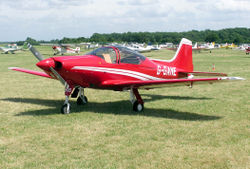
The Express is a four-seat, low-wing, all-composite homebuilt designed by Ken Wheeler and first flown in kit form on 28 July 1987. It debuted at Oshkosh that year as one of the first true high-performance four-place composite kits, positioned as an amateur-built answer to the Mooney and Bonanza: 190 KTAS on a Lycoming IO-540, 1,600 NM range on 92 gallons, and a 46-inch cabin wider than most certified singles in its class. The fuselage is split horizontally rather than vertically — top and bottom half molds — which gives builders unusually generous access to systems and interiors during construction and maintenance. The cruciform tail on early aircraft is the most recognizable visual signature, later revised to a conventional empennage on the Series 90.
Approximately 100 Express airframes have been registered with the FAA since the program began; roughly 55 remain actively flying as of the mid-2020s. The type has passed through at least four corporate owners: Wheeler Technology (bankrupt 1992), Express Design Incorporated of Redmond, Oregon (Chapter 7 in January 1996), Express Aircraft Company LLC under Paul Fagerstrom and Larry Olsen (1997-2007, based in Olympia, Washington), and Composite Aircraft Technology LLC under Darrell Peterson, which acquired the assets through bankruptcy court in September 2007 and relocated production to Toledo, Washington, where kits are still available today. Owners predominantly use these for fast cross-country travel — see Cross-Country Flying and Business Travel.
Variants & History
| Variant | Years | Engine | HP | Gear | Gross | Key Differences |
|---|---|---|---|---|---|---|
| Wheeler Express FT | 1987-1992 | Continental IO-360-ES1 | 210 | Fixed | 3,200 | Original fixed-gear kit, cruciform tail |
| Wheeler Express RG | 1988-1992 | Lycoming IO-540 | 250 | Retractable | 3,200 | Retractable gear, higher cruise ~190 KTAS |
| EDI Express | 1993-1996 | IO-540 | 250 | FG/RG | 3,200 | Minor refinements during EDI ownership |
| Express 2000 | 1997-2007 | IO-540 | 250-260 | FG/RG | 3,200 | EAC-era improvements, better finish kit |
| Express Series 90 (S-90 / CT) | 2007-present | IO-540 | 300 | FG/RG | 3,200 | 20% larger tail, conventional empennage, wider CG envelope, 300 hp option, 210 mph cruise |
Performance
Book cruise of 190 KTAS at altitude on the 250 hp IO-540 is credible and has been validated by builder reports and the 1997 CAFE Foundation APR evaluation, which found the aircraft delivered on manufacturer performance claims. The 300 hp S-90 pushes that to roughly 210 mph (183 KTAS indicated cruise). The 92-gallon fuel capacity yields 5+ hour legs with reserves, making 1,000 NM stage lengths routine. The NLF-1(0215)F laminar airfoil is efficient but intolerant of dirt, bugs, and paint imperfections — owners report 5-10 knot cruise losses with degraded wing surfaces.
The CAFE report flagged stability deficiencies, specifically poor yaw stability and inadequate low-speed control in the original cruciform-tail airframes. The Series 90 tail redesign (20% larger area) directly addresses both the CG range and the yaw/pitch stability findings. Stall speed is relatively high at 47-57 KIAS depending on variant and flap setting, and the airfoil gives little pre-stall warning — pilots transitioning from a 172 or Cherokee should treat the approach speeds and runway requirements seriously.
Payload & Range
With 92 gallons and 1,370 lb useful load:
- Full fuel (552 lb) + 2 adults (380 lb) + bags (150 lb): Well inside gross; ~1,360 NM still-air range at 14 GPH and 190 KTAS. This is the Express's sweet spot and the reason it exists.
- Full seats (4 x 190 = 760 lb) + bags (100 lb): Leaves ~510 lb / 85 gallons of fuel, good for roughly 1,150 NM. Still genuinely a four-place cross-country machine with four adults aboard.
- Max fuel + 4 adults + full bags: Over gross. Trade fuel for payload — a 3.5 hour leg (50 gal, 300 lb fuel) with four adults and 100 lb bags lands just under 3,200 lb.
The combination of 92-gallon capacity, 14 GPH cruise, and genuine 190 KTAS is rare in any price tier and is the single strongest argument for the type. See Cross-Country Flying.
Sources:
Mission Suitability
- Cross-country (9/10): This is the mission the Express was designed for. 190 KTAS, 1,360+ NM range, wide cabin, and a useful load that supports full fuel + 3 adults put it in Bonanza/Mooney territory for a fraction of the acquisition cost.
- Business travel (8/10): Fast, comfortable, IFR-capable with modern glass, four seats. Penalty is experimental status (some corporate insurance departments balk) and specialist maintenance.
- Local fun flying (6/10): Capable but overbuilt for the role — expensive fuel burn and high approach speeds make it less fun than a simpler airplane around the pattern.
- Cargo hauling (5/10): 1,370 lb useful load and a big cabin help, but no large cargo door and limited floor structure for heavy items.
- Surveying (4/10): Low wing limits downward visibility; speed is too high for most survey profiles.
- Flight training (2/10): Retract-capable, fast, slick composite — not a trainer.
- Backcountry (2/10): Low wing, prop clearance, fixed or retractable gear on paved-only tires, high stall speed. Wrong tool.
- Aerobatics (1/10): Not approved or designed for aerobatics despite the +8.8/-4.4 structural g limits quoted for ultimate load.
Avionics Ecosystem
As an experimental, the Express has no certification constraints — owners panel them across the full spectrum:
- Entry ($8-15K): Legacy steam gauges with a used Garmin 430W, basic autopilot (TruTrak or S-TEC legacy).
- Mid ($20-40K): Single Dynon SkyView HDX or Garmin G3X Touch, GTN 650Xi, GMC 507 autopilot head driving a Garmin GFC 500 or Dynon SkyView autopilot servos.
- High ($50-80K+): Dual G3X Touch displays, dual GTN 750Xi / 650Xi stack, GFC 500 with envelope protection, GMA 345 audio, ADS-B In/Out, engine monitor (EIS or integrated), backup ADAHRS.
Experimental autopilots in the Express work well because the airframe is aerodynamically clean and predictable in smooth air. See Aircraft Valuation Methodology for avionics premium calculations.

2016 Van's RV-10
Dual G3X Touch · IFR · Beautiful Owner Build
STCs & Modifications
STCs don't apply to experimentals, but common owner modifications include:
- Series 90 tail retrofit: Larger empennage kit from Composite Aircraft Technology — improves yaw stability and widens usable CG. Significant project requiring refinishing.
- IO-540 300 hp upgrade: Swapping a 250 hp IO-540 for a 300 hp variant adds ~15-20 mph cruise and meaningful climb improvement. $15-25K over a standard overhaul.
- Three-blade constant-speed prop: MT or Hartzell composite props reduce noise and vibration, small cruise gain.
- Wingtip fuel / winglets: Some builders have added winglets for stability and minor cruise benefit.
- Modern ANR-compatible interior: Leather, soundproofing, and power ports — an owner-driven refresh that materially affects resale.
Maintenance & Support
As experimental amateur-built, condition inspections can be performed by the original builder (if they hold the repairman certificate) or any A&P — no IA required. This meaningfully reduces annual inspection cost to the $800-1,800 range for a clean airframe, though parts-intensive years can run higher.
- Parts availability: Fair. Composite Aircraft Technology in Toledo, WA supports current kit builders and can supply structural parts, molds, and technical help. Lycoming IO-540 support is universal.
- Mechanic familiarity: Specialist. Most A&Ps can work the engine, prop, and systems, but composite repair work on the airframe benefits from a shop experienced with glass/vinylester layups. The Express builder community (Express Link newsletter, express-builder.com forums) is a practical support network.
- Annual cost estimate: $6,500-12,000 typical, depending on engine reserve accrual and avionics complexity.
- Expensive items: Engine overhaul ($45-55K for IO-540), paint refresh ($15-25K for a composite airframe done right), retract system component failures, and prop overhaul ($3-5K).
See Maintenance Ecosystem for broader experimental support context.
Valuation Factors
Price tiers (used market, 2024-2026):
- $90-120K: Older FG airframes with legacy avionics, original cruciform tail, mid-to-high-time engines, tired paint.
- $120-170K: Well-sorted RG airframes with 250 hp IO-540, glass panel retrofit, decent paint and interior, mid-time engine.
- $170-210K+: Series 90 or S-90 equivalent tail, 300 hp IO-540, low-time engine, dual-screen glass with GTN, GFC 500, fresh paint, documented build quality.
A new Composite Aircraft Technology airframe kit alone runs $76,250 plus tax (engine, prop, avionics, and finish kit extra) — total completed project cost for a well-equipped Series 90 today lands in the $220-280K range, well above used market clearing prices. Engine time remaining drives 15-25% of value; glass panel retrofits recover roughly 60-70 cents on the dollar at resale. See Aircraft Valuation Methodology.
ADs & Common Problems
Experimentals are exempt from FAA ADs, but recurring issues documented in the Express builder community and Express Link newsletter:
- Yaw stability on original cruciform tail: Contributed to at least one fatal accident; airframes still flying with the original tail should be evaluated carefully during pre-buy, and the Series 90 tail retrofit is strongly recommended.
- Two historical fatal demo accidents (1989-1990): A 1990 factory demo aircraft spin-in killed four people. NTSB assigned pilot error, but subsequent analysis suggested handling deficiencies contributed. Directly led to Wheeler Technology's 1992 bankruptcy.
- Builder workmanship variance: As with any kit, pre-buy should include a composite layup inspection by a qualified shop — delamination, voids, and inconsistent resin ratios are the highest-cost surprises.
- Landing gear rigging (RG): Electro-hydraulic retract systems require regular inspection; some airframes have had actuator, switch, and down-lock reliability issues.
- Fuel system: 92 gallons distributed across multiple tanks — venting and selector issues have been reported in builder forums.
- Surface contamination: Laminar airfoil sensitivity means wax, cleanliness, and paint quality directly affect cruise performance.
Insurance Profile
The Express is harder than average to insure due to (a) experimental/amateur-built status, (b) retractable gear on most examples, (c) high-performance IO-540 power, and (d) accident history affecting underwriter perception of the type. Typical hull premiums for a $150K Express RG run $2,800-3,800/year for a 500+ hour retract-experienced pilot; new-to-retract buyers face $4,500+ or outright declines. Most carriers require a make-and-model checkout with a type-experienced CFI (10+ hours dual) plus a minimum number of hours in retractable gear before solo coverage. Liability-only is available for low-time builders during Phase I testing. See GA Insurance Underwriting.
For sale (0)
No listings for this model right now.
Also worth looking at
What buyers usually weigh against the Wheeler Express / Express S-90 — aircraft flown for the same kind of mission.