Porto Aviation Group · 2015+
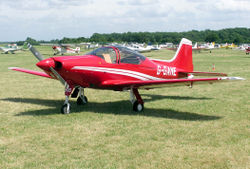
Porto Aviation Risen Superveloce
 i
iSpecifications
MOSAIC eligiblePerformance
Cruise
195KTAS
Range
800nm
Climb
2200fpm
Ceiling
18,000ft
Fuel Burn
7.5gph
Fuel Cap.
32gal
MPG
29.9mpg
Stall (Vs0)
43KIAS
T/O roll
700ft
Ldg roll
800ft
Size & weight
Seats
2
Useful Load
606lbs
Full-fuel payload
416lbs
Max gross
1,378lbs
Wingspan
26.9ft
Length
22.3ft
Engine
Engine
Rotax 916iS
Power
160hp
TBO
2,000hrs
Overhaul
$32k
Owning it
Hull insurance
$10k/yr
Parts
poor
Mechanics
specialist
Gear
Retractable
IFR
No
Category
experimental
Full specification
V-speeds
Airframe
- Empty weight
- 772 lbs
- Max fuel weight
- 190 lbs
- Wing position
- low
- Auto fuel (mogas)
- Auto fuel specified by the engine maker — 91 premium
Obstacle performance
- Takeoff over 50 ft
- 1,250 ft
- Landing over 50 ft
- 1,500 ft
Paperwork
- Certification basis
- European ultralight (472.5 kg, raised to 600/625 kg); registered in the US as Experimental Amateur-Built (kit with factory build assist) or Experimental Exhibition
These figures are typical for the model, not a specification for any individual aircraft. Real-world numbers vary with year, installed equipment, weight, modifications and engine condition — often by more than you would expect. Use them to compare types, and confirm anything you would act on against the Pilot's Operating Handbook for that specific airframe and a prebuy inspection.
Pricing
Typical
$320k
Range
$200k – $400k
Annual all-in
~$26k/yr
All-in at ~100 flying hours a year, using the midpoint of each range — the same figures broken out under “Cost to own” below. Your number will differ, and mostly for two reasons. Experience sets your insurance: a 2,000-hour pilot with recent training pays 30–40% less than a 200-hour owner, and student owners pay 20–40% more — on the same aircraft that is often a doubling. Location sets your hangar: a T-hangar runs $200–400 a month in the Midwest against $400–1,500 in a coastal metro, and an outside tie-down is less again. Engine reserves move too — a local shop reusing your serviceable cylinders can come in 30–50% under the national specialty-shop pricing we quote, though you trade the warranty and turnaround that comes with it. Reserves are money set aside toward a future overhaul, not a bill this year, and the annual inspection figure is the shop’s labor to look — whatever they find is separate.
Cost to own — estimate
Set your yearly hours and local fuel price. Fixed costs (insurance, hangar, annual inspection) don't change with hours; fuel, maintenance and the engine reserve do.
- Fuel (7.5 gph)
- $4,875
- Engine reserve
- $1,600
- Propeller reserve
- $175
- Maintenance, parts & wear items ($22/hr)
- $2,200
- Insurance
- $5,350–$10,650
- Hangar
- $3,599–$8,998
- Annual inspection (labor only)
- $2,500
- Databases & subscriptions
- $700
- Total per year
- $26,349
- Per flight hour
- $263
- Miles flown / year (at cruise)
- 22,440 mi
- Cost per mile
- $1.17/mi
- Time in the air
- 1 hr 32 min
- Fuel burned
- 12 gal
- Out of pocket
- $136
Fuel, engine reserve and wear only. Insurance, hangar and the annual are already paid whether you make the trip or not, so they are not charged here.
Estimate, not a quote. Where a line shows a range, the total, per-hour and per-mile figures use its midpoint— insurance moves most with your experience and time in type, hangar with where you base the aircraft, so your own number could sit at either end. Annual inspection is the shop's labor to open and inspect — what they find is the maintenance line, which covers oil changes, plugs, tires, brakes, hoses, lights, a battery and vacuum pump amortised over their life, and the unscheduled squawks that are the largest and least predictable part of it. Reserves are sinking funds toward an overhaul, not a bill you pay this year — and note that a propeller is due on hours or calendar time, typically six years, so flying less does not put it off forever.
Strengths
- 195 KTAS cruise on 7.5 GPH — unmatched efficiency for cross-country
- All-carbon construction, fully retractable gear, V-tail design
- Genuine transatlantic range on modest fuel (800–1,500 NM legs)
- Factory support and personal engagement from Porto Aviation
Weaknesses
- Severe speed discipline required: 70 KIAS gear/flap limits demand extensive descent planning
- Single-source parts from Italy; no US depot or aftermarket support
- Rotax 916iS is new; overhaul pricing unsettled and reserves estimated, not quoted
- High insurance costs dominate operating budget (~$9,500–11,000/yr) despite fuel efficiency
- Experimental-only; VFR operation and US operating limitations
Overview
The Risen is a two-seat, side-by-side, V-tail, all-carbon retractable designed by the Italian-Argentine engineer Alberto Porto and built by Porto Aviation Group in Lecco, Italy, with final assembly and test flying at Voghera Rivanazzano (LILH). It first flew in 2012 and was introduced at AERO Friedrichshafen in 2015. Early airframes were marketed through Swiss Excellence Airplanes, which is why the type appears in some references as the "Swiss Excellence Risen" — it is the same aircraft.
It is, by a clear margin, the fastest thing in this catalogue for the fuel it burns. The current Risen SV 916 Superveloce, on a 160 HP Rotax 916iS, cruises at 195 KTAS at 9,000 ft and 215 KTAS at FL180, and the type holds the FAI absolute speed record for its class — 428.18 km/h (266 mph) set 22 January 2023, raised to 453.20 km/h in October 2025. During record-setting transatlantic flying it burned roughly 4 GPH at 165 KTAS. That is a Bonanza's speed on a Cessna 150's fuel bill.
The efficiency is not marketing. It comes from a very small, very clean airframe: 91.5 sq ft of wing on the SV, fully retracting gear with no separate doors, a tightly cowled engine with minimal cooling drag, and a V-tail. The price of that efficiency is a narrow speed envelope at the slow end and a genuinely demanding descent-planning problem, covered below.
Variants & History
| Variant | Years | Engine | HP | MTOW | Wing Area | Key Differences |
|---|---|---|---|---|---|---|
| Risen 912 ULS / 912 iS | 2015- | Rotax 912ULS / 912iS | 100 | 472.5 kg, later 600 kg | 104.4 sq ft | The original; 160 KTAS on 4.7 GPH. Set the 2016 FAI class record at 323.82 km/h |
| Risen 914 | 2016- | Rotax 914 turbo | 115 | 472.5-600 kg | 104.4 sq ft | Turbocharged intermediate step |
| Risen 915 iSV | ~2019- | Rotax 915iS | 141 | 600 kg | 91.5 sq ft | Clipped wing, 197 KTAS cruise at 9,000 ft |
| Risen SV 916 Superveloce | ~2023- | Rotax 916iS | 160 | 625 kg | 91.5 sq ft | Current flagship; 215 KTAS at FL180, 31.7 gal standard, record holder |
| Siren | 2017- | Rotax 912/914 | 100-115 | 472.5 kg | 104.4 sq ft | Fixed-gear sibling with a revised cockpit; slower, simpler, cheaper |
Note the wing change. The 915/916 "SV" airframes have 2.6 ft less span and 91.5 sq ft against the original's 104.4 sq ft. That is what lifts the top end and what raises the stall from 38 KIAS to 43 KIAS. If you want the docile end of the family, the long-wing 912iS is the one to look at; if you want the record numbers, the SV is, and you accept the higher approach speeds.
Performance
KITPLANES flew the long-wing 912iS and measured 160 KTAS at 6,500 ft on 4.7 GPH at 75% power, and 150 KTAS on 3.5 GPH at a typical full-throttle 4,800 RPM cruise. The factory book figure of 162 KTAS at 9,000 ft on 3.7 GPH is therefore honest, which is unusual and worth saying plainly.
For the SV 916 the factory publishes 395 km/h (215 KTAS) at 75% power at FL180, 1,680 km (905 NM) range in that configuration, and a maximum of 450 km/h TAS above 13,600 ft. Those are real but altitude-dependent numbers requiring supplemental oxygen. The catalogue figures above use the more realistic 195 KTAS at 9,000 ft on about 7.5 GPH, which gives roughly 800 NM with VFR reserves on the standard 31.7 gallons. Optional tanks add 60-100 liters (16-26 gal) and push maximum-range cruise past 1,500 NM.
Climb is 2,000-2,200 FPM initially, trailing off with altitude. Best rate is about 86 KIAS. Best glide ratio is 20:1 — this airframe does not want to come down.
The hard part of flying a Risen is slowing it down. Gear extension and retraction are limited to 70 KIAS, full flaps to 70 KIAS, partial flaps to 86 KIAS. KITPLANES was explicit: "the most challenging part of flying the Risen is getting it slowed down for the very modest flap and gear speeds… you'll have to plan to be level for quite some time before the Risen decelerates sufficiently." Compounding this, the tight cowling leaves thin oil-temperature margins, so you cannot simply pull the power back and wait. Descent and arrival planning is a real workload item on this airplane, and it is the single most likely source of a first-flight-in-type incident.
Handling is otherwise reported as conventional and pleasant: light and linear pitch forces, neutral roll stability (it holds whatever bank you select), good yaw stability with no pitch/yaw coupling despite the V-tail, which uses a ruddervator mixer similar in principle to a Bonanza's. It is slightly less trim-stable in pitch than a larger aircraft, damping out over several oscillations.
Payload & Range
The SV 916 at 625 kg gross (1,378 lb) with a 772 lb empty weight gives about 606 lb useful load. This is the number that decides whether the airplane fits your mission:
- Full standard fuel (31.7 gal / 190 lb) + two 190 lb adults: 570 lb of 606 lb, leaving about 36 lb for baggage. It works, but only just, and only with light passengers.
- Two adults + bags (450 lb) : leaves 156 lb of fuel, about 26 gallons, which is still roughly 650 NM at 195 KTAS with reserves. In practice most owners fly this way.
- Solo with full fuel and optional tanks: the record-flight configuration. One pilot, ~50 gallons, and range past 1,500 NM. This is where the airplane is genuinely without peer.
- Real-world limit: as with the Shark, volume beats weight. There is no baggage compartment worth the name, and the 48-inch cabin buys shoulder room, not luggage space.
Compare directly with the Shark.Aero Shark — the Shark is tandem, slower, cheaper to insure by a little, and the only one of the two with certified turbulence cancelling; the Risen is side-by-side, 45 knots faster, and the better long-distance touring airplane. For the mission this aircraft is built around see Cross-Country Flying.
Mission Suitability
- Cross-country (9): This is the whole point. 195 KTAS on 7.5 GPH, 800-1,500 NM legs, a 48-inch cabin, and an autopilot. Nothing else in this catalogue does long-distance touring on this little fuel.
- Local fun flying (8): Fast, light-controlled, and a V-tail carbon rocket. Marked down slightly because it is an expensive, slippery airplane to bore holes in the sky with, and the pattern work is demanding.
- Business travel (6): The best score any experimental in this catalogue earns here. Genuine airline-competitive block times on 500 NM legs. Held back by VFR-only operation, US experimental operating limitations, and two seats.
- Surveying (4): Efficient and long-legged, but low-wing, fast, and unhappy at loiter speeds.
- Flight training (1): No. Retractable, constant-speed, V-tail, 70-knot gear and flap limits, and uninsurable for a student.
- Aerobatics (1): Not approved or stressed for aerobatics despite the +5/-3 envelope.
- Backcountry (1): Retractable gear, composite belly, low wing, and 1,500 ft over a 50 ft obstacle on landing.
- Cargo hauling (1): 606 lb useful load sounds fine until you subtract 190 lb of fuel and two adults. Baggage is soft bags only.
Avionics Ecosystem
- Factory standard on the SV: a single 10" Dynon SkyView HDX with engine monitoring at the pilot position, with a mounting provision for a second screen in front of the passenger. Some airframes carry three Dynon touchscreens. See Avionics Pricing Reference.
- Typical additions ($15-35k): second HDX screen for redundancy, two-axis autopilot (frequently fitted from new; the base price with radios and autopilot runs about €306,000 against €289,700 bare), Dynon or Garmin com and transponder, and US-compliant ADS-B, which European deliveries often lack.
- IFR: not certified anywhere and not supported by the certification basis. This is a VFR airplane. Given the 20:1 glide, the 70-knot gear speed and no known-ice capability, treat that as a genuine operational limit rather than paperwork.

2009 Van's RV-7
RV-7 · Fast + Aerobatic · Dynon Glass · Great First RV
Maintenance & Support
See Maintenance Ecosystem.
- Parts availability: poor. Everything comes from Italy, in euros, with customs. There is no US depot and no aftermarket.
- Mechanic familiarity: specialist. The Rotax 916iS is serviceable by any Rotax-capable shop, though the 916 is new enough that shop experience is thin. The airframe, gear and BRS need a composites-comfortable A&P, or the builder's own repairman certificate on an E-AB airframe.
- Factory support is unusually personal — owners deal directly with Alberto Porto and the Porto Aviation team. That is a genuine strength while the company is healthy and a concentrated risk if it is not.
- Annual condition inspection: $1,500-2,500 clean.
- Typical annual operating cost: roughly $19,500 at 100 hours — about $4,500 fuel, $9,500-11,000 insurance, $3,600 hangar, $1,500-2,500 inspection, $1,500 reserves. As with the Shark, insurance dominates, and the headline fuel efficiency is not what determines the cost of ownership.
- Expensive items: BRS repack/rocket ($4,000-6,000), canopy and electric lift mechanism, gear jackscrew motors, constant-speed prop overhaul (~$2,500), Rotax 916 turbo components.
- Reserves: budget $14-16/hr engine (the 916's overhaul cost is not yet well established — err high), $3-4/hr airframe and gear.
Valuation Factors
See Aircraft Valuation Methodology.
- Factory pricing: the 912iS model starts at €249,500 (about $272,000) including paint, interior, basic avionics, propeller, wheels, brakes and a training package. The SV 916 starts at €289,700 (about $316,000), or roughly €306,000 with radios and autopilot. Build-assist labor and travel sit on top.
- Early-adopter reality check: one US builder's completed airframe came to just under $200,000 all-in, but that reflects early pricing and component costs that have since risen. Do not plan on that number.
- Price tiers: used long-wing 912iS $200-260k; 915 iSV $260-330k; recent SV 916 $330-400k+.
- Engine is most of the delta. The step from 912iS to 916iS is 60 horsepower and roughly $60-80k of airplane. Decide whether you actually need FL180 performance before paying for it.
- Long-range tanks: $8-12k value add and the difference between an 800 NM and a 1,500 NM airplane.
- E-AB vs Experimental Exhibition: an E-AB airframe with a clean build log and a repairman certificate in the chain is worth materially more than an Exhibition import. Confirm which one you are buying.
- Records halo: the FAI records are real and do support residual values, but the market is thin. Very few exist in the US and comparable sales are scarce, so appraisals are weak and bid-ask spreads are wide.
ADs & Common Problems
No FAA Airworthiness Directives apply to experimental aircraft. Type-specific concerns:
- Gear and flap speed discipline. The 70 KIAS limits are low and the airframe is slippery. Overspeed damage to gear doors, jackscrews and flap tracks is the predictable failure mode. Inspect actuators and tracks, and ask directly about overspeed events.
- Three-motor gear system. More redundancy than most, but also more to go wrong. Confirm the emergency battery-direct extension circuit actually works during the pre-buy, not just on paper.
- Oil temperature margins. The tight cowl runs warm in the descent and hot in the climb on a summer day. Check for cooling modifications and ask about summer operations.
- Rotax 916iS is a young engine. TBO is nominally 2,000 hours but the in-service record is short and overhaul pricing is not yet settled — the $32,000 reserve here is an estimate extrapolated from 915iS experience, not a quoted figure.
- BRS currency. Rocket and canopy lives expire. Budget $4,000-6,000 and check the dates.
- Builder quality on E-AB airframes. The build-assist program produces consistent airframes, but a Risen finished outside it should be scrutinised hard, especially the wing layups and the spar joint.
- Single-source everything. There is no aftermarket. Canopy, gear components and control parts come from Italy or not at all.
Pre-buy red flags: any gear overspeed or gear-up event, undocumented composite repair, time-expired BRS, an Experimental Exhibition certificate where you expected E-AB, and avionics that will not meet US ADS-B rules.
Insurance Profile
See GA Insurance Underwriting. Similar to the Shark and, if anything, harder:
- Hull: roughly $9,000-11,000/year on a $320,000 hull (about 3% of hull value). Retractable gear, a V-tail, 195-knot cruise, composite construction and no US claims history all push the same direction.
- Liability: $1,000-1,500/year for $1M smooth.
- Underwriting quirks: expect 500+ hours total, real retractable and high-performance time, and a type-specific checkout that is very difficult to arrange in the US. Some carriers decline the type outright. Get a written quote before you commit to a build slot — a two-month build in Italy is a bad time to discover you cannot insure the result.
- Claim behavior: minor damage to a rare carbon airframe with a single European parts source tends to be settled as a total loss.
For sale (0)
No listings for this model right now.
Also worth looking at
What buyers usually weigh against the Porto Aviation Risen Superveloce — aircraft flown for the same kind of mission.