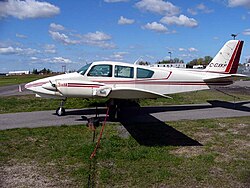
Cessna · 1964–1982
Cessna 337 Skymaster
 i
iSpecifications
Performance
Cruise
169KTAS
Range
1,139nm
Climb
940fpm
Ceiling
18,000ft
Fuel Burn
22.0gph
Fuel Cap.
90gal
MPG
8.8mpg
Stall (Vs0)
60KIAS
T/O roll
1000ft
Ldg roll
700ft
Size & weight
Seats
6
Useful Load
1,705lbs
Full-fuel payload
1,165lbs
Max gross
4,630lbs
Wingspan
38.2ft
Length
29.8ft
Engine
Engine
Continental IO-360-C / TSIO-360-C (P337)
Power
420hp
TBO
1,500hrs
Overhaul
$45keach
Engines
2
Owning it
Hull insurance
$5k/yr
Parts
fair
Mechanics
specialist
Gear
Retractable
IFR
Yes
Category
certified
Full specification
V-speeds
Airframe
- Empty weight
- 2,925 lbs
- Max fuel weight
- 540 lbs
- Height
- 9.2 ft
- Wing position
- high
Obstacle performance
- Takeoff over 50 ft
- 1,700 ft
- Landing over 50 ft
- 1,650 ft
Paperwork
- Type certificate
- A6CE
- Certification basis
- Part 23
These figures are typical for the model, not a specification for any individual aircraft. Real-world numbers vary with year, installed equipment, weight, modifications and engine condition — often by more than you would expect. Use them to compare types, and confirm anything you would act on against the Pilot's Operating Handbook for that specific airframe and a prebuy inspection.
Pricing
Typical
$115k
Range
$75k – $185k
Annual all-in
~$49k/yr
All-in at ~100 flying hours a year, using the midpoint of each range — the same figures broken out under “Cost to own” below. Your number will differ, and mostly for two reasons. Experience sets your insurance: a 2,000-hour pilot with recent training pays 30–40% less than a 200-hour owner, and student owners pay 20–40% more — on the same aircraft that is often a doubling. Location sets your hangar: a T-hangar runs $200–400 a month in the Midwest against $400–1,500 in a coastal metro, and an outside tie-down is less again. Engine reserves move too — a local shop reusing your serviceable cylinders can come in 30–50% under the national specialty-shop pricing we quote, though you trade the warranty and turnaround that comes with it. Reserves are money set aside toward a future overhaul, not a bill this year, and the annual inspection figure is the shop’s labor to look — whatever they find is separate.
Cost to own — estimate
Set your yearly hours and local fuel price. Fixed costs (insurance, hangar, annual inspection) don't change with hours; fuel, maintenance and the engine reserve do.
- Fuel (22 gph)
- $14,300
- Engine reserve
- $6,000
- Propeller reserve
- $600
- Maintenance, parts & wear items ($45/hr)
- $4,500
- Insurance
- $4,000–$8,000
- Hangar
- $6,830–$17,075
- Annual inspection (labor only)
- $4,500
- Databases & subscriptions
- $900
- Total per year
- $48,753
- Per flight hour
- $488
- Miles flown / year (at cruise)
- 19,448 mi
- Cost per mile
- $2.51/mi
- Time in the air
- 1 hr 47 min
- Fuel burned
- 39 gal
- Out of pocket
- $451
Fuel, engine reserve and wear only. Insurance, hangar and the annual are already paid whether you make the trip or not, so they are not charged here.
Estimate, not a quote. Where a line shows a range, the total, per-hour and per-mile figures use its midpoint— insurance moves most with your experience and time in type, hangar with where you base the aircraft, so your own number could sit at either end. Annual inspection is the shop's labor to open and inspect — what they find is the maintenance line, which covers oil changes, plugs, tires, brakes, hoses, lights, a battery and vacuum pump amortised over their life, and the unscheduled squawks that are the largest and least predictable part of it. Reserves are sinking funds toward an overhaul, not a bill you pay this year — and note that a propeller is due on hours or calendar time, typically six years, so flying less does not put it off forever.
Strengths
- Benign centerline-thrust engine-out handling; no conventional Vmc training required
- High-wing visibility and clamshell doors ideal for surveying, patrol, and observation
- True twin-engine redundancy for hard IFR with modest 22 GPH fuel burn vs. conventional twins
- 1,139 NM range; strong cross-country and business-travel capability
Weaknesses
- Rear-engine cooling requires careful management and is prone to CHT exceedances on neglected airframes
- Cramped fuselage pod and rear-engine access make maintenance labor-intensive; specialist mechanic essential
- Slower than competing twins (169 KTAS vs. 310R at 185 KTAS); annuals run $12k–$16k at specialist shops
- Orphaned type; Cessna no longer supports; airframe parts rely on salvage and specialty vendors with long lead times
Overview
The Cessna 337 Skymaster is one of the most visually distinctive general aviation twins ever produced — a high-wing, twin-boom, six-seat utility aircraft with two engines mounted in a push-pull centerline-thrust configuration. One engine pulls from the nose and one pushes from the rear of the fuselage pod, eliminating the asymmetric yaw that defines a conventional twin engine-out scenario. The FAA recognized this unique handling by granting the Skymaster its own "centerline thrust only" class rating, allowing pilots to earn a multi-engine privilege restricted to Skymaster-style aircraft without ever demonstrating conventional Vmc work.
The Skymaster lineage began with the fixed-gear Model 336 in 1964, followed by the retractable-gear Model 337 Super Skymaster introduced for the 1965 model year. Production continued through 1982, with approximately 2,993 civilian airframes built (including 332 pressurized T337G/P337 variants) plus 513 military O-2 Skymasters used extensively by the USAF as forward air controllers in Vietnam. The O-2 served into the 1990s and cemented the Skymaster's reputation as a rugged, stable observation platform.
The Skymaster attracted a devoted, somewhat contrarian following: pilots who valued the benign engine-out handling, the panoramic high-wing visibility, the wide utility cabin with clamshell rear doors, and the distinctive look. Detractors point to the rear-engine cooling quirks, the cramped cowlings that make maintenance labor-intensive, and the somewhat anemic performance compared to conventional twins of similar horsepower. Approximately 1,200 Skymasters remain on the FAA registry, supported by the Skymaster Owners And Pilots organization and a concentrated ecosystem of specialist shops. The type shares a parts-support challenge with other orphaned Cessnas — parts are available but require knowing where to look. See also Cessna 310/320 Skyknight for the conventional Cessna twin comparison.
Variants & History
| Variant | Years | Engine | HP/side | MTOW (lbs) | Key Differences |
|---|---|---|---|---|---|
| 336 Skymaster | 1964–1965 | Continental IO-360-A | 195 | 3,900 | Fixed gear, cowl flaps only on front engine, 195 built |
| 337 | 1965 | IO-360-C/D | 210 | 4,300 | First retractable-gear model, dorsal rear-engine air scoop, 239 built |
| 337A Super Skymaster | 1966 | IO-360-C/D | 210 | 4,400 | Detail refinements, 255 built |
| 337B / T337B | 1967 | IO-360-C/D / TSIO-360-A | 210/210 | 4,400 | First turbocharged variant, optional belly cargo pack, 230 + 231 built |
| M337B / O-2A | 1967–1970 | IO-360-C/D | 210 | 4,850 | Military forward air controller, 479 built for USAF |
| 337C / T337C | 1968 | IO-360-C/G / TSIO-360-A | 210/225 | 4,500 | New instrument panel, gross weight increase, 223 built |
| 337D / T337D | 1969 | IO-360-C/G / TSIO-360-B | 210/225 | 4,500 | Improved interior, 222 built |
| 337E / T337E | 1970–1971 | IO-360-G / TSIO-360-B | 210/225 | 4,500 | Refined cowlings, 100 built |
| 337F / T337F | 1972 | IO-360-G / TSIO-360-B | 210/225 | 4,630 | Minor updates, gross weight to 4,630 lbs |
| 337G / T337G | 1973–1977 | IO-360-G/GB / TSIO-360-C | 210/225 | 4,630 | Simplified electro-hydraulic gear, cleaner fuel system, split rear cowl |
| P337G (Pressurized) | 1973–1977 | TSIO-360-C | 225 | 4,700 | First pressurized push-pull twin, 3.35 psi differential, 332 built |
| 337H | 1978–1980 | IO-360-G | 210 | 4,630 | Final NA variant, minor updates |
| P337H / T337H | 1978–1980 | TSIO-360-H/HB | 225 | 4,700 | Final pressurized variant, improved systems |
| Riley Super Skyrocket P337 | aftermarket | TSIO-520 (Riley STC) | 310 | 4,700 | Riley Rocket conversion, intercoolers, 3-blade props, 2,500 fpm climb |
Recommended sweet spot: The 337G (1973–1977) is the preferred non-pressurized variant — it replaced the troublesome 1965–1972 hydraulic landing gear and complex fuel system with simpler, more reliable alternatives. The P337H (1978–1980) represents the peak of the line for high-altitude capability. Avoid the early 336 (fixed gear, underpowered) and early 337–337F airframes unless priced accordingly for their fuel and gear system headaches.
Performance
The Skymaster's 169 KTAS cruise on 420 total HP is slower than a comparable conventional twin — a 310R makes 185 KTAS on 570 HP but burns 28 GPH to the 337's 22 GPH. The drag penalty of the twin-boom configuration and the push-pull fuselage is real, and book numbers of 160–170 KTAS translate to roughly 155–165 KTAS at typical cruise power settings in the real world.
Rear engine cooling: The single most discussed performance quirk. The rear engine is fed by a dorsal air scoop and relies on large cowl flaps and carefully maintained baffling to stay within CHT limits, especially during prolonged climbs and hot-day ground operations. Properly rigged aircraft with healthy baffling do not overheat; neglected examples routinely exceed CHT limits on the rear engine, accelerating cylinder wear. A specific departure profile — shock cooling avoided, climb airspeed kept up, cowl flaps managed deliberately — is part of the type transition.
Turbocharged variants: The T337 and P337 use TSIO-360 engines producing 225 HP flat-rated well into the mid-teens. Critical altitude is approximately 20,000 ft, enabling 180–190 KTAS TAS in the high teens. The P337 adds 3.35 psi pressurization differential — modest by modern standards but sufficient for an 8,000 ft cabin at 20,000 ft, meaningfully reducing the fatigue of long high-altitude legs.
Engine-out handling: With thrust aligned along the fuselage centerline, losing an engine produces no yaw — just a reduction in available power. There is effectively no Vmc in the conventional sense (published Vmc of 65 KIAS is a bookkeeping speed; there is no critical engine). Pilots gain the margin of the second engine without the training burden of conventional asymmetric-thrust emergencies. The catch: the rear engine failure at takeoff is not always immediately obvious, and Skymaster accident history includes takeoff accidents where the pilot did not realize the rear engine had failed until the aircraft refused to climb. Pre-takeoff run-up procedures must verify both engines are making rated power.
Climb and ceiling: The NA 337G climbs at 940 FPM at sea level and has an 18,000 ft service ceiling on both engines. Single-engine climb rate is approximately 370 FPM (front engine only) or 235 FPM (rear engine only) — the front engine provides slightly better single-engine performance due to prop efficiency in clean air. Single-engine ceiling is approximately 7,000 ft NA, 12,000+ ft for the turbocharged variants.
Payload & Range
Standard fuel load (90 gal, 540 lbs):
- Max gross weight: 4,630 lbs
- Empty weight: 2,925 lbs
- Fuel: 540 lbs
- Remaining for payload: 1,165 lbs
- Practical occupancy: 4 adults (680 lbs) + 400 lbs of bags/cargo, or 5 adults (850 lbs) + 300 lbs bags
Full seats, reduced fuel (6 adults + bags):
- Pilot + 5 pax: ~1,020 lbs
- Baggage: 200 lbs
- Total payload: 1,220 lbs — slightly over the full-fuel payload budget
- Fuel available: 1,705 − 1,220 = 485 lbs = ~81 gal (just under full fuel)
- Range at 65% power (~22 GPH): approximately 550–600 NM with IFR reserve
Full fuel + 2 crew configuration (long-range cruise):
- Pilot + copilot + bags: 420 lbs
- Full fuel: 540 lbs
- Total used: 960 lbs (well under 1,705 useful)
- Range at 55% economy cruise (~18 GPH): approximately 1,100+ NM with reserve
P337H altitude advantage: The pressurized P337H cruises efficiently at FL180–FL200 at approximately 180 KTAS on 22–24 GPH total. The 3.35 psi differential maintains an 8,000 ft cabin at FL200, reducing passenger fatigue on long legs. For two-to-three-person business travel over weather, the P337H is the most capable aircraft in the family.
Practical limitation: Unlike the Cessna 310/320 Skyknight, the Skymaster is a legitimate "full seats plus meaningful fuel" aircraft at short-to-medium ranges. The useful load distribution favors people-hauling over fuel-loading. For surveying, observation, and 4–5 passenger regional trips, it is genuinely a full-cabin airplane.
For comparison with the conventional Cessna twin, see Cessna 310/320 Skyknight. For the next-size-up pressurized twin, see Cessna 340A (if available) and the Cessna 414 Chancellor & 421 Golden Eagle family.

2001 Cessna 206 Stationair
T206H Turbo · Load Hauler · Fresh Annual · No Damage
Mission Suitability
See Business Travel, Cross-Country Flying, surveying, Flight Training, Cargo Hauling.
Cross-Country (Score: 8/10): Strong cross-country tool. 1,139 NM range at economy cruise, true IFR capability, and the engine-out security for hard IFR legs over inhospitable terrain. The P337 extends capability into the flight levels for weather avoidance and tailwind harvesting. Slower than a 310 or Baron, but meaningfully cheaper to fuel.
Business Travel (Score: 7/10): A capable business platform for operators who value twin redundancy without the conventional-twin training overhead. Six-seat cabin with clamshell doors is the easiest cabin to board of any light twin. Modest 169 KTAS cruise makes it slower than competing twins, which matters on 500+ NM legs. The P337H is the business-travel sweet spot in the family.
Surveying (Score: 8/10): Exceptional surveying and observation platform — the military O-2 mission was exactly this. High wing provides unobstructed downward visibility, twin-engine redundancy for extended patrol operations, moderate fuel burn, and slow-flight capability from the 60 KIAS stall. Used extensively for aerial survey, pipeline patrol, law enforcement, and border operations. One of the few civilian aircraft where the Skymaster is the best tool for the job.
Cargo Hauling (Score: 5/10): 1,705 lb useful load is respectable, and the optional belly cargo pack (337B onward) adds ~300 lbs of external capacity for bulky freight. Clamshell rear doors ease loading. However, cabin volume is modest compared to dedicated haulers like the cessna-205-206-stationair, and the rear engine occupies space that a conventional twin would use for baggage.
Flight Training (Score: 5/10): Unique niche as a multi-engine trainer for pilots who want the "centerline thrust only" restricted rating — cheaper to earn and insure than a conventional multi-engine add-on. Poor as a primary or Vmc trainer because there is no conventional Vmc work. Some flight schools used Skymasters historically for this purpose; the market is small today but the role persists.
Backcountry (Score: 3/10): High wing and 700 ft landing ground roll suggest possibilities, but the low-slung rear engine and prop clearance limit unimproved operations. Some operators have used Skymasters on improved dirt strips; serious backcountry work belongs to Cessna 185 Skywagon or a Maule.
Local Fun Flying (Score: 4/10): Two engines to feed and maintain, annual inspections that run $12,000–$16,000, and a specialist mechanic requirement make the Skymaster an inefficient local-flying platform. Owners who fly frequent long trips amortize the fixed costs; occasional flyers do not.
Aerobatics (Score: 1/10): Not approved, not equipped, structurally inappropriate.
Avionics Ecosystem
The Skymaster fleet spans 1964–1982 with panel configurations ranging from original ARC radios through modern glass retrofits. Because the Skymaster is a niche twin, shops with installation experience are concentrated — expect to travel to a Skymaster specialist for complex installs. See Avionics Pricing Reference.
Budget tier ($0–$15,000): Legacy King KX-155/KX-165 nav/coms, KT-76/KT-78 transponders, KAP-150 or KFC-200 autopilots. ADS-B Out compliance via minimal GTX-335 install. Serviceable VFR and basic IFR, but parts support for the old ARC/King gear is shrinking.
Mid tier ($15,000–$45,000): Garmin GTN 650Xi or 750Xi navigator, GTX-345 transponder with ADS-B In, Garmin G5 attitude/HSI pair, audio panel upgrade. This package brings a 1970s Skymaster into contemporary IFR capability for well under six figures.
Premium tier ($45,000–$100,000+): Garmin G500 TXi primary flight display, dual GTN 750Xi navigators, GFC 500 or GFC 600 digital autopilot (STC availability for the 337 is more limited than for the 310 — verify STC coverage), engine monitoring for both engines (JPI EDM-760 twin or Electronics International MVP-50T). Rear-engine monitoring is especially valuable given the cooling concerns; a quality twin engine monitor is arguably the best single upgrade a Skymaster owner can make.
Panels in the wild: A 1976 337G in the mid-$130,000 range typically carries a GTN 650 + G5 + GTX-345 combination with legacy autopilot. Fully glass Skymasters are rare and command top-of-market pricing.
STCs & Modifications
Riley Super Skyrocket Conversion — The most famous Skymaster modification. Riley Aircraft's P337 conversion replaced the 225 HP TSIO-360 engines with 310 HP Continental TSIO-520s, added intercoolers, three-blade propellers, and air conditioning. The resulting Super Skyrocket climbed at 2,500 FPM and cruised 220+ KTAS. Riley Aircraft went into bankruptcy in 1996; STCs passed to SuperSkyrocket LLC and are now held by Kasper Industries. Converted airframes command significant premiums but parts for the Riley-specific components are difficult to source. Installation is not currently offered as a new conversion.
Robertson / Sierra STOL Kit — Leading-edge cuff, aileron gap seals, and flap modifications. Reduces stall speed by approximately 10 knots and improves short-field performance. Most visible identifier is extended dorsal fins along the tail booms. Install cost historically $25,000–$40,000; rarely seen on civilian 337s.
Micro Vortex Generators — Lower-cost alternative to the full STOL kit. Reduces VS1 by ~8 KIAS and improves slow-speed handling. Install cost approximately $2,500–$3,500. Common upgrade on surveying and observation airframes.
Flint Aero Auxiliary Fuel Tanks — Adds range through tip-mounted auxiliary tanks. Useful for ferry operations and long patrol missions.
Intercoolers (various) — Retrofit intercooler kits for turbocharged variants reduce induction air temperatures, lower CHTs, and extend engine life. Particularly valuable on the P337 for which rear-engine cooling margin is tight. Install cost approximately $6,000–$10,000.
Rear engine cooling modifications — Various third-party baffling improvements, cowl flap augmentations, and cylinder cooling enhancements target the Skymaster's recurring hot-rear-cylinder complaint. Pay attention to which specific cooling mods an aircraft has received during pre-buy.

1977 Cessna 210 Centurion
210M Centurion · Steam + GPS · Great Useful Load
Maintenance & Support
See Maintenance Ecosystem for the broader framework.
Parts availability (Fair): Continental IO-360 and TSIO-360 engines remain supported, with Air Power Inc. and Continental offering modern replacement variants (IO-360-CB, IO-360-GB, IO-360-HB, TSIO-360 variants) for the original part numbers. Airframe parts are more challenging: Cessna no longer supports the 337, and aftermarket supply depends on specialty vendors like Cessna Skymaster Mods & Parts, Preferred Airparts, and Dodson's International. Skymaster-specific components (gear doors, dorsal scoops, cowlings) often come from salvage yards. Expect parts lead times to exceed those for conventional Cessna twins.
Mechanic familiarity (Specialist): The Skymaster's cramped fuselage pod, rear-engine accessibility challenges, and quirky systems reward a shop that works the type regularly. The Skymaster Owners And Pilots (SOAP) community maintains a shop and mechanic directory. A first-encounter A&P on a Skymaster will spend significant time researching access procedures and specialty tools. Labor hours on routine annual inspections can reach 37–50+ hours for the airframe alone, before engine work.
Annual inspection cost: Expect $12,000–$16,000 for a clean, well-maintained 337G at a competent shop. First-year annuals on acquired or neglected aircraft frequently reach $20,000–$30,000 as deferred items surface. Owners report annuals stretching to six months at specialty shops waiting for parts.
Major cost items:
- Engine top overhaul (rear cylinder): $8,000–$15,000 (a recurring item on neglected airframes)
- Full engine overhaul: $36,000–$54,000 per engine
- Exhaust system (rear engine): $4,000–$8,000
- Landing gear overhaul: $4,000–$7,000
- Janitrol combustion heater overhaul: $3,000–$5,000
- Paint (strip and repaint): $18,000–$30,000
Estimated total annual cost (100 hours/year, 337G): $26,000–$32,000 including fuel (~$11,000), insurance ($4,500–$6,000), hangar, annual inspection, and a realistic maintenance reserve. The P337H runs $32,000–$40,000 reflecting higher insurance, pressurization maintenance, and turbocharged engine reserves.
Valuation Factors
See Aircraft Valuation Methodology for the full framework.
Key value drivers:
-
Variant and year: 337G (1973–1977) and 337H (1978–1980) command the strongest non-pressurized market due to simplified fuel and gear systems. P337H is the top of the non-Riley market. Pre-1973 337A–F variants sell at significant discounts.
-
Engine time: TSIO-360 TBO is 1,400 hours; IO-360 TBO is 1,500 hours. Mid-time engines on both sides are worth roughly $20,000–$30,000 each over run-out engines. Overhaul cost per engine is approximately $38,500–$51,500 for the NA IO-360 and $45,000–$45,000 for the TSIO-360.
-
Avionics: GTN 750 + twin engine monitor + GFC digital autopilot package adds $30,000–$50,000 versus legacy panels.
-
Rear engine history: Documented rear-engine cooling compliance (baffle inspections, CHT monitoring, good top-overhaul history) is a tangible value driver.
-
Riley conversion: A Riley Super Skyrocket P337 typically commands a $40,000–$80,000 premium over a standard P337, but the buyer inherits parts-supply risk for the Riley-specific components.
-
Paint and interior: Cosmetic restoration adds $10,000–$20,000 of perception value on a Skymaster because nice examples are scarce.
Price tiers (2025–2026 market):
| Tier | Price Range | Typical Aircraft |
|---|---|---|
| Entry | $75,000–$95,000 | Early 336/337A-E, aging panel, run-out engines, work needed |
| Mid-market | $95,000–$135,000 | 337F/G with decent engines and serviceable IFR panel |
| Premium | $135,000–$165,000 | Clean 337G/H, fresh engines, GTN avionics, documented history |
| Top (P337H / Riley) | $165,000–$250,000+ | P337H with glass panel or Riley Super Skyrocket conversion |
ADs & Common Problems
Critical ADs:
-
Exhaust System AD (Cessna 300/400 series, including 337) — Requires repetitive inspections and replacements of exhaust system components. The Skymaster's rear engine exhaust is particularly exposed to heat-cycle fatigue and is a recurring maintenance item. Verify compliance and recent inspection history.
-
Wing Spar / Wing Skin AD — FAA AD documents for Cessna 337-series airplanes cover inspection of wings for internal and external damage, with particular attention to cracks in upper wing skins on aircraft modified with certain STCs (notably heavy STOL and Riley conversions). Review carefully if considering a modified airframe.
-
Fuel Strainer Standpipe AD — Requires measuring the visible length of standpipe in the fuel strainer assembly and replacing units that fall out of tolerance.
-
Vented Fuel Cap AD — Specifies fitting the Cessna MESL ME 78-47 vented fuel cap.
Common pre-buy red flags:
-
Rear engine condition: Cylinder compressions and borescope inspection of the rear engine are mandatory. Historical cooling neglect accelerates wear; weak cylinders on the rear engine are the single most common pre-buy finding. Budget for near-term rear-engine top overhaul on any aircraft with marginal compression.
-
Fuel system (pre-1973 aircraft): Early 337s had a complex multi-tank fuel system with awkward tank selector logic that was replaced in 1973 with a simpler system. Early-system aircraft carry operational quirks and higher maintenance exposure — budget accordingly or focus on 1973+ 337G/H airframes.
-
Landing gear (pre-1973 aircraft): Original hydraulic landing gear was shared with the Cessna 210 and carried the same complexity. Replaced in 1973 by a simpler electro-hydraulic system. Pre-1973 gear is a recurring squawk item; verify recent overhaul history.
-
Filiform corrosion (1977+ Imron paint): When Cessna switched to DuPont Imron paint in 1977, an epidemic of filiform corrosion followed, especially on aircraft based in warm, humid coastal environments. Inspect carefully under the paint on 1977–1982 airframes.
-
Exhaust corrosion and heat damage: Rear engine exhaust runs through the fuselage pod structure. Heat-related corrosion, soot deposits, and cracked exhaust components are recurring findings.
-
Landing gear door rigging: The Skymaster's gear doors are complex and prone to rigging drift. Mis-rigged doors are a common squawk.
-
Vacuum and combustion heater: Like other Cessna twins of the era, the Janitrol combustion heater is a recurring annual-inspection item and CO hazard.
Insurance Profile
See GA Insurance Underwriting for the broader framework.
The Skymaster occupies a centerline thrust twin category that is unusually favorable for a retractable-gear twin. Because the FAA recognizes a separate "centerline thrust only" class rating, pilots can earn multi-engine privileges in the Skymaster without demonstrating conventional Vmc minimum-control work, and insurers price this reduced training burden accordingly.
Typical annual premiums (2025–2026):
- Liability only, experienced pilot: $450–$700/year
- Hull + liability ($100,000 hull, $1M/$100K liability), well-qualified pilot: $3,500–$5,500/year
- Hull + liability ($150,000 hull), lower-time pilot with centerline-thrust add-on: $5,500–$8,000/year
- P337H with higher hull values ($175,000–$225,000): $6,000–$9,000/year
Pilot qualifications insurers look for:
- Private Pilot with instrument rating strongly preferred
- Centerline thrust-only rating acceptable for most underwriters
- Minimum 10–25 hours dual in type for transition pilots
- For P337/T337 pressurized variants, additional high-altitude/pressurization sign-off
- Full multi-engine rating preferred but not strictly required
Underwriting quirks:
- The centerline thrust category is sometimes confused with conventional twin categories; confirm your broker understands the distinction.
- The post-2020 contraction in piston twin underwriters hit the Skymaster less severely than it hit conventional twins, because the safety record (absent the asymmetric-thrust loss-of-control accidents) is relatively clean.
- Aircraft with Riley conversions are underwritten as modified airframes and may require specialty carrier placement.
For sale (0)
No listings for this model right now.
Also worth looking at
What buyers usually weigh against the Cessna 337 Skymaster — aircraft flown for the same kind of mission.