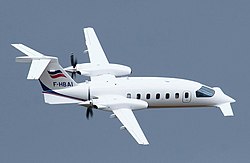
Piper · 1984–1991
Piper PA-42-1000 Cheyenne 400LS
 i
iSpecifications
Performance
Cruise
339KTAS
Range
1,821nm
Climb
3242fpm
Ceiling
41,000ft
Fuel Burn
103.0gph
Fuel Cap.
570gal
MPG
3.8mpg
Stall (Vs0)
84KIAS
T/O roll
1425ft
Ldg roll
1090ft
Size & weight
Seats
9
Useful Load
4,485lbs
Full-fuel payload
666lbs
Max gross
12,050lbs
Wingspan
47.7ft
Length
43.4ft
Engine
Engine
Honeywell (Garrett) TPE331-14A/B
Power
2000hp
TBO
—hrs
Overhaul
$350keach
Hot section
$55keach
Engines
2
Owning it
Hull insurance
$22k/yr
Parts
poor
Mechanics
rare
Gear
Retractable
IFR
Yes
Category
certified
Full specification
V-speeds
Airframe
- Empty weight
- 7,565 lbs
- Max fuel weight
- 3,819 lbs
- Height
- 17 ft
- Wing position
- low
Obstacle performance
- Takeoff over 50 ft
- 2,325 ft
- Landing over 50 ft
- 2,317 ft
Paperwork
- Type certificate
- A23SO
- Certification basis
- Part 23
These figures are typical for the model, not a specification for any individual aircraft. Real-world numbers vary with year, installed equipment, weight, modifications and engine condition — often by more than you would expect. Use them to compare types, and confirm anything you would act on against the Pilot's Operating Handbook for that specific airframe and a prebuy inspection.
Pricing
Typical
$1.1M
Range
$700k – $1.9M
Annual all-in
~$157k/yr
All-in at ~100 flying hours a year, using the midpoint of each range — the same figures broken out under “Cost to own” below. Your number will differ, and mostly for two reasons. Experience sets your insurance: a 2,000-hour pilot with recent training pays 30–40% less than a 200-hour owner, and student owners pay 20–40% more — on the same aircraft that is often a doubling. Location sets your hangar: a T-hangar runs $200–400 a month in the Midwest against $400–1,500 in a coastal metro, and an outside tie-down is less again. Engine reserves move too — a local shop reusing your serviceable cylinders can come in 30–50% under the national specialty-shop pricing we quote, though you trade the warranty and turnaround that comes with it. Reserves are money set aside toward a future overhaul, not a bill this year, and the annual inspection figure is the shop’s labor to look — whatever they find is separate.
Cost to own — estimate
Set your yearly hours and local fuel price. Fixed costs (insurance, hangar, annual inspection) don't change with hours; fuel, maintenance and the engine reserve do.
- Fuel (103 gph)
- $61,800
- Propeller reserve
- $2,500
- Maintenance, parts & wear items ($160/hr)
- $16,000
- Insurance
- $22,000–$49,500
- Hangar
- $12,421–$31,053
- Annual inspection (labor only)
- $12,000
- Databases & subscriptions
- $2,000
- Total per year
- $151,787
- Per flight hour
- $1,518
- Miles flown / year (at cruise)
- 39,011 mi
- Cost per mile
- $3.89/mi
- Time in the air
- 53 min
- Fuel burned
- 91 gal
- Out of pocket
- $711
Fuel, engine reserve and wear only. Insurance, hangar and the annual are already paid whether you make the trip or not, so they are not charged here.
Estimate, not a quote. Where a line shows a range, the total, per-hour and per-mile figures use its midpoint— insurance moves most with your experience and time in type, hangar with where you base the aircraft, so your own number could sit at either end. Annual inspection is the shop's labor to open and inspect — what they find is the maintenance line, which covers oil changes, plugs, tires, brakes, hoses, lights, a battery and vacuum pump amortised over their life, and the unscheduled squawks that are the largest and least predictable part of it. Reserves are sinking funds toward an overhaul, not a bill you pay this year — and note that a propeller is due on hours or calendar time, typically six years, so flying less does not put it off forever.
Strengths
- 351 KTAS cruise: fastest civil turboprop twin ever built
- 9-seat pressurized cabin, FL410 capability, 1,821 nm range
- Excellent business travel platform with short-field performance vs. light jets
- Stable, delightful flight characteristics
Weaknesses
- Orphan type: only 44 built, ~20 flying in US, no factory support
- Parts availability critical: 3-month waits on airframe items vs. 3 days for King Air
- Mechanic familiarity rare; requires shop relationship and specialized expertise
- Operating cost $1,100–$1,500/hour; annual maintenance $30k–$130k depending on findings
Overview
The Cheyenne 400LS is the fastest civil turboprop twin Piper ever built, and for its era the fastest anyone built. Take the Cheyenne III airframe, replace the Pratt & Whitneys with two Garrett TPE331-14s — 1,645 hp thermodynamic capability, a 1,250 hp gearbox limit, flat-rated to 1,000 shp each so they hold that power to 21,500 feet — turn 106-inch Dowty Rotol carbon-epoxy propellers in opposite directions to kill the slipstream effect, and pressurise the cabin to 7.6 psi so it can live at 41,000 feet. The result cruises at 351 knots true, climbs at 3,242 fpm at maximum gross weight, and outruns a good number of the light jets it was sold against.
It was type-certificated on 13 July 1984 under TCDS A23SO and sold first as the Cheyenne IV, then renamed the 400LS — "LS" for Lear Siegler, then Piper's owner, and "400" for the roughly 400 mph it would do. Only 44 were built between 1984 and 1991, and something over twenty are believed to be flying in the United States today. Its problem was never the airplane: it arrived into the mid-1980s general aviation collapse at a price that put it against entry-level jets, and Piper was in no position to fight that battle.
Business & Commercial Aviation flew a production 400LS on a three-leg business trip in 1985: 11 minutes from brake release to FL270 on 196 lb of fuel, 339 KTAS true at FL290, a maximum-effort departure from Savannah at 10,650 lb where the weight-to-power ratio was "about five to one — better than most World War II fighters", and 327 KTAS at FL370 on the way home.
The honest counterweight is that this is an orphan: 44 airframes, an engine model that appears on almost nothing else in this configuration, a propeller nobody else uses, and no factory support. It is not a first turbine. It is a superb airplane for an owner who has already run turbine equipment, has a shop relationship, and can absorb a long parts wait without it becoming a crisis.
Variants & History
| Variant | Model | Years | Engines | shp (each) | MTOW | Max Cruise | Ceiling | Built | Key Differences |
|---|---|---|---|---|---|---|---|---|---|
| Cheyenne IV | PA-42-1000 | 1983–1984 | TPE331-14 | 1,000 | 12,050 lb | 351 KTAS | 41,000 ft | prototype/early | Original marketing name; certificated 13 July 1984 |
| Cheyenne 400 | PA-42-1000 | 1984–1986 | TPE331-14A/B-801 | 1,000 | 12,050 lb | 351 KTAS | 41,000 ft | — | Renamed under Lear Siegler ownership |
| Cheyenne 400LS | PA-42-1000 | 1986–1991 | TPE331-14A/B-801 | 1,000 | 12,050 lb | 351 KTAS | 41,000 ft | 44 total | Final designation; serials 5135–5194 |
| Cheyenne III / IIIA | PA-42 / PA-42-720 | 1980–1991 | PT6A-41 / -61 | 720 | 11,200 lb | 290–305 KTAS | 33,000–35,000 ft | ~148 | Same fuselage, PT6A power, lower ceiling; see dedicated page |
The 400/400LS is effectively a single specification throughout its run. The meaningful differences between individual aircraft today are engine time, whether the engines are on Honeywell MSP, avionics generation, and how many hours the airframe has flown — not the model year.
Performance
Piper's cruise table for the 400LS, quoted at a mid-cruise weight of 10,000 lb and maximum cruise power, is the headline: 351 KTAS at 24,000 ft, 350 at 25,000 ft, 346 at 29,000 ft, 334 at 35,000 ft and 294 at 41,000 ft. Those are real numbers, not marketing ones — B/CA's flight test trued out at 339 KTAS at FL290 at 96% rpm and noted that the specific range achieved was better than the book predicted for maximum cruise power at 98%.
The stored fuel burn comes from that same flight test rather than a brochure. At FL290, 96% rpm, 210 KIAS indicated, the observed total fuel flow was 690 lb/hr — about 103 gph — for 339 KTAS true: a measured, matched pair, at a higher power setting than the factory's own "maximum cruise power @ 35,000 ft" row. That factory row itself pairs 334 KTAS with the 1,821 nm range stored in range_nm — a genuine mismatch in the frontmatter between which regime backs the speed/burn pair and which backs the range figure, disclosed here and in validator_exempt.cruise_altitude_ft rather than silently resolved, because no single source gives all three at once.
Correction to a claim this page previously made about the "60 gallons an hour" figure. An earlier version of this page asserted that number "fits neither the factory range chart nor the flight test, and is best treated as a per-engine number that lost its label" — with no citation behind that claim. AOPA Pilot's February 2015 "Quick Look" (Peter Bedell) states it directly and as a TOTAL, not per-engine: "At altitude, you can pull the miserly Garretts back to about 400 lbs (60 gallons) per hour for long-range cruise ... the 400LS can fly more than 2,000 nm at that setting" — which is consistent with the factory sheet's own long-range-power range table (2,176 nm at FL410, 2 passengers). The claim that it was a mislabelled per-engine figure does not hold up against a real source and has been withdrawn.
Climb is the 400LS's signature: 3,242 fpm at maximum gross weight at sea level and 4,110 fpm at 10,000 lb, with one owner reporting 4,000 fpm routinely. Single-engine rate of climb at max gross is 997 fpm with a single-engine service ceiling above 27,000 ft — the best single-engine performance of any turboprop twin in this catalogue, and a genuine safety argument for the type. Runway performance matches: 2,325 ft over a 50-ft obstacle at max gross, 2,317 ft to land over 50 ft without reverse and 2,038 ft with, accelerate-and-stop 3,180 ft, accelerate-and-go over 50 ft 3,160 ft, approach at a manageable 105 KIAS.
Two systems distinguish the fixed-shaft Garretts from the free-turbine PT6As most buyers will have flown. Integrated engine computers (IECs) compute the EGT limit for each flight condition and cap available torque at 100% up to the 21,500 ft critical altitude, protecting against inadvertent over-torque and over-temp; each carries a "personality module" that records engine data on command for trend monitoring. Negative torque sensing (NTS) relieves prop oil pressure when an engine loses power, pulsing the blades toward coarse pitch to cut windmilling drag. NTS is not autofeather — the prop will not feather itself and the pilot must select feather — but it buys time to react, which with 997 fpm of single-engine climb is enough.
Start technique is genuinely different, and it is the part of the transition that catches PT6A pilots out. Parallel battery starts are approved above 0°C; below that Piper calls for a ground power unit or a series start using both nickel-cadmium batteries in series, and without a GPU the second engine must be started off the running engine's generator. Hot starts are the classic Garrett failure mode and are expensive.
Handling speeds from the flight test: Vr around 105 knots, V2 125 KIAS, normal climb 138 KIAS, 10 degrees of flap below 194 KIAS, gear below 170 KIAS, full flaps at 161 KIAS, approach 105 knots, and a barber pole starting around 240 KIAS. The 7.6 psi pressurization holds a sea-level cabin to 18,500 ft, 8,000 ft at FL350 and 10,000 ft at FL410 — the best cabin in this class by a wide margin.
Payload & Range
The 400LS at 12,050 lb maximum takeoff weight (12,135 lb ramp), a factory equipped empty weight of 7,565 lb including standard Collins avionics, and 570 gallons (3,819 lb) of usable fuel. Useful load against maximum takeoff weight is 4,485 lb; Piper quoted 4,570 lb against the ramp weight. Maximum zero-fuel weight is 10,000 lb, which caps cabin load at 2,435 lb — the factory's own "maximum cabin load (equipped)" figure.
Piper published range against payload directly, which is unusually honest, and the table below is theirs. It assumes a 200 lb pilot allowance and passengers at 200 lb each.
| Payload | Occupants | Max cruise power, FL350 (334 KTAS) | Long-range power, FL410 (294 KTAS) |
|---|---|---|---|
| 1,600 lb | Pilot + 8 pax | 1,234 nm | 1,431 nm |
| 1,200 lb | Pilot + 6 pax | 1,466 nm | 1,715 nm |
| 800 lb | Pilot + 4 pax | 1,690 nm | 2,002 nm |
| 400 lb | Pilot + 2 pax | 1,821 nm | 2,176 nm |
The last row is the full-fuel case: with two passengers the airplane is fuel-limited rather than weight-limited, which is where the 1,821 nm in the frontmatter comes from. Note that it never runs out of useful load before it runs out of tank — even with eight aboard there is 2,770 lb of fuel available, and B/CA's flight test flew exactly that loading, calling it "typical of a mission such as we were commencing" and noting it would have supported 1,250 nm in four hours plus a 45-minute reserve.
Two conclusions fall out. First, this is a genuine eight-passenger, 1,200-plus-nautical-mile airplane, which almost nothing else in its price bracket is; one owner describes a routine 900 nm Northern Virginia to South Florida run on 2,750 lb of fuel, leaving 1,300 lb of payload — "six adults and 250 pounds of luggage". Second, the altitude is worth using: moving from maximum cruise at FL350 to long-range power at FL410 costs 40 knots and buys about 300 nm at every payload.
The cabin backs the numbers up: 275 inches long, 51 wide and 56 high — four inches taller than the Cheyenne III's — with 300 lb of nose baggage and 300 lb aft, and 7.6 psi holding an 8,000-foot cabin at FL350. Where a King Air's passengers are at a 10,000-foot cabin, the 400LS's are at 8,000 and going 50 knots faster. Hot-and-high is a strength rather than a caveat: the flat-rated Garretts hold full power to 21,500 feet, so departing a 6,000-ft elevation airport at gross costs far less here than on a PT6A twin of similar weight.
Related pages: Piper PA-42 Cheyenne III / IIIA, Piper PA-31T Cheyenne I/II/IIXL, Mitsubishi MU-2, Cessna 441 Conquest II, Rockwell/Gulfstream Turbo Commander, Beechcraft King Air B200, Beechcraft Starship, Piaggio Avanti, Aircraft Valuation Methodology, Engine Overhaul Pricing, GA Insurance Underwriting, Maintenance Ecosystem, Business Travel, Cross-Country Flying
Mission Suitability
Business travel (9/10). A 275-inch cabin, eight passengers, 7.6 psi, 339–351 knots, and the ability to sit at FL370–FL410 above weather and most other traffic. B/CA's whole test was built around short business legs and concluded the altitude capability paid off even on 186 nm hops. It does everything a light jet of its era did, into shorter runways, on cheaper fuel. Held back from a 10 purely by support.
Cross-country (9/10). 1,821 nm at maximum cruise power on full fuel with two aboard, or 1,431 nm at long-range power at FL410 with eight. Coast to coast in one comfortable stop.
Cargo hauling (6/10). 4,485 lb of useful load, a 10,000 lb zero-fuel weight, 300 lb in the nose and 300 lb aft, and a utility door — but a 51-inch cabin, no freight door, and no sensible reason to use a 44-airframe orphan as a freighter.
Surveying (6/10). Very high ceiling, long endurance and an exceptionally stable platform. Loses points on cost per hour and on the difficulty of approving a sensor installation on a type with almost no STC activity.
Backcountry (2/10). Retractable gear, a T-tail and composite props at low ground clearance. Paved runways.
Local fun flying (2/10). Delightful to fly and around $1,500 an hour all-in. Pick one.
Flight training (1/10). Transition and recurrent in type only.
Aerobatics (1/10). No.
A note on the type rating. At 12,050 lb maximum takeoff weight the 400LS falls below the 12,500 lb threshold, so the fastest civil turboprop twin ever certificated requires no type rating — a multi-engine-land rating and a §61.31(g) high-altitude endorsement is the whole legal requirement. That is a quirk of the regulations, not a reflection of the airplane's demands. The insurance market is the real gate here, and it should be.
Avionics Ecosystem
The 400LS was a top-of-the-line corporate airplane and was equipped as one. Standard fit was Collins: B/CA's test aircraft carried the Collins FCS-65 digital flight control system and a Collins EHSI-74 electronic HSI — advanced kit for 1985 and still perfectly usable, with the caveat that CRT displays and 1980s digital autopilot computers are a finite resource.
- Original Collins fit. Pro Line II radios, FCS-65 digital AFCS with yaw damper, EHSI-74/EFIS-85, Collins weather radar, and in most aircraft a Universal or Global FMS added in period. Capable and characteristic of the type; repairs are shop-dependent and slow.
- Mid-tier refresh ($120,000–$220,000 installed). Dual Garmin GTN 750Xi/650Xi navigators, GTX 345 with ADS-B In and Out, GDL datalink weather and traffic, a modern audio panel, and the Collins autopilot retained and overhauled. What most of the flying fleet has done.
- Full glass ($280,000–$500,000 installed). Garmin G600 TXi or G500 TXi displays, dual GTN Xi navigators, digital engine indication, synthetic vision and TAWS. Because the fleet is tiny, several of these have been done as one-off field approvals rather than under a fleet STC — check the paperwork, because that can complicate a later sale.
Two items dominate. The autopilot must be strong: single-pilot IFR at 339 knots at FL370 without a dependable AFCS and yaw damper is not a plan. And the radar must paint — this airplane's whole value proposition is going over and through weather, and a dead 1980s radar on an orphan airframe is an expensive surprise.
STCs & Modifications
There is very little STC activity on this airframe, and that is itself information. Forty-four aircraft is not a market anyone builds a supplemental type certificate for.
- Avionics retrofits. Garmin navigator and display packages are the only widely done modification, usually an AML STC for the display plus a field approval for the integration.
- Engine upgrades. None, and none are needed — the TPE331-14 is already flat-rated well below its thermodynamic capability and is limited by the reduction gearbox, not by available power.
- Propellers. The four-blade 106-inch Dowty Rotol carbon-epoxy composite propeller is original equipment and there is no alternative on the market. This matters — see Maintenance & Support.
- Interior refurbishment. Common and worthwhile; the cabin shell is excellent. Budget $150,000–$300,000 for a full interior and paint.
- Honeywell MSP enrolment. Not a modification, but the single most valuable thing a seller can have done. Treat an MSP-enrolled 400LS and a non-enrolled one as different products.
Maintenance & Support
See Maintenance Ecosystem. This is the section that decides whether a 400LS is right for a given owner.
- Parts availability: poor. Forty-four airframes, roughly twenty flying in the United States, no factory support and almost no PMA activity. Engine parts are fine — Honeywell supports the TPE331 globally. Airframe-unique items are the problem: pressurization components, control-system parts, certain gear and interior items, and above all the propellers. A part that takes three days for a King Air can take three months here. Owners who thrive on this type build relationships with the small owner network and the two or three shops that know it, and buy spares when spares appear.
- Mechanic familiarity: rare. A general A&P can do routine airframe work under supervision. The engines, IEC and NTS systems, pressurization and T-tail structure want a shop that has actually seen a 400LS; there are only a handful in the country.
- Annual / phase inspection: $30,000–$50,000 in a clean year; $70,000–$130,000 in a year that turns up empennage, pressurization or gear work.
- Hot section (per side): $50,000–$70,000 at roughly 2,700 hours.
- Overhaul (per side): $350,000, per
reference/engine-overhaul-pricing.md's TPE331-14 band (upper end of $200,000–$350,000). Budget roughly $700,000 for the pair — that is the per-engine figure doubled, not a pair price doubled again. The TBO interval this figure falls due at could not be confirmed for the -14 dash specifically this session — see Performance Notes andvalidator_exempt.tbo_hours— so budget on condition and logbook trend rather than a stated hour number until a primary source surfaces. - Propellers: the four-blade Dowty Rotol composite units are specialist overhaul items with no aftermarket alternative. Budget conservatively and inspect thoroughly; a damaged blade set is a schedule problem as much as a money problem.
- Honeywell MSP: covers scheduled and unscheduled engine events at an hourly rate. On this type it is close to essential and is priced into the resale value.
- Direct operating cost: roughly $1,100–$1,300 per hour including fuel, maintenance and engine and prop reserves. One long-term owner reports $1,500 an hour total fixed and variable, which is a good sanity check on any budget you build. Fixed costs — hangar for a 47-foot span and 17-foot tail, insurance, recurrent training, subscriptions, databases — add $75,000–$95,000 a year. At 150 hours a year, plan on an all-in budget of $250,000–$300,000.
The arithmetic to sit with before buying: a $1.1 million airplane that costs $275,000 a year to run will, over a five-year hold, cost more to operate than it cost to acquire. That is normal for this class and not a criticism of the 400LS — it is simply the number that decides whether this airplane makes sense.
Valuation Factors
See Aircraft Valuation Methodology. 400LS-specific notes:
Engines and props dominate. reference/engine-overhaul-pricing.md — the catalogue's house source of truth for this field, not researched per airplane — stores the TPE331-14 family at $270,000 per engine (band $200,000–$350,000, confidence B, "no published quote" exists for this specific dash). This page stores the band's upper end, $350,000 per engine, on the reasoning that the -14 is the largest and most powerful engine in the TPE331 family; a run-out pair is roughly a $700,000 liability against an airplane typically asking around $1.1 million. Hot sections fall at half TBO at roughly $55,000 per side (the TPE331 class figure; no dash-specific number was found — see hsi_cost_usd). This page could not confirm a TBO for the TPE331-14 specifically — see the note below and validator_exempt.tbo_hours — so the hot-section INTERVAL is not stated in hours either, only the per-event cost. Honeywell MSP converts both events into an hourly rate, and MSP enrolment is worth more on this type than on almost anything else in the catalogue, because it removes the two risks (engine cost and parts access) that most frighten buyers away.
Indicative 2025–2026 asking prices:
| Condition | Typical range |
|---|---|
| High engine time, original panel, deferred items | $700,000–$950,000 |
| Mid-time engines, refreshed avionics | $1,000,000–$1,350,000 |
| MSP-enrolled, low-time engines, glass panel, fresh interior | $1,500,000–$1,900,000 |
Controller listings through 2026 have run roughly $999,000 to $1.5 million, and dealer guides quote a $895,000 to $1.9 million band. One owner-focused article notes the type "averages a purchase price under $1 million" — true of the tired end of the fleet and misleading about the good end.
Value drivers, in order: MSP enrolment and engine time; propeller condition and time; avionics generation and autopilot health; airframe time and cycles; damage and corrosion history; interior and paint; completeness of records. Because only a handful are ever for sale, individual condition drives price far more than model year — the usual "newer is dearer" rule barely applies.
Liquidity is the risk nobody prices. A King Air B200 sells in weeks; a 400LS can sit for a year. Buy one because it is the right airplane for a long hold, not as a trade.
ADs & Common Problems
The PA-42 family's AD burden is modest for a forty-year-old pressurized turbine twin, and the 400LS shares the airframe items with the Cheyenne III. What is different is that a supply problem on any of them is a much bigger deal on a 44-airframe fleet.
AD 2009-13-06 R1 (Amendment 39-16820, effective 3 November 2011) — nose baggage door. Applies to PA-23, PA-31 and PA-42 series including the PA-42-1000. Establishes life limits on safety-critical nose baggage door components, requires their replacement, and mandates repetitive inspection and lubrication of the latching mechanism and lock assembly. Prompted by a series of incidents and fatal accidents in which the nose baggage door opened in flight. Recurring, with parts on a clock — establish what has been replaced, when, and what is next due, and confirm the parts are obtainable.
AD 96-21-03 (Amendment 39-9780) — inboard aileron hinge bracket. Applies to PA-31, PA-31P, PA-31T and PA-42 series aircraft not already fitted with the improved brackets. Dye-penetrant inspection of the aileron spar and rib beneath the inboard hinge bracket, replacement of any cracked structure before further flight, and installation of the improved P/N 74461-02/-03 brackets as terminating action. Most of the fleet is long complete; verify in the logs.
Flight manual directives. National AD schedules for the PA-42 series include mandated flight manual revisions covering power lever positioning, severe icing conditions and ice protection system operation, together with a hydraulic hose removal/replacement directive. These are paperwork items, but a missing or superseded AFM supplement is a real airworthiness finding at pre-buy.
TPE331 engine ADs and service bulletins are issued periodically by Honeywell and adopted by the FAA — typically covering fuel control, turbine and compressor components. Verify compliance through the engine logs and, where the engines are on MSP, through Honeywell's records.
The items that turn up repeatedly on this specific type:
- Hot starts. The fixed-shaft Garrett is less forgiving of a poor start than a PT6A, and a hot start is a hot-section event. Look for start-temperature records and ask the seller directly — this is the most common self-inflicted expense on the type.
- IEC and personality module data. The 400LS records its own trend data. Ask for it; an owner who cannot produce trend monitoring on an aircraft that generates it automatically is telling you how the airplane has been run.
- Propeller condition and history. The Dowty Rotol composite blades are the type's most exposed component: low production, no alternative product, specialised overhaul. Blade damage or a time-expired set is a serious commercial problem, not a routine one.
- T-tail and empennage attach structure. The horizontal stabiliser sits at the top of the fin, out of casual sight. Corrosion and fastener condition at the fin/stabiliser junction is the inspection most often skimped and most expensive to find late.
- Pressurization at 7.6 psi. The 400LS works its pressure vessel harder than any other Piper. Door seals, outflow valve and controller are the usual findings; investigate a differential problem before purchase, not after.
- De-ice boots, prop heat, gear and brakes. Full boot replacement is a $40,000–$70,000 job. Higher approach and landing weights than the III mean wear on actuators, uplocks and brake assemblies; a gear swing is not optional.
None of this makes a 400LS a bad airplane. A well-maintained, MSP-enrolled, trend-monitored example with good props and a clean empennage is outstanding and a pleasure to own. The point is that the gap between a good one and a bad one is much wider here than on a King Air, and there are far fewer to choose from.
Insurance Profile
See GA Insurance Underwriting and Insurance Costs.
- Hull: roughly $16,000–$28,000 a year on a $1,100,000 agreed value. Rates run above comparable-value PT6A twins because the underwriter knows a repair will be slow and a total loss is a real possibility on damage that would be repairable on a King Air.
- Liability: $6,000–$12,000 at $1M smooth, more for higher limits.
- Typical all-in owner-flown premium: $22,000–$35,000 a year.
No type rating is required, so the FAA is not the gate — the insurer is, and for an owner-flown 12,000-lb 350-knot turbine twin with 44 airframes built, the insurer is cautious. Expect requirements around 2,500 hours total, 750 multi-engine and 250–500 hours of turbine time, with Garrett/TPE331 time viewed distinctly from PT6A time. Where turbine or type time is short, expect a mandated mentor pilot for 50 hours or more and a first-year loading of 50% or better; initial type-specific training and annual recurrent will be conditions of the policy, not suggestions.
Get a quote before you sign. More than one buyer has found the airplane and then discovered nobody would write them for it at a price they would pay. Owners who fly with a professional in the right seat, or who come to the type from a King Air or an MU-2, have a much easier time.
For sale (0)
No listings for this model right now.
Also worth looking at
What buyers usually weigh against the Piper PA-42-1000 Cheyenne 400LS — aircraft flown for the same kind of mission.