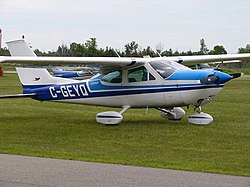
Cessna · 1970–1971
Cessna 182N Skylane (1973-1974)

Specifications
Performance
Cruise
141KTAS
Range
620nm
Climb
980fpm
Ceiling
18,900ft
Fuel Burn
12.5gph
Fuel Cap.
65gal
MPG
13.0mpg
Stall (Vs0)
48KIAS
T/O roll
710ft
Ldg roll
590ft
Size & weight
Seats
4
Useful Load
1,230lbs
Full-fuel payload
840lbs
Max gross
2,950lbs
Wingspan
36ft
Length
29ft
Engine
Engine
Continental O-470-R
Power
230hp
TBO
1,500hrs
Overhaul
$48k
Owning it
Hull insurance
$2k/yr
Parts
excellent
Mechanics
universal
Gear
Fixed
IFR
Yes
Category
certified
Full specification
V-speeds
Airframe
- Empty weight
- 1,720 lbs
- Max fuel weight
- 390 lbs
- Height
- 9.3 ft
- Wing position
- high
Obstacle performance
- Takeoff over 50 ft
- 1,315 ft
- Landing over 50 ft
- 1,335 ft
Paperwork
- Type certificate
- 3A13
- Certification basis
- Part 23
These figures are typical for the model, not a specification for any individual aircraft. Real-world numbers vary with year, installed equipment, weight, modifications and engine condition — often by more than you would expect. Use them to compare types, and confirm anything you would act on against the Pilot's Operating Handbook for that specific airframe and a prebuy inspection.
Pricing
Typical
$95k
Range
$68k – $140k
Annual all-in
~$27k/yr
All-in at ~100 flying hours a year, using the midpoint of each range — the same figures broken out under “Cost to own” below. Your number will differ, and mostly for two reasons. Experience sets your insurance: a 2,000-hour pilot with recent training pays 30–40% less than a 200-hour owner, and student owners pay 20–40% more — on the same aircraft that is often a doubling. Location sets your hangar: a T-hangar runs $200–400 a month in the Midwest against $400–1,500 in a coastal metro, and an outside tie-down is less again. Engine reserves move too — a local shop reusing your serviceable cylinders can come in 30–50% under the national specialty-shop pricing we quote, though you trade the warranty and turnaround that comes with it. Reserves are money set aside toward a future overhaul, not a bill this year, and the annual inspection figure is the shop’s labor to look — whatever they find is separate.
Cost to own — estimate
Set your yearly hours and local fuel price. Fixed costs (insurance, hangar, annual inspection) don't change with hours; fuel, maintenance and the engine reserve do.
- Fuel (12.5 gph)
- $8,125
- Engine reserve
- $3,200
- Propeller reserve
- $175
- Maintenance, parts & wear items ($12/hr)
- $1,200
- Insurance
- $900–$2,400
- Hangar
- $6,264–$15,660
- Annual inspection (labor only)
- $1,200
- Databases & subscriptions
- $400
- Total per year
- $26,912
- Per flight hour
- $269
- Miles flown / year (at cruise)
- 16,226 mi
- Cost per mile
- $1.66/mi
- Time in the air
- 2 hr 08 min
- Fuel burned
- 27 gal
- Out of pocket
- $270
Fuel, engine reserve and wear only. Insurance, hangar and the annual are already paid whether you make the trip or not, so they are not charged here.
Estimate, not a quote. Where a line shows a range, the total, per-hour and per-mile figures use its midpoint— insurance moves most with your experience and time in type, hangar with where you base the aircraft, so your own number could sit at either end. Annual inspection is the shop's labor to open and inspect — what they find is the maintenance line, which covers oil changes, plugs, tires, brakes, hoses, lights, a battery and vacuum pump amortised over their life, and the unscheduled squawks that are the largest and least predictable part of it. Reserves are sinking funds toward an overhaul, not a bill you pay this year — and note that a propeller is due on hours or calendar time, typically six years, so flying less does not put it off forever.
Strengths
- 230 hp Continental O-470-R with mature support ecosystem
- 150 lb increase to 2,950 lb takeoff weight vs. 182M
- 1971 models offer 200 lb baggage capacity (dual-bay)
Weaknesses
- Landing weight limited to 2,800 lb despite 2,950 lb takeoff — requires ~25-gallon fuel burn before touchdown
- No published POH found; performance figures (141 KTAS, 980 FPM, 12.5 GPH) are estimates pending handbook confirmation
- 55-year-old airframe requires careful inspection of wing spar/carry-through corrosion and main gear condition
- 1970 models carry only 120 lb baggage in single compartment
Overview
The 1970-1971 Cessna 182N carries the same Continental O-470-R at 230 hp as the 182M and 182J/K/L before it, with one real change the certificate does record: maximum takeoff weight rises to 2,950 lb, a 150 lb increase over the 182M's 2,800 -- with a catch. The certificate limits landing weight to 2,800 lb, so a 182N flown to gross must burn down roughly 25 gallons before touching down; it is not simply "150 lb of free useful load" the way a flat gross-weight increase would be on another airplane. Baggage capacity also increases mid-production: the certificate gives the 1970 airplanes 120 lb in a single compartment and the 1971 airplanes 200 lb across two -- this page stores the 1970 figure (also the bare numerical majority of the two-year run, 390 serials against 380) and the 1971 figure is confirmed by checking the data plate or the certificate's own serial table.
What changed on the airframe itself this year is less certain than this catalogue previously claimed. The page used to attribute the Camber-Lift drooped wing to the 182N. A production-history cross-check (Wikipedia's Cessna 182 article) instead attributes the Camber-Lift wing to the far earlier 182E (1962). Neither the certificate (legal limits, not airframe generations) nor a POH (none found for this model year -- see below) settles this, so no specific wing generation is asserted here. A buyer should check the airframe directly rather than rely on a model-year rule of thumb.
Variants & History
| Feature | 182M (1969) | 182N (1970-1971) | 182P (1972-1976) |
|---|---|---|---|
| Engine | O-470-R | O-470-R | O-470-R (early) / O-470-S (late) |
| Max takeoff weight | 2,800 lb | 2,950 lb (landing limited to 2,800 lb) | 2,950 lb |
| Fuel (usable) | 60 gal | 60 gal | 56 gal standard (61 gal total, smaller than 182N/M) |
| Baggage | 120 lb | 120 lb (1970) / 200 lb (1971) | 200 lb |
| Certification basis | CAR 3 | CAR 3 | CAR 3 |
Performance
These figures are still the April 2026 generated values and are NOT sourced to any document. A targeted search for a 1970 or 1971 Model 182N Pilot's Operating Handbook or period Owner's Manual (Bing: four queries; archive.org advancedsearch: three queries; Essco/Univair reprint search) found only a Cessna SERVICE manual (P/N D2006-4-13, covering 1969 thru 1976) -- maintenance procedures, not a performance chart. This is the pre-GAMA-POH exception runbook rule 25 names explicitly.
141 KTAS cruise, 980 FPM climb, 12.5 GPH, ~1,230 lb useful load (against the 2,950 lb takeoff weight) are carried forward from the original 2026 generation pass and should be treated as estimates pending a handbook.

2006 Cessna 172S
G1000 Skyhawk · Mid-Time Engine · Clean Logs
Maintenance & Support
Identical O-470-R ecosystem to the 182J/K/L/M. See Cessna 182 Skylane (1966-1968) for engine notes.
Valuation Factors
| Condition | Price Range |
|---|---|
| Project / needs engine | $52,000-$68,000 |
| Flying but tired | $68,000-$92,000 |
| Well-maintained | $85,000-$118,000 |
| Restored / upgraded | $115,000-$155,000 |
Unsourced generated figures, not a Vref/Bluebook pull. The page's own synced market listings below (two priced 1970-1971 asking prices, $120,000-$298,000) span well above and below this table -- a real disagreement flagged for a dedicated pricing pass rather than resolved here.
2005 Cessna 182T Skylane
G1000 Skylane · No Damage · Hangared
ADs & Common Problems
Universal Cessna 182 pre-buy concerns apply. 182N-specific:
- 2,950 lb operations history: confirm weight-and-balance documentation reflects the certificated 2,950 lb takeoff / 2,800 lb landing split, not a flat 2,950 lb assumption.
- Baggage-area configuration: verify which serial block (1970 single-bay, 1971 dual-bay) the specific airframe was built to, and that any modification is documented.
- General 182 pre-buy items: main gear condition, wing spar/carry-through corrosion on a 55-year-old airframe, AD compliance history.
For sale (0)
No listings for this model right now.
Also worth looking at
What buyers usually weigh against the Cessna 182N Skylane (1973-1974) — aircraft flown for the same kind of mission.