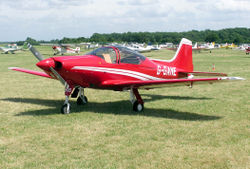
Van's Aircraft · 1985+
Van's RV-6 / RV-7 / RV-9 / RV-14

Specifications
MOSAIC eligiblePerformance
Cruise
180KTAS
Range
765nm
Climb
1900fpm
Ceiling
22,500ft
Fuel Burn
9.5gph
Fuel Cap.
42gal
MPG
21.8mpg
Stall (Vs0)
44KIAS
T/O roll
525ft
Ldg roll
500ft
Size & weight
Seats
2
Useful Load
686lbs
Full-fuel payload
434lbs
Max gross
1,800lbs
Wingspan
25ft
Length
20.4ft
Engine
Engine
Lycoming IO-360
Power
200hp
TBO
2,000hrs
Overhaul
$45k
Owning it
Hull insurance
$1k/yr
Parts
excellent
Mechanics
common
Gear
Fixed
IFR
Yes
Category
experimental
Full specification
V-speeds
Airframe
- Empty weight
- 1,114 lbs
- Max fuel weight
- 252 lbs
- Height
- 7.8 ft
- Wing position
- low
Obstacle performance
- Takeoff over 50 ft
- 900 ft
- Landing over 50 ft
- 950 ft
Paperwork
- Certification basis
- Experimental Amateur-Built
These figures are typical for the model, not a specification for any individual aircraft. Real-world numbers vary with year, installed equipment, weight, modifications and engine condition — often by more than you would expect. Use them to compare types, and confirm anything you would act on against the Pilot's Operating Handbook for that specific airframe and a prebuy inspection.
Pricing
Typical
$130k
Range
$60k – $350k
Annual all-in
~$19k/yr
All-in at ~100 flying hours a year, using the midpoint of each range — the same figures broken out under “Cost to own” below. Your number will differ, and mostly for two reasons. Experience sets your insurance: a 2,000-hour pilot with recent training pays 30–40% less than a 200-hour owner, and student owners pay 20–40% more — on the same aircraft that is often a doubling. Location sets your hangar: a T-hangar runs $200–400 a month in the Midwest against $400–1,500 in a coastal metro, and an outside tie-down is less again. Engine reserves move too — a local shop reusing your serviceable cylinders can come in 30–50% under the national specialty-shop pricing we quote, though you trade the warranty and turnaround that comes with it. Reserves are money set aside toward a future overhaul, not a bill this year, and the annual inspection figure is the shop’s labor to look — whatever they find is separate.
Cost to own — estimate
Set your yearly hours and local fuel price. Fixed costs (insurance, hangar, annual inspection) don't change with hours; fuel, maintenance and the engine reserve do.
- Fuel (9.5 gph)
- $6,175
- Engine reserve
- $2,250
- Propeller reserve
- $175
- Maintenance, parts & wear items ($12/hr)
- $1,200
- Insurance
- $1,150–$3,250
- Hangar
- $3,060–$7,650
- Annual inspection (labor only)
- $1,200
- Databases & subscriptions
- $400
- Total per year
- $18,955
- Per flight hour
- $190
- Miles flown / year (at cruise)
- 20,714 mi
- Cost per mile
- $0.92/mi
- Time in the air
- 1 hr 40 min
- Fuel burned
- 16 gal
- Out of pocket
- $163
Fuel, engine reserve and wear only. Insurance, hangar and the annual are already paid whether you make the trip or not, so they are not charged here.
Estimate, not a quote. Where a line shows a range, the total, per-hour and per-mile figures use its midpoint— insurance moves most with your experience and time in type, hangar with where you base the aircraft, so your own number could sit at either end. Annual inspection is the shop's labor to open and inspect — what they find is the maintenance line, which covers oil changes, plugs, tires, brakes, hoses, lights, a battery and vacuum pump amortised over their life, and the unscheduled squawks that are the largest and least predictable part of it. Reserves are sinking funds toward an overhaul, not a bill you pay this year — and note that a propeller is due on hours or calendar time, typically six years, so flying less does not put it off forever.
Strengths
- Side-by-side seating perfect for cross-country travel and instrument instruction
- 6,000+ flying examples with excellent community support and mechanic familiarity
- Outstanding fun factor with responsive handling and aerobatic capability (RV-6/7/14)
- Wide range of models to match mission: efficient RV-9 to payload-capable RV-14
Weaknesses
- Build quality entirely dependent on builder—pre-buy inspection by RV-experienced A&P is essential
- Two seats only limits utility for family or cargo missions
- Low-wing design limits backcountry/rough-field operations; primarily pavement/grass strips
- Experimental category restricts training to instrument-only; not primary training certified
Overview
The side-by-side Van's RV models are the most popular homebuilt aircraft in the world. The RV-6/6A (1985) broke open the homebuilt market with side-by-side seating that made the RV practical for couples and partners — 2,706 have been completed. Its successor, the RV-7/7A (2001), refined the design with more cockpit room, increased gross weight, and modern construction techniques — 1,910 completed. The RV-9/9A (1997) is the touring variant with longer wings for gentler handling and better efficiency. The RV-14/14A (2012) is the latest and largest — heavier gross weight, IO-390 power, and the most spacious cockpit in the RV line.
Together, these four models account for over 6,000 completed aircraft — more than half of all RVs flying. The side-by-side seating configuration is the key differentiator from the tandem RV-4/RV-8 covered in Van's RV-3 / RV-4 / RV-8. Side-by-side seating makes these aircraft far more practical for cross-country travel with a companion and for instrument training.
All four models are available in tailwheel (-6, -7, -9, -14) and nosewheel (-6A, -7A, -9A, -14A) configurations. The nosewheel versions outsell tailwheel roughly 3:1.
Variants & History
| Variant | First Flight | Engine | HP | Gross Weight (lbs) | Wingspan (ft) | Key Features |
|---|---|---|---|---|---|---|
| RV-6 | 1985 | O-360 | 180 | 1,600 | 23 | Side-by-side; 38 gal fuel; kit discontinued; 2,706 built |
| RV-6A | 1986 | O-360 | 180 | 1,600 | 23 | Nosewheel RV-6; most popular single model for years |
| RV-7 | 2001 | IO-360 | 160-215 | 1,800 | 25 | Replaced RV-6; wider cockpit; 42 gal fuel; 1,910 built |
| RV-7A | 2001 | IO-360 | 160-215 | 1,800 | 25 | Nosewheel RV-7; free-castering nosewheel |
| RV-9 | 1997 | O-320 | 118-160 | 1,750 | 28 | Long-wing touring; 36 gal; gentlest handling; 1,173 built |
| RV-9A | 1998 | O-320 | 118-160 | 1,750 | 28 | Nosewheel RV-9; popular with lower-time builders |
| RV-14 | 2012 | IO-390 | 210-215 | 2,050 | 27 | Largest side-by-side; 50 gal; 810 lbs useful; 207+ built |
| RV-14A | 2012 | IO-390 | 210-215 | 2,050 | 27 | Nosewheel RV-14; most spacious RV cockpit |
The progression from RV-6 to RV-14 shows steady increases in gross weight (1,600 → 2,050 lbs), fuel capacity (38 → 50 gal), and cockpit width. The RV-9 branches off as the efficiency/touring specialist with its 28-foot wingspan and 160HP engine — slower but more fuel-efficient and with the lowest stall speed (38 KIAS) of any RV.
Performance
The RV-7 with IO-360 at 200HP cruises at 180 KTAS on 9.5 GPH — nearly identical performance to the tandem RV-8 despite the wider fuselage. At economy cruise (65% power, lean of peak), 170 KTAS on 7.5 GPH provides 765 nm range from 42 gallons.
The RV-6 with O-360 at 180HP cruises at 173 KTAS on 9 GPH. The smaller airframe (1,600 lbs gross) gives it a remarkable rate of climb — 2,275 FPM, the highest of any side-by-side RV. The RV-6 is lighter, snappier, and more aerobatic-feeling than the later models.
The RV-9 with O-320 at 160HP cruises at 164 KTAS on 7 GPH. The 28-foot wing with lower wing loading provides a 38 KIAS stall speed — significantly lower than the RV-7's 44 KIAS. This makes the RV-9 the most forgiving RV for low-time pilots and the best short-field performer of the side-by-side models.
The RV-14 with IO-390 at 210HP cruises at 165 KTAS on 10 GPH. Despite more horsepower, the heavier airframe (2,050 lbs gross) means it's actually slower than the RV-7. The RV-14's strength is payload: 810 lbs useful load and 50 gallons of fuel provide 815+ nm range with two adults and baggage. The RV-14 is aerobatic at +6/-3G at its 1,900-lb aerobatic weight.
Payload & Range
RV-7A (IO-360, 200HP, 42 gal fuel):
| Scenario | Fuel (gal) | Fuel Weight (lbs) | Payload (lbs) | Pax + Bags | Range (nm) |
|---|---|---|---|---|---|
| Full fuel, 2 pax | 42 | 252 | 434 | 2 × 190 + 54 bags | 765 (75%) |
| Reduced fuel, 2 large pax | 30 | 180 | 506 | 2 × 210 + 86 bags | 500 |
| Full fuel, solo | 42 | 252 | 434 | 1 × 200 + 234 | 765 |
RV-9A (O-320, 160HP, 36 gal fuel):
| Scenario | Fuel (gal) | Fuel Weight (lbs) | Payload (lbs) | Pax + Bags | Range (nm) |
|---|---|---|---|---|---|
| Full fuel, 2 pax | 36 | 216 | 506 | 2 × 200 + 106 bags | 620 (55%) |
| Full fuel, solo | 36 | 216 | 506 | 1 × 200 + 306 | 620 |
RV-14A (IO-390, 210HP, 50 gal fuel):
| Scenario | Fuel (gal) | Fuel Weight (lbs) | Payload (lbs) | Pax + Bags | Range (nm) |
|---|---|---|---|---|---|
| Full fuel, 2 pax | 50 | 300 | 510 | 2 × 200 + 110 bags | 815 |
| Full fuel, 2 large pax | 50 | 300 | 510 | 2 × 220 + 70 bags | 815 |
| Reduced fuel, 2 large pax + cargo | 40 | 240 | 570 | 2 × 220 + 130 bags | 630 |
The RV-14 is the payload champion: 810 lbs useful load means two 200-lb adults with full fuel (50 gal / 300 lbs) still have 110 lbs for baggage — and 815 nm range. The RV-9A offers surprising payload flexibility: 722 lbs useful with only 216 lbs of fuel at full tanks, leaving over 500 lbs for people and bags. The RV-7A splits the difference — adequate for two average adults with full fuel and modest baggage, with 765 nm range at 75% power.
2009 Van's RV-7
RV-7 · Fast + Aerobatic · Dynon Glass · Great First RV
Mission Suitability
- Flight Training (5): Excellent for instrument training in the experimental category. Side-by-side seating allows proper instrument instruction. The RV-9 is the best trainer of the group — gentle stall, forgiving handling, lower speed. Not for primary training due to experimental category restrictions.
- Backcountry (2): Low-wing limits prop clearance on rough surfaces. No flaps on RV-6/7; the RV-9 has flaps but is still a pavement/grass-strip airplane. Some RV-7 tailwheel pilots operate from improved grass, but it's not the mission these were designed for.
- Business Travel (4): 165-180 KTAS cruise with side-by-side seating is practical for two-person business travel. The RV-14 with 810 lbs useful load and 50 gal fuel handles two adults with luggage for 800+ nm. Limited by two seats only.
- Aerobatics (6): The RV-6 and RV-7 are capable aerobatic platforms — loops, rolls, hammerheads, and spins are standard fare. The RV-14 is certified to +6/-3G at aerobatic weight. The RV-9 is the least aerobatic — its long wings and gentle handling are designed for touring. None match the tandem RV-8 or Pitts for serious competition.
- Cross-Country (8): THE sweet spot for these aircraft. Side-by-side seating for comfortable companionship, 165-180 KTAS cruise, 620-815 nm range, IFR capability with glass avionics. The RV-14 is the cross-country champion: largest cockpit, most fuel, highest useful load. The RV-9 trades speed for efficiency and docile handling.
- Cargo Hauling (2): Two seats only. Baggage area accommodates 50-100 lbs depending on model.
- Local Fun Flying (9): Outstanding fun. Quick to start, quick to climb, responsive handling, aerobatic capability (RV-6/7/14), and the Van's community provides endless fly-in opportunities. The side-by-side seating means you can share the fun.
- Surveying (3): Low wing limits downward visibility. Not designed for slow-speed observation work.
Avionics Ecosystem
- Budget VFR ($5,000-$10,000): Basic steam gauges, handheld GPS, single comm radio. Common on older RV-6 builds.
- Standard IFR ($15,000-$45,000): Garmin G3X Touch (experimental version), GPS navigator, ADS-B, comm/nav radio. The most popular configuration for cross-country builds.
- Full glass IFR ($45,000-$40,000): Dual-screen G3X Touch or Dynon SkyView HDX, GTN 650Xi/750Xi, GFC 500 autopilot, ADS-B In/Out, dual comm. The RV-14's wider panel accommodates the most generous avionics suite.
- Experimental avionics advantage: A full G3X Touch panel with autopilot costs $15,000-$45,000 — the same Garmin GI-275 + GTN + GFC 500 setup in a certified aircraft costs $50,000+. This price advantage is a major reason pilots choose experimental.
STCs & Modifications
Experimental amateur-built aircraft don't require STCs. Common builder choices:
- Engine selection: The biggest decision. RV-7 builders choose from O-320 (160HP), O-360 (180HP), IO-360 (200HP), or IO-390 (210HP). More power = faster climb and cruise but higher fuel burn and cost. The IO-360 at 180-200HP is the sweet spot.
- Propeller: Fixed-pitch (Sensenich, Catto) for simplicity and weight savings, or constant-speed (Hartzell, MT) for optimized climb and cruise. Fixed-pitch is lighter and cheaper; constant-speed adds 20-30 lbs and $5,000-$8,000 but improves both climb and cruise.
- Electronic ignition: SureFly, E-MAG, or Lightspeed replacing one or both magnetos. 5-10% fuel savings.
- Tip tanks / extended range: Some builders add wingtip fuel tanks for additional range beyond standard.
- Autopilot: Garmin GFC 500, TruTrak Vizion, or Dynon autopilot servos. Transforms cross-country capability.
- Tailwheel vs nosewheel: Builder's choice at construction time. Nosewheel is easier to insure and fly; tailwheel saves weight and has better prop clearance.
2012 Van's RV-7
RV-7A Tricycle · Garmin G3X · IFR Capable
Maintenance & Support
- Condition inspection: $850-$1,500/year. Builder with repairman certificate can self-inspect.
- Engine overhaul: $22,000-$45,000 for O-320/O-360/IO-360 at 2,000-hour TBO. $30,000 for IO-390 (RV-14).
- Parts availability: Excellent. Van's supports all models. All-aluminum construction means raw material is available from aircraft supply houses. Lycoming parts are universal.
- Mechanic familiarity: Common. With 6,000+ side-by-side RVs flying, most experimental A&Ps know the type well.
- Annual all-in cost: $8,000-$15,000 at 100 hours/year.
- Operating cost: $55-$95/hour all-in. The RV-9 at 7 GPH is the cheapest; the RV-14 at 10 GPH is the most expensive.
Valuation Factors
- RV-6/6A (O-360, 180HP): $60,000-$120,000. Kit discontinued; values stable. Older builds with steam gauges at lower end; well-equipped examples higher. 2,706 built means good availability.
- RV-7/7A (IO-360, 200HP): $80,000-$160,000. Current production kit. Well-built with G3X and autopilot $130,000-$160,000. Basic VFR builds $80,000-$100,000.
- RV-9/9A (O-320, 160HP): $70,000-$140,000. Lower-power engine means slightly less expensive. Touring-focused buyers value the long wings and gentle handling.
- RV-14/14A (IO-390, 210HP): $150,000-$350,000. Newest and most expensive. Well-equipped builds $250,000-$350,000. The RV-14 has the highest build cost due to the IO-390 engine and larger airframe.
Per Aircraft Valuation Methodology: Build quality is the primary value driver. Avionics configuration adds $15,000-$30,000 to value (full glass vs steam gauges). Engine time and condition are standard factors. Paint quality, interior finish, and builder reputation all affect value. First-flight date matters less than overall quality and maintenance history. Award-winning builds (Oshkosh, Sun 'n Fun) command 10-20% premiums.
ADs & Common Problems
No ADs apply (experimental category). Van's issues Service Bulletins.
Common Problems:
- Build quality variation: Same as all homebuilts — the builder IS the manufacturer. Pre-buy by an RV-experienced A&P is essential. Look for quality of riveting, sealant work, wiring, and systems installation.
- RV-6 wing spar cracking: Early RV-6 wings had reports of spar web cracking near the root. Van's addressed this with reinforcement kits. Pre-buy inspection should check spar web condition on RV-6 aircraft.
- Nosewheel shimmy (RV-6A/7A/9A/14A): The free-castering nosewheel can develop shimmy. Proper tire inflation, shimmy dampener maintenance, and technique resolve this.
- Fuel tank leaks: ProSeal tank sealant degrades over time. Fuel weeping from rivets is a common issue on older builds. Proper initial sealant application during construction is critical.
- Canopy crazing: Plexiglass canopies can develop crazing (micro-cracks) from UV exposure and chemical contact. Replacement canopies available from Van's.
- Engine cooling: Builder-dependent baffling quality affects cooling. Poorly-baffled RVs run hot, especially in climb. CHT monitoring is essential.
- Landing gear leg cracking: Wittman-style spring gear can develop fatigue cracks at attach points. Regular inspection required.
Insurance Profile
Per GA Insurance Underwriting:
- Hull + liability (qualified pilot): $1,000-$1,650/year for $80K-$100K hull value. Qualified = 300+ hours, 25+ in make/model.
- Hull + liability (low-time pilot): $1,600-$2,400/year.
- Liability only: $295-$500/year for qualified pilots.
- Nosewheel discount: RV-6A/7A/9A/14A are slightly cheaper to insure than tailwheel versions.
- RV-14 premiums: Higher hull values ($200K-$350K) mean higher absolute premiums — $1,500-$2,500/year typical.
- Van's RVs get favorable rates compared to other experimentals due to the large fleet, good safety record, and standardized construction.
For sale (5)
For sale elsewhere (24)
Current ads on Barnstormers, checked daily. Photos, full details and the seller are on the listing site.
Van's RV-6 / RV-7 / RV-9 / RV-14
Listed on BarnstormersVan's RV-6 / RV-7 / RV-9 / RV-14
Listed on BarnstormersVan's RV-6 / RV-7 / RV-9 / RV-14
Listed on BarnstormersVan's RV-6 / RV-7 / RV-9 / RV-14
Listed on BarnstormersVan's RV-6 / RV-7 / RV-9 / RV-14
Listed on BarnstormersAutopilot (unspecified)
View photos and full ad on Barnstormers ↗Van's RV-6 / RV-7 / RV-9 / RV-14
Listed on BarnstormersVortex generators
View photos and full ad on Barnstormers ↗1999 Van's RV-6 / RV-7 / RV-9 / RV-14
Listed on BarnstormersADS-B In · ADS-B Out · Garmin GNS 430
View photos and full ad on Barnstormers ↗2008 Van's RV-6 / RV-7 / RV-9 / RV-14
Listed on BarnstormersADS-B In · ADS-B Out · Autopilot (unspecified) · uAvionix AV-30
View photos and full ad on Barnstormers ↗2005 Van's RV-6 / RV-7 / RV-9 / RV-14
Listed on BarnstormersAudio panel · Autopilot (unspecified) · Garmin aera / GPSMAP portable · Garmin GNS 430
View photos and full ad on Barnstormers ↗Van's RV-6 / RV-7 / RV-9 / RV-14
Listed on BarnstormersAutopilot (unspecified)
View photos and full ad on Barnstormers ↗Van's RV-6 / RV-7 / RV-9 / RV-14
Listed on BarnstormersADS-B Out · Autopilot (unspecified) · Dynon EFIS (D-series) · Electronic ignition
View photos and full ad on Barnstormers ↗Van's RV-6 / RV-7 / RV-9 / RV-14
Listed on BarnstormersAngle of attack indicator · Electronic ignition · Engine monitor · Bendix/King KLX 135
View photos and full ad on Barnstormers ↗Van's RV-6 / RV-7 / RV-9 / RV-14
Listed on BarnstormersADS-B In · ADS-B Out · Audio panel · Autopilot (unspecified)
View photos and full ad on Barnstormers ↗2010 Van's RV-6 / RV-7 / RV-9 / RV-14
Listed on BarnstormersADS-B Out · Audio panel · Autopilot (unspecified) · Dynon EFIS (D-series)
View photos and full ad on Barnstormers ↗Van's RV-6 / RV-7 / RV-9 / RV-14
Listed on BarnstormersADS-B Out · Autopilot (unspecified) · Engine monitor
View photos and full ad on Barnstormers ↗2001 Van's RV-6 / RV-7 / RV-9 / RV-14
Listed on BarnstormersADS-B Out · Electronic ignition · Garmin GNC 250/300 · Bendix/King KT 76
View photos and full ad on Barnstormers ↗2011 Van's RV-6 / RV-7 / RV-9 / RV-14
Listed on BarnstormersADS-B In · ADS-B Out · Autopilot (unspecified) · Dynon EFIS (D-series)
View photos and full ad on Barnstormers ↗2013 Van's RV-6 / RV-7 / RV-9 / RV-14
Listed on BarnstormersDynon autopilot
View photos and full ad on Barnstormers ↗1993 Van's RV-6 / RV-7 / RV-9 / RV-14
Listed on BarnstormersADS-B In · ADS-B Out · Angle of attack indicator · Audio panel
View photos and full ad on Barnstormers ↗2002 Van's RV-6 / RV-7 / RV-9 / RV-14
Listed on BarnstormersADS-B In · ADS-B Out · Garmin G5 · Garmin GNC 250/300
View photos and full ad on Barnstormers ↗2006 Van's RV-6 / RV-7 / RV-9 / RV-14
Listed on BarnstormersADS-B In · ADS-B Out · Audio panel · Autopilot (unspecified)
View photos and full ad on Barnstormers ↗Van's RV-6 / RV-7 / RV-9 / RV-14
Listed on BarnstormersADS-B Out · Autopilot (unspecified)
View photos and full ad on Barnstormers ↗2012 Van's RV-6 / RV-7 / RV-9 / RV-14
Listed on BarnstormersADS-B Out · Autopilot (unspecified) · Engine monitor · Garmin G3X Touch
View photos and full ad on Barnstormers ↗2014 Van's RV-6 / RV-7 / RV-9 / RV-14
Listed on BarnstormersADS-B In · ADS-B Out · Electronic ignition · Garmin G5
View photos and full ad on Barnstormers ↗Also worth looking at
What buyers usually weigh against the Van's RV-6 / RV-7 / RV-9 / RV-14 — aircraft flown for the same kind of mission.