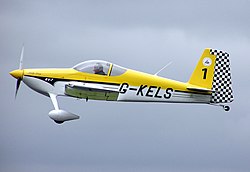
Van's Aircraft · 1971+
Van's RV-3 / RV-4 / RV-8

Specifications
MOSAIC eligiblePerformance
Cruise
182KTAS
Range
817nm
Climb
1900fpm
Ceiling
22,500ft
Fuel Burn
9.5gph
Fuel Cap.
42gal
MPG
22.0mpg
Stall (Vs0)
50KIAS
T/O roll
475ft
Ldg roll
500ft
Size & weight
Seats
2
Useful Load
680lbs
Full-fuel payload
428lbs
Max gross
1,800lbs
Wingspan
23ft
Length
20.4ft
Engine
Engine
Lycoming IO-360
Power
200hp
TBO
2,000hrs
Overhaul
$45k
Owning it
Hull insurance
$2k/yr
Parts
excellent
Mechanics
common
Gear
Fixed
IFR
Yes
Category
experimental
Full specification
V-speeds
Airframe
- Empty weight
- 1,120 lbs
- Max fuel weight
- 252 lbs
- Height
- 5.5 ft
- Wing position
- low
Obstacle performance
- Takeoff over 50 ft
- 825 ft
- Landing over 50 ft
- 950 ft
Paperwork
- Certification basis
- Experimental Amateur-Built
These figures are typical for the model, not a specification for any individual aircraft. Real-world numbers vary with year, installed equipment, weight, modifications and engine condition — often by more than you would expect. Use them to compare types, and confirm anything you would act on against the Pilot's Operating Handbook for that specific airframe and a prebuy inspection.
Pricing
Typical
$120k
Range
$55k – $180k
Annual all-in
~$18k/yr
All-in at ~100 flying hours a year, using the midpoint of each range — the same figures broken out under “Cost to own” below. Your number will differ, and mostly for two reasons. Experience sets your insurance: a 2,000-hour pilot with recent training pays 30–40% less than a 200-hour owner, and student owners pay 20–40% more — on the same aircraft that is often a doubling. Location sets your hangar: a T-hangar runs $200–400 a month in the Midwest against $400–1,500 in a coastal metro, and an outside tie-down is less again. Engine reserves move too — a local shop reusing your serviceable cylinders can come in 30–50% under the national specialty-shop pricing we quote, though you trade the warranty and turnaround that comes with it. Reserves are money set aside toward a future overhaul, not a bill this year, and the annual inspection figure is the shop’s labor to look — whatever they find is separate.
Cost to own — estimate
Set your yearly hours and local fuel price. Fixed costs (insurance, hangar, annual inspection) don't change with hours; fuel, maintenance and the engine reserve do.
- Fuel (9.5 gph)
- $6,175
- Engine reserve
- $2,250
- Propeller reserve
- $175
- Maintenance, parts & wear items ($12/hr)
- $1,200
- Insurance
- $1,100–$3,000
- Hangar
- $2,815–$7,038
- Annual inspection (labor only)
- $1,200
- Databases & subscriptions
- $400
- Total per year
- $18,377
- Per flight hour
- $184
- Miles flown / year (at cruise)
- 20,944 mi
- Cost per mile
- $0.88/mi
- Time in the air
- 1 hr 39 min
- Fuel burned
- 16 gal
- Out of pocket
- $162
Fuel, engine reserve and wear only. Insurance, hangar and the annual are already paid whether you make the trip or not, so they are not charged here.
Estimate, not a quote. Where a line shows a range, the total, per-hour and per-mile figures use its midpoint— insurance moves most with your experience and time in type, hangar with where you base the aircraft, so your own number could sit at either end. Annual inspection is the shop's labor to open and inspect — what they find is the maintenance line, which covers oil changes, plugs, tires, brakes, hoses, lights, a battery and vacuum pump amortised over their life, and the unscheduled squawks that are the largest and least predictable part of it. Reserves are sinking funds toward an overhaul, not a bill you pay this year — and note that a propeller is due on hours or calendar time, typically six years, so flying less does not put it off forever.
Strengths
- Exceptional cruise efficiency: 182 KTAS on 9.5 GPH rivals certified four-seaters on two-thirds fuel
- Aerobatic-capable with +6/-3G envelope; competitive at IAC Sportsman/Intermediate levels
- Outstanding community support: 11,000+ RVs flying; Van's Air Force provides peer expertise and parts availability
- Cost-effective ownership: $8,000–$15,000 annual all-in; builder/owner maintenance privileges reduce operating costs
Weaknesses
- Build quality is THE variable: identical models range from exceptional to problematic based entirely on builder skill and diligence
- No flaps means high approach speeds (70–80 KIAS) and poor backcountry/rough-strip capability
- Tandem seating limits passenger utility; not suitable for ab initio flight training
- Tailwheel versions (RV-8) have ground-loop tendency; nosewheel RV-8A eliminates this but at slightly higher cost
Overview
Van's Aircraft of Aurora, Oregon has produced the most successful line of homebuilt aircraft in history. More than 11,000 RV-series aircraft are flying worldwide — roughly one-third of the entire US experimental amateur-built fleet. The tandem-seat RV models (RV-3, RV-4, RV-8/8A) represent the aerobatic, sport-flying heart of the line.
The RV-3 (1971) started it all — Richard VanGrunsven's single-seat design that proved an amateur-built aircraft could deliver 170 KTAS on 150HP. The RV-4 (1979) added a second seat in tandem configuration and became the standard for homebuilt sport aircraft, with 1,446 flying. The RV-8/8A (1995/1998) is the modern evolution — wider cockpit, more wing area, heavier gross weight, and engine options up to 210HP. Over 1,611 RV-8/8A aircraft have been completed.
All three are all-metal semi-monocoque construction using 2024-T3 aluminum sheet, riveted together by the builder. Construction quality varies by builder, which is the defining characteristic (and risk) of all homebuilt aircraft. The RV-8 is available in tailwheel (RV-8) and nosewheel (RV-8A) configurations.
Van's Aircraft experienced financial difficulties in 2023-2024 but has restructured and continues to support builders and sell kits. The RV-8 kit remains available; the RV-3 and RV-4 kits are discontinued but parts support continues.
Variants & History
| Variant | First Flight | Engine | HP | Gross Weight (lbs) | Seats | Key Features |
|---|---|---|---|---|---|---|
| RV-3 | 1971 | Lycoming O-320 | 150 | 1,100 | 1 | Single-seat; 19'11" span; 30 gal fuel; 305 built; kit discontinued |
| RV-3B | 1990s | Lycoming O-320 | 150 | 1,100 | 1 | Redesigned wing; improved structural margins; current plans |
| RV-4 | 1979 | Lycoming O-360 | 180 | 1,500 | 2 tandem | Tailwheel only; 23' span; 32 gal fuel; 1,446 built; kit discontinued |
| RV-8 | 1995 | Lycoming IO-360 | 150-210 | 1,800 | 2 tandem | Tailwheel; 24' span; 42 gal fuel; wider cockpit; 1,611+ built |
| RV-8A | 1998 | Lycoming IO-360 | 150-210 | 1,800 | 2 tandem | Nosewheel version of RV-8; same performance; easier ground handling |
The RV-8 represents a substantial improvement over the RV-4: 300 lbs more gross weight, 10 gallons more fuel, a wider cockpit accommodating larger pilots, increased wingspan (24' vs 23'), and engine options from 150 to 210HP. The RV-4 is tailwheel-only; the RV-8/8A offers the builder's choice of tailwheel or nosewheel.
Most RV-8s are built with the Lycoming IO-360 at 180-200HP. The IO-390 at 210HP is the premium option, delivering the best climb and cruise performance.
Performance
The RV-8 with IO-360 at 200HP cruises at 182 KTAS (210 MPH) at 75% power and 8,000 feet on 9.5 GPH — this is faster than most certified four-seat aircraft on two-thirds the fuel. At economy cruise (65% power, lean of peak), 173 KTAS on 7.5 GPH is typical, providing over 800 nm range from 42 gallons.
The RV-4 with O-360 at 180HP cruises at 170 KTAS on approximately 9 GPH — only slightly slower than the RV-8 despite 20 fewer horsepower and smaller airframe.
The RV-3 is the fastest per horsepower — 170 KTAS on just 150HP, with a 350-lb useful load that's entirely for the pilot and fuel.
Rate of climb at 1,900 FPM (RV-8) and 1,950 FPM (RV-4) makes all three models excellent for aerobatics. The RV-8 has been designed for +6G/-3G at aerobatic gross weight and +4.4G/-1.75G at max gross weight. Practical aerobatic maneuvers can be accomplished at 3-4G positive without approaching structural limits.
Stall speed of 50 KIAS (RV-8) with no flaps — the RV-8 has no flap system, which simplifies construction and operation but means approach speeds run 70-80 KIAS.
The 22,500-foot service ceiling reflects the exceptional power-to-weight ratio and efficient airframe.
Payload & Range
RV-8 (IO-360, 200HP, 42 gal fuel):
| Scenario | Fuel (gal) | Fuel Weight (lbs) | Payload (lbs) | Pax + Bags | Range (nm) |
|---|---|---|---|---|---|
| Full fuel, 2 pax | 42 | 252 | 428 | 2 × 190 + 48 bags | 817 (55% power) |
| Full fuel, 2 pax (75%) | 42 | 252 | 428 | 2 × 190 + 48 bags | 580 |
| Reduced fuel, 2 large pax | 30 | 180 | 500 | 2 × 210 + 80 bags | 560 |
| Full fuel, solo aerobatics | 42 | 252 | 428 | 1 × 200 + 228 | 817 |
RV-4 (O-360, 180HP, 32 gal fuel):
| Scenario | Fuel (gal) | Fuel Weight (lbs) | Payload (lbs) | Pax + Bags | Range (nm) |
|---|---|---|---|---|---|
| Full fuel, 2 pax | 32 | 192 | 405 | 2 × 180 + 45 bags | 510 |
| Full fuel, solo | 32 | 192 | 405 | 1 × 200 + 205 | 510 |
RV-3 (O-320, 150HP, 30 gal fuel):
| Scenario | Fuel (gal) | Fuel Weight (lbs) | Payload (lbs) | Pax + Bags | Range (nm) |
|---|---|---|---|---|---|
| Full fuel, solo | 30 | 180 | 170 | 1 × 170 | 517 |
The RV-8's 680 lbs useful load handles two average-size adults with full fuel and 48 lbs of baggage for 800+ nm range at economy cruise. Two large adults (210 lbs each) require reducing fuel to 30 gallons, still providing 560 nm range. Solo with full fuel, the RV-8 has 428 lbs for pilot and cargo — enabling very long-range solo cross-country flights. The RV-4 is tighter — two 180-lb pilots with full fuel and minimal baggage, but still delivers 510 nm range.
Mission Suitability
- Flight Training (4): Not a primary trainer — experimental aircraft restrictions, tandem seating, and high performance make it unsuitable for ab initio training. Excellent for aerobatic training, tailwheel transition (RV-8), and formation flying training. The RV community uses RV-8s extensively for formation clinics.
- Backcountry (2): Low-wing, no flaps, and relatively high approach speed make it poorly suited for short rough strips. Some RV-8 (tailwheel) pilots operate from grass strips, but it's not the aircraft's strength.
- Business Travel (3): 182 KTAS cruise is competitive, but tandem seating limits utility. Solo business travel with baggage works well — the RV-8 gets you there fast. Range of 800+ nm means most trips are nonstop.
- Aerobatics (8): Outstanding aerobatic platform. +6/-3G at aerobatic weight enables all standard aerobatic figures — loops, rolls, hammerheads, snaps, spins. The RV-8 is competitive at IAC Sportsman and Intermediate levels. Not quite Pitts/Extra level for Unlimited due to lower G-limits and roll rate, but far more versatile as a traveling aerobatic aircraft.
- Cross-Country (7): This is where the RV-8 excels beyond its aerobatic mission. 182 KTAS with 800+ nm range, comfortable (for tandem) cockpit, and IFR capability with appropriate avionics. Many RV-8 pilots fly coast-to-coast regularly. Economy cruise at 173 KTAS on 7.5 GPH is outstanding efficiency.
- Cargo Hauling (1): Two tandem seats, small baggage area (50 lbs). Not a cargo aircraft.
- Local Fun Flying (10): THE fun airplane. The RV-8 combines aerobatic capability, 180+ knot cruise, responsive handling, and the satisfaction of flying something you built. The Van's community (Van's Air Force) is enormous, active, and welcoming. Formation flights, fly-ins, and aerobatic sessions define the RV lifestyle.
- Surveying (2): Low wing limits downward visibility. Not designed for slow-flight observation.
Avionics Ecosystem
- Basic VFR builds: Steam gauges with basic comm/nav. Some builders prioritize lightweight simplicity. $3,000-$8,000 for panel.
- Standard IFR builds: Garmin G5 or GI-275, GTN 650Xi, ADS-B transponder, autopilot. The most popular configuration for cross-country RV-8s. $15,000-$30,000 for panel.
- Full glass builds: Garmin G3X Touch with dual screens, GTN 750Xi, GFC 500 autopilot, ADS-B In/Out. Experimental avionics are significantly cheaper than certified equivalents. A full G3X panel costs $15,000-$45,000 in parts — the same capability in a certified aircraft costs $40,000+.
- The experimental avionics advantage: RV builders can install Garmin G3X, Dynon SkyView, or Advanced Flight Systems at a fraction of certified avionics costs. This makes the RV-8 one of the best-equipped aircraft flying for its price range.

2009 Van's RV-7
RV-7 · Fast + Aerobatic · Dynon Glass · Great First RV
STCs & Modifications
STCs don't apply to experimental amateur-built aircraft — the builder/owner can make modifications under the repairman certificate. Common modifications include:
- Engine upgrades: IO-390 (210HP) is the premium choice. Some builders install IO-540 (260HP) for extreme performance. Angle valve IO-360 variants are popular for better cylinder cooling.
- Electronic ignition: SureFly, E-MAG, or Lightspeed electronic ignition replacing one or both magnetos. Improves fuel efficiency 5-10% and provides more reliable ignition.
- Constant-speed propeller: Hartzell or MT constant-speed props optimize climb and cruise. Many builders choose fixed-pitch for simplicity and weight savings.
- Fuel injection: Standard on IO-360 models. Carbureted O-360 is lighter and simpler but lacks altitude compensation.
- Tip tanks: Extended range fuel tanks in wingtips. Some builders achieve 50+ gallon total capacity for 1,000+ nm range.
- Smoke system: Standard addition for aerobatic and formation flying.
- Autopilot: Garmin GFC 500, TruTrak Vizion, or Dynon autopilots. Transforms the RV-8 into a serious IFR cross-country machine.
Maintenance & Support
- Condition inspection: $850-$1,500/year. Experimental aircraft require an annual condition inspection (not an "annual" — different regulatory framework). Can be performed by the builder (with repairman certificate) or any A&P/IA.
- Engine overhaul: $45,000 for IO-360 at 2,000-hour TBO. $30,000 for IO-390. O-360 overhaul at $22,000.
- Parts availability: Excellent. Van's Aircraft maintains parts support for all models including discontinued RV-3 and RV-4. The all-aluminum construction means raw material is always available. Lycoming engine parts are universally available.
- Mechanic familiarity: Common. With 11,000+ RVs flying, most experimental-aircraft-experienced A&Ps are very familiar with the type. The Van's Air Force community provides extraordinary peer support.
- Annual all-in cost: $8,000-$15,000 at 100 hours/year. Lower than most certified aircraft due to builder/owner maintenance privileges.
- Operating cost: $60-$100/hour all-in. The RV-8 is one of the most cost-effective high-performance aircraft to operate.
Valuation Factors
- RV-3/3B (single-seat, 150HP): $40,000-$80,000. Single-seat limits market. Build quality is everything.
- RV-4 (tandem, 180HP, tailwheel): $55,000-$120,000. Kit discontinued; values stable. Nice examples $80,000-$100,000.
- RV-8 (tandem, tailwheel): $80,000-$170,000. Most desirable of the three. Well-equipped IO-360 examples $120,000-$150,000. IO-390 commands premium.
- RV-8A (tandem, nosewheel): $80,000-$180,000. Similar to RV-8; nosewheel slightly easier to insure.
- Premium builds: Award-winning, professionally-finished RV-8s with full glass panels and IO-390 engines can exceed $180,000.
- Kit cost (RV-8, new): Approximately $50,000-$60,000 for airframe kit + finishing kit. Engine, prop, avionics, and paint are additional — total build cost $100,000-$150,000+.
Per Aircraft Valuation Methodology: Build quality is THE primary value driver for all experimental aircraft. Logbook documentation of construction, quality of riveting, paint, and systems installation determine value more than total time. Engine time and condition are standard factors. Avionics configuration significantly affects value — a full G3X glass panel adds $15,000-$45,000. First-flight date matters less than build quality and maintenance history.
ADs & Common Problems
Experimental aircraft are not subject to Airworthiness Directives. However, Van's issues Service Bulletins that responsible builders/owners should comply with.
Key Service Bulletins:
- Wing spar web cracking (RV-3): The original RV-3 wing had structural concerns that led to kit suspension in 1996. The redesigned RV-3B wing addresses this. Original RV-3 owners should inspect spar webs and consider the wing retrofit.
- Fuel tank leaks: Various SBs addressing fuel tank sealant degradation and leak prevention.
- Elevator trim system: SBs addressing trim runaway potential and trim tab flutter.
Common Problems:
- Build quality variation: THE defining issue for all homebuilt aircraft. An RV-8 built by an experienced builder with 2,000 hours of careful work is a different aircraft than one rushed together in 800 hours. Pre-buy inspection by an RV-experienced A&P is essential.
- Engine installation quality: Baffling, exhaust, and cooling can vary dramatically between builders. Overheating is common in poorly-baffled installations.
- Landing gear: The RV-8 tailwheel uses Wittman-style spring steel legs. Ground loop tendency exists for the tailwheel version, though less severe than a Pitts. The RV-8A nosewheel eliminates this concern.
- Canopy seal leaks: Common nuisance. The sliding canopy design can develop seal degradation.
- Corrosion: Aluminum structure is susceptible to corrosion if not properly primed and protected during construction. Coastal and humid environments accelerate this.
- Propeller strike / sudden stoppage: Any propeller strike requires engine teardown inspection regardless of apparent damage.
Insurance Profile
Per GA Insurance Underwriting:
- Hull + liability (qualified pilot): $1,200-$1,800/year for $90K hull value. Qualified = 500+ hours, 100+ tailwheel hours, 25+ hours in type.
- Hull + liability (low-time pilot): $2,100-$2,400/year. New RV pilots face steep premiums until building time in type.
- Liability only: $550-$650/year for qualified pilots.
- RV-8A (nosewheel) discount: Slightly lower premiums than tailwheel RV-8 due to reduced ground-loop exposure.
- Aerobatic coverage: Available but adds premium. Many RV-8 policies specifically cover aerobatics.
- 7 carriers quote RV-8 insurance in the US — good market competition keeps rates reasonable for experimental aircraft.
- Experimental aircraft insurance is generally more expensive than equivalent certified aircraft due to build-quality variability and limited standardization.
For sale (0)
No listings for this model right now.
For sale elsewhere (12)
Current ads on Barnstormers, checked daily. Photos, full details and the seller are on the listing site.
2009 Van's RV-3 / RV-4 / RV-8
Listed on BarnstormersElectronic ignition · 406 MHz ELT · Garmin GTX 327/320
View photos and full ad on Barnstormers ↗2006 Van's RV-3 / RV-4 / RV-8
Listed on BarnstormersDynon EFIS (D-series) · Bendix/King KLX 135
View photos and full ad on Barnstormers ↗Van's RV-3 / RV-4 / RV-8
Listed on BarnstormersElectronic ignition
View photos and full ad on Barnstormers ↗2000 Van's RV-3 / RV-4 / RV-8
Listed on BarnstormersAutopilot (unspecified)
View photos and full ad on Barnstormers ↗Van's RV-3 / RV-4 / RV-8
Listed on BarnstormersADS-B Out · Audio panel · Autopilot (unspecified) · Electronics International engine monitor
View photos and full ad on Barnstormers ↗2018 Van's RV-3 / RV-4 / RV-8
Listed on Barnstormers2020 Van's RV-3 / RV-4 / RV-8
Listed on BarnstormersADS-B In · ADS-B Out · uAvionix echoUAT · Electronic ignition
View photos and full ad on Barnstormers ↗2015 Van's RV-3 / RV-4 / RV-8
Listed on BarnstormersADS-B In · ADS-B Out · Dynon autopilot · Dynon SkyView
View photos and full ad on Barnstormers ↗Van's RV-3 / RV-4 / RV-8
Listed on BarnstormersAlso worth looking at
What buyers usually weigh against the Van's RV-3 / RV-4 / RV-8 — aircraft flown for the same kind of mission.