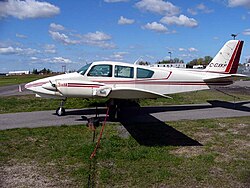
Piper · 1954–1962
Piper PA-23 Apache
Specifications
Performance
Cruise
135KTAS
Range
Not verified
Climb
1050fpm
Ceiling
17,000ft
Fuel Burn
17.0gph
Fuel Cap.
72gal
MPG
9.1mpg
Stall (Vs0)
49KIAS
T/O roll
—ft
Ldg roll
—ft
Size & weight
Seats
4
Useful Load
1,480lbs
Full-fuel payload
1,048lbs
Max gross
3,800lbs
Wingspan
37ft
Length
27.1ft
Engine
Engine
Lycoming O-320-B1A
Power
320hp
TBO
2,000hrs
Overhaul
$42keach
Engines
2
Owning it
Hull insurance
$2k/yr
Parts
fair
Mechanics
specialist
Gear
Retractable
IFR
Yes
Category
certified
Full specification
V-speeds
Airframe
- Empty weight
- 2,320 lbs
- Max fuel weight
- 432 lbs
- Height
- 9.4 ft
- Wing position
- low
Paperwork
- Type certificate
- 1A10
- Certification basis
- CAR 3
These figures are typical for the model, not a specification for any individual aircraft. Real-world numbers vary with year, installed equipment, weight, modifications and engine condition — often by more than you would expect. Use them to compare types, and confirm anything you would act on against the Pilot's Operating Handbook for that specific airframe and a prebuy inspection.
Pricing
Typical
$100k
Range
$70k – $130k
Annual all-in
~$42k/yr
All-in at ~100 flying hours a year, using the midpoint of each range — the same figures broken out under “Cost to own” below. Your number will differ, and mostly for two reasons. Experience sets your insurance: a 2,000-hour pilot with recent training pays 30–40% less than a 200-hour owner, and student owners pay 20–40% more — on the same aircraft that is often a doubling. Location sets your hangar: a T-hangar runs $200–400 a month in the Midwest against $400–1,500 in a coastal metro, and an outside tie-down is less again. Engine reserves move too — a local shop reusing your serviceable cylinders can come in 30–50% under the national specialty-shop pricing we quote, though you trade the warranty and turnaround that comes with it. Reserves are money set aside toward a future overhaul, not a bill this year, and the annual inspection figure is the shop’s labor to look — whatever they find is separate.
Cost to own — estimate
Set your yearly hours and local fuel price. Fixed costs (insurance, hangar, annual inspection) don't change with hours; fuel, maintenance and the engine reserve do.
- Fuel (17 gph)
- $11,050
- Engine reserve
- $4,200
- Propeller reserve
- $600
- Maintenance, parts & wear items ($45/hr)
- $4,500
- Insurance
- $4,000–$8,000
- Hangar
- $6,016–$15,041
- Annual inspection (labor only)
- $4,500
- Databases & subscriptions
- $900
- Total per year
- $42,278
- Per flight hour
- $423
- Miles flown / year (at cruise)
- 15,536 mi
- Cost per mile
- $2.72/mi
- Time in the air
- 2 hr 13 min
- Fuel burned
- 38 gal
- Out of pocket
- $452
Fuel, engine reserve and wear only. Insurance, hangar and the annual are already paid whether you make the trip or not, so they are not charged here.
Estimate, not a quote. Where a line shows a range, the total, per-hour and per-mile figures use its midpoint— insurance moves most with your experience and time in type, hangar with where you base the aircraft, so your own number could sit at either end. Annual inspection is the shop's labor to open and inspect — what they find is the maintenance line, which covers oil changes, plugs, tires, brakes, hoses, lights, a battery and vacuum pump amortised over their life, and the unscheduled squawks that are the largest and least predictable part of it. Reserves are sinking funds toward an overhaul, not a bill you pay this year — and note that a propeller is due on hours or calendar time, typically six years, so flying less does not put it off forever.
Strengths
- Excellent multi-engine trainer; teaches VMC respect with margin-limited single-engine performance
- Affordable purchase price (~$100k) for a twin-engine aircraft
- Fuel-efficient for a twin at 17–18.8 gph; reasonable endurance with 72-gallon tank
- Docile handling; roomy four-seat cabin; short-field landing capability
Weaknesses
- Marginal single-engine performance; best-rate climb on one engine may be descent on a hot day
- High operating cost: $42/hr engine reserve alone, plus hydraulic complexity and aging systems
- No electrical redundancy; single generator on right engine means battery-only if right engine fails
- Reversed gear (right) and flap (left) levers; trainer hazard; requires careful transition training
- Slow cruise (135 KTAS) on twin fuel burn; Cherokee 180 or Seminole outperforms at lower cost
Overview
The Apache is the airplane that made light twins affordable, and it has spent seventy years being gently insulted for it. Piper bought the design from Stinson, put a pair of 150 hp Lycoming O-320s on it and certificated it in January 1954 as the first genuinely mass-market twin — a four-seat, retractable-gear airplane with two of everything, aimed at owners who had never flown one. Budd Davisson's 1976 verdict has stuck: "a 3,500 pound sweet potato that has a couple of little Lycomings snuggled up next to it with a side-walk-sized wing tying the mass of bulges together."
The insults are about performance, and they are fair. AOPA's own fact sheet puts the 160 hp Apache at 1,050 fpm of climb and a 17,000 ft service ceiling — lower than the 150 hp airplane's 1,350 fpm and 18,500 ft, because the 160 came with 300 lb more gross weight than the extra 20 horsepower a side could carry. Davisson measured 155–160 mph true on 17 gallons an hour. That is Cherokee 180 speed on twin-engine fuel and twin-engine maintenance.
What the Apache is genuinely good at is teaching. It is docile, it is roomy, it lands short, and — this is the part that matters — its single-engine performance is so marginal that it makes the lesson unavoidable. Rick Durden, writing the Apache up for AOPA Pilot in 1999: "The Apache shines as proof that the loss of one engine results in loss of not half the climb rate but closer to 90 percent... It teaches that a pilot absolutely cannot realize climb performance that was not built into an airplane in the first place." A generation of multi-engine ratings was earned in Apaches for exactly that reason, and the type is still bought today mostly by people building multi time.
The other thing the Apache is good at is being cheap to buy relative to what it is. It is not cheap to own — two engines, a hydraulic system, retractable gear and a heavy AD burden see to that — and the gap between purchase price and running cost is the single most common way people get hurt by this airplane financially.
Roughly 2,046 Apaches were built across the two models before the Aztec took over the production line. Buyers looking at the Apache for time-building usually also look at the Piper PA-30 Twin Comanche, which is faster and more efficient but far less forgiving, and at the Piper PA-44 Seminole, which is the modern answer to the same question.
Variants & History
Every row carries its own figures. The frontmatter above describes the PA-23-160 row only.
| Model | Years | Serials | Engine | HP (each) | Seats | Max weight | Vne | Vno | Va | Vle | Vfe | Fuel |
|---|---|---|---|---|---|---|---|---|---|---|---|---|
| PA-23 (Apache 150) | 1954–1958 | 23-1 – 23-1182 except 23-1177 (1,181) | Lyc. O-320-A1A/A1B/A3A/A3B | 150 | 4 (5 optional) | 3,500 lb | 181 kt | 143 kt | 108 kt | 109 kt | 87 kt | 72 gal |
| PA-23, NOTE 3 airframes | late 1958 | 23-1068; 23-1152 – 23-1182 (32) | as above | 150 | 4 (5 optional) | 3,800 lb | 197 kt | 156 kt | 113 kt | 109 kt | 87 kt | 72 gal |
| PA-23-160 (Apache E/G/H) | 1958–1962 | 23-1177; 23-1183 – 23-2046 (865) | Lyc. O-320-B1A/B1B/B3A/B3B; C-series with Item 401(q) | 160 | 4 (5 optional) | 3,800 lb | 197 kt | 156 kt | 113 kt | 109 kt | 87 kt | 72 gal |
| PA-23-160, late serials | 1960–1962 | 23-1774; 23-1871 – 23-2046 (177) | as above | 160 | 4 (5 optional) | 3,800 lb | 197 kt | 156 kt | 113 kt | 130 kt | 109 kt | 72 gal |
All airspeeds are the type certificate's bracketed knots, stated as CAS.
The gear and flap speed change is the one operational difference worth shopping for. Davisson explains why better than the certificate does: "The only really significant changes came with the 1960 model when the gear speed was raised from 125 mph to 150 mph and the flap speed was brought up to 125 mph. This may not sound like much, but when you figure that the single engine rate of climb speed is 95 mph and the older flap speed is 100 mph, you can really find yourself busy during single engine operation trying to keep from exceeding flap speed." On an early airplane the flap limit sits five miles an hour above blue line. On a late one there is room to work.
688 of 865 PA-23-160 airframes are on the early, lower block and that is what the frontmatter stores. Check the serial number: 23-1871 and up gets the higher speeds, as does the single airplane 23-1774.
The optional fifth seat costs you the baggage compartment
TCDS 1A10 Section II certificates the PA-23-160 for four seats, or five with Item 609 or 613 installed — and in the same breath takes maximum baggage from 200 lb down to 30 lb, because the fifth seat sits at station +150, which is where the baggage compartment is. Davisson, who flew one: "the tiny fifth seat" whose occupant needed an extra window fitted "to keep the passenger... from blacking out from claustrophobia."
Treat the Apache as a four-seat airplane with a jump seat, not as a five-seater.
Geronimo and the other conversions
A large share of surviving Apaches are modified, and the modifications are worth real money because the base airplane is so marginal. The Geronimo conversion — originally Seguin Aviation, later Diamond Aire — is the significant one: bigger engines, a longer nose with a baggage compartment, a squared vertical fin, and a gross weight increase. The two pilot reports agree on the value: Rick Durden (AOPA Pilot, 1999) — "Even with the Apache's Geronimo modification, with 180-hp engines, the airplane will not cruise much faster than 145 kt" — and Budd Davisson (Air Progress, 1976) — "the docility of the basic bird combined with the power of the 180 hp mod is a nearly ideal situation."
A converted Apache is a different airplane from the one this page describes, and nothing in the frontmatter applies to it. Its weights, speeds and limits come from the STC paperwork, and the specific STC list for the specific airframe is a pre-buy document. Verify what is actually installed against what is approved; multi-STC conversions accumulate paperwork errors over sixty years.
Performance
The cruise and burn on this page are one pair from one flight. Budd Davisson,
flying a stock 160 hp Apache for Air Progress in 1976: "At a TAS of 155-160 mph
you can expect to have homebuilts doing barrel rolls around you... It's burning
about 8½ gallons per engine, and 17 gallons an hour ain't bad for a twin." The
stored 135 KTAS is the bottom of that band converted to knots (155 mph = 134.7
KTAS); 17 gph is his total for both engines, which is the house convention for
fuel_burn_gph on a twin — 8.5 gph a side.
There is a disagreement on fuel burn and it is not averaged away. AOPA's fact sheet gives 18.8 gph at 75% power for the 1960 PA-23-160, against Davisson's 17. Davisson's figure is stored because it comes paired with a speed from the same flight, which is what the cruise/burn/range rule asks for. Plan on 18.8 gph, and remember Davisson was leaning carefully and noted "careful leaning could probably get it even lower". AOPA's own article independently puts cruise at "130 to 135 kt is about it", which brackets the stored 135 from below.
No range figure is stored, deliberately. Nothing found publishes one for any Apache, and computing 72 gallons ÷ 17 gph would ignore the taxi, climb and reserve allowances a manufacturer's range chart applies — an error worth an hour of fuel on an airplane this size. An Apache Owner's Handbook range chart is the single most valuable document missing from this page.
The 160 climbs worse than the 150, and that is not a typo. AOPA gives 1,350 fpm and 18,500 ft for the 1954 PA-23-150 against 1,050 fpm and 17,000 ft for the 1960 PA-23-160. The 160 hp airplane gained 300 lb of gross weight — a 8.6% increase — for 6.7% more power, so it climbs and ceilings worse at maximum weight while carrying more. That is the whole trade, and it is the reason a lightly loaded Apache feels like a different airplane from a full one.
Single-engine performance is the number this page cannot give you, and on this type it is the number that matters most. TCDS 1A10 publishes no performance at all. Rick Durden describes the loss as "closer to 90 percent" of the climb rate and warns that at gross on a hot day, best single-engine rate of climb speed "may result in what is described as 'best rate of least going down.'" No source states a figure. The pre-split page asserted 180 fpm with nothing behind it and that claim has been deleted rather than repeated.
What can be said with a source: Vmc is 85 mph, blue line is 95 mph, rotation is 90 mph — all three from Durden's AOPA article — and that cleaning up and securing a failed engine while accelerating to blue line "takes at least 800 feet of altitude". Fly the airplane's real numbers, at its real weight, on a real day, with an instructor, before you need them — and plan every departure on the assumption that an engine failure means choosing a landing site rather than climbing away.
The V-speed fields are named _kias and 1A10 states its limits as CAS. The
block heading reads Airspeed Limits (CAS) and this certificate carries no
finding that indicated equals calibrated. The stored figures are the
certificate's own bracketed knots, unconverted — house rule, recorded in the
saved passage. AOPA independently prints 197 and 156 and labels them KCAS.
Auto fuel. Durden notes the Apache "can be a reasonable way to build time" partly because under an STC it will burn "a total of only about 16 gallons of auto gas per hour". The 150 hp PA-23 is certificated on 80/87 minimum grade and the 160 on 91/96, which is worth checking against whatever auto-fuel STC an airplane carries.
Payload & Range
All figures for the PA-23-160: 3,800 lb maximum weight, 2,320 lb standard empty, 1,480 lb useful load, 72 gallons total (432 lb), 200 lb of baggage — or 30 lb with the optional fifth seat fitted.
Full fuel, two adults. 432 lb of fuel plus two people and bags at 450 lb is 882 lb aboard, against 1,480 lb of useful load. 598 lb spare. Comfortable, and it is the load the airplane actually climbs well at.
Full fuel, four adults. Four at 190 lb is 760 lb, plus 432 lb of fuel is 1,192 lb — inside the 1,480 lb useful load, with 288 lb left for baggage against a 200 lb compartment limit. Full fuel and four adults is legal on paper. It is also 3,800 lb on a 1,050 fpm airplane with a 17,000 ft ceiling, and on a warm day at any elevation that is a very different airplane from the one in the two-adult case above. This is the loading where the Apache's reputation is earned.
Four adults and bags. 760 lb of people plus 200 lb of baggage is 960 lb, leaving 520 lb for fuel — about 86 gallons, more than the tanks hold, so fill them and accept the same 3,800 lb caveat.
TCDS 1A10 states no zero-fuel weight for the Apache, so unlike the Aztec there is no structural cap below gross weight to work around. Gross weight and the baggage compartment limit are the constraints.
The real constraint is not weight, it is density altitude. With 1,050 fpm at gross at sea level and a 17,000 ft service ceiling, a full Apache on a hot day at a 5,000 ft field has margins that need to be worked out from the flight manual for that specific airplane — and a single-engine failure in that configuration is a forced landing, not a climb-out.

1998 Piper Archer
Archer III · GNS 430W · Honest Trainer · Fresh Annual
Mission Suitability
| Mission | Score | Rationale |
|---|---|---|
| Flight Training | 7/10 | The Apache's best and most honest mission. Docile, roomy, cheap to buy, and marginal enough on one engine that the multi-engine lesson lands. Durden: "In the hands of a competent instructor, the Apache may teach multiengine students enough respect for VMC to allow them to stay alive when things go south in faster, more sophisticated twins." The reversed gear and flap levers are a training hazard in their own right |
| Backcountry / Bush Flying | 2/10 | Retractable gear, low wing, one hydraulic pump on the left engine. It lands short on pavement and that is where it should stay |
| Business Travel | 3/10 | 135 knots on 17-19 gph, four seats, and single-engine performance that makes hard IFR a real risk calculation. A 180 hp single does the same trip faster on half the fuel. The case for the Apache here is redundancy on a specific route, not capability |
| aerobatics | 1/10 | Normal category only; TCDS NOTE 2(a) prohibits acrobatic maneuvers including spins |
| Cross-Country Flying | 4/10 | 72 gallons is real endurance and the cabin is comfortable, but the speed is unremarkable and no published range figure exists to plan on. Fine for 300-mile legs with a good weather margin |
| Cargo Hauling | 3/10 | 1,480 lb of useful load minus 432 lb of fuel leaves about 1,050 lb, and the baggage compartment is limited to 200 lb — 30 lb if the fifth seat is fitted. This is not a load hauler; the Aztec is |
| Local Fun Flying | 3/10 | Two engines and 17 gallons an hour for pattern work. Owners do it; the fuel bill is why most of them stop |
| surveying | 3/10 | Endurance is adequate and two engines are welcome, but payload for equipment plus an operator is thin and single-engine margin over unfriendly ground is close to nil |
Avionics Ecosystem
Davisson identified the Apache's avionics problem in 1976 and it has only aged: "Since Apaches were the real 'in' thing to fly in the late '50s, every one who owned one loaded it up with the best radio gear available. The result is that subsequent owners have tried to keep the old gear running and replaced it piecemeal rather than all at one time. Now most Apache's are hodge-podge avionics museums of the highest order."
His advice still holds: "it's easy to tie up half the price of a good Apache in radios... it's best to shop around and spend a couple thousand for one that already has decent radios." On a $100,000 airplane, a panel rebuild is a significant fraction of the purchase price and will not come back on resale.
What to insist on: ADS-B Out compliance, verified on paper rather than assumed. A WAAS navigator if IFR is the point of owning a twin. A working autopilot, or the acceptance that hand-flying a twin in cloud is the deal. An engine monitor on both engines is cheap relative to a cylinder.
What not to bother with: a full glass rebuild. The airframe value will not support it, and the money is better spent on engines and hydraulics.
See Avionics Pricing Reference.
STCs & Modifications
Geronimo (Seguin Aviation, later Diamond Aire). The significant modification family for the Apache: larger engines, a longer nose with baggage, a squared fin, and a gross weight increase. Davisson rates the 180 hp version "a nearly ideal situation"; Rick Durden notes in AOPA Pilot that even converted, the airplane "will not cruise much faster than 145 kt." A Geronimo conversion changes the airplane's limits, and none of this page's frontmatter applies to one. Insist on the complete STC paperwork.
Auto fuel STC. Durden records about 16 gph of auto gas. Check the grade the specific model is certificated on — 80/87 for the PA-23, 91/96 for the PA-23-160 — and what the STC actually approves.
Third window. A common cosmetic and habitability modification, fitted to make the fifth seat tolerable. Davisson's airplane had one.
Vortex generators, tip tanks, gap seals, speed-slope windshields. Offered by the same conversion houses. Treat performance claims as claims; the airframe benefit that matters on this type is anything that improves handling near Vmc.

2019 Cirrus SR22
One Owner · Platinum · FIKI · Low 690 Hours · Hangared
Maintenance & Support
See Maintenance Ecosystem.
Mechanic familiarity: specialist. Durden's line about the cost of a twin — "the cost of maintaining a twin always seems to run about three times that of a single of comparable speed" — is the honest framing for this airplane. A shop that knows PA-23 hydraulics is worth travelling to. The Piper Apache Club is where to find one.
Parts availability: fair. Engine and consumable parts are straightforward. Airframe parts, hydraulic components and interior pieces are getting hard, and the conversion houses hold much of the remaining inventory.
Hourly running cost, built from this page's own fields:
- Fuel at 17–18.8 gph, which is the one genuinely cheap thing about the airplane
- Engine overhaul reserve: $42,000 ÷ 2,000 hr = $21 per engine per hour, so
$42/hr for the pair. (
engine_overhaul_cost_usdis PER ENGINE and the cost model multiplies byengine_count.) - Propeller reserve: the catalogue derives $6,000 per propeller at 2,000 hours for a piston twin — two full-feathering hubs, and the propellers must actually feather for the airplane to be dispatchable. Durden: "The propellers are cycled to ensure that they will actually feather; the inability to do so is a no-go item."
- A generous general maintenance reserve, because the airframe is old and the systems are plumbed
Valuation Factors
See Aircraft Valuation Methodology.
The pricing on this page is legacy data from the April 2026 generation pass and has NOT been re-sourced. The band comes from the pre-split page's own Apache valuation prose. Price a specific airplane from current asking prices and a Vref or Bluebook lookup.
What holds regardless of the band:
- Engine time dominates everything. Two O-320s at $42,000 each is $84,000 of liability, close to the value of the whole airplane. A run-out Apache is a project, not a bargain.
- Conversions carry a premium and deserve scrutiny. A well-documented Geronimo is worth a real amount more than a stock airplane and is also a much more complicated paperwork audit.
- Late 160s are worth more than early ones for the higher gear and flap speeds — a genuine operational difference, not a trim level.
- The cheapest Apache on the market is almost never the cheapest Apache to own. This is a type where deferred maintenance is normal and where the first annual after purchase decides whether the deal was good.
ADs & Common Problems
Verify AD applicability against the FAA's own database for the specific serial number. The pre-split page listed a number of AD references that have not been checked in this pass, and they have been removed rather than repeated — an unverified AD number in a catalogue is worse than none, because a buyer may believe it is a complete list.
Two things are worth stating with confidence:
AD 83-22-01 does NOT apply to the Apache. The zero-fuel-weight directive covers Models PA-23-235, PA-23-250 and PA-E23-250 — the Aztec-airframe airplanes. The pre-split page implied it governed every PA-23 fuel and payload calculation; it does not govern this one. TCDS 1A10 states no zero-fuel weight for the PA-23 or PA-23-160 at all.
AD 2009-13-06, the nose baggage door directive, is a long-nose airplane's problem. It life-limits nose baggage door components on certain PA-23, PA-31 and PA-42 airplanes. A stock Apache has no nose baggage compartment — the forward locker appears on the type certificate at PA-23-250 S/N 27-2000 — but a Geronimo-converted Apache does, and that is a specific question to ask about a converted airplane.
Pre-buy red flags, from the two pilot reports and from the systems:
- Rear fuselage bulkhead and rudder hinges. "Most Apaches have been used as trainers so the rudder has spent a lot of time banging against the stops which can raise hell with the rear bulkhead and eventually crack rudder hinges." Corrosion and cracks. Borescope it.
- Fuel selector cables. Durden: "The cables eventually stretch, resulting in an inability to move a selector fully to the proper position. The runup may be uneventful, but engine fuel starvation at about 60 mph on the takeoff roll can create some real excitement — and danger." This has killed people.
- Half-inch valves. Without them the engines do not carry a 2,000-hour TBO. Confirm on the engine data plates and logbooks, not by assumption.
- Hydraulics. One engine-driven pump, on the left engine, running the gear and flaps, with a hand pump and a CO2 blow-down behind it. Sixty-plus years of seals. Fly the emergency extension procedure before you need it, and note Durden's point that once blown down, "the hydraulic system has to be purged before further use."
- Single generator on the right engine. The Apache is not electrically redundant. Lose the right engine and you are on the battery.
- Reversed gear and flap levers. Gear on the right, flaps on the left — the opposite of most Pipers. A transition-training item on every checkout.
- Two engines at $42,000 each. $84,000 of overhaul liability on an airplane worth around $100,000. Engine time is the dominant term in any Apache purchase.
Insurance Profile
See GA Insurance Underwriting.
The Apache underwrites as a vintage light twin, and its long history as a trainer means underwriters know it well. Expect a multi-engine rating to be required, a dual requirement in make and model before solo, and recurrent training expected annually for favorable rates. Hull values are low enough that liability, not hull, is often the larger part of the premium.
The figure in typical_hull_insurance_annual_usd is carried unchanged from the
pre-split page and is a band, not a quote. On a twin bought by a low-time
multi-engine pilot the insurance answer can change the buying decision entirely —
get a real quote before making an offer.
For sale (0)
No listings for this model right now.
For sale elsewhere (1)
Current ads on Barnstormers, checked daily. Photos, full details and the seller are on the listing site.
1956 Piper PA-23 Apache
Listed on BarnstormersADS-B Out · Audio panel · Garmin G5 · Garmin GNC 255 / SL30
View photos and full ad on Barnstormers ↗Also worth looking at
What buyers usually weigh against the Piper PA-23 Apache — aircraft flown for the same kind of mission.