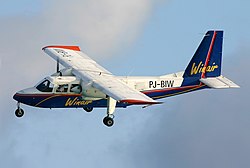
Pacific Aerospace/NZAero · 2004+
Pacific Aerospace P-750 XSTOL (PAC 750XL)
 i
iSpecifications
Performance
Cruise
167KTAS
Range
1,179nm
Climb
1067fpm
Ceiling
20,000ft
Fuel Burn
57.0gph
Fuel Cap.
332gal
MPG
3.4mpg
Stall (Vs0)
58KIAS
T/O roll
721ft
Ldg roll
543ft
Size & weight
Seats
10
Useful Load
4,428lbs
Full-fuel payload
2,205lbs
Max gross
7,500lbs
Wingspan
42.2ft
Length
36.6ft
Engine
Engine
Pratt & Whitney Canada PT6A-34
Power
750hp
TBO
4,000hrs
Overhaul
$387k
Hot section
$65keach
Owning it
Hull insurance
$22k/yr
Parts
fair
Mechanics
specialist
Gear
Fixed
IFR
Yes
Category
certified
Full specification
V-speeds
Airframe
- Empty weight
- 3,072 lbs
- Max fuel weight
- 2,223 lbs
- Height
- 12.8 ft
- Wing position
- high
Paperwork
- Type certificate
- A50CE
- Certification basis
- FAR Part 23 Normal / Utility
These figures are typical for the model, not a specification for any individual aircraft. Real-world numbers vary with year, installed equipment, weight, modifications and engine condition — often by more than you would expect. Use them to compare types, and confirm anything you would act on against the Pilot's Operating Handbook for that specific airframe and a prebuy inspection.
Pricing
Typical
$1.4M
Range
$900k – $1.9M
Annual all-in
~$143k/yr
All-in at ~100 flying hours a year, using the midpoint of each range — the same figures broken out under “Cost to own” below. Your number will differ, and mostly for two reasons. Experience sets your insurance: a 2,000-hour pilot with recent training pays 30–40% less than a 200-hour owner, and student owners pay 20–40% more — on the same aircraft that is often a doubling. Location sets your hangar: a T-hangar runs $200–400 a month in the Midwest against $400–1,500 in a coastal metro, and an outside tie-down is less again. Engine reserves move too — a local shop reusing your serviceable cylinders can come in 30–50% under the national specialty-shop pricing we quote, though you trade the warranty and turnaround that comes with it. Reserves are money set aside toward a future overhaul, not a bill this year, and the annual inspection figure is the shop’s labor to look — whatever they find is separate.
Cost to own — estimate
Set your yearly hours and local fuel price. Fixed costs (insurance, hangar, annual inspection) don't change with hours; fuel, maintenance and the engine reserve do.
- Fuel (57 gph)
- $34,200
- Engine reserve
- $9,675
- Propeller reserve
- $1,250
- Maintenance, parts & wear items ($160/hr)
- $16,000
- Hot section reserve
- $3,250
- Insurance
- $28,000–$63,000
- Hangar
- $9,267–$23,168
- Annual inspection (labor only)
- $12,000
- Databases & subscriptions
- $2,000
- Total per year
- $140,092
- Per flight hour
- $1,401
- Miles flown / year (at cruise)
- 19,218 mi
- Cost per mile
- $7.29/mi
- Time in the air
- 1 hr 48 min
- Fuel burned
- 102 gal
- Out of pocket
- $1,156
Fuel, engine reserve and wear only. Insurance, hangar and the annual are already paid whether you make the trip or not, so they are not charged here.
Estimate, not a quote. Where a line shows a range, the total, per-hour and per-mile figures use its midpoint— insurance moves most with your experience and time in type, hangar with where you base the aircraft, so your own number could sit at either end. Annual inspection is the shop's labor to open and inspect — what they find is the maintenance line, which covers oil changes, plugs, tires, brakes, hoses, lights, a battery and vacuum pump amortised over their life, and the unscheduled squawks that are the largest and least predictable part of it. Reserves are sinking funds toward an overhaul, not a bill you pay this year — and note that a propeller is due on hours or calendar time, typically six years, so flying less does not put it off forever.
Strengths
- Unmatched STOL capability and useful load for backcountry cargo delivery
- Proven turboprop reliability (PT6A-34) with universal maintenance support
- Purpose-built for high-utilization missions (skydive, survey, humanitarian ops)
- Current production and parts support restored under NZAero ownership (post-2021)
Weaknesses
- Maintenance ecosystem concentrated at handful of U.S. service centers; longer parts pipeline from New Zealand than Caravan
- Slow cruise (167 KTAS) makes it uneconomical for cross-country or business travel
- Annual inspection costs $20k–$45k+ (higher for skydive duty); hot-section inspection $50k–$70k; engine overhaul $387k–$455k at 4,000-hour TBO
- High-cycle skydive veterans show accelerated wear on landing gear, brakes, tires, and jump door; hot-section inspections arrive early
Overview
The PAC 750XL (marketed as the P-750 XSTOL) is a single-engine turboprop utility aircraft designed and manufactured in Hamilton, New Zealand. First flown in 2001 and FAA-certified in 2004, the 750XL was conceived as a purpose-built skydive and utility platform that married the proven high-lift wing and PT6A powerplant of the PAC Cresco agricultural aircraft to a new, large-capacity fuselage and modified empennage. Pacific Aerospace advertised it as the world's first "Extremely STOL" (XSTOL) aircraft, capable of operating from strips under 800 ft at max gross weight.
Over 120 airframes had been built by January 2019. The type is globally recognized as one of the dominant skydive platforms, able to haul 17 jumpers (or six tandem teams) to 12,000 ft and return to land in roughly 10 minutes. Beyond skydive, 750XLs serve in cargo, passenger, geophysical survey, agricultural, humanitarian (NatureLink operates them under UN WFP contracts in Africa), and military liaison roles — Australia gifted two to the Papua New Guinea Defense Force in 2023.
Pacific Aerospace Ltd. entered liquidation in 2021 after its prior Chinese-New Zealand ownership left the company owing approximately NZ$42 million. In April 2021 the business and assets were acquired by NZSkydive Ltd (principals Neil Young and Dee Bond), who restarted production, re-obtained NZ CAA manufacturing and type certificates, and rebranded the company as NZAero on 1 November 2023. In August 2023 NZAero received a type certificate amendment for the 750XL-II "SuperPac", a 900 hp PT6A-140A-powered evolution.
The 750XL flies like a scaled-up Cessna 208 with better short-field manners and worse cruise. It is not a pilot's airplane in the sporting sense — it is an operator's airplane. See also Cessna 208 Caravan for the closest direct competitor.
The base type-certificated airplane carries only 2 fixed seats. The
10-occupant configuration this page's seats field stores (2 crew + up to
8 optional passenger seats) comes from two named, FAA-approved optional
modifications printed directly on the certificate (Gippsland or Aero Twin
passenger seat installations) — it is the certificated MAXIMUM, not the
standard airplane. A skydive- or cargo-configured 750XL may carry no
passenger seats at all.
Variants & History
| Variant | Years | Engine | HP | MTOW | Key Differences |
|---|---|---|---|---|---|
| 750XL (original) | 2004–2018 | PT6A-34 | 750 | 7,500 lb | Baseline XSTOL, 3-blade Hartzell |
| 750XL (current production) | 2021–present | PT6A-34 | 750 | 7,500 lb | Post-NZAero restart, minor avionics updates |
| 750XL-II "SuperPac" | 2023–present | PT6A-140A | 900 | 7,500 lb | 4-blade prop, better hot/high, higher cruise. NOT found on TCDS A50CE's current (Jan 2022) revision — see the certificate-correction note above. Treat this row as the manufacturer's own marketing claim, unconfirmed against a certificate in this pass. |
| F-25 Firecatcher | In development | PT6A-34 | 750 | — | Aerial firefighting variant |
Performance
Aviation Consumer flight-tested the airplane at 167 KTAS / 57 GPH at
10,000 ft — this is the sourced cruise/burn pair stored in frontmatter,
replacing the previously-stored 140 KTAS / 40 GPH, neither of which could be
traced to a document. The same test found an economy setting of about 150
kt / 45 GPH. Both of these tests were flown on a 2005-vintage,
early-serial airplane with the smaller (227 gal) fuel system — so while
the speed and burn numbers describe the PT6A-34/airframe combination
generally (and are stored), no independently-sourced range figure exists
for today's standard, extended-tank airplane; see the range note below and
the validator_exempt block in the frontmatter.
Climb is the 750XL's signature trick, but every fast number on record is a light-weight number. Aviation Consumer: "nearly 3000 FPM initially, with less than half fuel and two people aboard... with 11 skydivers loaded... the airplane still climbed at 2200 FPM initially... nine minutes to reach 13,500 feet for an average rate of 1500 FPM." DiverDriver: "Initial climb rates exceed 2000 ft/min with 700lbs of fuel and 14 jumpers." Neither source gives a gross-weight, standard-day climb rate directly comparable to the stored book figure of 1,067 fpm at MTOW, which is retained as an unconfirmed legacy figure rather than replaced with one of the lighter-weight numbers above (which would overstate climb at max gross).
Takeoff ground roll under 800 ft at MTOW is real, not marketing copy — skydive operators routinely fly from 2,000 ft strips fully loaded. Landing ground rolls of ~550 ft are likewise reproducible with reverse and aggressive braking. Pilots transitioning from pistons report the airplane flies heavy in pitch but is docile at the bottom of the envelope. These specific runway figures, like the climb figure above, are retained as unconfirmed legacy numbers — no independent AFM was obtained in this research pass.
V-speed corrections against the certificate: VNO was stored as 145 kt,
corrected to the certificate's own 140 KIAS. VA/VO was stored as 120 kt;
the certificate states a single combined "VO, VA" of 131 KIAS, now
stored. VFE is published at TWO flap settings — 130 KIAS at 20°, 120 KIAS at
40° (full) — and the more restrictive 120 KIAS is stored in the single
vfe_kias field. Vx/Vy were stored as 75/95 kt with no traceable source;
DiverDriver's operator account gives Vx 80 / Vy 90, now stored, with the
disagreement noted rather than silently resolved. Maximum LANDING weight
(7,125 lb) is 375 lb — 5% — below maximum takeoff weight (7,500 lb); the
schema has no separate field for this, but a buyer planning a max-weight
landing should know the two are not the same number.
Payload & Range
The 750XL is one of the rare aircraft that can actually fly full seats and full fuel — useful load of 4,428 lb vs. max fuel weight of ~2,223 lb (standard extended-tank configuration, corrected from a previously-stored, smaller-tank figure — see the fuel note above) leaves about 2,205 lb for cabin load even with brimmed tanks.
- Full fuel (331.8 gal usable, ~2,223 lb) + 2 crew: ~2,225 lb remaining for cargo — still over a ton, though endurance/range at this load is not independently documented for the extended-tank airplane (see the Performance Notes range caveat above; do not treat the previously-published "1,100+ nm" figure below as re-verified this pass).
- Full seats (9 pax + pilot at 200 lb each = 2,000 lb): Leaves ~2,400 lb for fuel — about 360 gallons of capacity — more than the airplane can carry. So you can simultaneously fill every seat and top the tanks with room to spare, a claim almost no other nine-seat turboprop can match.
- 17 skydivers (~3,400 lb) + minimal fuel: Standard skydive operation — climb to 12,000 ft, drop load, descend, land, repeat. Up to 17 cycles per hour have been reported in intensive operations.
- Agricultural / hopper load: Cresco-derived wing supports heavy hopper work from short, narrow farm strips — though the Cresco itself remains the purpose-built ag airplane.
The 750XL's payload-range envelope is the single strongest argument for the type over a Caravan: it gives up ~30 KTAS in cruise in exchange for meaningfully more useful load, better short-field performance, and the ability to operate where a Caravan cannot.
Sources:
- PAC P-750 XSTOL — Wikipedia
- NZAero — 750XL
- NZAero — Our History
- NZAero — Wikipedia
- Pacific Aerospace comeback under new owners — NZ Herald
- Pacific Aerospace goes into liquidation — FLYER
- PAC 750XL — Aviation Consumer
- PAC 750XL Skydiving Aircraft — DiverDriver
- planephd.com 750XL valuation
- FAA AD 2021-24084 — wing skin chafing
- FAA AD E8-2831 — 750XL
- PT6A-34 CT blade AD — AgAir Update
- Utility Aircraft Corporation — 750XL support
- Classic Fighters — SuperPac 750XL-II
- PAC Cresco — Wikipedia
Mission Suitability
- Backcountry / Bush (9): Purpose-built for unimproved strip operations. Only Cessna 208 Caravan on amphibs or a DHC-6 can match the load/strip combination, and neither beats it on raw STOL numbers. See Backcountry / Bush Flying. Marked down from 10 only because the airframe is large and doesn't have the intimate "land on a sandbar" character of a Cub or Husky — it needs at least a pickup-truck-sized clearing.
- Cargo Hauling (10): 4,428 lb useful load, cavernous fuselage, large rear cargo door, and the ability to deliver it to places other turboprops cannot. This is the airplane's highest and best use. See Cargo Hauling.
- Surveying (9): Slow, stable, long-endurance, and has belly/hardpoint provisions for geophysical survey sensors (mag booms, LiDAR, gravimeters). A meaningful fleet flies survey full-time.
- Cross-Country (6): Turboprop reliability and long-legged fuel (331.8 gal usable on the standard extended-tank airplane) make it usable for distance work, but a flight-tested 167 KTAS cruise puts it well behind a Caravan, PC-12, or TBM on any pure point-to-point mission.
- Business Travel (5): Nine-passenger capacity with a turbine and IFR panel is viable for charter and corporate shuttle, but the cabin is utilitarian, noise is notable, and cruise is slow.
- Local Fun Flying (3): Too much airplane, too expensive to feed, and not a stick-and-rudder machine — you fly it for a job.
- Flight Training (2): Only relevant as a type-specific checkout for operators. Not a primary trainer.
- Aerobatics (1): Normal/Utility category only. Not aerobatic.
Avionics Ecosystem
Factory panels have evolved considerably over the production run:
- Early 2004–2010 airframes: Typically Garmin GNS 430/530 stacks with a KFC 150 or S-TEC 55X autopilot, conventional round-gauge steam panels. Many early skydive-optimized aircraft were delivered with minimal avionics — just enough to be IFR legal.
- 2010–2019: Garmin G600 or dual GTN 650/750 upgrades became common. Some customers specified Avidyne panels.
- 2021–present (post-restart): Garmin G600 TXi or G500 TXi with GTN 750Xi navigators is the standard offering. S-TEC 3100 autopilot integration is common.
- 750XL-II SuperPac: Delivered with full Garmin G600 TXi glass as standard.
Aftermarket avionics upgrades are straightforward because the type uses standard Part 23 certified boxes — no airframe-specific unobtanium.
STCs & Modifications
The 750XL modification ecosystem is small compared with Cessna/Piper fleets, but notable items include:
- Cargo pod / belly pod — factory option, adds ~20 cu ft
- Jump door modification — nearly universal on skydive-configured aircraft; factory offering
- Skydive interior kits — benches for 17 jumpers
- Geophysical survey hardpoints — mag booms, stinger tails
- Four-blade prop conversions — noise reduction and small climb improvement
- Oxygen systems — operators routinely fly to 18,000–20,000 ft
- SuperPac PT6A-140A engine upgrade path — limited to new-build airframes under the amended TC; not a straightforward retrofit for existing 750XLs
Maintenance & Support
See Maintenance Ecosystem. Support is the 750XL's single biggest ownership risk relative to a Caravan.
- Parts availability: Fair. NZAero has restored OEM production and parts support post-2021, but pipeline times from New Zealand are longer than Textron Caravan support out of Wichita. Operators in North America often keep a local spares cache.
- Mechanic familiarity: Specialist. PT6A-34 expertise is universal (any turbine shop can handle the engine), but airframe-specific knowledge is concentrated at a handful of service centers — Utility Aircraft Corporation in California has historically been the primary U.S. support hub.
- Annual / 100-hour costs: $20,000–$45,000 depending on utilization and mission; skydive operators run materially higher
- Hot section inspection (HSI): ~$50,000–$70,000 typical; required on condition / by P&WC recommended interval
- Engine overhaul (PT6A-34): $387,000–$455,000 per engine at TBO (4,000 hours — corrected from a previously-stored 3,600, see reference/engine-overhaul-pricing.md and the DiverDriver source) or on-condition
- Expensive items: Jump door hinges and seals, landing gear leg attach structure, flap tracks, Hartzell prop overhaul, and the NZ-sourced airframe skin panels
- Fuel burn: 45–57 GPH Jet-A typical cruise (Aviation Consumer flight-test range, economy to high-speed settings); 55+ GPH in climb
Valuation Factors
Pricing is heavily a function of cycles, engine time, and configuration. See Aircraft Valuation Methodology.
- New / factory build (NZAero): USD $1.75M–$1.9M depending on configuration
- Low-time / well-equipped used (2015–2020): $1.3M–$1.7M
- High-cycle skydive veteran (2004–2012): $900K–$1.2M
- Engine status premium: Mid-time PT6A-34 on condition is worth $150K–$250K relative to a run-out; a freshly overhauled engine is a major value driver
- Avionics premium: Modern Garmin TXi glass adds $75K–$125K vs. a legacy round-gauge panel
- Cargo pod / jump door: Normally treated as neutral because buyer and seller are likely in the same mission segment
- Paint / interior: Minor relative to engine and airframe condition — these are working airplanes
Post-2021 restart airframes command a premium because they carry current NZAero support relationships; the 750XL-II SuperPac is a distinctly different market segment from the original 750XL.
ADs & Common Problems
Active and historically significant ADs and issues include:
- FAA AD 2021-22-08 — Wing skin chafing from fuel-system finger filters on serial numbers 100–205, 207–213, and 8001. Requires inspection and corrective action.
- FAA AD 2008-03-xx — Early 750XL AD addressing control system / fastener issues.
- NZ CAA DCA/750XL/3A series — Various directives from the New Zealand authority covering flap tracks, elevator trim, and fuel system items.
- PT6A-34 compressor turbine blade AD (2022) — FAA AD covering PT6A-34/-34B/-34AG/-114/-114A blades after several reports of low-time CT blade fractures. Affects all PT6A-34-powered types, not just the 750XL.
- Operator wear items: High-cycle skydive fleets see accelerated wear on brakes, tires, landing gear attach structure, and the jump door. Hot-section inspections hit sooner on jump operators due to the brutal climb-descend-climb duty cycle.
- Pre-buy red flags: Verify compliance with all wing-skin and fuel-finger-filter ADs; inspect landing gear box carefully on skydive veterans; confirm engine cycles (not just hours) and hot-section status.
Insurance Profile
See GA Insurance Underwriting. The 750XL sits in the turbine-single utility category, which is materially more expensive than piston singles but cheaper than jets or pressurized turbines.
- Hull rate: Approximately 1.5–2.0% of hull value annually for experienced turbine-single pilots in utility operations
- Typical hull premium: $18,000–$28,000/year on a $1.3M hull
- Liability: $2,500–$5,000/year for typical commercial utility policies; skydive operators pay significantly more
- Underwriting quirks:
- Insurers require PT6A / turbine-single time; pure piston transitions face high premiums or an instructor-mentor requirement
- Skydive operations are a separate, much harder market — expect carrier attrition and purpose-built policies
- The New Zealand type certificate and post-liquidation parts supply concerns have occasionally tightened underwriting
- Commercial operator checkrides and recurrent training (FlightSafety or operator-run) are typically required
For sale (0)
No listings for this model right now.
For sale elsewhere (1)
Current ads on Barnstormers, checked daily. Photos, full details and the seller are on the listing site.
2004 Pacific Aerospace P-750 XSTOL (PAC 750XL)
Listed on BarnstormersAlso worth looking at
What buyers usually weigh against the Pacific Aerospace P-750 XSTOL (PAC 750XL) — aircraft flown for the same kind of mission.