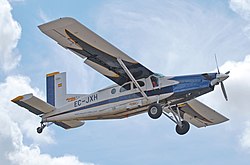
Cessna · 1986–2013
Cessna 208B Grand Caravan

Specifications
Performance
Cruise
Not verified
Range
Not verified
Climb
—fpm
Ceiling
25,000ft
Fuel Burn
Not verified
Fuel Cap.
332gal
MPG
—mpg
Stall (Vs0)
—KIAS
T/O roll
—ft
Ldg roll
—ft
Size & weight
Seats
11
Useful Load
Not verified
Full-fuel payload
—lbs
Max gross
8,750lbs
Wingspan
—ft
Length
—ft
Engine
Engine
Pratt & Whitney Canada PT6A-114A
Power
675hp
TBO
3,600hrs
Overhaul
$382k
Hot section
$65keach
Owning it
Hull insurance
—/yr
Parts
excellent
Mechanics
common
Gear
Fixed
IFR
Yes
Category
certified
Full specification
V-speeds
Airframe
- Max fuel weight
- 2,224 lbs
- Wing position
- high
Paperwork
- Type certificate
- A37CE
- Certification basis
- Part 23
These figures are typical for the model, not a specification for any individual aircraft. Real-world numbers vary with year, installed equipment, weight, modifications and engine condition — often by more than you would expect. Use them to compare types, and confirm anything you would act on against the Pilot's Operating Handbook for that specific airframe and a prebuy inspection.
Pricing
Typical
Price unavailable
Range
No recent market listings found for this model
Annual all-in
~$84k/yr
All-in at ~100 flying hours a year, using the midpoint of each range — the same figures broken out under “Cost to own” below. Your number will differ, and mostly for two reasons. Experience sets your insurance: a 2,000-hour pilot with recent training pays 30–40% less than a 200-hour owner, and student owners pay 20–40% more — on the same aircraft that is often a doubling. Location sets your hangar: a T-hangar runs $200–400 a month in the Midwest against $400–1,500 in a coastal metro, and an outside tie-down is less again. Engine reserves move too — a local shop reusing your serviceable cylinders can come in 30–50% under the national specialty-shop pricing we quote, though you trade the warranty and turnaround that comes with it. Reserves are money set aside toward a future overhaul, not a bill this year, and the annual inspection figure is the shop’s labor to look — whatever they find is separate.
Cost to own — fixed costs only
No handbook figures for this airplane give a fuel burn or a cruise speed, so the fuel, per-hour and per-mile estimates cannot be computed. What follows is what ownership costs before you fly it — these do not change with hours.
Fuel, maintenance and the engine reserve are on top of this and rise with every hour flown — on a comparable airplane they typically exceed the fixed costs at around 100 hours a year. The page above says which document would supply the missing figures.
Strengths
- Proven single-engine turboprop with 24+ million fleet hours and 3,000+ aircraft delivered
- Excellent parts availability and P&WC engine support — best in turboprop aviation
- Huge payload and cargo flexibility — cargo door, flat floor, belly pod, single-pilot turbine operation
- Versatile mission platform — cargo hauling, medevac, bush strips, surveying, floatplane operations
Weaknesses
- Unpressurized cabin limits practical altitude and cross-country speed versus pressurized competitors
- High direct operating costs make private weekend flying uneconomical
- Engine overhaul and hot-section maintenance are expensive; hot-section history critical on salt-water aircraft
- Fixed gear and 52 ft wingspan limit tightest backcountry strips
Overview
The Cessna 208 Caravan is the definitive utility turboprop single. First flown December 9, 1982 and FAA-certified October 1984, it was conceived by Cessna Pawnee chief engineer John Berwick as a large-payload, single-engine high-wing hauler. FedEx was the launch customer for the windowless Cargomaster freighter, and the subsequent 4-foot-longer 208B Super Cargomaster (1986) became the basis for the 208B Grand Caravan passenger model (1990). By 2022 over 3,000 Caravans had been delivered and the fleet had logged more than 24 million flight hours.
The Caravan is the airplane you see hauling overnight freight out of every feeder airport in North America, dropping skydivers in Spain, flying medevac in Kenya, running floatplane sightseeing in Alaska and Vancouver, and operating 9- to 14-seat regional passenger service in Brazil, Indonesia, and the South Pacific. It is strutted, fixed-gear, unpressurized, and almost indestructible — a twin-row airstair door and a huge left-side cargo door allow pallet loading, and the underbelly cargo pod adds roughly 111 cubic feet of lockable baggage/freight volume. Typical mission: single pilot, 9 revenue pax, 1,000-pound cargo pod, 3+ hours of fuel, useful out of a 2,500-foot strip. FedEx Feeder remains the largest single operator; the Brazilian Air Force, Afghan Air Force, and numerous militaries operate armed C-208B variants. In 2023 Textron listed the 208 at US$2.32M and the 208B Grand Caravan EX at US$2.61M; 2026 list is around $2.8M+.
Variants & History
| Variant | Years | Engine | SHP | MTOW (lb) | Seats (certificated max) | Source | Key Differences |
|---|---|---|---|---|---|---|---|
| Model 208 (short-body "Cessna Caravan") | 1984–present | PT6A-114A | 675 | 8,000 | 11 (this cert basis); 10-14 marketed on current-basis production | TCDS A37CE Item I + Textron current spec page | Still in current production; 4 ft shorter fuselage than 208B; also sold as Caravan Amphibian on Wipline floats (8,750 lb gross under the float STC, not the base TCDS) |
| "208A" cargo configuration | 1984–~1986 (S/N 20800001-60) | PT6A-114 | 600 | lower weight, see TCDS NOTE 3 | 2 crew (cargo) | TCDS A37CE Item I, NOTE 3 | Not a separate certificate model — early-serial cargo configuration of Model 208, convertible to standard 208 via SK-208-12/85A |
| Model 208B "Grand Caravan" (this page) | 1986–2013 | PT6A-114A | 675 | 8,750 | 11 | TCDS A37CE Item II | The historical-majority Caravan; discontinued when the EX launched |
| Model 208B, Super Cargomaster | 1986–present | PT6A-114A / -140 | 675 / 867 | 8,750 / 8,807 | 2 crew | TCDS A37CE Items II/III | FedEx freighter configuration on the same 208B airframe/TCDS item, no cabin windows |
| Model 208B Grand Caravan EX | 2013–present | PT6A-140 | 867 | 8,807 | 11 (this cert basis); 10-14 marketed | TCDS A37CE Item III + Textron current spec page | Higher-thrust engine, faster climb, current production; NOT this page's subject |
| Soloy Pathfinder 21 | Aftermarket | PT6A-135 | 750 | 9,000 | — | Not a Textron product / not on this TCDS | Third-party stretched Caravan conversion |
Manufacturer-sourced figures for the two currently-produced models, for comparison (do not apply to this page's 208B — different engine and gross weight each):
- Short-body 208 (Textron current spec, 2026-09-12): 186 KTAS max cruise, 1,070 nm range, 1,234 fpm climb, 2,055 ft takeoff distance / 1,160 ft ground roll, 1,625 ft landing distance / 715 ft ground roll, 61 KCAS stall, 3,305 lb useful load, 4,730 lb basic empty weight.
- Grand Caravan EX (Textron current spec, 2026-09-12): 185 KTAS max cruise, 912 nm range, 3,532 lb useful load, 2,160 ft takeoff distance.
Performance
No performance figures are stored in this page's frontmatter — see
"Conflation & Scope" above. The certificate publishes weights, fuel capacity,
V-speed limits and certification basis only; it has never published a cruise
speed, burn rate, climb rate or runway distance for any model on A37CE. The
legacy 675-SHP 208B's Pilot's Operating Handbook is on file at Cessna P/N
D1329-23-13PH (TCDS NOTE 2) but could not be retrieved this session — see
the empty_weight_lbs exemption for the search log. A supervising session
with web search or a direct handbook purchase could close this gap; until
then, treat any cruise/range/burn figure quoted for "the Grand Caravan"
elsewhere as describing either the short-body 208 or the EX, not this
airplane.
Payload & Range
Not populated this session — empty_weight_lbs and the performance
fields this table depends on are unsourced for this specific block (see
validator_exempt). Do not infer a payload table from the short-body 208's
or the EX's manufacturer figures in the Variants table above; both describe
different airframes at different gross weights.
Compare with Pilatus PC-12 (pressurized, faster, longer range, higher acquisition cost) and Daher Kodiak 100 (direct Part 23 utility competitor).
Mission Suitability
Cargo Hauling (10/10): Huge cargo door, flat floor, belly pod option, single-pilot turbine operation, Part 135 ubiquity. The Super Cargomaster configuration (2 PCLM, no cabin windows) sits on this same TCDS item.
Business Travel (8/10): Turbine reliability and a real cabin, at materially lower cost than the current-production EX. Unpressurized and slower than a Pilatus PC-12 on longer legs.
Cross-Country (7/10): Good range for the mission, turbine reliability, autopilot-equipped in most avionics refits. Unpressurized cabin caps practical cruise altitude without masks.
Backcountry / Bush (7/10): Fixed gear, big tires available, proven on gravel and dirt worldwide. 52 ft wingspan is wide for the tightest strips.
Surveying (8/10): Stable platform, cabin volume for sensors and crew, endurance.
Flight Training (3/10): Only as a type-transition platform; operating costs rule out primary instruction.
Local Fun Flying (2/10): Direct operating costs make weekend flying uneconomical for a private owner.
Aerobatics (1/10): Utility category, not aerobatic.
Avionics Ecosystem
Legacy 208B production (1986-2013) shipped with a mix of Bendix/King round-dial panels through the run, with G1000 becoming available on later production (2008-and-later per the certificate's ELOS notes referencing the Garmin G1000 Integrated Cockpit System). Most in active commercial service have been upgraded or trade at a discount if not.
Common panel upgrade paths:
- Garmin GTN 750 + G500 TXi + GFC 600: commonly quoted in the $150K-$250K installed range for a full retrofit; not independently priced this session.
- FIKI TKS: CAV Aerospace weeping-wing STC, an alternative to factory boots on legacy airframes.
See Avionics Pricing Reference.
STCs & Modifications
Confirmed to exist via scripts/drs.ts search-stc this session (per runbook
rule 32 — a TCDS never lists an STC, so absence from A37CE is not evidence
against any of these):
- Wipline 8750 Amphibious/Seaplane floats — SA1311GL, "Installation of Wipaire Model 8000 Amphibian/Seaplane floats or Wipaire Model 8750 Amphibian/Seaplane floats" — the float STC that raises the short-body 208's gross weight to 8,750 lb on floats.
- Texas Turbine Supervan 900 conversion — SA02291AK, "Installation of Honeywell TPE331-12JR turbine engine and Hartzell HC-B4TN-5QL... propeller" — a different engine CLASS from this page's PT6A-114A and would force its own page under this catalogue's Step 1 hard-split rule (different engine class) if ever catalogued separately.
- Cargo-door, cargo-net, seat and avionics STCs (multiple, e.g. SA02125AT-D, ST00026AT) exist and are common on both cargo and passenger 208/208B airframes.
Not independently re-confirmed this session: the widely-cited "Blackhawk
XP42A" PT6A-42A engine upgrade. A search-stc "Blackhawk" query returned no
matching STC this session (the holder name may not appear in DRS's indexed
description text); left in the prior page's general aviation knowledge as
common trade press but not verified against a primary FAA record here.
Maintenance & Support
- Parts availability: excellent — Textron actively supports the type and PT6A parts availability through P&WC is the best in turboprop aviation.
- Mechanic familiarity: common at any field seeing turbine traffic for airframe work; engine work requires a P&WC-authorized service center.
- Overhaul: $382,000 per engine (
reference/engine-overhaul-pricing.md, P&WCSMART 2026 flat-rate program), TBO 3,600 hr (unverified this session, seevalidator_exempt). - Hot section: ~$65,000 at ~1,800 hr (unverified this session, same caveat).
See Maintenance Ecosystem.
Valuation Factors
- Engine time: PT6A-114A TBO is 3,600 hours with a recommended hot section at 1,800 hours. Hot section: $80K–$130K. Full overhaul at a P&WC-authorized facility: $550K–$750K. Engine time dominates used Caravan pricing — a mid-time 208B is worth $500K–$800K more than an engine-run-out example at the same airframe hours.
- Avionics: G1000 (2008+) adds $200K–$400K vs a legacy steam-panel airframe of the same vintage.
- FIKI: Factory boots or CAV TKS adds $100K–$150K.
- Cargo pod: Adds $40K–$70K; most utility operators want it.
- Blackhawk or Supervan conversion: Adds most of its install cost back for the first several thousand hours.
- Float provisions / amphib kit: Wipline-equipped aircraft command $400K+ premium but have a smaller buyer pool.
Price tiers (2026):
- Legacy 1985–1999 208 / 208B: $900K–$1.5M depending on engine time, avionics, and logs.
- 2000–2007 pre-G1000 208B Grand Caravan: $1.3M–$1.9M.
- 2008–2013 G1000 Grand Caravan: $1.6M–$2.3M.
- 2013+ 208B Grand Caravan EX (PT6A-140): $2.2M–$3.2M used; $2.8M+ new from Textron.
- Super Cargomaster FedEx retirements: $800K–$1.2M windowless freighters, often bought for re-windowing and conversion.
See Aircraft Valuation Methodology.
ADs & Common Problems
- AD 2006-06-06 / recurring wing-strut inspection: repetitive inspection of wing lift struts and forked end fittings for corrosion and cracking.
- Flap AD 2020-18-01: flap actuator and track inspections after asymmetric flap events.
- Icing limitations: the Caravan is FIKI-approved on applicable airframes but operates under FAA-mandated speed/flap limitations in icing following fatal accidents; tailplane stall in icing has occurred.
- PT6A hot-section findings: compressor turbine blade sulfidation on maritime/salt operations; inspect hot-section history closely on amphibian and coastal-operated aircraft.
- Fuel-system water contamination: multiple ADs over the years.
Pre-buy red flags: unknown hot-section history, salt-water float operations without corrosion inspection, missing or lapsed wing-strut inspections, incomplete Textron service-bulletin compliance.
Insurance Profile
Turbine single, single-pilot Part 135 workhorse — a well-understood risk for underwriters but type-specific. Hull values of $1.5M–$3M drive premiums.
- Hull rates: Roughly 1.0–1.5% of hull value annually for experienced 135 operators, 1.5–2.5% for owner-flown Part 91 with lower-time pilots.
- Liability: $1M smooth is standard; $5M+ available for commercial operators with underwriter approval.
- Typical annual premium: $18K–$35K for a Part 91 owner-flown Grand Caravan EX at $2.5M hull; $25K–$60K for Part 135 cargo operators.
- Underwriting requirements: Type-specific initial training at FlightSafety (Wichita) or SimCom is effectively mandatory. Annual recurrent is typically required. Most underwriters demand 1,000+ TT and 250+ multi/turbine before solo in type; some require a mentor pilot for the first 25–50 hours. ATP is preferred, commercial minimum.
- Icing history: Underwriters scrutinize icing training and operating environment closely.
See GA Insurance Underwriting.
For sale (0)
No listings for this model right now.
Also worth looking at
What buyers usually weigh against the Cessna 208B Grand Caravan — aircraft flown for the same kind of mission.