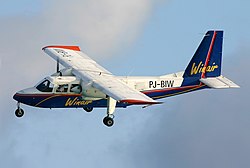
Pilatus · 1959–2022
Pilatus PC-6 Porter / Turbo-Porter
 i
iSpecifications
Performance
Cruise
115KTAS
Range
500nm
Climb
940fpm
Ceiling
25,000ft
Fuel Burn
38.0gph
Fuel Cap.
170gal
MPG
3.5mpg
Stall (Vs0)
52KIAS
T/O roll
645ft
Ldg roll
417ft
Size & weight
Seats
11
Useful Load
3,373lbs
Full-fuel payload
2,234lbs
Max gross
6,173lbs
Wingspan
49.7ft
Length
36ft
Engine
Engine
Pratt & Whitney Canada PT6A-27 (derated to 550 shp)
Power
550hp
TBO
3,600hrs
Overhaul
$372k
Hot section
$65keach
Owning it
Hull insurance
$17k/yr
Parts
good
Mechanics
specialist
Gear
Fixed
IFR
Yes
Category
certified
Full specification
V-speeds
Airframe
- Empty weight
- 2,800 lbs
- Max fuel weight
- 1,139 lbs
- Height
- 10.5 ft
- Wing position
- high
Obstacle performance
- Takeoff over 50 ft
- 1,444 ft
- Landing over 50 ft
- 1,030 ft
Paperwork
- Type certificate
- 7A15
- Certification basis
- CAR 3 / CAR 10
These figures are typical for the model, not a specification for any individual aircraft. Real-world numbers vary with year, installed equipment, weight, modifications and engine condition — often by more than you would expect. Use them to compare types, and confirm anything you would act on against the Pilot's Operating Handbook for that specific airframe and a prebuy inspection.
Pricing
Typical
$1.3M
Range
$750k – $2.1M
Annual all-in
~$131k/yr
All-in at ~100 flying hours a year, using the midpoint of each range — the same figures broken out under “Cost to own” below. Your number will differ, and mostly for two reasons. Experience sets your insurance: a 2,000-hour pilot with recent training pays 30–40% less than a 200-hour owner, and student owners pay 20–40% more — on the same aircraft that is often a doubling. Location sets your hangar: a T-hangar runs $200–400 a month in the Midwest against $400–1,500 in a coastal metro, and an outside tie-down is less again. Engine reserves move too — a local shop reusing your serviceable cylinders can come in 30–50% under the national specialty-shop pricing we quote, though you trade the warranty and turnaround that comes with it. Reserves are money set aside toward a future overhaul, not a bill this year, and the annual inspection figure is the shop’s labor to look — whatever they find is separate.
Cost to own — estimate
Set your yearly hours and local fuel price. Fixed costs (insurance, hangar, annual inspection) don't change with hours; fuel, maintenance and the engine reserve do.
- Fuel (38 gph)
- $22,800
- Engine reserve
- $10,333
- Propeller reserve
- $1,250
- Maintenance, parts & wear items ($160/hr)
- $16,000
- Hot section reserve
- $3,611
- Insurance
- $26,000–$58,500
- Hangar
- $10,735–$26,838
- Annual inspection (labor only)
- $12,000
- Databases & subscriptions
- $2,000
- Total per year
- $129,031
- Per flight hour
- $1,290
- Miles flown / year (at cruise)
- 13,234 mi
- Cost per mile
- $9.75/mi
- Time in the air
- 2 hr 37 min
- Fuel burned
- 99 gal
- Out of pocket
- $1,409
Fuel, engine reserve and wear only. Insurance, hangar and the annual are already paid whether you make the trip or not, so they are not charged here.
Estimate, not a quote. Where a line shows a range, the total, per-hour and per-mile figures use its midpoint— insurance moves most with your experience and time in type, hangar with where you base the aircraft, so your own number could sit at either end. Annual inspection is the shop's labor to open and inspect — what they find is the maintenance line, which covers oil changes, plugs, tires, brakes, hoses, lights, a battery and vacuum pump amortised over their life, and the unscheduled squawks that are the largest and least predictable part of it. Reserves are sinking funds toward an overhaul, not a bill you pay this year — and note that a propeller is due on hours or calendar time, typically six years, so flying less does not put it off forever.
Strengths
- Unmatched STOL performance and backcountry capability among certified turbines
- Flat-rated PT6A-27 excels in thin air and high density altitude
- Rugged, simple airframe with excellent Pilatus support through 2040+
- Huge useful load (3,373 lb) and cargo versatility
Weaknesses
- Operating costs ($130k–$160k/year) and acquisition price limit to specialist operators
- Painfully slow for cross-country (115 ktas, 500 nm range); unpressurized and noisy
- PT6A hot section overhaul (~$55k at 1,800 hr) is frequent and expensive cost item
- Ex-skydive airframes accumulate high cycles quickly; cycle tracking and fatigue items critical
Overview
The Pilatus PC-6 Porter is a single-engine high-wing STOL utility aircraft built by Pilatus Aircraft in Stans, Switzerland. First flown in May 1959, the PC-6 was designed from the outset as a ruthless utility tool for Alpine operations — short and rough strips, high density altitudes, and heavy loads. Over 63 years of production, 604 aircraft were delivered before the line closed; the final airframe was delivered in December 2022 after Pilatus announced the end of production in 2017 and wound down the line through 2019.
The PC-6 enjoys a near-mythic reputation in the backcountry and parachute worlds. It is the airplane that routinely lands on glaciers in the Himalayas and the Alps, supplies remote jungle strips in Papua New Guinea and Ecuador, and hauls loads of skydivers to 14,000 ft faster than almost any dedicated jump ship. It set the world landing-altitude record on Dhaulagiri at 18,865 ft in 1960. About 40 percent of PC-6s in European service in the early 1990s were skydiving mounts, and that share has only grown as military and missionary operators retired airframes into the civilian used market.
It is not a cheap or a fast airplane. Compared with the Pilatus PC-12, the PC-6 trades pressurization, range, and speed for the ability to get into and out of places no other certified turbine can reach. Compared with the de Havilland Canada DHC-2 Beaver — its closest spiritual competitor — the Turbo-Porter offers more payload, higher service ceiling, better hot-and-high performance, and the reliability of a PT6 in exchange for a significantly higher acquisition and operating cost.
Variants & History
| Variant | Years | Engine | Power (shp/hp) | MTOW (lb) | Notes |
|---|---|---|---|---|---|
| PC-6 | 1959-1961 | Lycoming GSO-480-B1A6 piston | 340 hp | 4,850 | Original piston Porter, 72 built |
| PC-6/350 | 1961-1962 | Lycoming IGO-540 piston | 350 hp | 4,850 | Interim piston variant, rare |
| PC-6/A Turbo-Porter | 1961-1964 | Turbomeca Astazou II | 523 shp | 4,850 | First turbine Porter; French engine |
| PC-6/B Turbo-Porter | 1964-1970 | P&WC PT6A-6A / PT6A-20 | 550 shp | 4,850 | First PT6-powered Porter |
| PC-6/B1-H2 | 1970-1975 | P&WC PT6A-20 | 550 shp | 6,173 | Increased gross weight |
| PC-6/B2-H2 | 1975-1990s | P&WC PT6A-27 | 680 shp derated 550 | 6,173 | Long production run |
| PC-6/B2-H4 | 1996-2022 | P&WC PT6A-27 | 680 shp derated 550 | 6,173 | Final production variant, strengthened airframe, wing hardpoints |
| PC-6/C Turbo-Porter | 1965-1968 | Garrett TPE331 | 575 shp | 4,850 | Rare Garrett-powered variant |
| AU-23A Peacemaker | 1970s | PT6A-27 | 550 shp | 6,100 | Fairchild-built US military variant, armed COIN |
Fairchild Hiller built roughly 90 PC-6s under license in Hagerstown, Maryland in the late 1960s and early 1970s, including the AU-23A Peacemaker armed variant for the US Air Force and friendly foreign air forces.
Performance
Book cruise of 115 ktas is honest, and most operators plan 110 ktas at 38 gph burn. The PC-6 is not aerodynamically clean — fixed gear, big slotted flaps, struts, and a square-ish fuselage all dump drag — so pushing it harder just burns more fuel without meaningful speed gains. Typical block speed on a 200 nm leg is 100-105 kt after climb and descent.
Where the Porter earns its keep is density altitude. The PT6A-27 holds its 550 shp flat rating well above 10,000 ft density altitude, and the big 2.56 m prop converts it into thrust at low forward speeds. Published takeoff ground roll of 645 ft at sea level MTOW routinely shrinks to under 400 ft with a light load and a touch of headwind. Landing ground roll of 417 ft is conservative; experienced Porter pilots regularly stop in under 300 ft using reverse beta. Over-a-50-ft-obstacle numbers (1,444 ft takeoff, 1,030 ft landing) are a big multiplier — the Porter is an incredible get-in airplane, slightly less incredible get-out airplane when obstacles exist.
Climb performance is 940 fpm at MTOW but jump operators routinely see 1,500+ fpm light, which is how the Porter earns its reputation as one of the fastest-to-altitude jump ships. Service ceiling of 25,000 ft is academic without oxygen, but it means the Porter climbs strongly all the way to jump altitudes.
The Porter is a draggy airframe and glide ratio is mediocre — best glide around 75 KIAS gives roughly 9:1, so engine-out planning is closer to a Cessna 185 than a PC-12. Low-speed handling is superb with huge elevator authority and very forgiving stall characteristics.
Payload & Range
Useful load is 3,373 lb, fuel capacity is 166 gal (1,113 lb of Jet-A). The Porter never runs out of useful load before it runs out of range:
- Max internal fuel (166 gal / 1,113 lb): Leaves 2,260 lb for pax and cargo — roughly 11 adults with light bags, or 2,000 lb of freight. Range ~500 nm with reserves.
- Typical jump load (60 gal / 400 lb): Leaves 2,973 lb for 14-16 skydivers and gear. Endurance ~90 min, plenty for a full day of jump sorties with quick refuels.
- Bush / cargo mission (100 gal / 670 lb): Leaves ~2,700 lb of payload with 3.5 hr endurance and ~350 nm range — realistic for a full-load cargo delivery into a backcountry strip.
- Ferry configuration with external tanks (166 gal internal + 116 gal external): Full tanks still leave ~1,400 lb for pilot and gear, and range stretches to 870+ nm — adequate for intercontinental ferry legs with planning.
The airplane is almost unique in certified single-engine turbines in that the pilot essentially never has to choose between people and fuel on typical missions. That, more than any speed or cruise number, is why operators who need a Porter will pay Porter money for one.
Mission Suitability
Backcountry (10/10): The definitive turbine backcountry aircraft. Nothing certified matches its combination of STOL performance, payload, and hot-and-high capability. See Backcountry / Bush Flying. Only the de Havilland Canada DHC-2 Beaver comes close, and the Beaver gives up 5,000 ft of service ceiling and 1,500 lb of useful load.
Cargo Hauling (9/10): 3,373 lb useful load, a large cargo door, flat floor, and the ability to deliver into unimproved strips makes it a premier utility hauler. See Cargo Hauling. Loses a point only because max internal cargo volume is smaller than a Caravan or Kodiak.
Surveying (9/10): Stable low-speed platform, huge observation windows available, belly camera ports factory-supported, slow loiter speeds, high endurance, and turbine reliability. Popular for aerial photo, pipeline patrol, and geophysical survey work.
Cross-Country (4/10): 115 kt cruise is painfully slow for long legs, unpressurized, 500 nm range with reserves, and the cabin is noisy. Fine for 200 nm hops, poor for regional travel.
Business Travel (3/10): Too slow, too loud, and too expensive to operate for anything but niche missions into places a Pilatus PC-12 cannot reach.
Local Fun Flying (4/10): Dream airplane to fly for fans of big utility turbines, but acquisition and operating costs put it out of private fun-flying territory for almost everyone.
Flight Training (2/10): Complex turbine single, expensive to operate, usually seen only in type-specific transition training.
Aerobatics (1/10): Not certified or suitable.
Avionics Ecosystem
Early Turbo-Porters came with round-gauge panels: KX-155 nav/comms, KT-76 transponders, KMA-24 audio, ADF and often a KLN-90B GPS. Military and missionary operators often kept minimal panels their entire service lives.
PC-6/B2-H4 airframes from 2000 onward were typically delivered with Bendix/King KFC-225 autopilots, dual Garmin GNS 430W/530W navigators, and Avidyne or Sandel EHSIs. The last production airframes (2010-2022) were optioned with Garmin G600 TXi or full Garmin integrated panels, GTN 750Xi, and GFC 600 autopilots. Synthetic vision and TAWS-B are near-universal on late-build airframes.
Retrofit market is active. Typical Garmin glass upgrades run $80,000-$160,000 installed. ADS-B Out is mandatory in most operating jurisdictions and is already installed on most flying Porters. See Avionics Pricing Reference.
STCs & Modifications
- Tundra tires / Alaskan Bushwheels: Common on bush-operated Porters. 29 to 35-inch mains, around $18,000-$30,000 installed. Minimal cruise penalty, significant rough-field capability.
- Skis (wheel-skis and straight skis): Landis, Aerocet, and Fluidyne fit PC-6 mounts. Common on glacier operators.
- Amphibious floats: Wipaire and Aerocet have built PC-6 floatplane versions. Rare; significantly reduces payload.
- Long-range tanks / external drop tanks: Factory wing hardpoints on /B2-H4 support 220 L (58 gal) external tanks, extending range from 500 nm to 870+ nm.
- Jump door / roll-up door: Skydive-configured Porters use a roll-up or removable door for jump operations.
- Camera ports and survey windows: Factory-supported belly hatches for aerial photography.
- Cargo pod: Belly cargo pod adds 200-300 lb of additional volume for light bulky loads.
- Hartzell composite prop upgrade: Replacement for original metal prop, improves climb and reduces noise; around $55,000 installed.
Maintenance & Support
Pilatus continues to support the PC-6 from Stans, with authorized service centers in the US, Europe, Africa, Asia, and Australia. Parts availability is good but not cheap — everything has "Pilatus" prices, and small airframe items can be multiples of a Caravan equivalent. A&P familiarity is specialist: not every shop will touch a Porter, and PT6 work (engine) is separate from airframe work. See Maintenance Ecosystem.
Typical annual direct operating costs (private use, 250 hr/year):
- Fuel (Jet-A, 38 gph, $6/gal): ~$57,000
- Engine reserves (PT6A-27, $325,000 overhaul at 3,600 hr TBO): ~$22,500
- Hot section reserves (~$55,000 at 1,800 hr): ~$7,600
- Annual inspection and routine maintenance: $15,000-$25,000
- Hangar, insurance, database subs, misc: $15,000-$25,000
- Total: $130,000-$160,000/year
Expensive items to watch: hot section (~$55,000), prop overhaul (~$22,000), wing strut inspection and AD compliance, landing gear overhaul, autopilot servos on Bendix/King installations.
Parts from Pilatus are strong through at least 2040 per factory commitment; PT6A-27 support from P&WC is effectively permanent given how many are in service across other applications.
Valuation Factors
The PC-6 market is thin and driven by operator needs. Typical 2026 asking prices:
- Mid-time /B2-H2, 1970s-1980s airframe, steam gauges, ex-military or ex-missionary: $750,000-$1,000,000
- /B2-H2 with recent hot section, decent panel, civilian history: $1,000,000-$1,400,000
- /B2-H4, 1996-2010, mid-time engine, G500/GTN panel: $1,300,000-$1,800,000
- Late /B2-H4, 2010-2019, low-time, full Garmin glass: $1,800,000-$2,100,000+
Major value drivers: time since hot section and time since overhaul on the PT6A-27 are the biggest single factor (a fresh overhaul adds $200,000-$300,000 over a mid-time engine). Cycle count matters more than hours for ex-skydive airframes. Glass panels add $50,000-$120,000 over steam gauges. Tundra-tire and float capability add modest premiums. Factory external tank plumbing is a meaningful range/value plus. See Aircraft Valuation Methodology.
Because production has ended and Pilatus has indicated no successor, late-build /B2-H4 airframes are holding value unusually well — there is no direct replacement for a brand-new Porter on the market, and the Kodiak 100 / Caravan are larger, heavier, and less STOL-capable.
ADs & Common Problems
Pilatus continues to support the PC-6 fleet from Stans and publishes ongoing service bulletins. EASA and FAA ADs are routine but not crushing:
- EASA AD 2025-0281 (Dec 2025): Life limit added to the control column pitch trim relay following reports of possible loss of structural integrity. Adopted by FAA in April 2026.
- Recurring wing strut inspections: PC-6 wing struts are an inspection item; corrosion and fitting cracks have been found on older military-surplus airframes.
- Aileron hinge wear: Recurring inspection item, cheap to address if caught early.
- Flap track wear: High-cycle skydive airframes wear flap tracks; overhaul is straightforward but not cheap.
- PT6A-27 hot section: 1,800 hr recommended hot section inspection, roughly $45,000-$70,000. Cycle-limited in skydive service, where a single day may be 40+ cycles.
- Airframe fatigue: Skydive Porters accumulate high cycles quickly, and airframe life-limited items (landing gear, wing attach) need close tracking on high-cycle ex-jump airframes.
Pre-buy red flags: ex-military airframes with poor logbook continuity; skydive airframes with undocumented cycle counts; corrosion on coastal or float-operated examples; uncertified overseas MROs on the engine logs.
Insurance Profile
PC-6 insurance is a commercial-turboprop conversation, not a private-single conversation. See GA Insurance Underwriting.
- Liability only, $1M CSL, qualified turbine-rated pilot, private use: $3,500-$5,500/year.
- Full hull + liability, $1M liability and $1.5M hull, private use: $12,000-$18,000/year.
- Commercial skydive operation, $1M liability and $1.5M hull: $25,000-$45,000/year, with mandatory annual recurrent training and strict cycle tracking.
- Commercial bush / Part 135 operations: Negotiated per-hull with specialty underwriters; often $40,000-$80,000/year per airframe.
Underwriting requirements typically include: ATP or commercial turbine time, 500+ hr turbine PIC, annual SimCom or FlightSafety recurrent training (PC-12 sim is often accepted as near-equivalent), and STOL / mountain training signoff for operators doing backcountry work.
For sale (0)
No listings for this model right now.
For sale elsewhere (1)
Current ads on Barnstormers, checked daily. Photos, full details and the seller are on the listing site.
2015 Pilatus PC-6 Porter / Turbo-Porter
Listed on BarnstormersADF · ADS-B In · ADS-B Out · Autopilot (unspecified)
View photos and full ad on Barnstormers ↗Also worth looking at
What buyers usually weigh against the Pilatus PC-6 Porter / Turbo-Porter — aircraft flown for the same kind of mission.