Cessna · 1980–1985
Cessna 172RG Cutlass
 i
iSpecifications
MOSAIC eligiblePerformance
Cruise
140KTAS
Range
714nm
Climb
800fpm
Ceiling
16,800ft
Fuel Burn
10.0gph
Fuel Cap.
62gal
MPG
16.1mpg
Stall (Vs0)
46KIAS
T/O roll
1060ft
Ldg roll
625ft
Size & weight
Seats
4
Useful Load
1,023lbs
Full-fuel payload
651lbs
Max gross
2,650lbs
Wingspan
35.8ft
Length
27.5ft
Engine
Engine
Lycoming O-360-F1A6
Power
180hp
TBO
2,000hrs
Overhaul
$45k
Owning it
Hull insurance
$2k/yr
Parts
good
Mechanics
common
Gear
Retractable
IFR
Yes
Category
certified
Full specification
V-speeds
Airframe
- Empty weight
- 1,627 lbs
- Max fuel weight
- 372 lbs
- Height
- 8.7 ft
- Wing position
- high
Obstacle performance
- Takeoff over 50 ft
- 1,775 ft
- Landing over 50 ft
- 1,340 ft
Paperwork
- Type certificate
- 3A17
- Certification basis
- CAR 3
These figures are typical for the model, not a specification for any individual aircraft. Real-world numbers vary with year, installed equipment, weight, modifications and engine condition — often by more than you would expect. Use them to compare types, and confirm anything you would act on against the Pilot's Operating Handbook for that specific airframe and a prebuy inspection.
Pricing
Typical
$120k
Range
$80k – $195k
Annual all-in
~$28k/yr
All-in at ~100 flying hours a year, using the midpoint of each range — the same figures broken out under “Cost to own” below. Your number will differ, and mostly for two reasons. Experience sets your insurance: a 2,000-hour pilot with recent training pays 30–40% less than a 200-hour owner, and student owners pay 20–40% more — on the same aircraft that is often a doubling. Location sets your hangar: a T-hangar runs $200–400 a month in the Midwest against $400–1,500 in a coastal metro, and an outside tie-down is less again. Engine reserves move too — a local shop reusing your serviceable cylinders can come in 30–50% under the national specialty-shop pricing we quote, though you trade the warranty and turnaround that comes with it. Reserves are money set aside toward a future overhaul, not a bill this year, and the annual inspection figure is the shop’s labor to look — whatever they find is separate.
Cost to own — estimate
Set your yearly hours and local fuel price. Fixed costs (insurance, hangar, annual inspection) don't change with hours; fuel, maintenance and the engine reserve do.
- Fuel (10 gph)
- $6,500
- Engine reserve
- $2,250
- Propeller reserve
- $175
- Maintenance, parts & wear items ($22/hr)
- $2,200
- Insurance
- $2,000–$4,000
- Hangar
- $5,907–$14,767
- Annual inspection (labor only)
- $2,500
- Databases & subscriptions
- $700
- Total per year
- $27,662
- Per flight hour
- $277
- Miles flown / year (at cruise)
- 16,111 mi
- Cost per mile
- $1.72/mi
- Time in the air
- 2 hr 09 min
- Fuel burned
- 21 gal
- Out of pocket
- $238
Fuel, engine reserve and wear only. Insurance, hangar and the annual are already paid whether you make the trip or not, so they are not charged here.
Estimate, not a quote. Where a line shows a range, the total, per-hour and per-mile figures use its midpoint— insurance moves most with your experience and time in type, hangar with where you base the aircraft, so your own number could sit at either end. Annual inspection is the shop's labor to open and inspect — what they find is the maintenance line, which covers oil changes, plugs, tires, brakes, hoses, lights, a battery and vacuum pump amortised over their life, and the unscheduled squawks that are the largest and least predictable part of it. Reserves are sinking funds toward an overhaul, not a bill you pay this year — and note that a propeller is due on hours or calendar time, typically six years, so flying less does not put it off forever.
See how every Cessna 172 / Skyhawkyear stacks up — engines, changes, and which to buy — in our year-by-year buyer's guide.
Strengths
- Affordable complex trainer with docile 172 handling
- Genuine cross-country capability: 140 KTAS, 700+ nm range
- Parts availability good; engine shared across O-360 family
- IFR capable with standard avionics fit
Weaknesses
- Electro-hydraulic gear system is maintenance-intensive and failure-prone
- High percentage of fleet has experienced at least one gear-up landing
- Gear-specific A&P expertise required; annual inspections run $2,500–$4,500
- Market value suppressed by reputation; slower than many fixed-gear alternatives
Overview
The Cessna 172RG Cutlass is the retractable-gear variant of the venerable Cessna 172, produced from 1980 to 1985. Cessna built approximately 1,191 Cutlass RGs during this period, introducing the model just as the general aviation market entered its steep 1980s decline. The 172RG was created primarily to serve as an affordable complex aircraft trainer — its retractable landing gear, constant-speed propeller, and 180 HP engine meet the FAA requirements for the complex aircraft endorsement needed for the Commercial Pilot certificate.
The Cutlass delivers roughly 15-18 knots of cruise speed improvement over a standard fixed-gear 172, thanks to the cleaner aerodynamics of retracted gear. It shares the same airframe DNA, docile handling, and high-wing visibility that made the 172 the most popular trainer in history, but adds meaningful systems complexity. Despite its training role, the 172RG is a capable cross-country machine with 62 gallons of fuel and over 700 nm of range. Its reputation, however, is complicated by a well-documented history of landing gear system failures.
Variants & History
| Variant | Years | Engine | HP | Gross Weight | Key Differences |
|---|---|---|---|---|---|
| 172RG | 1980-1981 | Lycoming O-360-F1A6 | 180 | 2,650 lbs | Original Cutlass RG, 28V electrical system |
| 172RG II | 1982-1985 | Lycoming O-360-F1A6 | 180 | 2,650 lbs | Preferred options package, improved interior trim |
All production years share the same engine, propeller, and gear system. Differences between years are limited to interior trim, avionics packages, and minor system refinements. The 172RG II designation reflects a marketing update, not an engineering change.
Performance
The 172RG cruises at 135-140 KTAS at 75% power, compared to 120-122 KTAS for a contemporary fixed-gear 172P. The 15-18 knot gain comes entirely from the retracted landing gear reducing parasite drag. Rate of climb at 800 fpm is modestly better than a fixed-gear 172 but nothing dramatic — the extra 20 HP is largely offset by the roughly 170 lbs of additional empty weight from the gear mechanism and hydraulic system.
Real-world pilots report that the book cruise numbers are achievable. Fuel burn runs 9.5-10.5 GPH at 75% power. Reducing to 65% power drops burn to about 8.5 GPH with cruise speeds around 128-130 KTAS, which represents the best efficiency point for cross-country work.
The 172RG handles almost identically to a standard 172, which is both its strength and its purpose. There are no surprises in the transition from fixed-gear to retractable except the gear and prop management procedures. Service ceiling of 16,800 feet is adequate for mountain crossing, though climb performance at altitude thins considerably at the 172RG's power loading.
Payload & Range
| Scenario | Fuel (gal) | Fuel Weight | Payload | Range (nm) | Endurance (hr) |
|---|---|---|---|---|---|
| Full fuel + 2 pax (170 lbs each) | 62 | 372 lbs | 340 lbs available for pax | 714 | 5.8 |
| Full fuel + 2 adults (200 lbs each) | 62 | 372 lbs | 400 lbs used, 251 lbs remaining | 714 | 5.8 |
| 4 adults (170 lbs each) + bags | 43 | 258 lbs | 680 lbs pax, 85 lbs bags | 490 | 4.0 |
| Max payload | 30 | 180 lbs | 843 lbs | 340 | 2.8 |
The 172RG's 1,023-lb useful load is generous for a four-seat single, but full fuel (372 lbs) leaves only 651 lbs for occupants and baggage. With two 200-lb adults and 50 lbs of bags, full fuel works comfortably and delivers the airplane's full 714 nm range. Four adults requires a significant fuel reduction, cutting range to under 500 nm — still a very usable number for most missions. The 62-gallon fuel capacity is the 172RG's cross-country ace, providing nearly 6 hours of endurance at economy cruise.
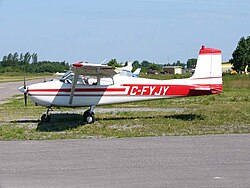
1975 Cessna 172M Skyhawk (1973-1976)
Good plane - Demo
Mission Suitability
- Flight Training (7): The primary purpose of the 172RG's existence. It is the most accessible complex endorsement trainer in general aviation. Familiar 172 handling minimizes transition risk while teaching gear and prop management. Scored 7 rather than higher because modern flight training increasingly uses glass-cockpit fixed-gear aircraft, and the 172RG's gear reliability issues make fleet operations expensive.
- Backcountry (2): Retractable gear is a liability on unimproved strips. Prop clearance is adequate but the gear doors and mechanism are vulnerable to FOD. Not suitable.
- Business Travel (5): Moderate speed (140 KTAS) and good range (714 nm) make it functional for regional trips, but the single-engine speed falls short of typical business travel expectations. The useful load of 1,023 lbs accommodates full fuel plus three adults.
- Aerobatics (1): Not certified for aerobatic flight.
- Cross-Country (7): A genuinely capable cross-country machine. The 62-gallon fuel capacity and 140-knot cruise provide a solid speed/range combination. IFR capable with standard avionics fit.
- Cargo Hauling (3): Useful load is decent at 1,023 lbs, but the cabin volume is standard 172 — acceptable for personal cargo, not suited for commercial hauling.
- Local Fun (5): Flies like a 172, which is pleasant but not exciting. The retractable gear adds workload that diminishes casual flying enjoyment without adding any thrill.
- Surveying (5): High wing provides good ground visibility, but the constant need to manage gear and prop systems distracts from observation tasks. A fixed-gear 172 or 182 is better suited.
Avionics Ecosystem
Most surviving 172RGs were flight school aircraft and have been through multiple panel upgrades. Common configurations by price tier:
- Budget ($80K-$100K): Original steam gauges, King KX-170B or KX-155 radios, basic IFR with an older GPS (KLN-89B or GNS 430 non-WAAS). Functional but dated.
- Mid-range ($100K-$140K): Garmin GNS 430W or GTN 650, basic autopilot (KAP 140 or S-TEC 30), ADS-B compliant. Capable IFR platform.
- Premium ($140K-$195K): Garmin G500 TXi or Aspen PFD, GTN 750, GFC 500 autopilot, full ADS-B In/Out. These are typically low-time owner-flown aircraft rather than ex-trainers.
The 172RG shares panel dimensions with the standard 172 family, so all Cessna 172 avionics STCs and mounting solutions apply. See Avionics Pricing Reference for current equipment and installation costs.
STCs & Modifications
| STC / Mod | Description | Cost | Performance Delta |
|---|---|---|---|
| Horton STOL Kit | Leading edge cuff, stall fences, vortex generators | $3,500-$5,000 installed | -5 knots stall, shorter takeoff |
| Power Flow exhaust | Tuned exhaust system | $3,200-$4,000 installed | +4-6 knots cruise, smoother operation |
| Knots 2U speed mods | Gap seals, fairings, wheel well covers | $1,500-$3,000 | +3-5 knots cruise |
| LED landing light conversion | Replace sealed-beam with LED | $300-$600 | Visibility improvement, lower power draw |
The 172RG does not benefit from engine upgrade STCs to the same degree as fixed-gear 172s — the O-360-F1A6 at 180 HP is already the right engine for this airframe. Speed modification kits are the most popular upgrades, as even small cruise improvements are meaningful on an airplane purchased specifically for its retractable-gear speed advantage.
2006 Cessna 172S
G1000 Skyhawk · Mid-Time Engine · Clean Logs
Maintenance & Support
- Parts availability: Good. The 172RG shares most structural and engine parts with the broader 172 family and the O-360 engine line. Gear-specific parts (power pack, actuators, pivot assemblies, hydraulic lines) are available but can be expensive and occasionally on backorder.
- Mechanic familiarity: Common. Most A&Ps have worked on 172s, but the retractable gear system is a specialty item. Seek an A&P with specific 172RG experience for annual inspections and gear work.
- Annual inspection cost: $2,500-$4,500 depending on findings. The gear system inspection adds meaningful time and cost compared to a fixed-gear 172 annual.
- Gear overhaul: Budget $3,000-$8,000 for a comprehensive gear overhaul including actuators, seals, bushings, and rigging. This is a periodic expense unique to the retractable variant.
- Engine overhaul: $45,000-$35,000 for a field overhaul of the O-360-F1A6. Factory reman available from Lycoming at higher cost.
See Maintenance Ecosystem for general maintenance cost context.
Valuation Factors
The 172RG market has historically lagged behind the broader used aircraft market. Values have been suppressed by the airplane's reputation for gear problems, the large number of ex-flight-school airframes with high total time, and the niche appeal of a complex single that is slower than many fixed-gear alternatives (e.g., Mooney M20C).
Key price drivers:
- Gear-up history: An airplane with a well-documented gear-up repair is not necessarily worth less than one without, provided the repair was done properly. But poorly documented repairs or multiple gear-ups are significant discounts.
- Total time: Many 172RGs have 5,000+ hours from flight school use. High-time airframes with well-maintained engines are still serviceable but command less than low-time owner-flown examples.
- Engine time: Standard valuation applies — see Aircraft Valuation Methodology. Fresh overhauls add proportionally to value.
- Avionics: The spread between a steam-gauge 172RG and a glass-panel example can be $50K+. Avionics upgrades are the primary differentiator in the mid-to-upper price range.
| Condition Tier | Price Range | Typical Profile |
|---|---|---|
| Project / High-time | $80,000-$95,000 | 5,000+ TT, mid-time engine, basic avionics, needs work |
| Average | $95,000-$130,000 | 3,000-5,000 TT, mid-time engine, IFR GPS |
| Above Average | $130,000-$160,000 | Low time, recent overhaul, modern GPS/autopilot |
| Premium | $160,000-$195,000 | Low time, fresh engine, full glass panel, pristine |
ADs & Common Problems
Critical ADs
- AD 2001-06-06: Main landing gear pivot assembly inspection. Requires inspection for cracks in pivot assemblies and installation of new bushings. If cracks are found, pivot replacement costs $4,600-$7,600 depending on whether one or both sides need replacement. This is the most significant AD on the 172RG and represents roughly 10% of the airplane's value.
- AD 84-26-02: Nose gear actuator inspection for proper shimming. Incorrect shimming can prevent nose gear extension.
- AD 2012-18-10: Landing gear side brace bolt inspection and replacement.
Chronic Problems
The electro-hydraulic landing gear system is the 172RG's defining maintenance challenge. The system uses a hydraulic power pack that cycles periodically during flight to maintain pressure. Key failure modes include:
- Hydraulic line rupture: A leak anywhere in the system will cause the power pack to pump all fluid overboard before the pilot realizes the pump has been running too long. This failure mode results in a gear-up landing with no manual backup that can overcome a drained system.
- Power pack failures: The electric motor and hydraulic pump assembly is a common maintenance item. Expect rebuild or replacement at some point during ownership.
- Gear position indication: Micro-switch failures causing false unsafe-gear indications are routine nuisances.
- Gear door actuator rod ends: Wear and play in the linkages cause gear door fit issues and can prevent clean retraction or extension.
A very large percentage of 172RGs have experienced at least one gear-up landing during their service lives. Pre-buy inspections must include a thorough gear system examination by an A&P familiar with the type. Check gear pivot assemblies, hydraulic lines, power pack condition, actuator rod ends, and micro-switch rigging. A properly maintained gear system is reliable, but deferred maintenance compounds quickly.
Insurance Profile
The 172RG falls into the complex/retractable gear insurance category, which carries approximately 30% higher premiums than an equivalent fixed-gear 172. For a private pilot with 250+ hours and retractable time, expect annual hull and liability premiums of $1,800-$2,500 depending on hull value and experience. See GA Insurance Underwriting for category details.
New retractable-gear pilots should expect significantly higher premiums or open-pilot-warranty exclusions until they accumulate 25-50 hours of retractable time. Some underwriters require a checkout with a CFI before binding coverage.
The 172RG's gear-up landing history affects the insurance market broadly — underwriters price the fleet risk, not just individual airframes. This is one reason 172RG values have historically been suppressed relative to fixed-gear 172s that cost more to insure per dollar of hull value.
Flight schools operating 172RGs face particularly steep insurance costs due to the combination of retractable gear, student/low-time pilots, and high utilization. Many training operations have shifted to Piper Arrows or simply use simulators for complex endorsement training to avoid 172RG insurance premiums.
For sale (1)
Also worth looking at
What buyers usually weigh against the Cessna 172RG Cutlass — aircraft flown for the same kind of mission.

