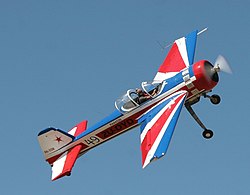
Sukhoi · 1984–2009
Sukhoi Su-26 / Su-29 / Su-31
 i
iSpecifications
Performance
Cruise
162KTAS
Range
440nm
Climb
3540fpm
Ceiling
13,125ft
Fuel Burn
19gph
Fuel Cap.
46gal
MPG
9.8mpg
Stall (Vs0)
56KIAS
T/O roll
560ft
Ldg roll
740ft
Size & weight
Seats
2
Useful Load
420lbs
Full-fuel payload
144lbs
Max gross
2,095lbs
Wingspan
26.2ft
Length
22.3ft
Engine
Engine
Vedeneyev M-14P (Su-26/29) / M-14PF (Su-31)
Power
360hp
TBO
750hrs
Overhaul
$55k
Owning it
Hull insurance
$8k/yr
Parts
poor
Mechanics
rare
Gear
Fixed
IFR
No
Category
experimental
Full specification
V-speeds
Airframe
- Empty weight
- 1,675 lbs
- Max fuel weight
- 276 lbs
- Height
- 8.9 ft
- Wing position
- low
Obstacle performance
- Takeoff over 50 ft
- 1,015 ft
- Landing over 50 ft
- 1,345 ft
Paperwork
- Certification basis
- Experimental Exhibition (FAA) / AR-23 (Russia) / EASA RCoA SAS.A.093
These figures are typical for the model, not a specification for any individual aircraft. Real-world numbers vary with year, installed equipment, weight, modifications and engine condition — often by more than you would expect. Use them to compare types, and confirm anything you would act on against the Pilot's Operating Handbook for that specific airframe and a prebuy inspection.
Pricing
Typical
$235k
Range
$120k – $400k
Annual all-in
~$34k/yr
All-in at ~100 flying hours a year, using the midpoint of each range — the same figures broken out under “Cost to own” below. Your number will differ, and mostly for two reasons. Experience sets your insurance: a 2,000-hour pilot with recent training pays 30–40% less than a 200-hour owner, and student owners pay 20–40% more — on the same aircraft that is often a doubling. Location sets your hangar: a T-hangar runs $200–400 a month in the Midwest against $400–1,500 in a coastal metro, and an outside tie-down is less again. Engine reserves move too — a local shop reusing your serviceable cylinders can come in 30–50% under the national specialty-shop pricing we quote, though you trade the warranty and turnaround that comes with it. Reserves are money set aside toward a future overhaul, not a bill this year, and the annual inspection figure is the shop’s labor to look — whatever they find is separate.
Cost to own — estimate
Set your yearly hours and local fuel price. Fixed costs (insurance, hangar, annual inspection) don't change with hours; fuel, maintenance and the engine reserve do.
- Fuel (19 gph)
- $12,350
- Engine reserve
- $7,333
- Propeller reserve
- $175
- Maintenance, parts & wear items ($12/hr)
- $1,200
- Insurance
- $2,100–$7,500
- Hangar
- $3,506–$8,764
- Annual inspection (labor only)
- $1,200
- Databases & subscriptions
- $400
- Total per year
- $33,593
- Per flight hour
- $336
- Miles flown / year (at cruise)
- 18,643 mi
- Cost per mile
- $1.80/mi
- Time in the air
- 1 hr 51 min
- Fuel burned
- 35 gal
- Out of pocket
- $390
Fuel, engine reserve and wear only. Insurance, hangar and the annual are already paid whether you make the trip or not, so they are not charged here.
Estimate, not a quote. Where a line shows a range, the total, per-hour and per-mile figures use its midpoint— insurance moves most with your experience and time in type, hangar with where you base the aircraft, so your own number could sit at either end. Annual inspection is the shop's labor to open and inspect — what they find is the maintenance line, which covers oil changes, plugs, tires, brakes, hoses, lights, a battery and vacuum pump amortised over their life, and the unscheduled squawks that are the largest and least predictable part of it. Reserves are sinking funds toward an overhaul, not a bill you pay this year — and note that a propeller is due on hours or calendar time, typically six years, so flying less does not put it off forever.
Strengths
- Unlimited-class aerobatic performance—400+ deg/sec roll rate, exceptional vertical penetration
- Proven competition pedigree—WAC podiums since 1984, flown by world-class pilots
- Composite airframe design delivers efficiency with the M-14P radial engine
- Su-29 two-seat variant enables instruction and ride revenue
Weaknesses
- Parts availability virtually non-existent post-2022 sanctions; airframe parts now salvage or one-off machined
- Mechanic support extremely rare—fewer than a dozen U.S. shops competent on Sukhoi airframes
- Operating cost $20k–$28k annually for 50 hours; $40k+ for serious aerobatic use
- M-14P engine TBO is 750 hours, not negotiable; overhauls cost $45k–$60k
Overview
The Sukhoi Su-26, Su-29, and Su-31 are a family of Russian unlimited-class aerobatic aircraft designed by the civilian sport-aviation arm of the Sukhoi Design Bureau (better known for the Su-27 fighter). The Su-26 first flew in June 1984 as a pure single-seat competition machine, intended to give the Soviet national aerobatic team a weapon to match the Zlin and CAP designs dominating the World Aerobatic Championships. It worked: Sukhoi pilots took the team gold at the 1984 WAC in Hungary on the type's first international outing, and Sukhois have been on unlimited-class podiums continuously since.
The family is defined by three things: a nine-cylinder Vedeneyev M-14P radial producing 360 hp (400 hp in the M-14PF used on the Su-31), a carbon-fiber / kevlar / honeycomb composite airframe (over 60% composite by weight — unusually advanced for the mid-1980s), and brutal structural limits. The Su-26 is certified to +12 / -10 G ultimate, the Su-29 to roughly +11 / -9 G, and the Su-31 to +12 / -10 G — numbers that mean the airplane will break the pilot long before the airplane breaks.
- Su-26 (1984): Single-seat, the original. Roughly 20 airframes built in the earliest series before the Su-26M refinement with MT-Propeller three-blade composite prop and refined tail.
- Su-29 (1991): Two-seat trainer/competition derivative of the Su-26. Stretched fuselage, second cockpit, slightly more fuel, slightly reduced G envelope to accommodate the longer airframe. The two-seat layout made it the practical choice for U.S. buyers who wanted to give rides or train students.
- Su-31 (1992): Single-seat refinement of the Su-26 with the 400 hp supercharged M-14PF, lighter airframe, and further aerodynamic tuning. The most capable unlimited Sukhoi — over 400 deg/sec roll rate — and the one modern competition pilots covet.
By mid-2001 Sukhoi had built approximately 166 airframes in the Su-26/29/31 series, of which all but ten were exported, with roughly 80 going to the United States (most through Pompano Air Center in Florida). Civilian sport production at Sukhoi wound down in the early-to-mid 2000s; there is no new-build pipeline today.
Who flies them: competition aerobatic pilots at the Advanced and Unlimited levels, airshow performers, and a small cohort of wealthy owner-pilots who want the most airplane their wallet and spine can tolerate. See also Yakovlev Yak-55M (the Soviet single-seat unlimited contemporary), Yakovlev Yak-52 (the M-14P primary trainer that shares the engine), and Extra 200/300/330 Series (the German competition rival that eventually overtook the Sukhois commercially).
Variants & History
| Variant | Years | Seats | Engine | HP | Empty Wt (lb) | MTOW (lb) | G Limits | Notes |
|---|---|---|---|---|---|---|---|---|
| Su-26 | 1984–1986 | 1 | M-14P | 360 | ~1,455 | ~1,985 | +11/-9 | First series, 2-blade prop, ~20 built |
| Su-26M | 1986–1995 | 1 | M-14P | 360 | ~1,622 | ~2,120 | +12/-10 | Refined tail, 3-blade MT composite prop, standard production Su-26 |
| Su-26M3 | late 1990s | 1 | M-14P | 360 | ~1,635 | ~2,120 | +12/-10 | Structural reinforcement, strengthened fuselage/wing |
| Su-29 | 1991–2005 | 2 | M-14P | 360 | ~1,675 | ~2,095 | +11/-9 | Two-seat trainer/touring aerobat, stretched fuselage |
| Su-29KS | 1994 | 2 | M-14P | 360 | ~1,720 | ~2,145 | +11/-9 | Rocket-deployed ballistic parachute recovery system; Farnborough 1994 debut |
| Su-31 | 1992–2000 | 1 | M-14P | 360 | ~1,475 | ~1,885 | +12/-10 | Lightened single-seat, baseline 360 hp |
| Su-31T / Su-31M | mid-1990s | 1 | M-14PF | 400 | ~1,520 | ~1,920 | +12/-10 | Supercharged M-14PF, 400+ deg/sec roll rate, the top-tier Sukhoi |
Approximate totals: ~166 airframes across all variants by 2001. Western buyers overwhelmingly took the Su-29 (two-seat practicality) or Su-31 (ultimate competition tool); the original Su-26 is the rarest on the U.S. register.
Performance
Book numbers for the Su-26/29/31 are almost irrelevant — nobody buys one to cruise. The family's defining numbers are:
- Roll rate: Su-31T exceeds 400 deg/sec; Su-26M around 360 deg/sec; Su-29 around 345 deg/sec. For comparison a Extra 200/300/330 Series rolls 340–400 deg/sec depending on variant.
- Vertical penetration: From a competition entry at 180 KIAS the Su-31 will climb 1,500+ ft straight up before running out of energy. The M-14P's low-RPM torque and the composite airframe's low parasite drag are what make the radial competitive against the tuned Lycomings in the Extras and CAPs.
- Cruise: Max speed ~178 kt, cruise ~162 kt for the Su-29, ~158 kt for the Su-26M, ~183 kt max / ~160 kt cruise for the Su-31. Usable for short repositioning flights but fuel burn is brutal (18–20 gph) and range is limited (~270 nm Su-26, ~440 nm Su-29 with the larger tank, ~300 nm Su-31).
- Service ceiling: ~13,000–13,800 ft — these are low-altitude airplanes, unsupercharged M-14P. The M-14PF in the Su-31T is supercharged but still a low-altitude powerplant.
- Density altitude: The radial holds power better than a Lycoming but the huge cowling and propeller drag mean climb performance degrades noticeably above 6,000 ft DA. Not a mountain airplane.
- Real-world vs book: Pilots report book numbers are honest for a fresh M-14P on a cold day. A tired engine (common — see maintenance section) loses 20–30 hp and it shows everywhere.
Payload & Range
Useful load is tight on all three variants because the airframe is built for G loads, not payload.
- Su-26 (single seat): ~480 lb useful load. Pilot + parachute (200 lb) + full fuel (~215 lb, ~36 gal) = 415 lb, leaving ~65 lb for a bag and smoke oil. Range at full fuel is ~270 nm with reserves — practically a 1.5-hour leg.
- Su-29 (two seat): ~420 lb useful load. Two pilots with parachutes (400 lb) leaves only 20 lb for fuel above empty tanks — unacceptable. Realistic two-pilot ops are with ~25 gal fuel (150 lb) yielding 300-lb-pilot + 300-lb-pilot max, or lighter pilots with more fuel. Two-pilot range with reasonable fuel is ~1.5 hours. Solo from the rear seat with full fuel pushes range to ~440 nm / ~2.5 hours.
- Su-31 (single seat): ~400 lb useful load. Similar to Su-26 but lighter airframe and slightly smaller fuel. Solo competition mission only; cross-country is an afterthought.
Bottom line: these are single-sortie airplanes. The Su-29 is the only one of the three that meaningfully carries a second person, and even then only for short hops. Nobody buys a Sukhoi for its payload-range envelope — they buy it for what happens inside a 3,000-foot cube of airspace directly above the runway.
Mission Suitability
Aerobatics (10/10): This is the entire reason the airplane exists. The Su-31 is arguably the best unlimited airplane ever built for positive-G vertical work, and the Su-26/29 are right behind it. Competition Unlimited qualified straight from the factory; see aerobatics.
Local Fun (5/10): Scored moderate only because (a) operating cost is serious, (b) the radial is loud and smoky enough to be a neighborhood issue, and (c) the G envelope rewards a pilot who actually uses it. If you want a "fun Sunday flyer" buy a Christen Eagle II or a Decathlon; the Sukhoi is a race car you do not drive to the grocery store.
Flight Training (2/10): The Su-29 two-seater is excellent for aerobatic instruction of already-rated pilots, but it is wildly unsuitable for primary or IFR training. No score above 2.
Cross-Country (2/10): Technically capable — the Su-29 has almost 440 nm range — but the cockpit is a competition cockpit (hard seat, no heat worth mentioning, bubble-canopy glare, minimal baggage). Two-hour legs are the realistic limit.
Business Travel / Cargo / Backcountry / Surveying (1/10): No. Single-pilot Exhibition category limits operations to airshow/practice/ferry; tailwheel; 46 gal fuel total; zero baggage; grass-strip capable but not rough-field.
Avionics Ecosystem
Factory panels were deliberately minimal: airspeed, altimeter, VSI, slip ball, G-meter, engine gauges, a basic VHF comm, and that's about it. The philosophy was every ounce that isn't contributing to the aerobatic mission is wasted weight.
Typical U.S. owner upgrades:
- Entry ($5–15k add): Basic Garmin GTR 200 / GTR 225 comm, Trig TT21/TT22 transponder with ADS-B Out, handheld GPS velcroed to the panel.
- Mid ($15–30k add): Single G5 or GI 275 for attitude/airspeed/altitude, integrated ADS-B In/Out, small MFD.
- Competition ($30–50k add): Smoke oil system, 3-axis G-meter / data logger, panel-mounted video camera feeds, inverted fuel/oil system verification instrumentation.
No owner puts a real IFR stack in a Sukhoi. It's not legal without extensive work and it's pointless — the airplane cannot be flown hands-off in cloud, and the canopy is not suitable for prolonged IMC. See Avionics Pricing Reference.

2009 Van's RV-7
RV-7 · Fast + Aerobatic · Dynon Glass · Great First RV
STCs & Modifications
Because the fleet is Experimental Exhibition in the U.S., there are no STCs — modifications are done via the builder/owner under the operating limitations. Common mods:
- MT-Propeller upgrade: Factory MTV-9 3-blade composite. Almost all U.S. aircraft already have it.
- Hartzell 3-blade composite: Aftermarket swap popular on some Su-29s. ~$18,000 installed.
- Christen inverted fuel/oil system verification/rebuild: Factory-fitted but requires periodic rework; $4,000–8,000.
- Smoke system: Airshow-spec oil injection system, $3,000–6,000 installed.
- BRS / ballistic recovery: Factory option on Su-29KS only, not retrofit to other airframes.
- M-14PF upgrade (360→400 hp): Theoretically possible on a Su-26/29 at overhaul time; rarely done because the airframe isn't optimized for it and parts cost is prohibitive.
- Cockpit ergonomics: Custom seat cushions, five- or six-point harness upgrades (Hooker, Crow), and canopy latch modifications are the most common owner-level changes.
Maintenance & Support
This is the single biggest reason to hesitate before buying a Sukhoi today.
- Parts availability: POOR. Factory Sukhoi civil sport support effectively ceased in the 2000s; any remaining channels became essentially unusable for U.S. owners after the February 2022 sanctions. Airframe-specific parts (canopy rails, composite panels, control linkages, instruments) are now sourced from salvage, machined one-off, or simply unavailable.
- Engine parts: The M-14P is relatively well-supported compared to the airframe — M-14P, Inc. (Huntington, IN) is the only OKBM factory-trained overhaul shop in the U.S. and maintains a meaningful parts inventory. Overhauls run ~$45,000–$60,000 all-in depending on the scope; full new-parts overhauls higher. TBO is 750 hours certified / ~2,250 hours design life experimental.
- Mechanic familiarity: RARE. Perhaps a dozen shops in the U.S. will touch a Sukhoi airframe with confidence. Plan on ferrying to a specialist for any significant work. Annual inspections in the $4,000–8,000 range are typical; anything involving the engine, composite structure, or inverted systems runs much higher.
- Expensive items: M-14P overhaul ($55k), prop overhaul/replacement ($8–15k), canopy replacement (essentially unobtainable new — $15k+ if you can find one), composite wing repair (shop rate $150/hr, 40–200 hours depending on damage).
- Annual operating cost: Realistic budget for ~50 hours/year of active aerobatic flying is $20,000–$28,000 including fuel, oil, annual, engine reserve, and modest unscheduled maintenance. Airshow-level use (150+ hours) runs $40,000+.
See Maintenance Ecosystem for the general U.S. GA support picture; the Sukhoi sits at the extreme bad end of the parts-risk spectrum.
Valuation Factors
Price tiers as of 2025–2026 (U.S. market):
- Su-26 / Su-26M: $120,000–$200,000. Rarest of the three, appeals to collectors more than active competitors. Condition spread is extreme — a tired airframe with a run-out M-14P can be had near the bottom of the range; a freshly-overhauled airshow-ready example tops it.
- Su-29: $180,000–$350,000. The most liquid of the three because the second seat makes it useful for instruction and rides. Recent sales cluster $220k–$280k for healthy mid-time airframes.
- Su-31 / Su-31T: $250,000–$400,000+. The premium product. A Su-31T with fresh M-14PF and current competition panel is top-of-market. European listings have been seen near $260k (equivalent) but ferrying one to the U.S. now is a paperwork nightmare.
Value drivers:
- M-14P / M-14PF time remaining: Biggest single factor. A fresh engine is a $45–60k line item; a run-out engine on an otherwise nice airframe can wipe half the value.
- Composite condition: A clean spar and no delamination history is worth more than any avionics upgrade.
- Competition history: Known-provenance competition airframes flown by named pilots command a premium; unknown-history ex-Russian examples discount.
- Import paperwork: Complete and current U.S. Experimental Exhibition program letter, operating limitations, and logbooks in order are essential. Missing paperwork can make an airplane practically unsellable.
See Aircraft Valuation Methodology for the general approach; Sukhois deviate because TBO is 750 hours (not 2000) and parts risk is extreme.
ADs & Common Problems
The airframes are not FAA type-certificated, so there are no U.S. ADs. EASA maintains Specific Airworthiness Specification SAS.A.093 for the Su-29 in Europe, and issues Mandatory Continuing Airworthiness Information (MCAI) through that document.
Recurring problem areas owners report:
- Composite wing spar delamination: Thoroughly inspect the main spar laminations, especially on high-time airframes or ones with repeated +10G excursions. Factory repair scheme exists but requires Sukhoi engineering sign-off, which since 2022 is essentially unavailable.
- Inverted fuel/oil system: The flop-tube and inverted oil pickup require periodic inspection and overhaul. Failures in inverted flight are career-ending.
- M-14P engine bearings and crankshaft: 750-hour certified TBO is not a suggestion. Running past TBO in an unlimited airplane is asking for a prop-strike-grade failure at the worst moment.
- Exhaust cracks: The M-14P exhaust collector ring cracks routinely. Part availability via m-14p.com is OK but expensive.
- Tail wheel / tail spring: Heavy landings (common — the airplane has a narrow gear and is slippery) crack tail structure.
- Canopy locking mechanism: Several reported cases of canopies departing in flight; inspection of latch cams and locking pins is critical.
- Document package: Russian-language logbooks, metric-unit placards, and incomplete import paperwork are the most common pre-buy red flags. Engage a specialist (Pompano Air Center historically, or the handful of U.S. Sukhoi maintenance shops) for pre-buy.
Insurance Profile
Single-seat Russian unlimited aerobatic is one of the hardest categories to insure in U.S. general aviation. Key realities:
- Hull coverage: Available but expensive. Typical hull premium runs 4–8% of agreed value per year — meaning a $250,000 Su-31 costs $10,000–$20,000/year in hull alone. Many owners carry liability-only to keep it affordable.
- Liability: $1M smooth is achievable for qualified pilots but underwriters will scrutinize pilot experience.
- Pilot requirements: Underwriters want 500+ total time, 100+ tailwheel, 50+ aerobatic (IAC-recognized), and formal training in type — usually via a known Sukhoi/Yak instructor. First-time Sukhoi owners with less than this will be declined or priced out.
- Agreed value: Getting the agreed value written realistically is a negotiation; bring appraisal, logs, and recent comps.
- Exhibition operating restrictions: The Experimental Exhibition certificate requires a program letter. Underwriters will ask to see it; non-compliance voids coverage.
For a two-seat Su-29 used for aerobatic instruction, add an instructor endorsement and expect premiums roughly 30% higher than the single-seat equivalent of the same value. See GA Insurance Underwriting.
For sale (0)
No listings for this model right now.
Also worth looking at
What buyers usually weigh against the Sukhoi Su-26 / Su-29 / Su-31 — aircraft flown for the same kind of mission.