Aerostar/Piper · 1967–1984
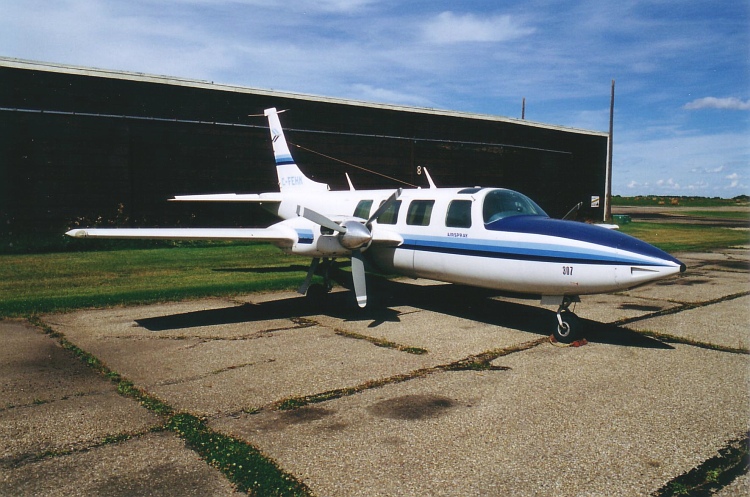
Piper Aerostar 601P
Specifications
Performance
Cruise
233KTAS
Range
1,086nm
Climb
1460fpm
Ceiling
26,350ft
Fuel Burn
36.0gph
Fuel Cap.
165gal
MPG
7.4mpg
Stall (Vs0)
67KIAS
T/O roll
1900ft
Ldg roll
1230ft
Size & weight
Seats
6
Useful Load
1,944lbs
Full-fuel payload
954lbs
Max gross
6,000lbs
Wingspan
36.7ft
Length
34.8ft
Engine
Engine
Lycoming TIO-540-S1A5
Power
580hp
TBO
1,800hrs
Overhaul
$58keach
Engines
2
Owning it
Hull insurance
$7k/yr
Parts
fair
Mechanics
specialist
Gear
Retractable
IFR
Yes
Category
certified
Full specification
V-speeds
Airframe
- Empty weight
- 4,056 lbs
- Max fuel weight
- 990 lbs
- Height
- 12.1 ft
- Wing position
- mid
Obstacle performance
- Takeoff over 50 ft
- 2,490 ft
- Landing over 50 ft
- 2,030 ft
Paperwork
- Type certificate
- A17SO
- Certification basis
- Part 23
These figures are typical for the model, not a specification for any individual aircraft. Real-world numbers vary with year, installed equipment, weight, modifications and engine condition — often by more than you would expect. Use them to compare types, and confirm anything you would act on against the Pilot's Operating Handbook for that specific airframe and a prebuy inspection.
Pricing
Typical
$280k
Range
$150k – $500k
Annual all-in
~$65k/yr
All-in at ~100 flying hours a year, using the midpoint of each range — the same figures broken out under “Cost to own” below. Your number will differ, and mostly for two reasons. Experience sets your insurance: a 2,000-hour pilot with recent training pays 30–40% less than a 200-hour owner, and student owners pay 20–40% more — on the same aircraft that is often a doubling. Location sets your hangar: a T-hangar runs $200–400 a month in the Midwest against $400–1,500 in a coastal metro, and an outside tie-down is less again. Engine reserves move too — a local shop reusing your serviceable cylinders can come in 30–50% under the national specialty-shop pricing we quote, though you trade the warranty and turnaround that comes with it. Reserves are money set aside toward a future overhaul, not a bill this year, and the annual inspection figure is the shop’s labor to look — whatever they find is separate.
Cost to own — estimate
Set your yearly hours and local fuel price. Fixed costs (insurance, hangar, annual inspection) don't change with hours; fuel, maintenance and the engine reserve do.
- Fuel (36 gph)
- $23,400
- Engine reserve
- $6,444
- Propeller reserve
- $600
- Maintenance, parts & wear items ($45/hr)
- $4,500
- Insurance
- $7,000–$15,400
- Hangar
- $7,663–$19,157
- Annual inspection (labor only)
- $4,500
- Databases & subscriptions
- $900
- Total per year
- $64,955
- Per flight hour
- $650
- Miles flown / year (at cruise)
- 26,813 mi
- Cost per mile
- $2.42/mi
- Time in the air
- 1 hr 17 min
- Fuel burned
- 46 gal
- Out of pocket
- $450
Fuel, engine reserve and wear only. Insurance, hangar and the annual are already paid whether you make the trip or not, so they are not charged here.
Estimate, not a quote. Where a line shows a range, the total, per-hour and per-mile figures use its midpoint— insurance moves most with your experience and time in type, hangar with where you base the aircraft, so your own number could sit at either end. Annual inspection is the shop's labor to open and inspect — what they find is the maintenance line, which covers oil changes, plugs, tires, brakes, hoses, lights, a battery and vacuum pump amortised over their life, and the unscheduled squawks that are the largest and least predictable part of it. Reserves are sinking funds toward an overhaul, not a bill you pay this year — and note that a propeller is due on hours or calendar time, typically six years, so flying less does not put it off forever.
Strengths
- Speed unmatched by other piston twins — 230–240 KTAS realistic cruise
- Pressurized cabin for high-altitude cross-country comfort
- Laminar-flow mid-wing design and meticulous aerodynamic fairing
- Factory support continues through Aerostar Aircraft Corporation
Weaknesses
- High fuel burn (36–40 GPH at cruise) drives operating costs
- Complex pressurization and systems require specialist maintenance
- Narrow CG range and high wing loading demand proficient multi-engine IFR pilot
- Annual inspections $7,000–$20,000+; total annual ownership ~$45,000–$58,000
- Elevated fatal accident rate in early NTSB studies vs. comparable twins
Overview
The Aerostar is one of the fastest piston twins ever to enter series production and the only mid-wing, counter-rotating piston twin certified under FAR Part 23. Designed by Ted R. Smith — who also gave the world the Aero Commander — the Aerostar represents a philosophy of speed above all else. Its laminar-flow mid-wing and meticulously faired airframe achieve drag numbers that still embarrass contemporaries. The pressurized 601P, the most common variant, cruises faster than most turboprops at a fraction of the acquisition cost.
This page describes the PA-60-601P specifically — the pressurized line. The unpressurized 600 and 601 have their own page, piper-aerostar-600-601, split out per docs/CATALOG-SPLITTING-RULE.md's Step 1 hard test: pressurized vs unpressurized is an absolute split, and the 601P/602P/700P family here is pressurized while the 600/601 family is not. See "Why this page covers three models, and not just the 601P" below for the reasoning that keeps 602P and 700P on this same page rather than splitting further.
The aircraft has a complicated ownership history. Ted Smith Aircraft Company first flew a prototype in 1966 and began production in 1967. Ownership passed through American Cement Company, then Ted Smith and Associates, before Piper Aircraft acquired the line in 1978 and moved production to Vero Beach, Florida. Piper built the last Aerostar in 1984. In 1991, Piper sold the type certificate to Aerostar Aircraft Corporation (headed by Machen Inc. principals), which continues to provide factory support, service bulletins, and the STC conversion program described below.
Approximately 1,010 Aerostars were built across all variants (this figure is carried from the pre-existing page and was not independently re-verified against a production registry this session — Wikipedia's Piper Aerostar article gives different per-variant counts, noted in the Variants table below). The 601P is by far the most produced variant and most commonly traded today. Ownership demands genuine multi-engine IFR currency, a fat maintenance budget, and ideally a relationship with a specialist shop. When flown by a proficient pilot, the Aerostar delivers speed that no piston twin can match.
Variants & History
| Variant | Years | Engine | HP (each) | Gross Wt (lbs, max takeoff) | Key Differences | Units Built |
|---|---|---|---|---|---|---|
| 601P | 1974–1982 | Lycoming IO-540-P1A5/S1A5, turbocharged per RAJAY STC SE60WE or Aerostar STC SE81WE | 290 | 6,000 (5,700 pre-Option-93, early S/N) | Pressurized (4.25 psi differential, TCDS-confirmed); max operating altitude 25,000 ft (30,000 ft with AAC Options 262 & 264); most produced pressurized variant | 492 (per pre-existing page; Wikipedia does not give a separate 601P figure to cross-check) |
| 602P (Sequoia) | 1981–1984 | Lycoming IO-540-AA1A5, factory-installed AAC turbocharger kits (not RAJAY aftermarket) | 290 | 6,000 (6,029 max ramp) | Piper-developed; factory turbo installation rather than an aftermarket STC; TCDS: "Same as" 601P for pressurization and most limits | 124 (per pre-existing page; Wikipedia agrees) |
| 700P | 1983–1984 | 1x Lycoming LTIO-540-U2A + 1x TIO-540-U2A (counter-rotating), TCDS-confirmed | 350 | 6,315 (6,356 max ramp, 6,000 max landing) | TCDS: "Same as PA-60-602P except engines, propellers, maximum weights..."; airspeed limits stated in KIAS (not KCAS, unlike every other model on this certificate); rarest and fastest factory variant | 26 (per pre-existing page and Wikipedia, which agree) |
Notes:
- The 602P is essentially a Piper-revised 601P with a factory-turbocharged engine assembly; performance is slightly lower than a well-maintained 601P but detonation risk is meaningfully reduced (this specific claim is carried from the pre-existing page's prose and was not independently re-verified this session).
- The 700P and its STC clone, the Machen/Aerostar Aircraft "Super 700" (FAA STC SA1658NM, "700CR" tier — see STCs & Modifications), are the definitive high-performance Aerostars, and the STC conversion is now confirmed to be certificated at the SAME weight limits as the factory 700P (6,356/6,315/6,000 lb).
- Production-number sources disagree and neither was independently audited against a registry this session: this page's pre-existing figures (492/124/26) and Wikipedia's figures (492 is not stated separately by Wikipedia for the 601P, but its 600/601/601B breakdown differs materially from this page's — see piper-aerostar-600-601 for that discrepancy) are recorded rather than reconciled.
Performance
601P real-world cruise: Book figures show 257 KIAS max speed; realistic long-leg cruise at 75% power and 20,000–23,000 ft produces 230–240 KTAS burning 36–40 GPH total. At economy cruise (65%, 15,000 ft) expect 210–220 KTAS on 30–33 GPH. Block times are genuinely impressive: a 1,000 nm trip with a favorable FL that most piston aircraft cannot reach takes about 4.5 hours. None of this paragraph's figures were independently re-sourced this session — no Aerostar POH/AFM was located (see validator_exempt for what was searched). It is carried forward from the pre-existing page and should be read as unverified until a handbook surfaces.
700P and Super 700: At 75% and 25,000 ft, the 700P/Super 700 trues at 255–265 KTAS on 48–51 GPH. Throttled to 55%, fuel burn drops to 32 GPH for 225 KTAS — a remarkable economy cruise that extends range to 1,100+ nm with max fuel. Same caveat: unverified performance prose carried from the pre-existing page, though the underlying engine (350 hp counter-rotating TIO-540-U2A/LTIO-540-U2A) and weight limit (6,315 lb takeoff / 6,356 lb ramp) ARE now certificate/STC-confirmed.
High wing loading: At 35.4 lbs/sq ft the Aerostar rides through convective turbulence better than lighter-loaded twins. The tradeoff is a narrow slow-speed envelope — Vs1 is 77 KIAS on the 601P (unverified this session; no POH found); approach speeds are consequently higher than on comparable aircraft.
Single-engine performance: Single-engine service ceiling (601P) is approximately 8,800 ft; single-engine climb rate is 240 FPM at sea level at max gross (both figures now promoted into the schema as single_engine_ceiling_ft and single_engine_climb_fpm — see the field comments; neither is independently re-sourced this session). The 700P improves this to approximately 320 FPM and 14,500 ft SE ceiling per the pre-existing page's prose, also unverified.
Pressurization — now certificate-confirmed: TCDS A17WE Section III states the 601P's maximum cabin operating pressure as 4.25 PSI (5.50 PSI with AAC Option 262), and maximum operating altitude as 25,000 ft (30,000 ft with AAC Options 262 and 264). This is a real correction of emphasis rather than of value: the OLD page already stated similar figures in prose ("cabin altitude of approximately 11,000 ft at the 25,000 ft service ceiling") but had NO certificate citation behind them and conflated the certificate's operating altitude limit with a POH-style service ceiling, which are different concepts (see the removed service_ceiling_ft field and its validator_exempt entry).
Density altitude sensitivity: Both the naturally aspirated 600/601 line and this page's turbocharged models are affected by density altitude at takeoff, though the turbocharged models maintain rated power to their critical altitude. High-elevation field departures at max gross weight should be planned carefully given the accelerate-stop distances (unverified prose, carried forward).
Payload & Range
The Aerostar 601P has a book useful load of approximately 1,944 lbs (6,000 lb TCDS-confirmed gross minus 4,056 lb empty weight — the empty weight figure is NOT independently re-sourced this session; TCDS does not publish empty weight and no POH was found). Real-world equipped useful load on a glass-panel, air-conditioned 601P is typically closer to 1,600–1,750 lbs after avionics, paint, interior and equipment additions (unsourced, carried forward).
Max fuel (165.5 gal usable = 993 lbs, TCDS-confirmed):
- Remaining payload after full fuel: approximately 600–750 lbs (unsourced arithmetic using the unverified empty-weight figure)
- Range at 75% (36 GPH, unsourced): approximately 1,000–1,100 nm with 45-minute reserve
Full seats (6 x 190 lbs = 1,140 lbs occupants + 100 lbs baggage = 1,240 lbs, up to 7 seats certified with the bench option):
- Range severely limited with full occupancy; this configuration is occasionally viable for short hops.
700P / Super 700 (6,315–6,356 lb gross, TCDS/STC-confirmed):
- Additional gross weight allowance of 315–356 lbs over the 601P improves all scenarios slightly.
- With optional extended fuel (unsourced this session), range at economy cruise exceeds 1,300 nm per the pre-existing page's prose.
Important CG note: The Aerostar has a relatively narrow CG envelope. Weight and balance calculations are mandatory before every flight.
Cross-references: Aircraft Valuation Methodology | GA Insurance Underwriting | Maintenance Ecosystem | Avionics Pricing Reference | Piper Aerostar 600/601 (unpressurized) Related aircraft: Piper PA-34-220T Seneca V | Piper PA-30/PA-39 Twin Comanche | Piper PA-23-250 Aztec

1998 Beechcraft Bonanza A36
GTN 750 · GFC 500 · Mid-Time IO-550 · No Damage
Mission Suitability
Cross-Country Flying — Score: 9/10. The Aerostar's primary purpose. Speed, pressurization, long range, and IFR capability combine to make this one of the best owner-flown cross-country platforms in piston aviation. The only demerits are high fuel burn and the complexity/maintenance cost of ownership.
Business Travel — Score: 8/10. Fast, pressurized, and capable of flying above most weather make the Aerostar compelling for business travel. Six-seat configuration accommodates a pilot plus five passengers nominally (seven certified maximum with the bench-seat option — TCDS-confirmed), though useful load limitations in practice restrict full-fuel operations to pilot plus three to four adults. Cabin is narrow and not stand-up.
Local Fun Flying — Score: 4/10. Technically possible but wasteful given systems complexity and cost-per-hour.
Cargo Hauling — Score: 4/10. Useful load of ~1,944 lbs book (not independently re-verified this session) is reasonable for light cargo, but the narrow cabin and door placement limit practical loading.
Flight Training — Score: 1/10. Not a training aircraft. High wing loading, critical engine-out margins, pressurization systems, and a narrow CG range make it unsuitable for training environments.
aerobatics — Score: 1/10. Not aerobatic-certified; pressurization and systems are entirely incompatible with aerobatic use.
Backcountry / Bush Flying — Score: 1/10. High approach speeds, long accelerate-stop distances, retractable gear, and zero STOL capability make the Aerostar completely unsuited to backcountry operations.
surveying — Score: 3/10. Speed and altitude capability could theoretically serve photogrammetric survey missions, but the fixed cabin windows and limited nose-down visibility make purpose-built survey platforms far more practical.
Avionics Ecosystem
The Aerostar fleet spans 1974–1984 production for the pressurized line, so panel configurations range from steam gauges with old autopilots to full glass. The type certificate supports modern STC-approved retrofits.
Entry-level (steam gauge, original): King KX-175/165 nav/comms, a KI-209 CDI, KT-76A transponder, and a vintage autopilot (S-TEC 60 or original Piper AutoControl).
Mid-range modernized: Garmin GTN 650Xi or 750Xi as the primary navigator, a Garmin GI-275 or Aspen EFD1000 as a standby/backup ADI, original autopilot retained. Cost approximately $20,000–$35,000 installed.
Full glass: Garmin G500 TXi with GTN 750Xi navigator, GFC 500 or GFC 600 digital autopilot, GTX 345 ADS-B transceiver, and GMA 35 audio panel. Installation runs $80,000–$120,000 depending on complexity.
Autopilot note: aging original servos and computers make overhauls expensive; an S-TEC 55X or Garmin GFC 500/600 retrofit provides considerably more capability.
ADS-B: Garmin GTX 345 or GTX 335 (Out only) are common solutions.
STCs & Modifications
Machen "Super 700" conversion — FAA STC SA1658NM, "700CR" tier. Replaces the 601P's stock 290 hp engines with a counter-rotating pair (one Lycoming TIO-540-U2A, one LTIO-540-U2A) at 350 hp each, mated to Hartzell HC-C3YR-2UF/FC8468DB-14 propellers (one standard, one left-hand/counter-rotating). Certificated at 6,356 lb max ramp / 6,315 lb max takeoff / 6,000 lb max landing — identical to the factory 700P. This is the FIRST time this conversion has carried an actual STC number on this page; the prior version named it with no citation at all. SA1658NM is a five-tier program (650/680/700/700A/700CR options at 325/340/350/350/350 hp respectively), of which 700CR is the highest tier and the one matching "Super 700" in the type-club literature. See raw/tcds/stc-sa1658nm-aerostar-machen-power-weight-2026-09-08.md for the full table.
Gross weight increase to 6,850 lb — FAA STC SA01701SE. A further weight increase on top of whichever SA1658NM tier is installed (SA1658NM is a stated prerequisite in SA01701SE's own certificate text), taking a converted 601P/602P to 6,850 lb takeoff — above even the factory 700P. Held by Machen Inc., most recently amended 2006.
300 hp power increase — FAA STC SA4307NM. A smaller, cheaper modification than the two above: keeps the existing IO-540-S1A5 engine and raises its continuous power rating from 290 to 300 hp per side (with a specific Hartzell propeller), no weight change. Applies to 600, 601 and 601P.
Blended winglets — FAA STC SA02242SE. Held by Aerostar Aircraft Corporation itself, current, applies to all five PA-60 models. No quantified performance delta was found in FAA DRS this session (the metadata record gives only "Fabrication of blended winglets"), so this is NOT recorded in stc_variants — per data/vault/CLAUDE.md's guard, an STC with no sourced numeric delta stays prose-only.
Pressurization Door Seal Modification (unsourced, carried from the pre-existing page): a widely adopted operator-developed modification replacing the original door pressure seals and routing pressurization through a dedicated electric pump. No STC number was located for this specific modification this session.
Speed Brake STC (unsourced, carried from the pre-existing page): spoiler/speed-brake installations for descent speed control. No specific STC number was located this session.

2002 Beechcraft Baron 58
G500 TXi · GTN 750 · Known-Ice · Air Conditioning
Maintenance & Support
See Maintenance Ecosystem for the general framework.
A&P familiarity: Specialist. Aerostar Aircraft Corporation (Coeur d'Alene, ID — confirmed as the current TC holder's address from the TCDS itself) remains the primary factory support organization.
Annual inspection: Owner-reported costs range from $7,000 to $20,000+ depending on condition (unsourced, carried forward).
Engine overhaul: Lycoming IO-540-S1A5 (turbocharged) TBO is 1,800 hours; field overhaul cost per engine approximately $51,500–$64,500, consistent with reference/engine-overhaul-pricing.md's $58,000 TIO-540 band used in this page's frontmatter.
Parts availability: Fair. Aerostar Aircraft Corporation maintains a parts inventory; some parts require NOS sourcing.
Total annual ownership cost estimate (601P, 100 hours/year, mid-time engines, unsourced): approximately $45,000–$58,000/year.
Valuation Factors
See Aircraft Valuation Methodology for the full framework. None of the dollar figures below were independently re-sourced this session (no Vref/Bluebook access) — carried from the pre-existing page.
Model tier pricing (2025 approximate, unsourced):
- 601P (pressurized, 290 hp): $150,000–$380,000
- 602P (Piper Sequoia): $160,000–$400,000
- 700P (factory 350 hp, 26 built): $350,000–$600,000+
- Super 700 conversion (SA1658NM "700CR" on a 601P/602P): $250,000–$500,000
Engine time: Dominates valuation. TBO is 1,800 hours for turbocharged variants. Fresh factory overhaul per side adds $51,500–$64,500 in direct cost.
Super 700 conversion: Now a citable modification (SA1658NM) rather than an unsourced claim — adds typically $80,000–$130,000 over a comparable unmodified 601P (unsourced dollar figure, carried forward).
ADs & Common Problems
Critical Recurring ADs (carried from the pre-existing page — not independently re-verified against the FAA's AD database this session):
- AD 79-1-5: Fuel system — crossfeed placarding and low-fuel warning light.
- AD 83-14-7: Stall characteristics — aerodynamic stall improvement kit.
- AD 87-07-09: Exhaust system inspection.
- Balance tube corrosion, main landing gear lower side brace cracking, oil scavenge pump replacement, and wing attach fitting inspections (SB600-136) — all carried forward from the pre-existing page.
Common Pre-Buy Red Flags: fuel system corrosion in aging wet wings, exhaust cracks, pressurization leaks, detonation damage on the 601P's 8.7:1-compression TIO-540-S1A5, nose gear fragility from improper towing, alternator output limits, and an elevated fatal accident rate in early NTSB studies versus the Beech Baron 58 — all carried from the pre-existing page and not independently re-verified this session.
Insurance Profile
See GA Insurance Underwriting for the general framework. None of the figures below were independently re-verified this session.
Underwriting category: high-performance complex piston twin with above-average accident history. Minimum total time 2,500 hours, minimum multi-engine time 1,000 hours, minimum make/model time 25 hours (some carriers 50).
Typical annual premiums (601P, $175,000–$250,000 hull value, 2021–2025 data): $5,500–$8,200/year for qualified pilots; $9,850–$14,000/year for less-qualified pilots; $8,000–$15,000/year for 700P or Super 700 hull values.
For sale (0)
No listings for this model right now.
Also worth looking at
What buyers usually weigh against the Piper Aerostar 601P — aircraft flown for the same kind of mission.


