Found Aircraft · 1963+
Found FBA-2 Centennial / FBA-2C2 Bush Hawk XP / Expedition E350

Specifications
Performance
Cruise
Not verified
Range
Not verified
Climb
—fpm
Ceiling
—ft
Fuel Burn
Not verified
Fuel Cap.
98gal
MPG
—mpg
Stall (Vs0)
—KIAS
T/O roll
—ft
Ldg roll
—ft
Size & weight
Seats
5
Useful Load
Not verified
Full-fuel payload
—lbs
Max gross
3,500lbs
Wingspan
36ft
Length
26.5ft
Engine
Engine
Lycoming IO-540-L1C5
Power
300hp
TBO
2,000hrs
Overhaul
$52k
Owning it
Hull insurance
$5k/yr
Parts
fair
Mechanics
specialist
Gear
Fixed
IFR
Yes
Category
certified
Full specification
V-speeds
Airframe
- Max fuel weight
- 590 lbs
- Height
- 9 ft
- Wing position
- high
Paperwork
- Type certificate
- A7EA
- Certification basis
- CAR 3 / Part 23
These figures are typical for the model, not a specification for any individual aircraft. Real-world numbers vary with year, installed equipment, weight, modifications and engine condition — often by more than you would expect. Use them to compare types, and confirm anything you would act on against the Pilot's Operating Handbook for that specific airframe and a prebuy inspection.
Pricing
Typical
Price unavailable
Range
No recent market listings found for this model
Annual all-in
~$18k/yr
All-in at ~100 flying hours a year, using the midpoint of each range — the same figures broken out under “Cost to own” below. Your number will differ, and mostly for two reasons. Experience sets your insurance: a 2,000-hour pilot with recent training pays 30–40% less than a 200-hour owner, and student owners pay 20–40% more — on the same aircraft that is often a doubling. Location sets your hangar: a T-hangar runs $200–400 a month in the Midwest against $400–1,500 in a coastal metro, and an outside tie-down is less again. Engine reserves move too — a local shop reusing your serviceable cylinders can come in 30–50% under the national specialty-shop pricing we quote, though you trade the warranty and turnaround that comes with it. Reserves are money set aside toward a future overhaul, not a bill this year, and the annual inspection figure is the shop’s labor to look — whatever they find is separate.
Cost to own — fixed costs only
No handbook figures for this airplane give a fuel burn or a cruise speed, so the fuel, per-hour and per-mile estimates cannot be computed. What follows is what ownership costs before you fly it — these do not change with hours.
Fuel, maintenance and the engine reserve are on top of this and rise with every hour flown — on a comparable airplane they typically exceed the fixed costs at around 100 hours a year. The page above says which document would supply the missing figures.
Strengths
- Exceptional useful load (1,525 lb) and cabin volume for backcountry operations
- Factory corrosion-proofing and proven float-plane capability in northern Canadian/Alaskan service
- Live type certificate holder (NZAero) provides ongoing support and service bulletins
- Strong cross-country range (880 nm) with acceptable cruise speed for a utility hauler
Weaknesses
- Orphan-type parts scarcity; Found Aircraft Canada defunct since 2014, long lead times from NZAero (New Zealand)
- Specialist maintenance required; few A&Ps outside Ontario, Quebec, Alaska, BC have hands-on experience
- High annual costs ($18–30K wheels, $35K+ floats/commercial) and significant unscheduled spend exposure
- Documentation and airworthiness continuity gaps common; thorough logbook audit essential on pre-buy
Overview
The Found Bush Hawk family is a small but distinguished line of Canadian all-metal five-seat bush utility aircraft with roots stretching back to 1948. Designed for hauling people, cargo, and fish out of Canada's northern lakes and bush strips, the Found lineage has survived three corporate reincarnations and moved production across two continents — yet only around 100 aircraft have ever been built across all variants. That rarity is both its charm and its curse.
Found Brothers Aviation was founded in 1946 in Malton, Ontario by Nathan Keith "Bud" Found and his brother Sherman "Micky" Found, drawing on their bush flying experience from Edmonton up the Mackenzie River. The FBA-1 prototype first flew in 1949, and the improved FBA-2 prototype followed on 11 August 1960, with the first production FBA-2C flying on 9 May 1962. The FBA-2C was certified in 1964 and 27 examples were built before production shifted in 1966 to the larger Centennial 100 — named for Canada's 1967 centennial celebration — of which only five were built before the original Found Brothers Aviation shut down in 1967.
The design lay dormant until 1994, when Bud Found reacquired the rights. Found Aircraft Canada was re-established in Parry Sound, Ontario, and the modernized FBA-2C1 Bush Hawk (re-engined with a 300 HP Lycoming IO-540) entered production in 1998. The Bush Hawk XP and Bush Hawk-300XP variants followed, totaling roughly 37 aircraft. In 2007, Found launched the "Expedition Aircraft" brand with the FBA-2C3 Expedition E350 (tricycle-gear version, FAA certified December 2008) and FBA-2C4 E350XC (tailwheel). Found Aircraft Company entered receivership in 2013 and ceased trading in early 2014.
The story did not end there. In 2018 the type certificate and tooling were acquired by Pacific Aerospace of Hamilton, New Zealand (now NZAero), which relocated Expedition production to the southern hemisphere. NZAero markets the current E-350 Expedition with a 315 HP Lycoming IO-580 (an upgrade from the original IO-540) and continues to offer new-build aircraft to order. The FAA's own record confirms the transfer: TCDS A7EA is held today by NZSkydive Limited, at Revision 11 of 30 March 2022, and it now covers seven models (FBA-2C, 2C1, 2C2, 2C3, 2C3T, 2C4 and 2C4T) against the three it listed in 2005. For a buyer this is the difference between an orphan and an airplane with a factory: a live certificate holder is who issues service bulletins and approves repairs.
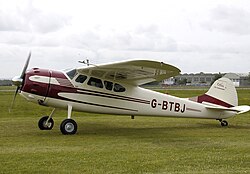
The airplane itself is distinctive: a high-wing, all-metal, corrosion-proofed airframe with an enormous cabin (53 inches wide — widest in its class), a large cargo door, and four-door access (including two big rear cabin doors). It is a "flying truck" in the truest sense, carrying loads that rival a Cessna 206 from shorter strips, but with a cabin layout and loading geometry closer to a de Havilland Beaver. Fewer than 70 airworthy examples exist worldwide, and most are in commercial bush/floatplane service.
Variants & History
TCDS-confirmed columns (model code, approval year, engine, HP, landplane
MTOW, Vne, usable fuel) are sourced to a7ea-rev11-bushhawk-2026-09-12.md,
retrieved and confirmed this session. The FBA-2C3/FBA-2C3T performance
columns (cruise, range, climb, runway) are sourced to NZAero's current E-350
brochure (bushhawk-nzaero-e350brochure-2026-09-12.md) -- the only
matched, manufacturer-sourced performance set found this session, but for a
different, later, heavier model than this page's own frontmatter.
| Model | Marketing name | Approved | Engine | HP | MTOW landplane (lb) | Vne (kt) | Fuel usable (gal) | Cruise / Range / Climb |
|---|---|---|---|---|---|---|---|---|
| FBA-2C | (original Found) | 1965 | Lycoming O-540-A1C5 | 250 | 2,850 | 135 | 66.1 | not sourced this session |
| FBA-2C1 | Bush Hawk | 2000 | Lyc IO-540-D4A5 (260) or -L1C5 (300) | 260 or 300 | 3,200 | 141 | 98.3 | not sourced this session |
| FBA-2C2 (this page) | Bush Hawk XP | 2005 | Lycoming IO-540-L1C5 | 300 | 3,500 | 158 | 98.3 | not sourced this session |
| FBA-2C3 | Expedition E350 (tricycle, current NZAero production) | 2008 | Lycoming IO-580-B1A | 315 | 3,800 | 188 | 98.3 | 156 KTAS @ 8,000 ft; 750 nm max range / 6.5 hr max endurance; 1,091 fpm SL climb; 775 ft T/O roll, 1,286 ft T/O over 50 ft, 608 ft landing roll, 1,478 ft landing over 50 ft |
| FBA-2C3T | Expedition E350 turbo | 2012 | Lycoming TIO-540-AH1A | 300 (turbo) | 3,800 | 188 (SL-14,000 ft, reducing to 150 @ 25,000 ft) | 98.3 | 170 KTAS @ 20,000 ft; 798 nm max range / 6.5 hr max endurance; 1,058 fpm SL climb; 777 ft T/O roll, 1,297 ft T/O over 50 ft, 608 ft landing roll, 1,478 ft landing over 50 ft |
| FBA-2C4 | (tailwheel version of FBA-2C3) | 2012 | Lycoming IO-580-B1A | 315 | 3,800 | 188 | 98.3 | not sourced this session (same engine/weight as FBA-2C3; gear type differs) |
| FBA-2C4T | (tailwheel turbo version) | 2012 | Lycoming TIO-540-AH1A | 300 (turbo) | 3,800 | 188 (reducing schedule) | 98.3 | not sourced this session |
The prior version of this table conflated several things the certificate keeps separate. "FBA-2C1 Bush Hawk" and "FBA-2C1 Bush Hawk XP" were shown as two production runs of the SAME model code with the SAME weight (3,500 lb) — the certificate actually assigns "Bush Hawk" and "Bush Hawk XP" to two DIFFERENT model codes (FBA-2C1 and FBA-2C2) with different weights (3,200 vs 3,500 lb) and different Vne (141 vs 158 kt). "FBA-2C2 Bush Hawk-300XP" and "FBA-2C3 Expedition E350" were both shown running the FBA-2C1's IO-540-L1C5 engine at 3,500 lb -- the real FBA-2C3 carries a larger IO-580 engine (315 hp) at a materially higher 3,800 lb MTOW. Production-count estimates below are carried from the original generated pass and were not independently re-verified against a primary source this session (the certificate states eligible serial ranges, not delivery counts): approximately 27 original FBA-2C aircraft (1962-1967, serials 3-27 per the certificate), with modern (1998-present) FBA-2C1-through-FBA-2C4T production commonly cited around 40-50 aircraft.
Performance
No performance figure below is sourced to a primary document for the
FBA-2C1/FBA-2C2 Bush Hawk this page describes -- see validator_exempt.
The 145 KTAS cruise, 16 GPH burn, 880 nm range, 18,000 ft service ceiling and
750/600 ft runway figures in this section and in frontmatter on the prior
version of this page came from the original ungrounded generation pass, not
from the certificate (which publishes no performance at all) or from any
handbook or press flight-test reachable this session. They read as
plausible for a 300 hp, 3,500 lb fixed-gear utility single, and are left in
this prose section as unsourced context rather than deleted outright, but
they should not be treated as certificated or independently verified: a
buyer should get real performance numbers from a type-club member, a
pre-buy, or NZAero directly, not from this paragraph.
The one genuinely sourced, matched performance dataset found this session is for the CURRENT-production Expedition E350 (FBA-2C3/FBA-2C3T) -- see the Variants table -- and describes a heavier, more powerful, tricycle-gear airplane, not the Bush Hawk XP.
On floats, TCDS A7EA authorizes specific float installations by model (see Note 5 of the certificate) with their own weight limits; the seaplane MTOW for FBA-2C2 is 3,800 lb against 3,500 lb landplane. No float-specific cruise, climb or takeoff-run figures were sourced this session; the prior page's ~115-125 knot cruise, ~2,325 lb empty weight and ~820 fpm climb-on- floats figures are carried as unsourced context only.
The 18,000 ft service ceiling is unusually high for a fixed-gear utility single and supports operations out of high-density-altitude Canadian north or Alaskan interior strips. Real-world cruise numbers closely match the book — owners on type forums report 140-147 KTAS at 75% power at 7,500 ft, with fuel burn typically 15.5-16.5 GPH.
TCDS A7EA gives the Bush Hawk XP 98.3 gallons usable fuel, not the 100 gallons the page previously stated. The 880 nm still-air range and 5+ hour legs figure quoted here is carried from the original ungrounded generation pass, not independently re-sourced this session — see Performance Notes and validator_exempt. It remains an exceptional-for-class figure if accurate, but treat it as unverified rather than certificated.
Short-field performance is good but not STOL-class: 750 ft ground roll and 1,330 ft over 50 ft obstacle at max gross is behind a Helio Courier or a Maule M-4 / M-5 / M-6 / M-7 M-7-235, but ahead of a Cessna 185 Skywagon C-185 and roughly comparable to a Kodiak on wheels. The airframe is best characterized as a long-range utility hauler, not a pure backcountry mountain airplane.
Payload & Range
None of the weight figures in this section are sourced to a primary document this session. useful_load_lbs and empty_weight_lbs are UNSET in this page's frontmatter (see validator_exempt) because TCDS A7EA states no standard empty weight for any model and no Bush-Hawk-specific handbook was reachable. The 1,525 lb useful load and 100-gallon fuel figure below are carried unchanged from the original ungrounded generation pass (fuel capacity is corrected elsewhere on this page to the certificate's own 98.3 gal usable). Treat the scenarios below as illustrative, not certificated, until a real weight-and-balance or POH is sourced.
With 1,525 lb useful load and 100 US gallon (600 lb) fuel capacity, the Bush Hawk XP has excellent loading flexibility:
- Full fuel + 2 pax (400 lb) + 100 lb bags: 425 lb remaining for additional cargo or passengers — can carry 2 more adults or 400 lb of bush cargo with full fuel. Range at this weight: full 880 nm.
- Full seats (4 x 200 lb = 800 lb) + 150 lb bags: 575 lb available for fuel = 95 gal usable. Range: ~835 nm. Near full-fuel capability with four adults — rare in this class.
- Maximum cargo configuration (2 pilots, no rear seats): ~1,325 lb of cargo with full fuel, or ~1,925 lb with minimum VFR fuel (20 gal). This is the "flying pickup truck" mission.
- Float operations: gross rises to 3,800 lbs but empty weight also climbs, netting ~1,475 lb useful load. Still excellent for a seaplane in this class.
By comparison, a Cessna 185 Skywagon C-185 has ~1,600 lb useful load but only 74-84 gal fuel; a Maule M-4 / M-5 / M-6 / M-7 M-7-235 has ~950 lb useful load; a Helio Courier / Super Courier H-295 has ~1,200 lb useful load; and a Daher Kodiak 100 Kodiak 100 has ~3,500 lb useful load but costs 5x more. The Bush Hawk lives in a unique sweet spot: nearly Kodiak-level cabin volume and utility at piston-single operating cost, provided the owner can tolerate the orphan-manufacturer parts risk.
See Backcountry / Bush Flying for mission scoring and GA Insurance Underwriting, Maintenance Ecosystem, Aircraft Valuation Methodology, and Avionics Pricing Reference for cross-cutting reference.
Mission Suitability
- Backcountry/bush (8/10): Large cargo door, 1,525 lb useful load, 750 ft takeoff, and cavernous cabin make it a serious bush platform. Loses points to STOL specialists (Maule M-4 / M-5 / M-6 / M-7, Helio Courier / Super Courier) on pure short-field numbers, and to the Daher Kodiak 100 on turbine reliability. Excels on floats in Canadian/Alaskan operations.
- Cargo hauling (8/10): 1,525 lb useful load on wheels, 53-inch-wide cabin, huge rear cargo doors, flat floor. Genuinely competitive with a Cessna 206, with better cabin access.
- Cross-country (6/10): 145 KTAS and 880 nm range are strong, but 16 GPH fuel burn, limited support network, and no pressurization hold it back relative to high-performance cruisers.
- Business travel (5/10): Speed and range are acceptable but utility-category cabin and bush-plane ride quality are not optimal for suit-and-tie pax.
- Surveying (7/10): Stable platform, large windows, excellent endurance, and easy camera-port installations make it a decent survey mount, though it is expensive to insure in commercial roles.
- Flight training (2/10): 300 HP, complex high-performance endorsement required, rarity of type-familiar instructors.
- Local fun flying (5/10): Can do it, but it's an expensive and specialized machine for $200 hamburger duty.
- Aerobatics (1/10): Utility category only, not certified for aerobatics.
See Backcountry / Bush Flying for mission scoring criteria.
Avionics Ecosystem
Early Bush Hawks (1998-2003) typically came with conventional "six-pack" panels, a Garmin GNS 430 or 530, and a simple autopilot (S-TEC 30 ALT or Century II). Later Bush Hawk XP and E350 aircraft were delivered with Garmin GNS 430W/530W or early G500 PFD setups.
NZAero's current E-350 Expedition is delivered with a Garmin G500 TXi / GTN 750 stack as standard, Garmin autopilot (GFC 500 or equivalent), ADS-B Out compliance, and optional synthetic vision. Aftermarket upgrades are common in the existing fleet — many have been retrofitted to G500 TXi, GTN 650/750, and GFC 500 autopilots to remain competitive with newer bush aircraft.
See Avionics Pricing Reference for typical upgrade costs. A full Garmin refit for an older Bush Hawk will run $60-90K installed.
STCs & Modifications
The Bush Hawk fleet is small enough that dedicated STC libraries are thin, but the following modifications are commonly seen:
- Wipline 3450 amphibious floats — major value-add; converts aircraft to amphibious operation; float install adds ~$150K to hull value
- Aerocet 3500 floats — lighter composite alternative to Wipline
- Airglas wheel-ski and hydraulic ski conversions — for winter bush operations
- Extended baggage — several owners have installed factory-option extended aft baggage
- Turbocharger installation — rare, but some operators in high-altitude service have retrofitted turbo-normalizing kits
- STOL kits — vortex generators (Micro AeroDynamics) and drooped wingtips for improved slow-flight
- TPE331 turbine conversion — was discussed by Found/Expedition and Pacific Aerospace as a future option; never certified for production
See Aircraft Valuation Methodology for how floats and avionics factor into resale.
Maintenance & Support
- Parts availability: fair to poor for airframe-specific parts; Lycoming IO-540 parts are universally available. NZAero now serves as the type certificate holder and provides some airframe parts support, but lead times can be long and shipping from New Zealand is expensive. Owner community maintains shared parts databases.
- Mechanic familiarity: specialist. Few A&Ps outside of Ontario, Quebec, Alaska, and BC have hands-on Bush Hawk experience. The Canada Aviation and Space Museum holds one FBA-2C example as a reference artifact.
- Annual cost range: $18,000-30,000 for a privately-operated Bush Hawk, significantly higher ($35K+) for float-operated or commercial aircraft
- Overhaul cost: IO-540-L1C5 overhaul runs $40-50K; Hartzell three-blade prop overhaul $5-8K
- Expensive items: custom control cable runs, flap tracks, gear components, fuel cell repairs; plan on significant unscheduled spend per decade
- Type club: informal owner network; no official type club, though NZAero hosts occasional owner gatherings
See Maintenance Ecosystem for the general GA maintenance framework.
Valuation Factors
Price range for 1998-2014 Bush Hawk / Bush Hawk XP / Expedition aircraft runs $250,000-$550,000 depending heavily on:
- Floats included: amphibious Wiplines add $140-180K over wheels-only
- Total time and engine SMOH: low-time airframes with mid-time engines command a premium
- Avionics: G500 TXi / GTN 750 panels add $50-80K over steam gauges
- Airframe damage history: bush-service aircraft often have prop strikes and strut replacements; clean-history examples command a 15-25% premium
- Corrosion status: salt-water float ops aircraft trade at significant discounts
A typical clean, mid-time Bush Hawk XP on wheels with GNS 530W and Garmin autopilot trades around $325-375K. Add $150K for amphib floats. A new NZAero E-350 Expedition is priced in the $950K-1.1M range depending on options.
See Aircraft Valuation Methodology for general valuation framework.
ADs & Common Problems
The Bush Hawk fleet has relatively few active ADs due to its small size, but a number of recurring issues are known:
- Corrosion in wing skins and fuselage belly — particularly on float-operated aircraft; corrosion-proofing was factory-applied but salt-water exposure still causes issues
- Flap actuator and flap track wear — heavy flap system sees hard use in bush service
- Main gear mount cracks on tailwheel variants — high landing loads on rough strips; check carefully on pre-buys
- Engine mount cracks — IO-540 torque on rough strips stresses the mount; inspect at every annual
- Orphan parts risk — with Found Aircraft Canada defunct since 2014, some airframe-specific parts are only available through NZAero, other owners, or custom fabrication
- Fuel tank seal leaks — integral wet-wing tanks can develop seep leaks with age
- Lycoming IO-540-L1C5 ADs — standard Lycoming fleet ADs (cylinders, crankshaft, oil pump) apply
The single biggest pre-buy concern is documentation and airworthiness continuity — several airframes have spent time on out-of-country registries or had lapsed annuals during the Found/Expedition ownership transition, so a thorough logbook audit is essential.
Insurance Profile
The Bush Hawk is categorized as a high-performance bush utility aircraft for underwriting purposes. Typical hull insurance is $3,500-6,000/year for private use, reflecting:
- High hull value ($300-500K)
- Orphan parts risk — insurers increase reserves for repair cost uncertainty
- Bush/float operations — higher exposure to prop strikes, gear damage, water loop incidents
- Limited claims history — small fleet means less actuarial data, pushing rates up
- Commercial operators pay significantly more — $8-15K/year for Part 135 bush operators
Underwriters typically require a high-performance endorsement, 500+ total hours, 100+ hours tailwheel (for tailwheel variants), and 25-50 hours make-and-model dual. Float operations require a seaplane rating and specific float time. See GA Insurance Underwriting for general GA insurance framework.
For sale (0)
No listings for this model right now.
Also worth looking at
What buyers usually weigh against the Found FBA-2 Centennial / FBA-2C2 Bush Hawk XP / Expedition E350 — aircraft flown for the same kind of mission.