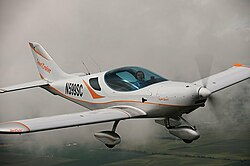
Flight Design · 1997+
Flight Design CT / CTLS / CTLSi
 i
iSpecifications
MOSAIC eligiblePerformance
Cruise
115KTAS
Range
721nm
Climb
805fpm
Ceiling
15,000ft
Fuel Burn
4.3gph
Fuel Cap.
34gal
MPG
30.8mpg
Stall (Vs0)
39KIAS
T/O roll
460ft
Ldg roll
500ft
Size & weight
Seats
2
Useful Load
520lbs
Full-fuel payload
316lbs
Max gross
1,320lbs
Wingspan
27.6ft
Length
20ft
Engine
Engine
Rotax 912ULS / 912iS
Power
100hp
TBO
2,000hrs
Overhaul
$17k
Owning it
Hull insurance
$2k/yr
Parts
fair
Mechanics
specialist
Gear
Fixed
IFR
No
Category
light sport
Full specification
V-speeds
Airframe
- Empty weight
- 800 lbs
- Max fuel weight
- 204 lbs
- Height
- 7.7 ft
- Wing position
- high
- Auto fuel (mogas)
- Auto fuel specified by the engine maker — 91 premium
Obstacle performance
- Takeoff over 50 ft
- 820 ft
- Landing over 50 ft
- 900 ft
Paperwork
- Certification basis
- ASTM F2245 (S-LSA)
These figures are typical for the model, not a specification for any individual aircraft. Real-world numbers vary with year, installed equipment, weight, modifications and engine condition — often by more than you would expect. Use them to compare types, and confirm anything you would act on against the Pilot's Operating Handbook for that specific airframe and a prebuy inspection.
Pricing
Typical
$110k
Range
$55k – $200k
Annual all-in
~$14k/yr
All-in at ~100 flying hours a year, using the midpoint of each range — the same figures broken out under “Cost to own” below. Your number will differ, and mostly for two reasons. Experience sets your insurance: a 2,000-hour pilot with recent training pays 30–40% less than a 200-hour owner, and student owners pay 20–40% more — on the same aircraft that is often a doubling. Location sets your hangar: a T-hangar runs $200–400 a month in the Midwest against $400–1,500 in a coastal metro, and an outside tie-down is less again. Engine reserves move too — a local shop reusing your serviceable cylinders can come in 30–50% under the national specialty-shop pricing we quote, though you trade the warranty and turnaround that comes with it. Reserves are money set aside toward a future overhaul, not a bill this year, and the annual inspection figure is the shop’s labor to look — whatever they find is separate.
Cost to own — estimate
Set your yearly hours and local fuel price. Fixed costs (insurance, hangar, annual inspection) don't change with hours; fuel, maintenance and the engine reserve do.
- Fuel (4.3 gph)
- $2,795
- Engine reserve
- $850
- Maintenance, parts & wear items ($12/hr)
- $1,200
- Insurance
- $1,000–$2,750
- Hangar
- $3,312–$8,280
- Annual inspection (labor only)
- $1,200
- Databases & subscriptions
- $400
- Total per year
- $14,116
- Per flight hour
- $141
- Miles flown / year (at cruise)
- 13,234 mi
- Cost per mile
- $1.07/mi
- Time in the air
- 2 hr 37 min
- Fuel burned
- 11 gal
- Out of pocket
- $126
Fuel, engine reserve and wear only. Insurance, hangar and the annual are already paid whether you make the trip or not, so they are not charged here.
Estimate, not a quote. Where a line shows a range, the total, per-hour and per-mile figures use its midpoint— insurance moves most with your experience and time in type, hangar with where you base the aircraft, so your own number could sit at either end. Annual inspection is the shop's labor to open and inspect — what they find is the maintenance line, which covers oil changes, plugs, tires, brakes, hoses, lights, a battery and vacuum pump amortised over their life, and the unscheduled squawks that are the largest and least predictable part of it. Reserves are sinking funds toward an overhaul, not a bill you pay this year — and note that a propeller is due on hours or calendar time, typically six years, so flying less does not put it off forever.
Strengths
- Exceptional fuel efficiency: 4–5 GPH cruise, 800+ nm range, lowest operating cost in LSA category (~$45/hr all-in)
- BRS whole-airframe parachute standard on most models — documented life-saver in multiple deployments
- Rotax 912 engine widely supported with parts available through major suppliers regardless of manufacturer status
- Docile handling and side-by-side seating make it ideal for training and cross-country flying
Weaknesses
- Manufacturer insolvency (December 2024) creates uncertainty for long-term airframe parts availability
- Composite construction intolerant of hard landings; landing gear fractures and nose-gear issues documented on pre-2008 models
- Five-year hose replacement ($4,000) is largest single routine maintenance expense; failure to comply is known cause of engine problems
- LSA category limits night VFR flight for sport pilots and prevents aerobatics; not suitable for backcountry operations
Overview
The Flight Design CT series is one of the best-selling light-sport aircraft families in the world, with over 2,000 delivered across more than 60 countries since production began in 1997. Designed in Germany by Flight Design GmbH (founded 1993), the CT line established a benchmark for what an LSA can achieve: 115 KTAS cruise, 800+ nm range, and a generous useful load from a two-seat composite airframe burning 4–5 GPH on a Rotax 912.
The aircraft traces its lineage from European ultralight regulations. The original CT debuted in 1996, followed by the CT2K, the short-wing CTSW (widely used for FAA S-LSA compliance after the 2004 LSA rule), the CTLS with revised tail and landing gear in 2008, the fuel-injected CTLSi in 2012, and the next-generation F2 in 2019. The companion CTMC (Metal Concept) variant uses welded steel and aluminum construction aimed at flight training durability.
All CT variants share a high-wing, side-by-side composite airframe with a Rotax engine, fixed tricycle gear, slotted flaps, and an all-moving horizontal stabilator. The BRS whole-airframe parachute system — standard on most production models — has saved lives in multiple documented CT deployments and is a meaningful safety differentiator versus most other LSA designs.
Production and company note: Flight Design GmbH entered insolvency in 2016 due to financial difficulties; LiftAir acquired the company in 2017 and resumed deliveries. The Ukraine war disrupted production at the Kherson factory beginning in 2022. Flight Design filed for insolvency again in December 2024 following the loss of Ukrainian production capacity, with restructuring underway from a Czech Republic facility. This creates parts and support uncertainty for new buyers that should be factored into pre-purchase analysis.
As of 2026, the CTLS/CTLSi remains the core product, with approximately 362 FAA-registered CTLS and CTSW models in the US fleet. Used examples from $55,000 (early CTSW) to $160,000 (recent CTLSi) are the primary market. New production pricing is uncertain pending restructuring resolution.
Variants & History
| Variant | Years | Engine | HP | Gross Wt (lbs) | Key Differences |
|---|---|---|---|---|---|
| CT / CT2K | 1997–2003 | Rotax 912UL/ULS | 80–100 | 1,042 | Original composite design; European UL cert; narrower useful load |
| CTSW | 2003–2017 | Rotax 912ULS | 100 | 1,042–1,320 | Shorter 27'11" wingspan; US S-LSA cert 2005; nosewheel issues on early examples |
| CTLS | 2008–2017 | Rotax 912ULS | 100 | 1,320 | Revised tail; improved nosegear; better handling; 28'2" span |
| CTLS-Lite | 2010–2013 | Rotax 912ULS | 100 | 1,320 | Reduced features; lower entry price; discontinued |
| CTHL | 2010–2014 | Rotax 914 | 115 | 1,320 | High-lift/turbocharged; float and tow operations; limited production |
| CTLSi | 2012–present | Rotax 912iS | 100 | 1,320 | Fuel-injected; 21% lower fuel burn; FADEC; 2,000-hr TBO; current production |
| CTMC | 2008–2017 | Rotax 912ULS | 100 | 1,320 | Metal Concept: welded steel cage + aluminum; training market; 5–7 kts slower; 50 lbs less useful load |
| CT-Super / Super Injection | current | Rotax 912ULS / 912iS | 100 | 1,320 | The current CT. Dynon D1000 EFIS/MFD, BRS standard, Day-VFR; night and autopilot optional. Flight Design says it "can be delivered with a 710 pounds empty weight" using simplified avionics and lighter European-spec parts — about 610 lb useful load if so |
| CTLSi GT "2020" | 2020–present | Rotax 912iS | 100 | 1,320 | $189,000 fully loaded. Dual Garmin G3X 10.6" or dual Dynon SkyView HDX, GFC 507 autopilot with level button, BRS 1350, ASTM night package, lithium-iron battery, 3-axis trim. Quoted at 35 gal where the spec table says 34 |
The CTLS to CTLSi transition in 2012 is the most important single upgrade in the line. The Rotax 912iS fuel injection cuts fuel burn from ~5.5 GPH to ~4.3 GPH at cruise, eliminates carburetor icing concerns, improves high-altitude performance, and the dual-channel FADEC electronic ignition reduces spark plug and magneto maintenance. Most CTLS operators consider the 912iS well worth the premium on used aircraft.
The F2 used to be a row in this table and should never have been. It is a clean-sheet design, not a CT variant — different wing, different fuselage, different structure (pre-impregnated rather than wet-laid carbon), a combined throttle-and-brake lever, AMSAFE airbags and Garmin ESP. More to the point, the F2-CS23 is EASA CS-23 certified as of December 8, so the certified version is not a light-sport aircraft at all and cannot share a page with one. Listing it here meant anyone searching for an F2 landed on an LSA page describing a different airplane.
There is no F2 page yet, and that is deliberate. Flight Design publishes
the F2's engine, fuel capacity, cabin width, avionics and safety equipment and
no wingspan, weights, cruise speed, stall speed, climb rate or range. Its
own specifications-brochures page 404s, and the Flying Magazine pilot report
it links to has rotted to a 404 as well. Of the ten fields a page here must
have, the F2 can supply seven. Writing it would mean inventing the wing of an
airplane nobody has published the wing of. The full record of what was searched
is in raw/mfr/flight-design-ct-f2-usa-2026-10-11.md; the EASA type
certificate would unblock it.
And a MOSAIC generation is coming. Flight Design announced an F2-M160
at Oshkosh 2026 and a "NEW F2 MOSAIC & CT SERIES GENERATION" at AERO 2026. The
name suggests MOSAIC and 160 hp — a Rotax 916 iS in this family — but that is
an inference from a product name and no specification has been published. This
is the third manufacturer found in one day to have rebuilt its line around
MOSAIC while our pages describe the pre-MOSAIC products; see
docs/LSA-CATEGORY-GAP.md.
Performance
The stored range was wrong by 109 nm and in the wrong unit. This page
carried range_nm: 830. Flight Design publishes "Max. Range; 34 Gal. no
reserve 4300 RPM | 830 miles" — statute miles, written as the word
"miles" immediately beside the number. The field is nautical. 830 sm is
721 nm, and that is what the page now stores.
This is the failure docs/CATALOG-RESEARCH-PROTOCOL.md names in so many
words: "Statute miles stored as nautical… 59 of 279 pages currently claim
more range than their own fuel allows." It was not a hard number to check —
the source says "miles" in plain text.
Do not read the range and the cruise speed as a pair. The 721 nm is at 4300 RPM with no reserve; the 115 KTAS cruise is at 75% power. 4300 RPM is below 75% on a Rotax 912, so the two figures describe different flights at different speeds. A trip planned at 115 kt will not go 721 nm, and a flight flown for 721 nm will not average 115 kt. Treat 721 nm as a still-air economy maximum with nothing held back, and plan a real leg with a reserve well inside it.
One more disagreement left unresolved, deliberately. The manufacturer's specification page gives a takeoff roll of 800 ft at gross weight; this page carries 460 ft. Neither figure states its temperature, altitude or technique, so there is no basis for choosing between them — a 460 ft roll and an 800 ft roll can both be true of the same airplane on different days. The stored figure is unchanged and this note is the flag. A handbook would settle it; none was reachable.
The CTLSi's published numbers are 115 KTAS at 75% power on 4.3 GPH, with 830 nm maximum range. Real-world pilots report 5–6 GPH at normal cruise, and 800 nm range with VFR reserves — consistent with factory figures. At economy cruise (55–60% power), fuel burn drops to 3–3.5 GPH with airspeed of 105–110 KTAS, enabling extraordinary endurance of 7+ hours on 34 gallons.
The CTLS is not a STOL performer despite its high-wing configuration. The 460-foot ground roll (published, sea level, standard day, max gross) is good but not remarkable. The slotted high-lift flaps help Vs0 to 39 KIAS, enabling approach at 55–60 KIAS. Obstacle clearance performance (takeoff over 50 ft obstacle: ~820 ft) is competitive with similarly powered certified aircraft.
Rate of climb at 805 FPM (published) is adequate but the CT climbs more efficiently at Vy (71 KIAS) than feels intuitive to pilots used to certificated aircraft with lower Vy speeds. Density altitude affects performance significantly — the naturally-aspirated 912ULS/912iS produces full power only at sea level. Plan for 10–15% climb performance reduction per 3,000 ft of density altitude.
The CTLS service ceiling is 15,000 ft. The CTHL variant with the turbocharged Rotax 914 extended this meaningfully for operations over mountainous terrain. The carbureted 912ULS is susceptible to carburetor icing in IMC-adjacent conditions — a limitation the fuel-injected 912iS eliminates.
The VNE of 145 KIAS is the published figure for the CTLSi (flightdesignusa.com spec sheet). The CTSW's VNE was listed at 163 KIAS (300 km/h) in the European ultralight certification, but the US S-LSA documentation used the lower number. Pilots should always reference their specific variant's limitations.
The CT is universally described as "light and responsive" on controls with a noticeably different feel than standard-category aircraft. The side-stick control (rather than a conventional yoke) and the all-moving horizontal stabilator contribute to a sensitive pitch response. Visibility from the high wing is excellent. The cockpit is positioned such that pilots sit "out over the wing strut," which can complicate landing flare judgment — most CTLS pilots tape a reference mark on the windshield until the sight picture is ingrained.
Payload & Range
CTLSi (Rotax 912iS, 100 HP, 34 gal usable, 1,320 lb gross, 800 lb empty weight)
Useful load = 520 lbs. Max fuel weight = 204 lbs (34 gal × 6.0 lb/gal).
| Scenario | Fuel (gal) | Fuel Wt (lbs) | Available for Pax+Bags (lbs) | Range (nm) | Notes |
|---|---|---|---|---|---|
| Full fuel + 2 light pax | 34 | 204 | 316 | 830 | 2 × 150 lb = 300 lbs; 16 lbs bags |
| Full fuel + 2 avg pax | 34 | 204 | 316 | 830 | 2 × 170 lbs exceeds payload; reduce fuel |
| Half fuel + 2 avg pax | 17 | 102 | 418 | 430 | 2 × 170 = 340 lbs; 78 lbs bags |
| Full fuel, solo pilot | 34 | 204 | 316 | 830 | 1 × 200 lb pilot; 116 lbs bags |
| Max payload, min fuel | 8 | 48 | 472 | ~200 | 2 × 200 + 72 lbs bags; short-hop only |
Payload note: The CTLS has a published useful load of approximately 520–552 lbs depending on installed equipment and variant. Empty weight varies; heavier avionics configurations reduce useful load. Verify actual empty weight from aircraft weight-and-balance document — factory "typical" empty weight of 717–810 lbs means real-world useful load can range from 510 to 600 lbs.
Key constraint: Two average-weight US adults (170 lbs each = 340 lbs combined) leave only 180 lbs for fuel and bags on a 520-lb useful load aircraft. Full fuel (204 lbs) with two average pilots is not possible. Practical two-occupant loading typically means 17–25 gallons of fuel, limiting range to 300–600 nm. For true long-range solo flight, the CT shines; for two-up long-range flying, careful weight planning is required.
F2 comparison (Rotax 912iS, 34 gal, 1,320 lb gross, 840 lb empty):
- Useful load: 480 lbs — less than the CTLS due to heavier empty weight from wider cabin/safety features
- Two 170-lb pilots (340 lbs) leave only 140 lbs for fuel — approximately 23 gallons, or ~450 nm range
- F2 is best understood as a comfort-optimized aircraft, not a payload maximizer
Mission Suitability
| Mission | Score | Rationale |
|---|---|---|
| Flight Training | 8 | One of the most common LSA trainers in the US. Low operating cost (~$45/hr all-in), side-by-side seating, Rotax reliability, BRS safety, and docile stall behavior make it excellent. The sport pilot market is the CT's core use case. High wing and wide cabin work well for instruction. |
| Backcountry / Bush Flying | 2 | Not suited for backcountry. Composite construction is intolerant of rough strip abuse. Tricycle gear with sensitive nose wheel, no tailwheel option, minimal ground clearance. The CTHL floatplane variant exists but is rare. |
| Business Travel | 3 | 115 KTAS, two seats only, LSA limitations (no night VFR for sport pilots without PPL), and uncertainty over manufacturer support reduce utility. Solo regional travel is feasible, but not a business aircraft. |
| aerobatics | 1 | LSA category; no aerobatic approval. +4g / -2g design load limits. |
| Cross-Country Flying | 7 | The CT's strongest suit outside training. Best range-per-gallon of any common LSA. 800+ nm with a reserve means coast-to-coast in 2–3 legs. 115 KTAS is competitive with many 172-class aircraft. Auto fuel compatibility saves money on long trips. IFR-incapable is the limiting factor. |
| Cargo Hauling | 1 | Two seats, modest baggage compartment, 520 lb useful load consumed primarily by occupants and fuel. Not a cargo platform. |
| Local Fun Flying | 8 | Fun, efficient, and affordable to operate. The CT handles well, the BRS adds safety margin, and the Rotax 912 enables auto fuel. At $45/hour all-in, pilots can fly more often. The high wing, wide cabin, and good visibility make every flight pleasant. |
| surveying | 5 | High wing provides excellent downward visibility. 7+ hour endurance at economy cruise is exceptional for extended survey operations. Stable in cruise. Limited by two-seat capacity and LSA weight restrictions on equipment. |
Avionics Ecosystem
Base/Entry (older used CTSW/CTLS, ~2005–2010): Dual Dynon D100/D120 EFIS screens, Garmin 496 GPS, SL30 nav/comm, GTX 327 transponder. Adequate for VFR. Many mid-market used examples fall in this tier.
Mid-tier (CTLS/CTLSi, ~2010–2016): Dual 7-inch Dynon SkyView screens, Garmin aera 796 or 796/796 GPS, SL40 comm, GTX 330 Mode-S transponder, traffic information service (TIS). ADS-B In via Dynon. Most CTLS in the $90K–$130K range are in this tier.
Premium (recent CTLSi, ~2016–present): Dual 10-inch Dynon SkyView HDX displays with synthetic vision (SVS), Dynon SV-2 autopilot, GTX 345 ADS-B In/Out transponder, integrated engine monitoring, battery backup on all screens. Factory-configured pricing at this tier is $150K–$170K used.
F2 Standard: Dual 10-inch Garmin G3X Touch with EFIS/MFD functionality, GTX 345 transponder, G5 standby display, optional GFC 500 autopilot with envelope protection. The G3X integration with the Rotax 912iS engine management system provides comprehensive engine diagnostics and digital checklists.
Per Avionics Pricing Reference: upgrading an older Dynon D-series panel to SkyView HDX typically runs $8,000–$15,000 installed. Factory-fresh CTLSi and F2 avionics represent good value versus aftermarket upgrades on early CT models.

2011 CubCrafters Carbon Cub
Carbon Cub SS · STOL Legend · Tundra Tires
STCs & Modifications
S-LSA aircraft operate under ASTM standards, not FAA Part 23. Modifications must be approved through manufacturer-issued service documentation rather than STCs. Key approved modifications:
Engine:
- Rotax 912iS upgrade (carbureted 912ULS to fuel-injected 912iS): Factory-approved conversion. Eliminates carb icing, reduces fuel burn 21%, improves starts. Approximate cost: $10,000–$15,000 installed including airframe harness and ECU wiring.
- Rotax 914 (turbocharged) installation: Available for CTHL variant; limited applicability to standard CTLS.
Structural / Cosmetic:
- 600 kg (1,323 lb) gross weight increase: DAeC-approved for newer CTLS models; upgrades standard 600 kg (1,320 lb) models. Most current production CTLS are delivered at 600 kg; conversion available at authorized Flight Design maintenance facilities.
- LED landing/position/strobe lights: Manufacturer-approved replacement for incandescent. Reduces electrical load and improves visibility. Cost: $800–$1,500.
- Electric trim system: Aftermarket electric elevator trim upgrade available through authorized dealers. Reduces workload, especially on longer cross-country flights. Cost: ~$2,000 installed.
- Wheel fairings: Factory option; improve cruise by 2–3 knots.
BRS Parachute:
- BRS-1350 HS repack: Required every 6 years (or per BRS inspection schedule). Cost: ~$1,000–$1,500 at certified BRS shop.
- BRS-1350 replacement: If parachute is beyond service life, replacement is $5,000–$8,000.
Maintenance & Support
Per Maintenance Ecosystem:
Routine maintenance:
- Condition inspection (annual equivalent): $700–$900. The S-LSA annual is simpler than a Part 23 annual — no required airframe overhaul items, manufacturer-defined inspection procedures. Must be performed by FAA-certificated A&P or LSA Repairman (Maintenance).
- Rotax 100-hour inspection: ~$250–$450 flat-rate at a Rotax-authorized shop. Includes carburetor sync (912ULS) or fuel injection check (912iS), oil/filter change, gearbox check.
- Carburetor sync (912ULS only): Required at 200-hour intervals; ~$250.
- Gearbox inspection: 1,000-hour interval (or 600 hours if >50% 100LL operation); ~$300.
- Propeller inspection: 1,500-hour interval; ~$450.
- BRS parachute repack: Every 6 years; ~$1,000–$1,500.
- Rubber hose replacement: Every 5 calendar years; ~$4,000 including labor. This is the largest single routine maintenance expense.
Engine overhaul:
- Rotax 912ULS TBO: 1,500–2,000 hours (2,000 hr TBO with regular oil analysis). Overhaul cost: $10,000–$15,000 exchange.
- Rotax 912iS TBO: 2,000 hours. Overhaul cost: $15,000–$20,000 exchange.
- Engine reserve: ~$8–$10/hour for 912ULS; ~$9–$10/hour for 912iS.
Mechanic availability:
- LSA Repairman (Maintenance) certificate required for condition inspections on S-LSA. Pilots can obtain an LSA Repairman (Inspection) certificate to perform their own condition inspections (not the case for standard-category aircraft).
- Rotax 912 mechanics: Rotax-authorized service centers are widespread in the US; Rotax parts are readily available through Aircraft Spruce, Lockwood Aviation, and other suppliers regardless of Flight Design's manufacturer status.
- Airframe parts: Composite panels, canopy, gear, and fuselage parts flow through Flight Design USA (Airtime Aviation as of 2024). The manufacturer's December 2024 insolvency increases long-term risk for unique airframe parts. CTSW/CTLS airframe parts availability is rated "fair" due to this uncertainty.
Annual operating cost estimate (100 hrs/year):
- Fuel (4.3 GPH, $6.00/gal mogas average): ~$2,580
- Annual inspection: ~$800
- Rotax 100-hr service: ~$350
- BRS repack reserve: ~$250/year (amortized over 6 years)
- Engine overhaul reserve: ~$900/year
- Hose replacement reserve: ~$800/year (amortized over 5 years)
- Other maintenance, oil: ~$500
- Total direct operating costs: ~$6,180/year (~$62/hour)
- Add hangar ($2,400–$6,000/year) and insurance ($1,200–$2,000/year) for full ownership cost.
Valuation Factors
Per Aircraft Valuation Methodology:
Price tiers (2024–2026 market):
| Variant | Year Range | Typical Used Price | Notes |
|---|---|---|---|
| CT / CT2K | 1997–2003 | $35,000–$60,000 | Early examples; older engine; lower useful load |
| CTSW | 2003–2008 | $55,000–$90,000 | Most common used market; verify gear service bulletins |
| CTLS | 2008–2012 | $80,000–$120,000 | Improved design; solid used values |
| CTLSi | 2012–2020 | $100,000–$160,000 | Fuel injection; current engine; best long-term value |
| F2 | 2019–present | $160,000–$200,000+ | New design; limited supply; top of market |
Key value drivers:
- Engine variant: 912iS fuel-injected models command a $15,000–$25,000 premium over carbureted 912ULS equivalents of the same year.
- Avionics configuration: Dual Dynon SkyView HDX or Garmin G3X panel adds $10,000–$20,000 versus legacy Dynon D-series equipment.
- BRS parachute status: Parachute within repack interval (current) vs. overdue repack is a ~$1,500 buyer cost. A parachute approaching end-of-service-life ($8,000 replacement) should be reflected in price negotiations.
- Documentation quality: Thorough maintenance records (Safety Directive log, hose replacement, oil change intervals, gear inspection) add $5,000–$10,000 to justified market value.
- Engine TBO remaining: 912iS at 2,000-hr TBO — each 500 hours of remaining life is worth approximately $3,000–$4,000 versus a mid-time engine.
- Manufacturer insolvency risk (2025–2026): Flight Design's December 2024 insolvency filing has introduced uncertainty around parts support. This is likely to compress prices for all variants, especially newer aircraft dependent on manufacturer parts supply. Early CTSW/CTLS models with widely-available parts are relatively insulated.
- Gear service history (CTSW): Nose gear service bulletin compliance is a meaningful value factor on CTSW examples.
ADs & Common Problems
S-LSA aircraft are not subject to FAA Airworthiness Directives. Instead, Flight Design issues Safety Directives (Service Notices, Service Bulletins, Safety Alerts), compliance with which must be recorded per ASTM standards. CTLS owners must maintain current records of all applicable Safety Directives — a requirement not always met on poorly-maintained used aircraft.
CTSW-specific issues (important for pre-buy on 2003–2008 aircraft):
- Nosewheel shimmy and steering: Early CTSW nose gear design had documented shimmy issues and gear failures under hard landings. Flight Design issued service bulletins for reinforcement. Verify service bulletin compliance and inspect nose gear strut, rod ends, and steering mechanism for wear.
- Landing gear fractures: Composite main gear legs have fractured on hard or sideways landings. The problem was partly attributed to inadequate pilot checkout — the CT requires landing on main wheels, not the nose. Inspect main gear attach points and gear legs for cracks. Replacement gear is $1,500–$3,000 per leg.
CTLS/CTLSi issues (2008-present):
- Rotax oil maintenance: CT aircraft frequently flown on 100LL require oil and filter changes every 25 hours (vs. 100 hours on mogas). "Lead mud" accumulation in the oil tank from 100LL operation without adequate oil change intervals is a red flag on pre-buy. Inspect the oil tank interior.
- Five-year hose replacement: Rotax 912 rubber hoses (coolant, fuel, breather) must be replaced on a 5-year calendar interval regardless of hours. Average cost: $4,000. Verify this was done — failure to replace aging hoses is a known cause of engine problems.
- Canopy seals and trim tab deformation: Aircraft left outside can develop leaking canopy seals (water intrusion) and tail trim tab deformation from sun/heat exposure. Inspect for warping or paint separation on the horizontal stabilator trim tab.
- Wingtip strobe haziness: Wing-tip strobe lenses become milky on aircraft that have sat outside in UV exposure. Cosmetic but indicative of overall storage quality.
- Oil return line disconnection: Documented failure mode where oil return lines become disconnected, potentially leading to rapid oil loss and engine failure. Inspect all oil line connections and verify service bulletin compliance.
- Composite repair history: Composite damage must be repaired per manufacturer procedures. Inspect belly, wing leading edges, and nose for non-standard repairs. Poor composite repairs are expensive to remediate.
Pre-buy essentials:
- Full logbook review: look for frequent oil changes (sign of 100LL use), BRS inspection/repack dates, hose replacement records, gear repairs, and Safety Directive compliance log.
- Detailed condition inspection write-up (at least 1 page of findings) indicates thorough maintenance. Short three-line annual write-ups are a red flag. Well-documented aircraft command a $5,000–$10,000 premium but are worth it.
- Verify nose gear strut condition (CTSW especially) and main gear attach point inspection.
- Check manufacturer support status — parts availability has become a concern given the December 2024 insolvency filing.
Insurance Profile
Per GA Insurance Underwriting:
Typical annual premiums (2024–2025):
- Hull + liability ($100,000 hull / $1M liability / $100K per-passenger): ~$1,617/year
- Hull + liability (no per-passenger sublimit, $100K hull): ~$2,098/year
- Range for typical used CTLS: $900–$2,000/year depending on hull value, pilot experience, and liability limits selected
Underwriting factors specific to LSA/CTLS:
- Pilot hours: Pilots with 250+ total hours and 25+ hours in make/model receive the most favorable rates. Low-time sport pilots (<100 hours) face higher premiums and may require a CFI checkout hour before coverage binds.
- Sport Pilot certificate: Sport Pilot holders (vs. Private Pilot with SP privileges) are accepted by all major LSA insurers. Some insurers require BasicMed or medical certificate for higher coverage limits.
- BRS parachute: Some underwriters offer a modest discount for BRS-equipped aircraft; others treat it as neutral. Confirm with your broker.
- Flight school use: Commercial training operations require a different policy structure, typically $2,000–$3,500/year for fleet coverage.
- Lapsed repack: An overdue BRS repack can complicate hull coverage. Maintain current repack status.
Primary LSA insurers: USAIG, Global Aerospace, Avemco, and Skywatch AI write LSA coverage. BWI and Aviation Insurance Resources (AIR) are common brokers. Skywatch AI offers usage-based/hourly LSA coverage which may benefit low-utilization owners.
For sale (0)
No listings for this model right now.
For sale elsewhere (5)
Current ads on Barnstormers, checked daily. Photos, full details and the seller are on the listing site.
2006 Flight Design CT / CTLS / CTLSi
Listed on Barnstormers2006 Flight Design CT / CTLS / CTLSi
Listed on BarnstormersAutopilot (unspecified) · Garmin G3X Touch
View photos and full ad on Barnstormers ↗2008 Flight Design CT / CTLS / CTLSi
Listed on BarnstormersADS-B In · ADS-B Out · Autopilot (unspecified) · Airframe parachute (CAPS/BRS)
View photos and full ad on Barnstormers ↗2014 Flight Design CT / CTLS / CTLSi
Listed on BarnstormersAutopilot (unspecified) · Garmin aera / GPSMAP portable
View photos and full ad on Barnstormers ↗Flight Design CT / CTLS / CTLSi
Listed on BarnstormersADS-B Out · Autopilot (unspecified)
View photos and full ad on Barnstormers ↗Also worth looking at
What buyers usually weigh against the Flight Design CT / CTLS / CTLSi — aircraft flown for the same kind of mission.