Wainfan · 1993–1995
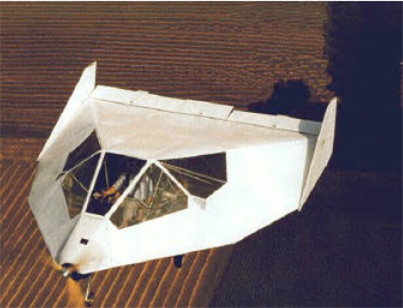
Wainfan FMX-4 Facetmobile
Specifications
MOSAIC eligiblePerformance
Cruise
78KTAS
Range
180nm
Climb
750fpm
Ceiling
10,000ft
Fuel Burn
3.5gph
Fuel Cap.
10gal
MPG
25.6mpg
Stall (Vs0)
26KIAS
T/O roll
400ft
Ldg roll
350ft
Size & weight
Seats
1
Useful Load
370lbs
Full-fuel payload
310lbs
Max gross
740lbs
Wingspan
—ft
Length
—ft
Engine
Engine
Rotax 503 DCDI
Power
46hp
TBO
300hrs
Overhaul
$4k
Owning it
Hull insurance
—/yr
Parts
poor
Mechanics
rare
Gear
Fixed
IFR
No
Category
experimental
Full specification
V-speeds
Airframe
- Empty weight
- 370 lbs
- Max fuel weight
- 60 lbs
- Wing position
- mid
Obstacle performance
- Takeoff over 50 ft
- 900 ft
- Landing over 50 ft
- 800 ft
Paperwork
- Certification basis
- Experimental Amateur-Built
These figures are typical for the model, not a specification for any individual aircraft. Real-world numbers vary with year, installed equipment, weight, modifications and engine condition — often by more than you would expect. Use them to compare types, and confirm anything you would act on against the Pilot's Operating Handbook for that specific airframe and a prebuy inspection.
Pricing
Typical
$0k
Range
$0k – $0k
Annual all-in
~$12k/yr
All-in at ~100 flying hours a year, using the midpoint of each range — the same figures broken out under “Cost to own” below. Your number will differ, and mostly for two reasons. Experience sets your insurance: a 2,000-hour pilot with recent training pays 30–40% less than a 200-hour owner, and student owners pay 20–40% more — on the same aircraft that is often a doubling. Location sets your hangar: a T-hangar runs $200–400 a month in the Midwest against $400–1,500 in a coastal metro, and an outside tie-down is less again. Engine reserves move too — a local shop reusing your serviceable cylinders can come in 30–50% under the national specialty-shop pricing we quote, though you trade the warranty and turnaround that comes with it. Reserves are money set aside toward a future overhaul, not a bill this year, and the annual inspection figure is the shop’s labor to look — whatever they find is separate.
Cost to own — estimate
Set your yearly hours and local fuel price. Fixed costs (insurance, hangar, annual inspection) don't change with hours; fuel, maintenance and the engine reserve do.
- Fuel (3.5 gph)
- $2,275
- Engine reserve
- $1,167
- Maintenance, parts & wear items ($12/hr)
- $1,200
- Insurance
- $900–$1,800
- Hangar
- $2,400–$7,200
- Annual inspection (labor only)
- $1,200
- Databases & subscriptions
- $400
- Total per year
- $12,392
- Per flight hour
- $124
- Miles flown / year (at cruise)
- 8,976 mi
- Cost per mile
- $1.38/mi
- Time in the air
- 3 hr 51 min
- Fuel burned
- 13 gal
- Out of pocket
- $179
Fuel, engine reserve and wear only. Insurance, hangar and the annual are already paid whether you make the trip or not, so they are not charged here.
Estimate, not a quote. Where a line shows a range, the total, per-hour and per-mile figures use its midpoint— insurance moves most with your experience and time in type, hangar with where you base the aircraft, so your own number could sit at either end. Annual inspection is the shop's labor to open and inspect — what they find is the maintenance line, which covers oil changes, plugs, tires, brakes, hoses, lights, a battery and vacuum pump amortised over their life, and the unscheduled squawks that are the largest and least predictable part of it. Reserves are sinking funds toward an overhaul, not a bill you pay this year — and note that a propeller is due on hours or calendar time, typically six years, so flying less does not put it off forever.
Strengths
- Unique lifting-body aerodynamics; genuine stall-proof handling (mushing below 30 mph without break)
- Extremely low fuel burn and modest operating costs ($1,500–$3,500/year)
- Historically significant one-off; EAA award winner and NASA research basis
- Very light useful load and short ground roll suit confined-area operations in principle
Weaknesses
- Single prototype only; no plans, kits, or production support; unobtainable for any buyer other than Wainfan
- Rotax 503 out of production since 2010; parts availability declining; ~300-hour TBO requires re-engine planning
- No maintenance manual, illustrated parts catalog, or mechanic familiarity; builder must perform all service
- Fragile aluminum gear, high drag, slow cruise (78 KTAS), marginal density-altitude performance, sensitive to gusts
Overview
The Wainfan FMX-4 Facetmobile is a one-off homebuilt research aircraft designed and built by Barnaby Wainfan, a professional aerodynamicist at Northrop Grumman (where he has worked on stealth and advanced tactical aircraft programs) and a long-time Kitplanes magazine columnist. First flown on April 22, 1993, the Facetmobile is not a production kit and only a single prototype exists — it was built to explore whether an all-lifting-body configuration could produce a practical, safe, low-cost personal airplane.
The aircraft's most striking feature is that it has no distinct wing: the entire airframe is a low-aspect-ratio lifting body formed from eleven flat panels, giving it an angular, F-117-like appearance (though Wainfan's work predates and is unrelated to stealth goals). The shape is a practical consequence of building a curved-lift surface out of straight aluminum tubing and flat-wrapped skins — faceting lets a homebuilder approximate a lifting body in a garage without compound curves or molds.
The Facetmobile flew roughly 130 hours of test flying through the mid-1990s, won the EAA Special Award for Innovative Design at Oshkosh AirVenture 1994, and became the basis for a later NASA-funded feasibility study (NAG-1-03054) exploring low-aspect-ratio airframes for Personal Air Vehicles. No plans or kits have ever been sold, and Wainfan has stated publicly that the airplane is a research vehicle rather than a product. For the FlightFinder knowledge base, the FMX-4 is included as a reference point for the lifting-body configuration and as an example of a builder-designer research project, not as a realistic recommendation. See also Rutan Long-EZ (Model 61) for another builder-designer's experimental configuration that did reach widespread homebuilt production.
Variants & History
| Variant | Years | Engine | HP | Gross (lb) | Notes |
|---|---|---|---|---|---|
| FMX-4 Facetmobile | 1993–present (prototype) | Rotax 503 DCDI 2-stroke | 46 | 740 | Single prototype, N-numbered experimental, still flyable as of Wainfan's most recent public updates. Eleven-facet lifting body, 6061 aluminum tube/sheet, Cherrymax rivets, BRS ballistic parachute, fixed tricycle gear. |
| FMX-5 / FMX-7 (paper) | — | — | — | — | Follow-on concepts Wainfan has discussed in articles and conference talks; two-seat and larger variants proposed but never built as full-scale aircraft. |
Performance
Documented performance is modest and consistent with a 46-hp two-stroke pushing a blunt low-aspect-ratio body: cruise around 90 mph (≈78 KTAS), 750 fpm climb solo, service ceiling around 10,000 ft. The headline number is not speed but minimum controllable airspeed: in flight test the FMX-4 mushed along at under 30 mph without a conventional stall break, because a very low-aspect-ratio lifting surface simply never reaches a sharp stall — lift degrades gracefully as angle of attack climbs past 20–30 degrees. Wainfan has demonstrated full-aft-stick flight with full control authority, which is the aerodynamic point of the whole exercise.
Drag is high for the installed power (flat-panel body, exposed gear, short span), so top speed and range are unremarkable. Range with the standard 10 gal tank is roughly 180 nm; with the 19 gal aux tank Wainfan fitted for cross-country demonstration flights, endurance stretches enough to reach Oshkosh from Southern California in legs. Density altitude hurts performance quickly because both thrust (small two-stroke) and L/D are marginal.
Payload & Range
With an empty weight of 370 lb and a gross weight of 740 lb, the Facetmobile's 370 lb useful load carries exactly one pilot and fuel. Full 10 gal main fuel = 60 lb of avgas/premium mogas + 2-stroke oil, leaving roughly 310 lb for the pilot — comfortable for most adults. With the 19 gal aux tank (≈114 lb fuel), pilot weight is capped near 256 lb before busting gross. Because the aircraft is single-place, there is no "full fuel + 2 pax" scenario; the realistic envelope is simply "how much fuel will fit under the pilot's weight." At 3.5 gph cruise, full-main endurance is roughly 2.8 hours / 180 nm still-air, and full-aux endurance is roughly 5.4 hours / 340 nm still-air — the latter is the configuration Wainfan actually used for the Oshkosh trip.
Mission Suitability
- Flight training (1): Single seat, one-off, no instructor access.
- Backcountry (2): Short ground rolls and low stall speed are backcountry-friendly in principle, but the 46 hp Rotax, fragile nose gear, and zero spares support make it a non-starter.
- Business travel (1): Single seat, 78 KTAS, VFR only.
- Aerobatics (1): Not stressed for acro, two-stroke engine, lifting-body configuration unsuited to sustained inverted flight.
- Cross-country (2): Wainfan has flown it cross-country, but slow, VFR, no payload for bags.
- Cargo (1): Single seat, 370 lb useful load including pilot + fuel.
- Local fun (6): This is the one mission where the Facetmobile shines — if you are the builder, it is a genuinely fun, unusual, stall-proof local airplane. For anyone else it is unobtainable.
- Surveying (1): No payload capacity, no camera port, no IFR.
Avionics Ecosystem
The prototype panel is minimal and reflects early-1990s homebuilt practice: airspeed, altimeter, VSI, slip-skid ball, engine tach and CHT/EGT for the Rotax, a magnetic compass, and a handheld VHF comm. No certified nav, no transponder originally (a Mode C transponder was added for later cross-country trips and AirVenture arrivals). There is no realistic "panel tier" discussion because there is only one airframe. A hypothetical modern rebuild would likely use a single small EFIS (Dynon D3/D10A class, Garmin G5, or MGL Xtreme) plus a handheld nav/com and ADS-B Out via a uAvionix skyBeacon-style unit — the airframe has no room or weight budget for a full glass panel.
STCs & Modifications
STCs are not applicable to experimental amateur-built aircraft. The only documented modification to the prototype itself is the auxiliary fuel tank Wainfan installed for the 1994 Oshkosh cross-country trip, extending capacity from 10 to 19 US gal, and the BRS ballistic parachute fitted as a safety system for the flight test program.
Maintenance & Support
- Parts availability: Poor. The airframe is entirely bespoke — every tube length, bracket, and panel was fabricated by the builder. Rotax 503 support is fading; new-production replacement requires re-engineering the motor mount for a 4-stroke (Rotax 582 is equally dead, 912 is too heavy, Hirth F-23/F-33 or HKS 700E are the plausible paths).
- Mechanic familiarity: Rare. No A&P has ever seen one; the builder (owner) performs the annual condition inspection under experimental rules, assisted by an A&P or DAR willing to sign it off.
- Annual cost: Nominally $1,500–$3,500/year for two-stroke top-end work, fuel system service, fabric/tape touch-ups, and the condition inspection. Expensive line items are rare because there are no expensive systems to fail.
- Documentation: Build drawings, weight & balance, flight test notes, and operating limitations exist only in Wainfan's own records and articles; there is no maintenance manual or illustrated parts catalog.
Valuation Factors
Not applicable in any normal market sense. The Facetmobile has never been sold, has no comparables, and Wainfan has not offered plans or kits. Any "valuation" is notional:
- Scratch-build material cost in 2026 dollars would run roughly $15,000–$25,000 (aluminum tube, sheet, rivets, Rotax 503 or modern 4-stroke substitute, basic instruments, BRS).
- The prototype itself is historically significant (EAA award, NASA study basis, one-of-a-kind) and would only change hands in a private arrangement with Wainfan or his estate.
- There is no engine-TBO-remaining premium, no avionics premium, no STC premium — standard valuation methodology from Aircraft Valuation Methodology does not apply.
- The
price_*frontmatter fields are set to 0 to signal "not available on any market" rather than any real dollar figure.
ADs & Common Problems
No Airworthiness Directives apply — experimental amateur-built aircraft are not subject to ADs, and as a single-prototype design there is no service-difficulty history. Known risk areas are those general to any Rotax 503–powered homebuilt:
- Rotax 503 two-stroke TBO is short (around 300 hours), and the engine has been out of production since 2010 — parts availability is declining and any long-term operator would need to re-engine.
- Carburetor ice on the 503 DCDI is a real risk in humid conditions.
- Fuel system vigilance: two-stroke oil injection lines, pulse-driven fuel pumps, and the small 10 gal main tank leave little margin.
- Nose gear and main gear are lightweight welded aluminum, not designed for rough-field abuse.
- As a lifting-body configuration with very low wing loading, the FMX-4 is sensitive to gusts and crosswinds despite its stall resistance.
Insurance Profile
Experimental one-off aircraft with a two-stroke engine and no type history are functionally uninsurable for hull coverage on the open market. A builder-owner would typically carry liability-only through an experimental-friendly broker (Avemco, Falcon, EAA program) with no hull, and premiums would depend almost entirely on the pilot rather than the airframe. The typical_hull_insurance_annual_usd field is set to 0 because no hull market exists; expect $400–$900/year for liability-only coverage in the 2026 market. See GA Insurance Underwriting for the general experimental category.
For sale (0)
No listings for this model right now.
Also worth looking at
What buyers usually weigh against the Wainfan FMX-4 Facetmobile — aircraft flown for the same kind of mission.


