Taylorcraft · 1946–2008
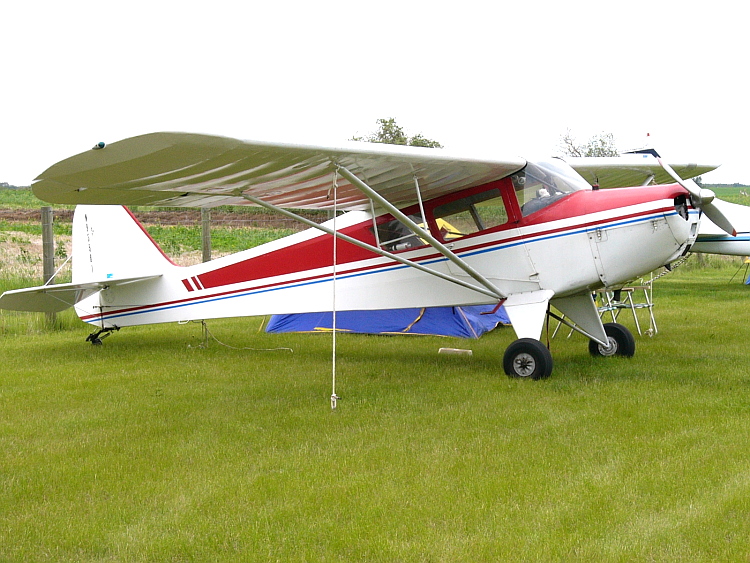
Taylorcraft BC-12D Twosome
Specifications
Cruise
83KTAS
Range
260nm
Seats
2
Useful Load
450lbs
Full-fuel payload
342lbs
Fuel Burn
4.2gph
Fuel Cap.
18gal
MPG
22.7mpg
Stall (Vs0)
30KIAS
T/O roll
500ft
Ldg roll
350ft
Power
65hp
Engine
piston single
Gear
Fixed
IFR
No
Category
certified
Pricing
Typical
$28k
Range
$18k – $45k
Annual all-in
~$6k/yr
All-in estimate at ~100 flying hours a year — fuel, annual inspection, engine reserve, insurance, and hangar. It scales with your actual hours, and insurance and hangar vary most by region and pilot.
Cost to own — estimate
Set your yearly hours and local fuel price. Fixed costs (insurance, hangar, annual inspection) don't change with hours; fuel and the engine reserve do.
- Fuel (4.2 gph)
- $2,730
- Engine reserve (toward overhaul)
- $889
- Fixed (insurance, hangar, annual, subscriptions)
- $1,881
- Total per year
- $5,500
- Per flight hour
- $55
- Miles flown / year (at cruise)
- 9,551 mi
- Cost per mile
- $0.58/mi
Estimate, not a quote — insurance and hangar (the fixed bucket) vary most by region and pilot. Anchored to our model figure at 100 hrs and $6.50/gal.
Strengths
- Exceptionally affordable and fun to fly—quintessential $100 hamburger airplane
- Simple, honest stick-and-rudder trainer; excellent for tailwheel endorsements
- Excellent parts support and active community (Univair, ITA, taylorcraft.org)
- Already LSA-compliant; lowest cost-of-ownership in certified GA
Weaknesses
- Tube-and-fabric airframe requires vigilant corrosion inspection and eventual re-cover ($15k–$30k+)
- 65 hp A-65 engine marginal at altitude and in hot/high conditions; density-altitude sensitive
- No electrical system on most examples; limited panel and no radio without retrofit
- Only ~260 nm range and 83 KTAS—fair-weather local flying only
Overview
The Taylorcraft BC-12D is a two-seat, side-by-side, high-wing, tube-and-fabric light airplane designed by C.G. Taylor — the same engineer who created the original Piper J-2 Cub before parting ways with William Piper in 1936. Taylor formed Taylorcraft Aviation in Alliance, Ohio, and the postwar Model B series became one of the archetypal classic lightplanes of American aviation. Over 2,800 BC-12Ds were built between 1946 and 1950, with the vast majority produced during the 1946 postwar boom year before the GA market collapse bankrupted Taylorcraft along with most of its competitors.
Unlike the tandem-seating piper-j3-cub, the Taylorcraft B series pioneered side-by-side seating in the ultralight category, offering a more social cockpit and better forward visibility. It competes directly with the luscombe-8-silvaire as a lightweight, economical classic two-seater. The company was resurrected multiple times — most notably to produce the F-19 Sportsman (1973-1980, 120 built) with a Continental O-200, and the F-21/F-21A/F-21B (1980-1990s, 43 built) with a Lycoming O-235. A final resurrection attempt ran until roughly 2008 under Taylorcraft Aviation LLC before folding again.
The BC-12D and its successors already met the pre-MOSAIC LSA definition (max gross at or below 1,320 lb for the BC-12D, max stall under 45 kt), making them sport-pilot legal without any weight-reduction gymnastics. Under the mosaic rule (effective for pilots October 2025, for aircraft certification July 2026), even the heavier F-19 and F-21 variants remain comfortably sport-pilot eligible. T-Crafts are revered as pure stick-and-rudder machines: light, responsive, honest, and cheap to fly. This page primarily covers the BC-12D; the F-19 and F-21 are treated in the Variants section.
Variants & History
| Variant | Years | Engine | HP | Gross Wt | Notes |
|---|---|---|---|---|---|
| BC-12D | 1946-1950 | Continental A-65-8 | 65 | 1,200 lb | Postwar production standard; ~2,800 built; 18 gal (12 gal header + 6 gal wing aux) |
| BC-12D-85 | late 1940s / field mod | Continental C-85 | 85 | 1,200-1,500 lb (STC dependent) | Common O-200/C-85 upgrade STC for real-world climb |
| F-19 Sportsman | 1973-1980 | Continental O-200 | 100 | 1,500 lb | 120 built; revived by Taylorcraft Inc.; 300 mi range; metalized struts, improved interior |
| F-21 | 1980-1985 | Lycoming O-235-L2C | 118 | 1,500 lb | 43 total F-21 series built; updated type certificate |
| F-21A | mid-1980s | Lycoming O-235 | 118 | 1,500 lb | Minor refinements |
| F-21B | late 1980s-1990s | Lycoming O-235 | 118 | 1,750 lb | Higher gross, 200 lb baggage, firewall battery, skylight option |
| F-22 | 1990s | Lycoming O-235 | 118 | 1,750 lb | Final production variant; few built under multiple resurrection attempts through ~2008 |
Most T-Crafts in the used market today are 1946 BC-12Ds; F-19s and F-21s are uncommon and typically command a premium.
Performance
Book numbers for the BC-12D show roughly 95 mph (≈83 KTAS) cruise at 2,150 RPM on the 65 hp Continental A-65, burning about 4.2 gph. Real-world owners report honest 85-90 mph indicated at altitude. Rate of climb is advertised at 500 fpm at sea level but drops rapidly with density altitude and gross weight — two adults plus fuel in a 65 hp T-Craft on a hot summer day produces anemic climb at best, and operators in the mountain west frequently upgrade to the C-85 or O-200. The airplane is a textbook density-altitude sensitivity case study; the 12,000 ft service ceiling is optimistic for a fully loaded example.
Stall speed is genuinely low (around 35 mph / 30 KIAS power-off at gross), contributing to short-field numbers in the 500 ft ground roll range. The T-Craft floats in ground effect and demands a proper stick-and-rudder approach — it's a more slippery wing than the Cub. Landing is more demanding than a J-3 because of the side-by-side cockpit's narrower tread and the higher approach speed, but it's still firmly in the "friendly classic tailwheel" category rather than the "squirrely" category.
The F-19 and F-21 improve every practical number: 100-120 mph cruise, 600-800 fpm climb, and meaningful useful load with two adults plus fuel and baggage. The F-21B's 1,750 lb gross with a 118 hp O-235 makes it a genuinely capable two-place cruiser rather than a fair-weather local hopper.
Payload & Range
The BC-12D is payload-limited before it is range-limited. With a 450 lb useful load:
- Two 170 lb pilots + full 18 gal fuel (108 lb): 340 lb + 108 lb = 448 lb, right at useful load. Legal but zero margin for baggage, coats, or a gallon of oil. Range at 4.2 gph leaves a ~3 hour / ~240 nm leg with 45-minute VFR reserve.
- Two 200 lb pilots + full fuel: 400 + 108 = 508 lb. Over gross. Fuel must be reduced to ~10 gal (60 lb), cutting usable range to ~100 nm.
- Solo + full fuel + 40 lb baggage: ~310 lb, comfortably under gross, with full 260 nm practical range.
- Two 170 lb pilots + 10 gal fuel: 340 + 60 = 400 lb, with 50 lb margin for light baggage. ~100 nm practical range.
The F-19 (1,500 lb gross, 100 hp, still 18 gal) roughly doubles the margin, allowing two adults, reasonable fuel, and real baggage. The F-21B (1,750 lb gross, 118 hp, 200 lb baggage area) is the only variant that is genuinely a "two adults plus stuff" cross-country airplane.
The honest summary: the BC-12D is a one-adult-or-one-couple fair-weather local airplane with enough range for a leisurely breakfast flight two counties over. Treat it as such and it is delightful; demand more and it disappoints.
Related: piper-j3-cub | luscombe-8-silvaire | piper-pa15-pa17-vagabond | mosaic | valuation-methodology | avionics-pricing | insurance-underwriting | maintenance-ecosystem

1980 Cessna 152
Honest Trainer · Mid-Time Engine · Fresh Annual
Mission Suitability
- Local fun flying (9/10): Exactly what this airplane exists for. Low stall, benign handling, panoramic visibility, fuel-sipper economics, nostalgic grin factor. A superb Sunday-morning $100 hamburger airplane and the quintessential "just fly" platform.
- Flight training (6/10): Excellent stick-and-rudder and tailwheel trainer for pilots who want to genuinely learn coordination and energy management. Not suited for primary students targeting PPL/IFR because there's no electrical system on most BC-12Ds, no radio without retrofit, and no modern instrument panel. Outstanding for tailwheel endorsements and LSA transition training.
- Backcountry (5/10): Short-field numbers are respectable and weight is low, but 65 hp is marginal at altitude, the gear is not bush-rated, and tire/prop clearance is modest. F-19/F-21 variants with more horsepower score higher here but still fall well short of a piper-pa18-super-cub or Maule.
- Cross-country (3/10): 83 KTAS cruise, ~260 nm range (about 3 hours at 4.2 gph on 18 gal with VFR reserves), minimal panel, and no electrical system on most airframes makes XC a fair-weather day-trip proposition. F-19/F-21 variants nudge this up to 4/10.
- Surveying (4/10): Slow speed and good visibility are surveying-friendly, but lack of electrical system and single door limit utility for camera mounts and sensor packages.
- Business travel (1/10), Aerobatics (1/10), Cargo (1/10): Not remotely the mission. BC-12D is placarded against intentional spins and is not certified for aerobatics.
Avionics Ecosystem
Most BC-12Ds were delivered without an electrical system — no starter, no battery, no lights, no radio. Hand-propping is normal and expected. Typical panels are airspeed, altimeter, compass, oil pressure, oil temp, tach, and perhaps a slip-skid ball. Period.
Modern owner upgrades tier roughly as:
- Bare-bones vintage ($0 extra): Stock 1946 panel. Handheld com and handheld GPS velcroed to the panel. Sport-pilot friendly.
- Light electrical retrofit ($3,000-$6,000): B&C or Plane-Power small alternator and battery kit, panel-mount com radio (Val, Icom A220), LED position lights. Transponder optional.
- ADS-B compliant ($6,000-$12,000): uAvionix tailBeacon or skyBeacon, Garmin GTR-200 or Val com, portable ADS-B In (Sentry/GDL-50), iPad nav. Enough to operate in Mode C veils and near Class B/C/D without issue.
- F-19/F-21: Most were factory-delivered with electrical systems and basic Narco/King radios; panel refreshes follow the same logic as any 1970s-80s trainer.
Certified avionics pricing details are in avionics-pricing.
STCs & Modifications
- Continental C-85 / C-90 / O-200 engine upgrade STCs: The most common and most value-added mod. Restores adequate climb, raises gross weight to 1,500 lb on some STCs, and greatly improves density-altitude performance. Install cost varies widely; a running C-85 or O-200 plus STC paperwork and firewall-forward work typically runs $15,000-$30,000 above the cost of an overhaul.
- Metalized lift struts: Univair and others supply sealed or PMA-replacement struts to address the chronic corrosion AD on original vented struts. $2,000-$4,000 per pair plus labor. Essentially mandatory on any BC-12D still running original struts.
- Electrical system retrofit: B&C small alternator and lightweight battery kits are common, enabling radios and lights without giving up too much useful load.
- Cleveland brake conversion: Replaces original heel brakes with toe brakes and modern Cleveland hardware — widely done for better directional control.
- Extended baggage compartment, skylight, door windows: Period owner-preference mods.
- Tundra tires / bush tires: Possible but not transformative on 65 hp.

1989 Aviat Husky
Husky A-1 · Tundra Tires · Backcountry Ready
Maintenance & Support
- Parts availability: good. Univair is the single most important supplier, holding extensive Taylorcraft PMA parts (struts, windshields, fairings, hardware, steel tubing, fabric kits, fuel system components). Wag-Aero, Aircraft Spruce, and the Taylorcraft Foundation also stock or source common items. The International Taylorcraft Association and taylorcraft.org are active communities providing technical support, parts leads, and restoration help.
- Mechanic familiarity: common. Any A&P comfortable with tube-and-fabric classics can work on a BC-12D — this is a simple, forgiving airplane for a competent mechanic. Finding an A&P willing to do the strut AD inspections and re-cover work is the main filter.
- Engine: Continental A-65 parts and overhaul shops (Continental Engine Services, Aircraft Specialties, Poplar Grove, etc.) remain well-supported because the same engine family powers Cubs, Aeronca Champs, Ercoupes, Luscombes, and countless others. Overhaul runs $14,000-$18,000 for a straight-up rebuild; a C-85/O-200 upgrade is a popular alternative when the A-65 is due.
- Annual inspection cost: Typically $800-$1,500 for an owner-assisted annual if the airplane is in good condition; $2,500-$4,000+ if fabric issues, strut work, or tubing repair is uncovered.
- Re-cover cost: $15,000-$30,000 for a full fabric job depending on whether the owner assists and which covering system (Ceconite, Stits/Poly-Fiber, Oratex) is used.
- Annual total cost of ownership (hangared, flown 75-100 hr/yr): Roughly $4,500-$7,000/year including fuel, insurance, annual, reserves for engine/fabric, and tie-down/hangar. This is among the cheapest genuine certified GA airplanes to own.
Valuation Factors
- Price floor (~$18,000-$22,000): Needs-work BC-12Ds with tired fabric, mid-to-high-time A-65, original struts still pending AD compliance, and cosmetic issues.
- Driver-quality ($25,000-$32,000): Good fabric (under 10 years), mid-time A-65, AD-compliant metalized struts, honest logs, basic handheld-friendly panel. This is the market sweet spot.
- Show-quality / low-time BC-12D ($35,000-$45,000): Recent re-cover, low-time engine, fresh paint, original or high-quality restoration.
- BC-12D with C-85/O-200 STC: Add $6,000-$12,000 above equivalent A-65 airframe.
- F-19 Sportsman: Typically $30,000-$55,000 given low production (120 units), electrical system, and O-200 power.
- F-21 / F-21B: Rare (43 total); typically $45,000-$75,000 when they appear on the market, driven by scarcity and the O-235 performance delta.
- Fresh fabric is king. A re-cover done within the last 5-10 years can be worth $15,000+ of the asking price on a classic T-Craft. Tired fabric is the single biggest negative value driver.
See valuation-methodology for engine time and avionics valuation deltas.
ADs & Common Problems
- AD 2007-26-08 / 2008-04-25 (lift strut corrosion): The recurring AD on Taylorcraft A, B, and F series requiring inspection (and often replacement) of front and aft wing lift struts for corrosion and cracks. Multiple in-flight wing separations traced to through-the-thickness internal corrosion of the original vented struts drove this AD. This is the single biggest BC-12D pre-buy item. Replacement with sealed or PMA struts makes the AD a non-issue going forward.
- Wing strut attach fitting corrosion: A documented fatal accident on a BF12-65 involved ~70% corrosion of the wing strut attach fitting on the fuselage, where fabric wrap had plugged the drain hole and trapped water. Inspection of these fittings (and confirmation that the drain path is clear) is a mandatory pre-buy item.
- Header tank cork floats: Original fuel gauge floats in the 12 gal fuselage header tank are cork and deteriorate after a couple of decades. Standard owner fix is dual Ford Model A rubber floats on the welding-rod gauge arm.
- Fabric condition: All BC-12Ds are tube-and-fabric. Re-cover jobs run $15,000-$30,000+. A fresh-fabric airplane is worth substantially more than one approaching re-cover.
- Tube frame corrosion: Steel fuselage tubing corrodes from the inside out, especially at the tailpost and cluster welds. Borescope inspection is essential on any pre-buy.
- A-65 wear items: Tired A-65s with weak compression, oil leaks, and stuck valves are common given the age of the fleet. Assume any mid-time A-65 is closer to overhaul than the logbook implies.
- Wood wing spars (very early airframes): Most BC-12Ds have metal spars, but a small number of very early or oddball variants had wood — confirm the TCDS type on any given airframe.
See maintenance-ecosystem for general vintage fabric aircraft maintenance patterns.
Insurance Profile
The BC-12D is a benign vintage tailwheel from an underwriting perspective. Insurance is cheap by modern standards: AOPA Insurance Services has quoted as little as $600-$700/year in hull plus liability for experienced tailwheel pilots. Low hull values ($20K-$35K typical) keep premiums genuinely affordable.
Underwriting quirks:
- Tailwheel time required. Expect 5-15 hours of tailwheel dual and the 61.31(i) endorsement before solo coverage is bound. Low-time tailwheel pilots pay noticeably more in the first year and may face open-pilot restrictions.
- Older pilots: Most classic insurers still write the demographic that flies T-Crafts, but pilots 75+ should expect annual medical underwriting and possible CFI-accompanied restrictions.
- Hangar vs tie-down: Fabric airplanes outside are penalized — hangared BC-12Ds get better rates.
- Not-in-motion only coverage is a common budget option for owners who accept ground-loop risk in exchange for liability-only pricing.
See insurance-underwriting for the broader vintage-category framework.
For sale (0)
No listings for this model right now.