ICP · 2000+
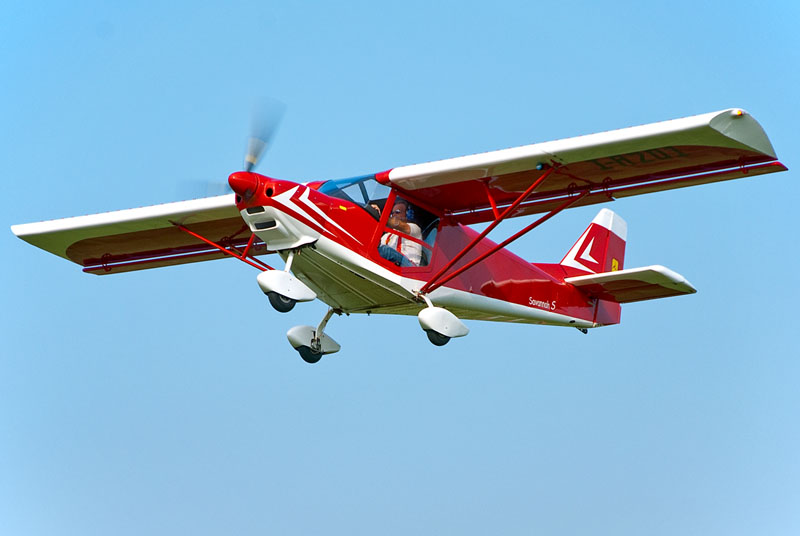
ICP Savannah S
Specifications
MOSAIC eligiblePerformance
Cruise
97KTAS
Range
410nm
Climb
1200fpm
Ceiling
14,000ft
Fuel Burn
4.2gph
Fuel Cap.
21gal
MPG
26.6mpg
Stall (Vs0)
26KIAS
T/O roll
180ft
Ldg roll
230ft
Size & weight
Seats
2
Useful Load
604lbs
Full-fuel payload
478lbs
Max gross
1,234lbs
Wingspan
30.5ft
Length
20.5ft
Engine
Engine
Rotax 912ULS
Power
100hp
TBO
2,000hrs
Overhaul
$14k
Owning it
Hull insurance
$2k/yr
Parts
good
Mechanics
common
Gear
Fixed
IFR
No
Category
experimental
Full specification
V-speeds
Airframe
- Empty weight
- 630 lbs
- Max fuel weight
- 126 lbs
- Height
- 8.2 ft
- Wing position
- high
- Auto fuel (mogas)
- Auto fuel specified by the engine maker — 91 premium
Obstacle performance
- Takeoff over 50 ft
- 625 ft
- Landing over 50 ft
- 495 ft
Paperwork
- Certification basis
- E-AB (51% kit) / E-LSA / S-LSA (ASTM F2245)
These figures are typical for the model, not a specification for any individual aircraft. Real-world numbers vary with year, installed equipment, weight, modifications and engine condition — often by more than you would expect. Use them to compare types, and confirm anything you would act on against the Pilot's Operating Handbook for that specific airframe and a prebuy inspection.
Pricing
Typical
$95k
Range
$55k – $135k
Annual all-in
~$14k/yr
All-in at ~100 flying hours a year, using the midpoint of each range — the same figures broken out under “Cost to own” below. Your number will differ, and mostly for two reasons. Experience sets your insurance: a 2,000-hour pilot with recent training pays 30–40% less than a 200-hour owner, and student owners pay 20–40% more — on the same aircraft that is often a doubling. Location sets your hangar: a T-hangar runs $200–400 a month in the Midwest against $400–1,500 in a coastal metro, and an outside tie-down is less again. Engine reserves move too — a local shop reusing your serviceable cylinders can come in 30–50% under the national specialty-shop pricing we quote, though you trade the warranty and turnaround that comes with it. Reserves are money set aside toward a future overhaul, not a bill this year, and the annual inspection figure is the shop’s labor to look — whatever they find is separate.
Cost to own — estimate
Set your yearly hours and local fuel price. Fixed costs (insurance, hangar, annual inspection) don't change with hours; fuel, maintenance and the engine reserve do.
- Fuel (4.2 gph)
- $2,730
- Engine reserve
- $700
- Maintenance, parts & wear items ($12/hr)
- $1,200
- Insurance
- $900–$2,400
- Hangar
- $3,752–$9,379
- Annual inspection (labor only)
- $1,200
- Databases & subscriptions
- $400
- Total per year
- $14,445
- Per flight hour
- $144
- Miles flown / year (at cruise)
- 11,163 mi
- Cost per mile
- $1.29/mi
- Time in the air
- 3 hr 06 min
- Fuel burned
- 13 gal
- Out of pocket
- $143
Fuel, engine reserve and wear only. Insurance, hangar and the annual are already paid whether you make the trip or not, so they are not charged here.
Estimate, not a quote. Where a line shows a range, the total, per-hour and per-mile figures use its midpoint— insurance moves most with your experience and time in type, hangar with where you base the aircraft, so your own number could sit at either end. Annual inspection is the shop's labor to open and inspect — what they find is the maintenance line, which covers oil changes, plugs, tires, brakes, hoses, lights, a battery and vacuum pump amortised over their life, and the unscheduled squawks that are the largest and least predictable part of it. Reserves are sinking funds toward an overhaul, not a bill you pay this year — and note that a propeller is due on hours or calendar time, typically six years, so flying less does not put it off forever.
Strengths
- Genuine STOL capability — 180–250 ft takeoff roll on grass with 40° flaps
- Excellent value for backcountry flying — half the acquisition cost of a Super Cub with comparable performance
- Low operating cost — 4–4.5 gph on Rotax 912ULS, simple maintenance, good parts availability
- Forgiving slow-flight handling — documented 26 KIAS stall with vortex generators, mushes rather than breaks
Weaknesses
- Slow cruise — 90 KTAS limits cross-country usefulness to short hops; 400+ nm routes are exhausting
- Density altitude penalty — climb degrades to 400–500 fpm above 7,000 ft DA; takeoff rolls double
- Experimental/ELSA airframe fatigue — stressed-skin aluminum depreciates with airframe hours; >2,500 hrs discounts significantly
- Mechanic supply — Rotax expertise is common, but Savannah airframe work requires experienced A&P; lead times on Italian parts run 2–6 weeks
Overview
The ICP Savannah is a two-seat, all-metal, high-wing STOL aircraft produced by I.C.P. srl in Castelnuovo Don Bosco, Piedmont, Italy. Design lineage traces to the Zenith/Zenair CH 701 — the original "Classic" Savannah used the CH 701's fixed leading-edge slats before ICP evolved the design with its own airfoil (modified NACA 65-018), vortex generators, and progressively refined cabins. Production began around 2000; by 2010 roughly 650 airframes had been delivered, and total ICP production (Savannahs plus Bingos) has since exceeded 2,000 aircraft, making it one of the highest-volume STOL airframes in the world.
In the United States the airplane is flown in three primary channels: as an S-LSA (historically imported and supported by Skykits/ICPANA and more recently AZ Aeroservices / "Savannah USA"), as an E-LSA after a 51% kit build, and as Experimental Amateur-Built. Outside the US it is typically registered as a 450 kg (Euro ULM) or 600 kg (Australia/NZ) microlight. Typical owners are STOL enthusiasts, bush pilots on a budget, short-strip farm operators, and sport pilots who want genuine off-airport capability without CubCrafters money. See Backcountry / Bush Flying and Local Fun Flying.
Variants & History
| Variant | Years | Engine | MTOW (kg) | Key Differences |
|---|---|---|---|---|
| MXP-740 Savannah (Classic) | 2000–2004 | Rotax 912UL 80 hp / 912ULS 100 hp | 450 / 560 | Original model, Zenith-derived fixed leading-edge slats, narrower cabin, early flap system |
| Savannah ADV | ~2003 | Rotax 912ULS | 450 | Re-profiled tapered wing (8.00 m), higher cruise (~108 kt), fewer built |
| Savannah VG | 2004–present | Rotax 912UL/ULS, Jabiru 2200, Suzuki G10 | 450 / 560 | Replaced slats with vortex generators on wing leading edge; extended 40° flaps; lower drag, same stall |
| Savannah XL / VGW | 2009–present | Rotax 912ULS | 450 / 560 | Widened cabin (1,130 mm), transparent doors and roof, adjustable rudder pedals, raked windscreen, integrated cowl. Sold as "VGW" (Wide) in North America |
| Savannah S | 2010–present | Rotax 912ULS, 912iS, Viking 130, Aeromomentum AM13/AM15 | 450 / 560 / 600 | Current flagship; rounded tail fuselage, smooth skin, XL cabin, cleaner aerodynamics |
| Savannah T | 2013–present | Rotax 912ULS | 450 / 560 | Taildragger conversion of S, tundra tire option |
| Vimana / Rampage | 2006–present | Rotax 912ULS | 450 / 560 | Ultra-STOL variant with double-slotted Fowler flaps; sold as Rampage in North America via Skykits |
| Savannah Hydro | — | Rotax 912ULS | 560 | Kevlar/carbon fiber floats or amphibs |
Performance
Book numbers for the 100 hp Savannah S at 472.5 kg advertise a 55 m (180 ft) ground roll, takeoff over a 15 m obstacle in 190 m (~625 ft), landing roll of 70 m (~230 ft), and better than 1,000 fpm initial climb. Real-world numbers at full 560 kg experimental MTOW degrade modestly: expect 250–300 ft ground roll on grass and 700–800 ft over a 50 ft obstacle. VG-equipped wings hold controllability to a documented 26 KIAS indicated stall with full 40° flaps — the airplane simply mushes and buffets rather than breaking.
Cruise is honest but not fast. Plan 85–95 KTAS at 4,800 rpm burning 4.0–4.5 gph on the 912ULS; the 912iS drops that to ~3.5 gph. The 20.6 US gal (78 L) standard tank gives a legal 3.5–4.0 hr endurance; Australian long-range tanks push 150 L / ~8 hr. Density altitude hits the 100 hp engine hard above 7,000 ft DA — climb degrades to 400–500 fpm and takeoff rolls roughly double. At 14,000 ft service ceiling the airplane is still climbing but at single-digit fpm. See Backcountry / Bush Flying for DA-adjusted STOL math.
Payload & Range
At 1,234 lb experimental MTOW and ~630 lb empty, useful load is ~604 lb. Working examples:
- Full fuel (21 gal / 126 lb) + baggage limit (44 lb): 434 lb available for two occupants — practical for ~215 lb average adults.
- Two 200 lb adults + 30 lb baggage (430 lb cabin): 174 lb fuel = ~29 gal, exceeds standard tank capacity, so you're limited by tank volume (21 gal = 126 lb), leaving headroom of 48 lb under MTOW.
- Two 200 lb adults + full 21 gal fuel + 78 lb baggage: Exactly at gross. Typical mission profile.
- Long-range (150 L / 248 lb) tanks: Useful load for occupants drops to ~356 lb — impractical for two adults without reducing fuel.
- Endurance vs payload: Standard tank gives ~4.0 hr / ~360 nm at 90 kt with 45-min reserve. Long-range tank gives ~7.5 hr / ~670 nm but with solo + light baggage only.
The Savannah's honest two-adult + full-fuel capability is one of its strongest selling points relative to the similarly sized zenith-ch-701 (which is tighter on useful load) and on par with the wide-body Aeroprakt A-22 Foxbat / A-32 Vixxen.
Mission Suitability
- Backcountry / Bush (9): One of the genuinely capable STOL two-seaters on the market. Shorter takeoff than a Super Cub for a fraction of the acquisition cost. Spring gear and tundra tires (Savannah T) handle rough strips; the VG wing with 40° flaps is forgiving at slow approach speeds.
- Local Fun Flying (9): Docile handling, great visibility, low fuel burn, quick to preflight, easy to hangar. The classic "grin factor" sport aircraft.
- Surveying (8): Slow flight and excellent downward visibility through large bulged doors make it a solid pipeline / powerline / wildlife observation platform. Limited endurance and no turbocharger are the main constraints.
- Flight Training (6): Used in Europe for ab-initio ULM/SEP training. In the US, sport pilot and E-LSA rental markets are smaller; insurance on a non-owner basis is difficult.
- Cross Country (4): 90 kt cruise is fine for 200 nm hops but painful beyond 400 nm. No IFR certification, marginal icing equipment, small fuel load.
- Cargo Hauling (3): 600 lb useful load after full fuel leaves ~475 lb for occupants and baggage — adequate for two adults but no more.
- Business Travel (2): Single-engine ULM with no IFR is a non-starter for schedule-sensitive travel.
- Aerobatics (1): Not approved. +6/-3 g structural rating but no aerobatic category.
Avionics Ecosystem
The Savannah is usually delivered with a sparse panel and finished to owner preference. See Avionics Pricing Reference for current experimental avionics costs. Typical configurations:
- Entry-level (~$3–6k): Dynon D10A or single Garmin G5, handheld VHF, analog backup ASI/ALT/tach. Common on kit-built E-AB.
- Mid-tier (~$8–15k): Single Dynon SkyView HDX 7", ADS-B In/Out via uAvionix tailBeaconX or Garmin GTX 45R, integrated VHF (Trig TY91), autopilot servos.
- Premium (~$20–30k): Dual Dynon SkyView HDX 10" or Garmin G3X Touch dual, two-axis autopilot, AoA, synthetic vision, ADS-B weather, EMS for 912iS. Uncommon on Savannahs but occasionally seen on higher-end S builds.
Panel space is tight — the Savannah is a simple airplane and most owners keep it that way.

2009 Van's RV-7
RV-7 · Fast + Aerobatic · Dynon Glass · Great First RV
STCs & Modifications
STCs do not apply to E-AB/E-LSA; owners modify freely within the airworthiness limitations. Common modifications:
- Tundra tires (8.00×6 to 29" Airstreak): +3–5 kt drag penalty, much better rough-field capability. $1,500–3,500.
- Extended long-range tanks: 150 L Aussie-style auxiliary tanks, ~$2,000 installed. Doubles endurance.
- Vortex generator upgrade: Retrofit for Classic/MXP-740 to VG-spec wing. ~$800 kit.
- Rotax 912iS conversion: Fuel injection for altitude / fuel-burn improvement. ~$8,000 delta over 912ULS.
- Viking 130 / Aeromomentum conversions: Automotive conversions offered as factory options on the S; lower initial cost but smaller service network.
- BRS ballistic parachute: Optional factory install, ~$6,500. Common in European fleets, rarer in US.
- Float kit (Hydro): Kevlar/carbon floats or amphibs; adds ~90 lb empty and ~$25–35k.
Maintenance & Support
See Maintenance Ecosystem for overall GA context. Savannah-specific items:
- Parts availability: Good, not excellent. ICP supplies parts through ICPANA and AZ Aeroservices ("Savannah USA") in the US. Common airframe parts (control hardware, skins, fasteners, canopy parts) ship from Italy with 2–6 week lead time. Rotax 912 parts are independently excellent worldwide.
- Mechanic familiarity: Common for the Rotax 912 (any Rotax-trained A&P or Light Sport Repairman); less common for the Savannah airframe itself, though construction is conventional sheet metal within any experienced A&P's skill set. An owner with an E-AB repairman certificate can do most of the work.
- Annual cost estimate: $3,500–6,000/year all-in for a privately flown airframe at 100 hrs/yr, excluding engine reserve. Rotax 100-hour / annual inspection runs ~$600–1,200 at a Rotax shop. Engine overhaul reserve: $7/hr ($14k over 2,000 hr TBO).
- Expensive items: Rotax gearbox overhaul at 1,000 hrs ($1,500–2,500), 5-year rubber replacement ($800–1,500), prop overhaul or replacement ($1,500–3,500). Canopy/door transparencies are single-source from ICP and run ~$1,200 each if damaged.
- Build support (kit builders): AZ Aeroservices and ICPANA provide US-based kit build support. Complete kits with Rotax 912ULS engine and basic instruments have historically been advertised in the mid-$50k range; current (2025) quick-build kits with engine run $70–90k depending on options. Build times range from ~110 hrs (factory quick-build) to 350–500 hrs for standard kits.
Valuation Factors
See Aircraft Valuation Methodology for the general framework. Savannah-specific drivers:
- Engine time: Rotax 912ULS TBO is 2,000 hrs / 15 yr. A fresh-zero-time 912 adds roughly $12–15k to the asking price; a run-out (past TBO or calendar) discounts by a similar amount.
- Airframe total time: Unlike certified aircraft, E-AB Savannahs depreciate meaningfully with airframe hours because the structure is stressed-skin aluminum and fatigue accumulates. <500 hrs commands a premium; >2,500 hrs discounts ~$10–15k.
- Variant: Classic/VG airframes trade $55–80k. XL/VGW $70–100k. S-model $85–130k. Rampage/Vimana $95–135k. T (taildragger) commands a $5–8k premium over equivalent nose-dragger.
- Kit vs factory-built: Factory-built S-LSA carry a ~$15–20k premium over comparable E-AB kits; workmanship quality of the builder is the single biggest variable on the kit side.
- Avionics: Dual-screen SkyView or G3X Touch add $12–18k to ask; basic steam gauge panels trade at the bottom of the range.
- STOL mods: Tundra tires, long-range tanks, VG upgrades each add their cost back at sale on bush-market airframes.
US market range (2025): approximately $55,000 (older VG kit-built, run-out engine) to $135,000 (late-model S-LSA factory-built with glass panel and fresh 912iS). Typical transaction $85–100k.
ADs & Common Problems
Experimental and ELSA Savannahs are not subject to FAA ADs, but ICP issues Mandatory Service Bulletins that apply to S-LSA and are strongly recommended for E-LSA/E-AB. Key items:
- Wing strut / gusset inspection (early SBs, mid-2000s): Early MXP-740 and Classic airframes had reports of cracking in the wing strut attachment gusset and the lower strut fork fittings. ICP issued mandatory SBs requiring recurring dye-penetrant inspection and in some cases a reinforced gusset replacement. Pre-buys on pre-2008 airframes should document compliance.
- SB031 — main spar inspection: ICP-issued mandatory bulletin requiring inspection of the main spar carry-through structure after a reported in-service finding. Compliance log must be on file.
- Flaperon bellcrank wear: Recurring wear item on high-time VG/XL airframes — inexpensive to replace but easy to miss on annual condition inspection.
- Nose gear fork cracking: Tricycle variants flown on rough strips have shown nose gear fork fatigue cracking; tailwheel (T) conversions eliminate the issue.
- Rotax 912-series rubber replacement: Not Savannah-specific, but the Rotax 5-year rubber replacement (carb sockets, fuel lines, coolant hoses) is a recurring ~$800–1,500 shop event. See Maintenance Ecosystem.
- Corrosion of bare aluminum interior structure: Italian build standard leaves some interior skins unpainted — coastal/humid-environment owners report pitting.
Pre-buy red flags: undocumented ICP SB compliance, obvious hangar rash on the stressed skin wings, loose flaperon hinges, soft or delaminated fiberglass cowling, unlogged hard landings (bush airplanes get beaten up).
Insurance Profile
Standard experimental / light-sport underwriting. See GA Insurance Underwriting. Key points:
- Hull premiums: Typically 1.5–2.5% of hull value annually for owner-pilots with 100+ TT and tailwheel/STOL endorsement as applicable. On a $90k hull, plan $1,400–2,200/yr.
- Liability: $1M / $100k smooth is generally not available on experimentals; typical limits are $1M / $100k per-passenger sublimit. $500–900/yr.
- Underwriting quirks: Low-time pilots (<100 TT) face steep surcharges or outright declines. Taildragger (Savannah T) requires tailwheel endorsement and 10+ hrs dual in type for best rates. Off-airport operations may be excluded unless explicitly scheduled. Insurers occasionally exclude specific strips or require named off-airport operation endorsements.
- Italian-manufacturer factor: Parts lead time out of Europe makes hull claims slower than on a Cub or Husky; some insurers apply a 5–10% surcharge. Having a US support outlet (AZ Aeroservices / Savannah USA) helps.
- Sport pilot discount: Some carriers offer modest discounts for sport-pilot-only operations.
For sale (0)
No listings for this model right now.
Also worth looking at
What buyers usually weigh against the ICP Savannah S — aircraft flown for the same kind of mission.


