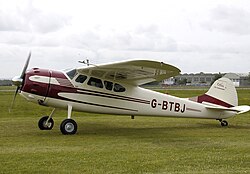
Helio · 1954–1984
Helio Courier / Super Courier
 i
iSpecifications
Performance
Cruise
130KTAS
75% power @ 8,500 ft
Range
Not verified
75% power @ 8,500 ft
Climb
1150fpm
Ceiling
20,500ft
Fuel Burn
19.0gph
75% power @ 8,500 ft
Fuel Cap.
58gal
MPG
7.9mpg
Stall (Vs0)
46KIAS
T/O roll
335ft
Ldg roll
270ft
Size & weight
Seats
6
Useful Load
1,275lbs
Full-fuel payload
926lbs
Max gross
3,400lbs
Wingspan
39ft
Length
31ft
Engine
Engine
Lycoming GO-480-G1D6 (or GO-480-G1A6, high-speed generator drive)
Power
295hp
TBO
1,400hrs
Overhaul
$55k
Owning it
Hull insurance
$4k/yr
Parts
fair
Mechanics
specialist
Gear
Fixed
IFR
Yes
Category
certified
Full specification
V-speeds
Airframe
- Empty weight
- 2,125 lbs
- Max fuel weight
- 349 lbs
- Height
- 8.8 ft
- Wing position
- high
Obstacle performance
- Takeoff over 50 ft
- 610 ft
- Landing over 50 ft
- 520 ft
Paperwork
- Type certificate
- 1A8
- Certification basis
- CAR 3 (Part 3 of the Civil Air Regulations, effective 1 Nov 1949, as amended to 16 May 1953)
These figures are typical for the model, not a specification for any individual aircraft. Real-world numbers vary with year, installed equipment, weight, modifications and engine condition — often by more than you would expect. Use them to compare types, and confirm anything you would act on against the Pilot's Operating Handbook for that specific airframe and a prebuy inspection.
Pricing
Typical
$145k
Range
$90k – $185k
Annual all-in
~$35k/yr
All-in at ~100 flying hours a year, using the midpoint of each range — the same figures broken out under “Cost to own” below. Your number will differ, and mostly for two reasons. Experience sets your insurance: a 2,000-hour pilot with recent training pays 30–40% less than a 200-hour owner, and student owners pay 20–40% more — on the same aircraft that is often a doubling. Location sets your hangar: a T-hangar runs $200–400 a month in the Midwest against $400–1,500 in a coastal metro, and an outside tie-down is less again. Engine reserves move too — a local shop reusing your serviceable cylinders can come in 30–50% under the national specialty-shop pricing we quote, though you trade the warranty and turnaround that comes with it. Reserves are money set aside toward a future overhaul, not a bill this year, and the annual inspection figure is the shop’s labor to look — whatever they find is separate.
Cost to own — estimate
Set your yearly hours and local fuel price. Fixed costs (insurance, hangar, annual inspection) don't change with hours; fuel, maintenance and the engine reserve do.
- Fuel (19 gph)
- $12,350
- Engine reserve
- $3,929
- Propeller reserve
- $175
- Maintenance, parts & wear items ($12/hr)
- $1,200
- Insurance
- $1,300–$4,200
- Hangar
- $7,254–$18,135
- Annual inspection (labor only)
- $1,200
- Databases & subscriptions
- $400
- Total per year
- $34,698
- Per flight hour
- $347
- Miles flown / year (at cruise)
- 14,960 mi
- Cost per mile
- $2.32/mi
- Time in the air
- 2 hr 18 min
- Fuel burned
- 44 gal
- Out of pocket
- $407
Fuel, engine reserve and wear only. Insurance, hangar and the annual are already paid whether you make the trip or not, so they are not charged here.
Estimate, not a quote. Where a line shows a range, the total, per-hour and per-mile figures use its midpoint— insurance moves most with your experience and time in type, hangar with where you base the aircraft, so your own number could sit at either end. Annual inspection is the shop's labor to open and inspect — what they find is the maintenance line, which covers oil changes, plugs, tires, brakes, hoses, lights, a battery and vacuum pump amortised over their life, and the unscheduled squawks that are the largest and least predictable part of it. Reserves are sinking funds toward an overhaul, not a bill you pay this year — and note that a propeller is due on hours or calendar time, typically six years, so flying less does not put it off forever.
Strengths
- Unmatched STOL performance and backcountry capability in certified single-engine class
- Six-seat cabin with 1,300+ lb useful load and 50 cu ft cargo volume
- Slow-flight control authority down to 27 mph via leading-edge slats and interceptor spoilers
- Excellent high-altitude short-field performance (20,500 ft service ceiling)
Weaknesses
- GO-480 geared engine is expensive to maintain and overhaul ($50–65k) with limited shop availability
- Cruise speed limited to 120–130 KTAS; cross-country performance is mediocre vs. comparable cost airplanes
- Requires specialist A&P maintenance; very few shops outside Alaska and missionary-aviation hubs
- Annual operating costs ($17–22k fixed/variable) are high relative to useful load and speed
Overview
The Helio Courier is the original "extreme STOL" light airplane — a high-wing, six-place utility single born in the MIT aero department and refined through three decades of bush, missionary, and clandestine military service. Designed by Otto C. Koppen (MIT professor, co-designer of the Ford Trimotor and Piper Cub) and Lynn R. Bollinger (Harvard Business School), it started life in 1949 as the "Helioplane," a modified Piper Vagabond fitted with full-span Handley Page leading-edge slats. The production Courier that followed married that slat system to full-span slotted flaps, interceptor spoilers for low-speed roll control, and a massive geared Lycoming GO-480 turning a three-blade prop — producing an airplane that could take off in a few plane-lengths, climb at breathtaking angles, and remain controllable at airspeeds as low as 27 mph.
Helio Aircraft Corp. built roughly 500 Couriers between 1954 and 1974, first in Norwood, Massachusetts, then in Pittsburg, Kansas. The U.S. Air Force adopted the Super Courier as the L-28/U-10, and the type flew in Vietnam with Air Commando squadrons and CIA-connected Air America, landing on jungle strips no other fixed-wing airplane could use. Missionary aviation organizations (JAARS, MAF) operated large fleets into the 1990s. A final attempt by Helio Aircraft Ltd. in the early 1980s produced 18 "direct-drive" H-700 and H-800 models with the troublesome geared engine replaced by the Lycoming TIO-540 and IO-720. The type certificate today is held by Helio Aircraft LLC, which supports the in-service fleet. Compared to a Piper Super Cub the Courier is in a completely different class — twice the payload, IFR panel, six seats — and compared to a Maule M-4 / M-5 / M-6 / M-7 it offers better slow-speed handling and steeper climb at the cost of higher operating complexity.
Variants & History
| Variant | Years | Engine | HP | Gross (lb) | Seats | Built | Notes |
|---|---|---|---|---|---|---|---|
| H-391 Courier | 1954-1958 | Lyc GO-435-C2 | 260 | 3,000 | 4 | 102 | First production, geared engine |
| H-392 Strato Courier | 1958 | Lyc GSO-480-A1A5 | 340 | 3,400 | 4 | 3 | High-altitude supercharged, rare |
| H-395 Super Courier | 1958-1965 | Lyc GO-480-G1D6 | 295 | 3,400 | 5 | 138 | Basis for USAF U-10A/B |
| H-250 Courier | 1964-1966 | Lyc O-540-A1A5 | 250 | 3,400 | 6 | 41 | Direct-drive, stretched fuselage, 6 seats |
| H-295 Super Courier | 1965-1974 | Lyc GO-480-G1D6 | 295 | 3,400 | 6 | ~150 | Definitive version, stretched + geared |
| HT-295 Trigear Courier | 1974-1976 | Lyc GO-480-G1D6 | 295 | 3,400 | 6 | ~20 | Fixed tricycle gear |
| U-10A/B/D Courier | 1958-1970 | Lyc GO-480-G1D6 | 295 | 3,400-3,920 | 6 | 123 | USAF/CIA military |
| AU-24A Stallion | 1971-1974 | P&W PT6A-27 | 680 shp | 5,100 | 10 | 20 | Turboprop gunship, COIN |
| H-700 Courier | 1983-1984 | Lyc TIO-540-J2B | 350 | 3,400 | 6 | ~8 | Turbo direct-drive, winglets |
| H-800 Courier | 1983-1984 | Lyc IO-720-A1B | 400 | 3,400 | 6 | ~10 | Eight-cyl direct-drive |
Performance
The Courier's book numbers understate what it actually does on a short strip. Published 610 ft over a 50 ft obstacle is measured with no wind at max gross — a competent H-295 pilot, light, into 10 kt of headwind, will be airborne in under 150 ft and over a 50 ft tree in 300 ft. The automatic leading-edge slats deploy around 55-60 KIAS and the airplane can be flown under control all the way down to 27 mph indicated, with the interceptor spoilers (small plates that pop up from the upper wing surface as aileron inputs are applied below stall speed) maintaining roll control when the ailerons have no authority. Vx with 30 degrees of flap is only 45 KIAS and the nose attitude in a full-power slow climb is theatrical — Courier airshow takeoffs famously crossed a 150 ft wide runway sideways.
Cruise performance is the trade: the draggy wing, massive flaps, and fixed gear limit the H-295 to about 130 KTAS at 75% power (8,500 ft, 19 gph) or 120 KTAS at 65% (14.8 gph), per AOPA Pilot's January 2001 flight test. Fuel capacity is where this page corrects a real error: the standard H-295 carries 58.2 gal usable (60.7 total) per its own type certificate, not 120 gallons — 120 gal (116.4 usable) is the FACTORY-OPTIONAL auxiliary tank system (Helio P/N 250-080-901), fitted to many but not all flying Couriers. On the standard tanks alone, range at 75% power works out to roughly 300 NM with reserves; with the optional aux system fitted, AOPA's own flight-test numbers give 819 NM at 75% or 972 NM at 65%. The airplane is not a speed machine regardless of tank size — a cirrus-sr22 would beat it to any destination that has a runway longer than 2,000 ft. Density altitude performance is outstanding: service ceiling is 20,500 ft and the Courier still posts impressive short-field numbers at 9,000 ft elevation, which is why it dominates Nepalese and Andean missionary aviation. Compared to a Daher Kodiak 100 it is dramatically cheaper to acquire but slower and with less payload.
Payload & Range
The H-295 Super Courier's standard fuel system is 58.2 gal usable (349 lb) per its type certificate — NOT 120 gallons, a figure that actually describes the factory-optional 60-gallon auxiliary system (116.4 gal usable total, 698 lb). With a 1,275 lb useful load (AOPA's own flight-test weight statement), this is one of few piston singles where you can realistically fill all six seats and carry meaningful fuel, on either fuel system:
Standard tanks (58.2 gal usable, 349 lb):
- Full fuel + 600 lb payload: Three adults plus moderate baggage, roughly 300 nm range with reserves. Standard-tank ferry profile.
- Six adults (~1,020 lb) + remaining ~255 lb fuel (~42 gal): Under 300 nm range, still the ability to use a 600 ft strip at both ends. Missionary/bush trip profile.
With the optional 60-gal auxiliary system (116.4 gal usable, 698 lb):
- Full fuel + 577 lb payload: Three adults plus moderate baggage, 819 nm range at 75% power (AOPA's own tested figure) or 972 nm at 65%. Long-range ferry profile.
- Pilot + 900 lb cargo + remaining fuel: A half-ton-plus payload is available specifically because the aux system adds capacity without touching useful load — the tanks just fill more of it with gas instead of cargo, or less, at the pilot's choice.
The airplane's true advantage is that none of these loadings require a long runway. Compared to a Daher Kodiak 100 the Courier carries less absolute payload but accesses shorter and rougher strips; compared to a Piper Super Cub it carries four times as much and flies real IFR. That combination is why missionary aviation fleets kept them flying into the 2000s despite the GO-480 maintenance bill, and why Alaskan bush operators still pay six figures for a good example today.

1998 Beechcraft Bonanza A36
GTN 750 · GFC 500 · Mid-Time IO-550 · No Damage
Mission Suitability
Backcountry (10/10): This is the airplane's reason for existing. Slat/slotted-flap system, 250+ lb/sec low-speed control, huge tires available, and it will land shorter than a CubCrafters XCub while hauling four times the payload. Nothing in the certified single-engine world operates from rougher or shorter strips. See Backcountry / Bush Flying.
Cargo hauling (9/10): 1,300+ lb useful load, enormous cabin (roughly 50 cu ft behind the seats with rear seats removed), double cargo doors on military variants. Missionary operators routinely fly 900 lb of supplies into 400 ft jungle strips. Only limited by cruise speed and single-engine economics.
Surveying (8/10): Slow flight, excellent visibility from the high-wing cockpit, the ability to orbit at 45 KIAS, and high useful load for sensor packages make it good for aerial photography and wildlife work. The geared engine's TBO is the drawback on high-hour missions.
Cross-country (6/10): With the optional 60-gal aux tanks fitted, range is genuinely 800-970 nm; on standard tanks alone it is roughly a third of that. Cruise is only 120-130 KTAS either way. Acceptable for ferrying to remote destinations, mediocre for routine travel.
Local fun flying (6/10): A joy to fly slowly but expensive per hour, and the geared engine is unforgiving of sloppy power handling.
Business travel (4/10): Too slow, too expensive per hour, and parts of any trip involving hard-surface airports offer no Courier advantage.
Flight training (3/10): Complex, expensive, geared engine, tailwheel — inappropriate for primary training. A viable transition airplane for commercial bush pilots.
Aerobatics (1/10): Not approved and not suitable.
Avionics Ecosystem
Most surviving Couriers are military-surplus U-10s or civilian H-295s that have been through one or two avionics refreshes. Common configurations:
- Original/bush ops: King KX-155 or Narco MK-12D nav/com, basic panel, no IFR pretensions. Many Alaskan Couriers fly VFR only.
- Mid-tier refurb ($20-40k avionics value): Garmin GTN 650, GTX 345 transponder with ADS-B, maybe a single G5 for attitude, analog engine gauges retained. Typical of the current 2024 market.
- Premium restoration ($60-100k avionics value): Dual Garmin G5s or a G3X Touch certified install, GFC 500 autopilot (STC'd), GTN 750Xi, engine monitor — pushes the airplane into legitimate IFR touring territory.
See Avionics Pricing Reference for install cost context. The Courier's spacious panel accommodates modern stacks easily, but STC availability for autopilots is limited compared to a cessna-182.
STCs & Modifications
- Landoll/Stene 3,600 lb gross weight increase — popular on H-295, adds 200 lb useful load.
- Alaska Bushwheel 29" tires — standard bush configuration.
- Wipline 3000 floats — Courier makes an excellent seaplane; STC widely installed in Alaska and Canada.
- Robertson STOL kit — redundant on the Courier given the native STOL system; rarely seen.
- BAS shoulder harnesses — near-universal retrofit.
- Sportsman 2+2 seating conversions — for H-250/295 family adding full six-place utility.
- O-540 conversions — some H-295s have been converted to direct-drive 250-300 HP O-540 variants to escape the geared-engine maintenance burden, at cost of peak STOL performance.
- IO-550 conversion (Peterson) — experimental path explored but not widely STC'd.

2002 Beechcraft Baron 58
G500 TXi · GTN 750 · Known-Ice · Air Conditioning
Maintenance & Support
- Parts availability: fair. Helio Aircraft LLC holds the TC and supports the fleet but lead times are long on many airframe parts. Cannibalization of surplus U-10 airframes is a routine practice.
- Mechanic familiarity: specialist. Very few A&Ps outside Alaska, Idaho, and missionary-aviation hubs have Courier experience. Owner networks (HelioCourier.net, flyhelio.com forums) are critical.
- Annual inspection: $4,500-8,000 typical, more for float-equipped or high-hour airframes.
- GO-480 overhaul: $50,000-65,000 at the few qualified shops (Penn Yan, Western Skyways, specialty shops) — the highest per-HP overhaul cost in the piston world. Quill shaft and reduction gear replacement drive the cost.
- Slat and flap system rigging: specialized labor, typically $2,000-4,000 per event.
- Fuel bladders: $8,000-15,000 for a full set of replacements.
- Prop overhaul: $5,000-7,000 for the three-blade Hartzell.
Typical owner-operated annual cost envelope (100 hours/year): $17,000-22,000 fixed and variable, before engine reserve. With engine reserve the true cost-per-hour approaches $300 for an H-295. See Maintenance Ecosystem.
Valuation Factors
Current (2024-2025) advertised H-391B and H-295 Couriers span roughly $80,000 to $185,000, clustering around $130-140k for a mid-time H-295 with decent avionics and no corrosion. Value drivers:
- Engine time on the GO-480 is worth more here than on almost any other airframe. A freshly overhauled GO-480 adds $40-50k; a run-out engine is nearly a deal-killer given the $50-60k overhaul cost.
- Float-equipped Couriers command $30-60k premiums; the Wipline STC and float condition are the largest single variable.
- Military provenance (documented U-10 history) adds collector interest but not operational value.
- Direct-drive conversions (O-540) actually reduce resale slightly with collector buyers but improve utility and insurance for operators.
- H-700/H-800 are scarcer and can command $120-180k in good condition on novelty alone.
See Aircraft Valuation Methodology. The Courier sits in a peculiar market: operationally unique, mechanically demanding, with a shrinking but dedicated buyer pool (Alaskan operators, missionary orgs, collectors).
ADs & Common Problems
- GO-480 geared reduction — recurring inspections. The geared engine's quill shaft and reduction gears are the Courier's single biggest maintenance headache. Recurring inspections, limited shop availability, and expensive overhauls (see Maintenance section).
- Wing attach fitting AD (AD 74-12-07 family) — recurring inspection of wing attach points.
- Leading-edge slat track inspection — slats must operate symmetrically; worn tracks or binding are a common pre-buy finding.
- Tailwheel steering / tail post corrosion — tundra ops expose the aft fuselage to punishment.
- Spar corrosion — coastal and float-operated Couriers need careful wing spar inspection.
- Fuel bladder deterioration — bladder tanks leak; replacements are expensive and back-ordered.
- Flap track and actuator wear — the full-span flap system has many moving parts.
Pre-buy red flags: any engine with unknown quill shaft history, prop strike without complete teardown (mandatory with geared engines), corrosion around the seaplane attach points, and undocumented field repairs to the composite wingtip or slat hardware.
Insurance Profile
The Courier is a specialty taildragger risk. Underwriters want 500+ tailwheel hours, 100+ in make/model, and typically require a formal checkout from a Helio-current instructor (a short list). Hull values of $120-150k attract annual premiums in the $3,500-5,000 range for qualified pilots; low-time tailwheel pilots may be declined entirely or pay $7,000+. Float operations add another 30-50% to premiums. The HT-295 trigear version is slightly cheaper to insure but carries a payload penalty.
Claim history is dominated by ground loops and off-airport nose-over incidents — both mitigated by the slat system's docile slow-flight handling but not eliminated. See GA Insurance Underwriting.
For sale (0)
No listings for this model right now.
Also worth looking at
What buyers usually weigh against the Helio Courier / Super Courier — aircraft flown for the same kind of mission.